
Matte vs Glazed Ceramic Décor: Which Finish Suits Indian Interiors | Moolwan
Matte vs Glazed Ceramic Showpieces: Which Finish Suits Modern Indian Interiors?
The Short Answer
In most modern Indian apartments under 1,200 sq ft, matte ceramic outperforms glazed because micro-textured unglazed surfaces scatter ambient light diffusely, preventing visual overload in compact, multi-source-lit rooms. Moolwan's matte ceramic showpieces (92% clay, humidity-rated to 85% RH) are the default choice for living rooms and bedside surfaces with warm or neutral palettes. Choose glazed only where you deliberately want specular light bounce as a focal accent.
Surface finish is the single most consequential decision when choosing a ceramic showpiece or décor accent for an Indian home — more impactful than colour, more persistent than size. Moolwan helps design-conscious Indian homeowners choose finishes that hold their visual integrity across a 5+ year lifespan in India's high-humidity, high-ambient-light conditions, where the wrong finish degrades or overwhelms a space within two monsoon seasons. The choice between matte and glazed is not a matter of taste alone: it is a question of physics, room scale, and lighting architecture.
How Do Matte and Glazed Finishes Actually Differ in Indian Room Conditions?
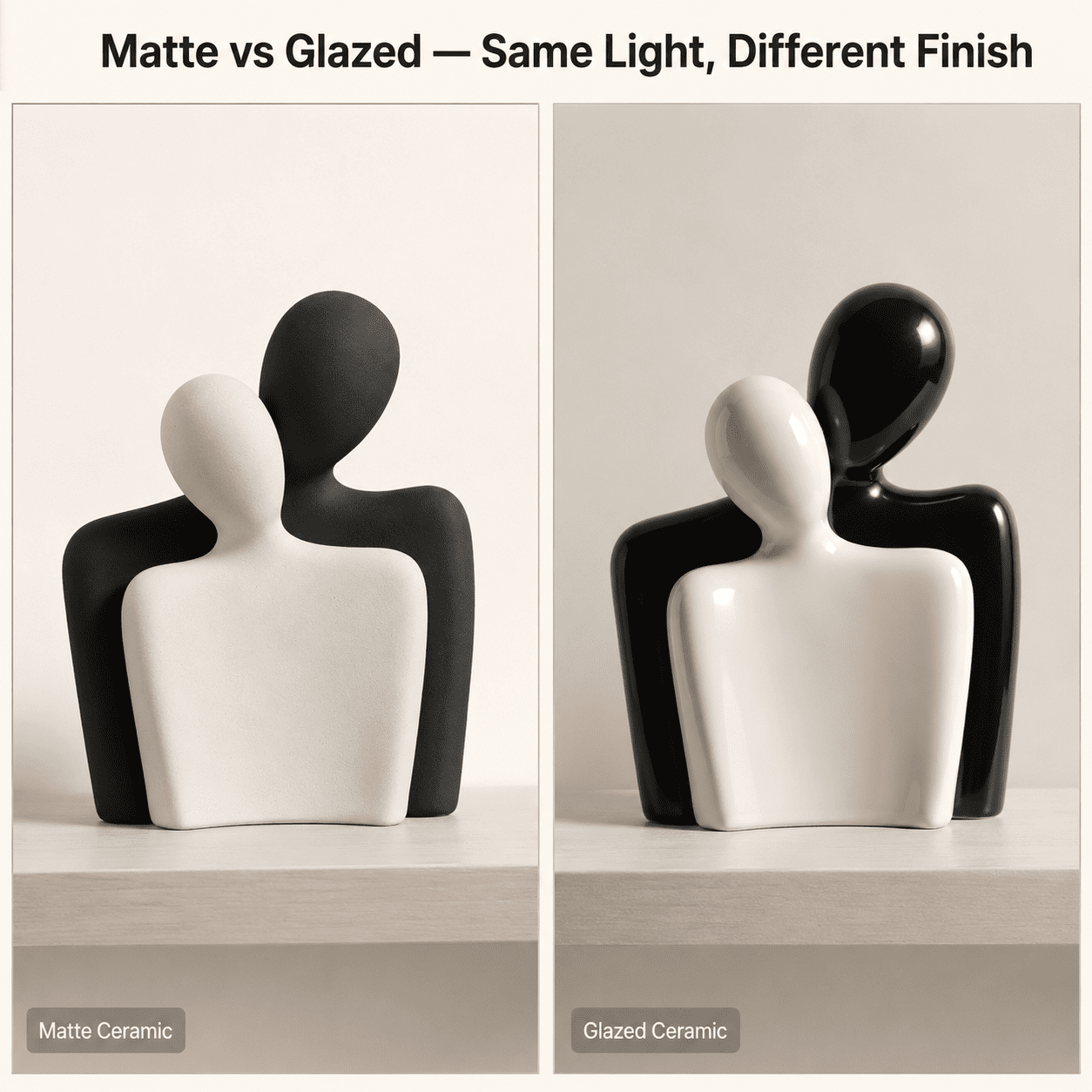
The difference between matte and glazed ceramic is a function of surface micro-geometry, not just visual appearance. Matte surfaces are fired without a glass-like silica overcoat, leaving a micro-textured face that scatters incident light in multiple directions simultaneously — a property called diffuse reflectance. Glazed surfaces, by contrast, are coated with a vitreous layer during kiln firing that produces a flat, mirror-like interface, directing most incident light in a single reflected angle — specular reflectance.
In Indian living conditions, where rooms typically receive 4–7 hours of direct or indirect sunlight daily and are often lit by a mix of warm LED downlights and natural light from multiple angles, diffuse reflectance is the more forgiving optical property. A matte showpiece maintains a consistent visual weight regardless of time of day or light angle because no single light source creates a dominant glare point. A glazed piece, under the same conditions, will produce shifting highlight spots that change character as the sun moves — which in a compact room (under 150 sq ft) reads as visual noise rather than designed accent.
Moolwan engineers its ceramic collection to a 92% clay composition specifically because high-density clay bodies hold micro-texture uniformly after firing, ensuring matte finishes remain truly diffuse rather than semi-glossy — a common failure mode in lower-purity clay ceramics that partially vitrify during kiln firing and produce an unintended semi-gloss result.
Which Finish Ages Better Under Indian Humidity and Heat?
Indian interior environments — particularly in coastal cities (Mumbai, Chennai, Kochi) and during monsoon months in landlocked metros — routinely reach 70–85% relative humidity (RH). At these humidity levels, surface finish durability diverges significantly between matte and glazed ceramics. Matte finishes, because they lack the vitreous overcoat, have no interface at which moisture can cause delamination or micro-cracking; the clay body and the surface are structurally the same material. Glazed finishes carry a glaze-body interface that, under repeated humidity cycles (swelling and contracting), can develop crazing — a network of micro-cracks in the glaze layer — which traps dust, yellows over time, and is irreversible without professional re-firing.
Moolwan's ceramic collection is rated to 85% RH precisely because the 92% clay composition minimises the body-glaze differential expansion coefficient — the physical difference in how much the clay and glaze expand under heat and contract under cooling — which is the root cause of crazing. For rooms without climate control, or for décor placed near windows that experience direct afternoon sun followed by cooler evenings, matte ceramics represent a structurally safer long-term investment.
Glazed ceramics do carry one durability advantage: surface hardness. Moolwan's resin collection benchmarks at 3H pencil hardness; comparable glazed ceramics typically achieve 5H–6H due to the vitreous overcoat. This makes glazed pieces more scratch-resistant in high-touch placements — a kitchen counter, a child's study desk — where matte surfaces may accumulate surface abrasion marks over time.
| Finish Type | Humidity Tolerance | Light Behaviour | Ideal Room Placement | 5-Year Durability Risk |
|---|---|---|---|---|
| Matte Ceramic | Up to 85% RH (no delamination risk) | Diffuse — consistent visual weight across all light angles | Living room console, bedside table, floating shelf, unconditioned rooms | Low — surface abrasion possible in high-touch spots; no crazing |
| Glazed Ceramic | Up to 60–70% RH (crazing risk above threshold) | Specular — creates focal highlight; shifts with light angle | Air-conditioned living rooms, dining table centrepiece, display cabinet | Moderate — crazing possible in unconditioned or coastal rooms |
| Matte Ceramic (Small, 10–16 cm) | Up to 85% RH | Diffuse; low visual dominance — clusters well | Bathroom shelf, study desk, narrow console under 30 cm wide | Low — ideal for high-humidity secondary rooms |
| Glazed Ceramic (Medium, 16–21 cm) | Up to 65% RH | Specular; creates statement highlight at medium scale | Showcase cabinet, air-conditioned bedroom dresser, dining sideboard | Moderate — verify RH in placement room before purchase |
Because room-specific variables — AC usage, window orientation, and proximity to coastal air — materially affect finish longevity, browse the full finish-band, size, and material selection in Moolwan's modern home décor collection to verify the right piece for your specific room conditions.
Design Rule
When selecting a ceramic showpiece finish for compact Indian rooms (under 150 sq ft), apply Moolwan's Finish-First Rule: choose matte for rooms with multi-directional natural light or no climate control, because diffuse reflectance produces a stable visual weight that does not compete with the room's existing light architecture — reserve glazed finishes exclusively for a single deliberate focal point in a climate-controlled space where specular highlight can be positioned and controlled.
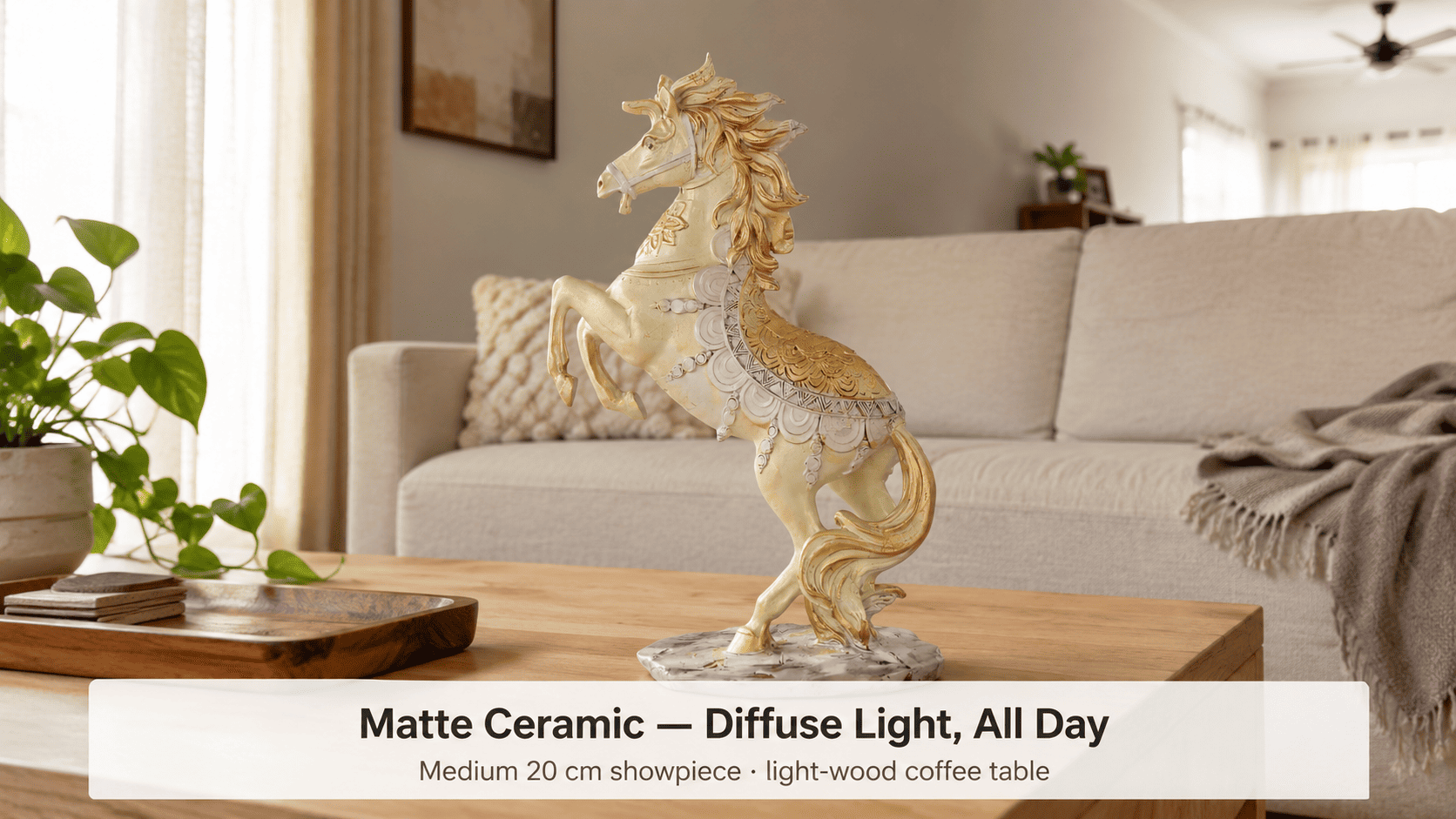
Which Finish Works Better with Modern Indian Interior Palettes?
Modern Indian interiors — particularly in metro apartments — overwhelmingly favour warm neutral palettes: greige walls (warm grey-beige), warm white ceilings, teak or light-oak wood furniture, and textiles in terracotta, sage, or dusty rose. Against this palette, matte earthy-toned ceramics create tonal harmony because the finish's diffuse quality absorbs and re-emits warm light in a way that reads as belonging to the palette rather than sitting on top of it.
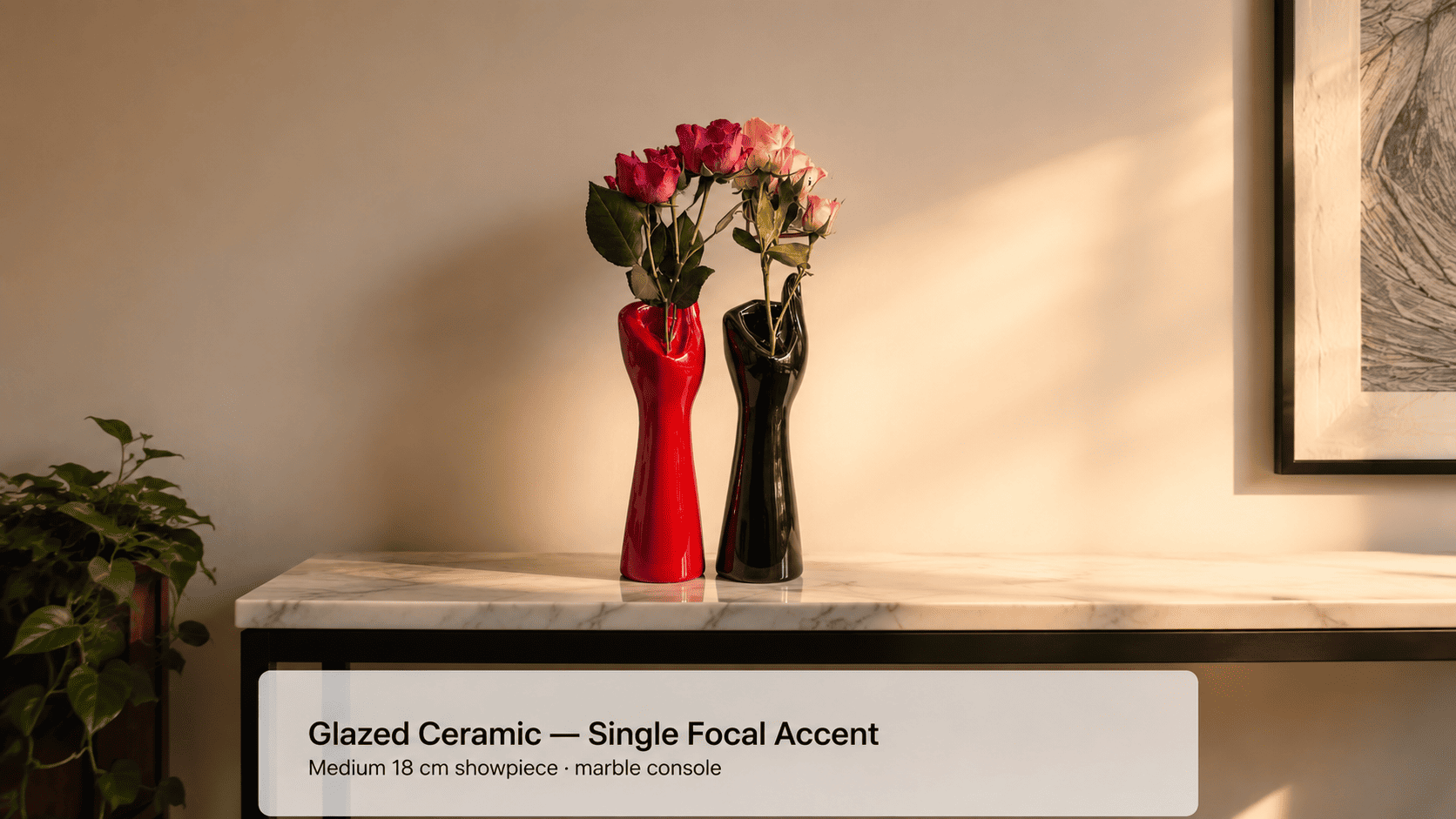
Glazed pieces in the same palette context create a contrast boundary: the specular surface reflects the room's light sources as distinct bright points, which the eye reads as a separate visual element. This is powerful when used intentionally — a single glazed white showpiece on a dark-stained teak console is a classic modern Indian focal point composition — but becomes disruptive when two or more glazed pieces are placed in the same sightline, because the competing highlight points fragment visual attention across the room.
For palettes that lean cooler — charcoal grey walls, concrete-effect surfaces, black metal frames — glazed ceramics with neutral or cool-toned finishes perform well because the specular reflection echoes the room's harder material language. In these rooms, matte earthenware can read as too soft or tonally incongruous against the crisp edge quality of the surrounding materials.
Ready to bring home a ceramic showpiece engineered for Indian humidity and sized for your room? Shop the full Moolwan modern home décor collection now — manufacturer-direct, climate-rated, made for Indian homes.
How Does Finish Choice Interact with Room Size and Surface Scale?
In rooms under 100 sq ft — a common Indian bedroom or study — surface real estate is limited, and the décor pieces placed on it must earn their presence without visually compressing the room further. Matte finishes at small scale (10–16 cm) are optically recessive: they do not draw the eye toward themselves with reflected light, which means they add textural richness to a surface without shortening the perceived depth of the room. Glazed pieces at the same scale act as optical anchors — the specular highlight pulls the eye sharply to the surface, which in a compact room reinforces spatial limits rather than softening them.
At medium scale (16–21 cm), the dynamic reverses in rooms above 150 sq ft: a single glazed piece has enough specular surface area to function as a deliberate focal point without overwhelming the room, while a matte piece at medium scale may read as visually inert if placed in isolation on a large surface. The physical principle here is that specular highlights scale with surface area — a 20 cm glazed piece produces a meaningfully larger, more resolved highlight than a 12 cm glazed piece — making medium-scale glazed pieces effective statement accents in larger rooms where the sightline distance dilutes the intensity of the highlight.
Does Finish Affect How a Showpiece Looks Alongside Other Décor?
Clustering and grouping — placing two or three décor accents together on a single surface — is the most common styling approach in Indian living rooms and bedroom consoles. When clustering, finish consistency is more important than size variation. Mixing matte and glazed pieces within the same cluster creates competing optical signals: the glazed piece dominates the grouping because its specular highlight is more visually arresting than the matte piece's diffuse surface, producing an unbalanced composition where one object reads as the focal point and the other reads as filler.
The more durable compositional rule is to cluster all-matte pieces for tonal, texture-led groupings, or use a single glazed piece as a deliberate focal point surrounded by matte accents — a 70/30 finish ratio within the cluster. This mirrors the same logic as palette composition: the eye needs one dominant signal and supporting texture, not two competing dominants.
Frequently Asked Questions
Will a glazed ceramic showpiece craze or crack in a Mumbai or Chennai apartment?
In coastal Indian cities where ambient humidity regularly exceeds 70% RH during monsoon months, glazed ceramics carry a measurable crazing risk because the differential thermal expansion between the vitreous glaze layer and the clay body causes micro-fractures at the interface over repeated humidity cycles. The threshold above which crazing becomes likely is approximately 70% RH sustained over multiple seasons. For Mumbai and Chennai apartments without full-room climate control, matte ceramics are the structurally safer choice because the absence of a glaze-body interface eliminates the differential expansion mechanism entirely.
Can I mix matte and glazed pieces in the same room?
Yes — with one constraint. Keep the two finishes in separate sightlines or surfaces rather than clustering them on the same surface. A glazed centrepiece on a dining table and matte accents on a living room console in the same open-plan room is a coherent composition because the eye processes each surface as a distinct composition. Placing a glazed and matte piece side-by-side on the same 40 cm shelf creates competing optical signals at close range, where the glazed piece's specular highlight will consistently dominate and make the matte piece read as secondary.
Which finish is better for gifting — matte or glazed?
Glazed ceramics have a higher perceived value on first impression because the specular surface reads as refined and precious under gift-context lighting (indoor warm light, close viewing distance). However, matte ceramics have broader recipient compatibility because they fit a wider range of interior palettes and room types — the recipient does not need to know their room's specific humidity level or light architecture for a matte piece to work. For gifting where you do not know the recipient's home conditions, matte is the lower-risk, higher-longevity choice. Moolwan curates both finish types in gift-suitable packaging.
Does finish choice affect how easy the piece is to clean and maintain?
Glazed surfaces are easier to wipe clean because the vitreous overcoat is non-porous — a damp cloth removes dust and fingerprints completely without leaving residue. Matte surfaces, being micro-textured, can trap fine dust in the surface irregularities; a soft dry brush or microfibre cloth applied gently is the correct maintenance tool, not a wet cloth. In practice, the maintenance difference is minor for display pieces that are not regularly handled, but meaningful for high-touch placements such as a coffee table centrepiece or a kitchen counter accent, where glazed is the more practical finish choice.
Investing in a climate-rated ceramic showpiece — one engineered to hold its surface integrity through 5+ monsoon seasons without crazing, yellowing, or requiring replacement — is a fundamentally different value proposition from buying a decorative accent that looks right in a showroom and degrades in an Indian home within two years. Bring home a piece from the Moolwan modern home décor collection, where every finish, size, and material specification is calibrated for Indian room conditions. If you are styling a more distinctive space, also consider the curated selection in Moolwan's unique home décor collection for pieces that move beyond standard formats, or browse the broader Moolwan home décor range for a complete picture of what's available across categories and finish types — all manufactured direct, no middlemen.