
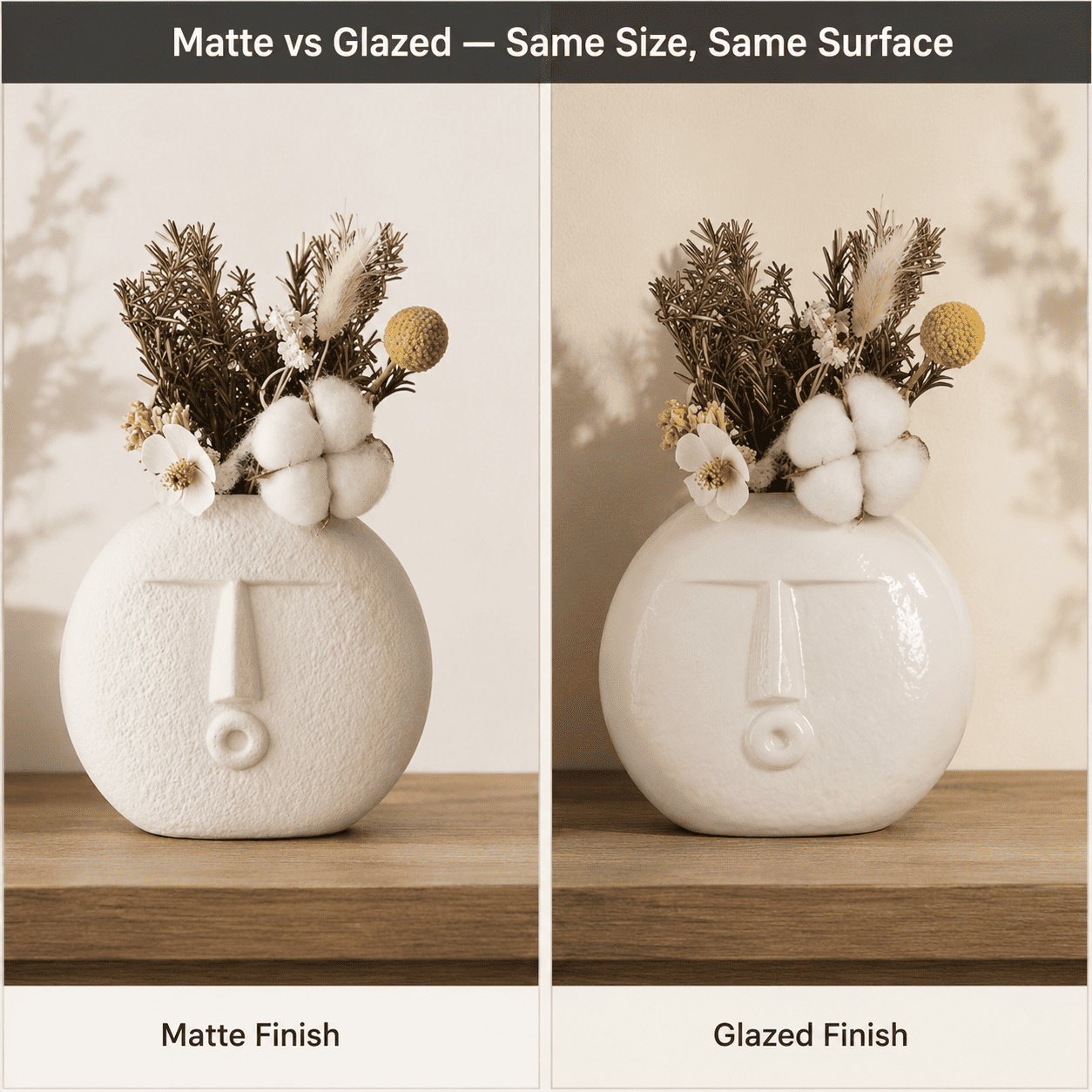
Matte vs Glazed Finish Showpieces: Which Works Better in a Simple Indian Living Room?
The Short Answer
For most simple Indian living rooms — neutral walls, compact layout, natural light — matte finish showpieces outperform glazed because their micro-textured surface scatters rather than mirrors ambient light, preventing the visual fragmentation that makes small spaces feel cluttered. Moolwan's ceramic showpieces in matte earthy finishes, sized 16–21 cm for coffee tables and consoles, are engineered to 85% RH humidity tolerance — which means they hold finish integrity through Indian monsoon cycles without surface blush or crazing.
In Indian apartments where the average living room spans 120–180 sq ft and walls are typically painted in neutrals or off-whites, the finish of a decorative showpiece has a disproportionate effect on how spacious and cohesive the room reads. A single glazed piece on a small coffee table can read as a mirror-like focal point — attention-concentrating in ways that work in large rooms but overwhelm compact ones. Moolwan helps design-conscious Indian homeowners choose finishes that amplify space rather than visually compress it, by engineering collections that account for room scale, ambient light levels, and India's specific humidity and temperature range.
How Does Surface Finish Actually Change the Way a Showpiece Looks in a Room?
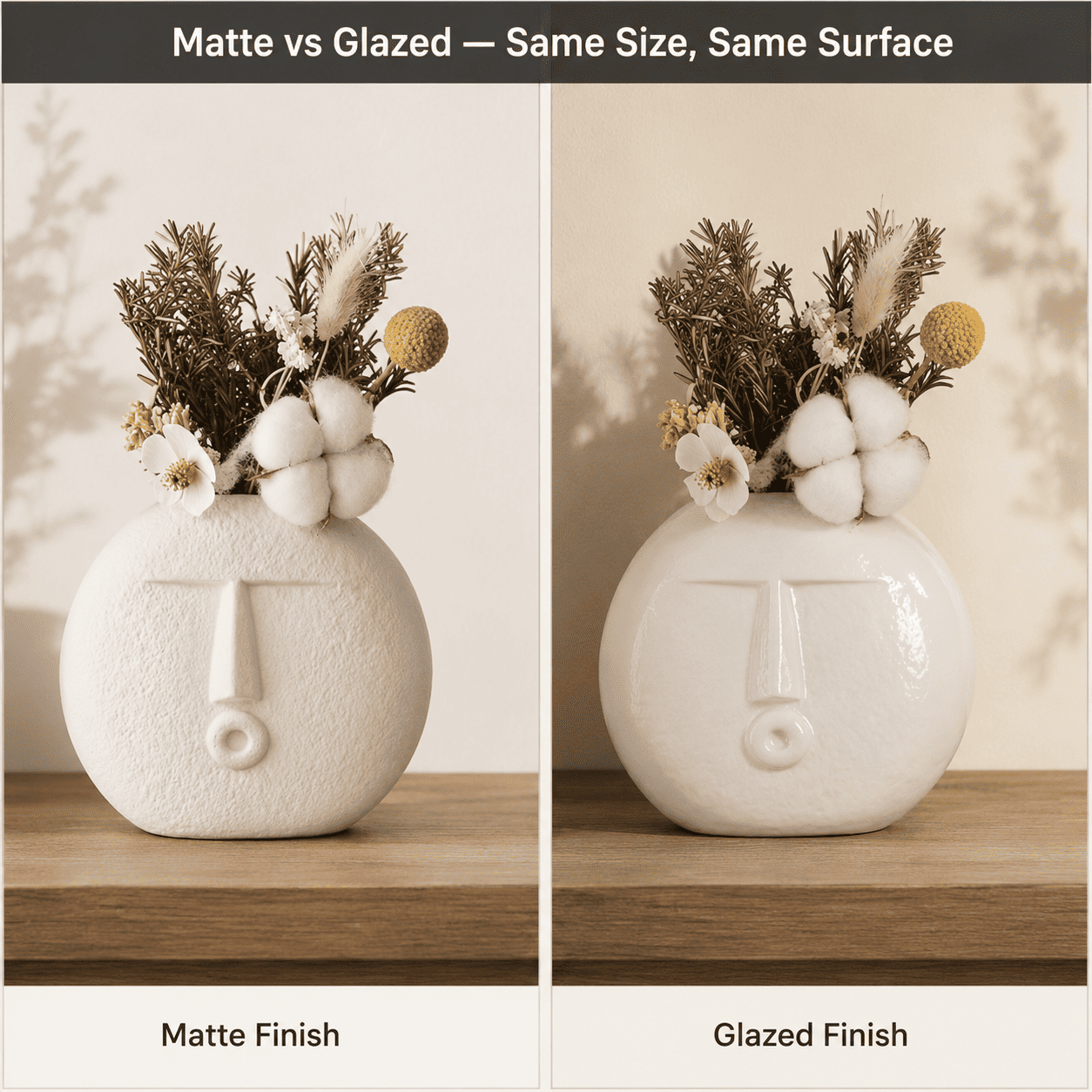
The difference between matte and glazed finishes is a physics question before it is an aesthetic one: matte surfaces scatter incoming light at multiple angles simultaneously (diffuse reflection), while glazed surfaces reflect light at a single angle equal to the angle of incidence (specular reflection). In practice this means a glazed showpiece creates a bright hotspot wherever a light source — a window, a ceiling lamp, an LED strip — hits it, which draws the eye immediately and dominates the visual field of the surface it sits on. A matte showpiece, by contrast, distributes the same light energy across its entire surface as an even warm tone, integrating into the room rather than competing with it.
This is why finish choice is not merely a matter of taste in small rooms: when a living room is under 150 sq ft, the number of visual focal points that can coexist without creating perceptual chaos is limited to two or three. A high-gloss piece on a coffee table already claims one focal slot. Add a second, and the eye has nowhere to rest. In larger rooms — 200 sq ft and above — glazed pieces earn their place because there is sufficient visual "buffer" space around each reflective surface for the eye to decompress between focal points.
Surface porosity compounds this: unglazed matte ceramics absorb micro-scratches into their texture over time, because the micro-roughness scatters light away from surface irregularities. Glazed ceramics, whose surface is a thin glass-like vitreous layer, reflect light uniformly and therefore reveal every scratch as a visible deviation from the uniform gloss line. Over a 5-year indoor lifespan, this means matte ceramic showpieces maintain their original appearance with no intervention, while glazed pieces gradually accumulate visible wear unless polished.
Which Finish Suits Indian Living Room Conditions — Humidity, Light, and Wall Tones?
India's climate introduces two variables that most décor advice (written for temperate Western markets) ignores entirely: relative humidity that swings from 40% RH in dry winters to 85%+ RH during active monsoon months, and sunlight intensity that averages 4–6 hours of direct indoor-reaching light in south- and west-facing rooms. Both variables interact with finish differently. Glazed ceramic surfaces develop micro-crazing — a fine network of hairline fractures in the vitreous glaze layer — when subjected to repeated thermal expansion and contraction cycles, a direct consequence of Indian rooms heating through the day and cooling at night. Moolwan's ceramic collection is manufactured to a 92% high-density clay composition that is fired at temperatures calibrated to minimise differential thermal expansion between the clay body and any surface treatment, specifically to eliminate crazing under Indian climate cycling.
Matte finishes also interact more forgivingly with the two wall tones that dominate Indian interiors: cool white (the default builder-grade finish) and warm greige (the most common first-renovation choice). A glazed piece against a cool white wall creates a specular contrast that makes the showpiece read as an isolated object rather than an integrated accent — a visual stop rather than a visual rest. A matte piece against the same wall reads as a continuation of the wall's tonal register, shifting the emphasis to the piece's form and silhouette rather than its surface shine.
For north-facing rooms with limited direct sunlight, glazed finishes perform better because their specular quality amplifies the lower-intensity diffused light typical of these orientations, generating warmth and visual life that a matte piece in dim conditions cannot. Glazed finishes are therefore the correct specification for rooms below 80 lux average ambient light — typically north-facing apartments, rooms with small or high windows, or interior rooms without direct window access.
What Size and Finish Combination Works for Each Surface in a Simple Living Room?
Surface width is the primary sizing constraint in compact Indian living rooms, and finish choice must account for how a piece's reflective quality either amplifies or reduces perceived surface clutter. The rule is that specular (glazed) finishes add apparent visual weight — a 16 cm glazed piece reads as large as a 20 cm matte piece on the same surface because the bright specular return expands the visual footprint of the object. This means that on narrow surfaces — console tables under 40 cm deep, floating shelves, small bedside ledges — glazed pieces should be sized one band smaller than their matte equivalents to achieve the same perceived presence without overcrowding.
| Living Room Surface | Surface Width | Recommended Matte Size | Recommended Glazed Size | Climate / Humidity Tolerance |
|---|---|---|---|---|
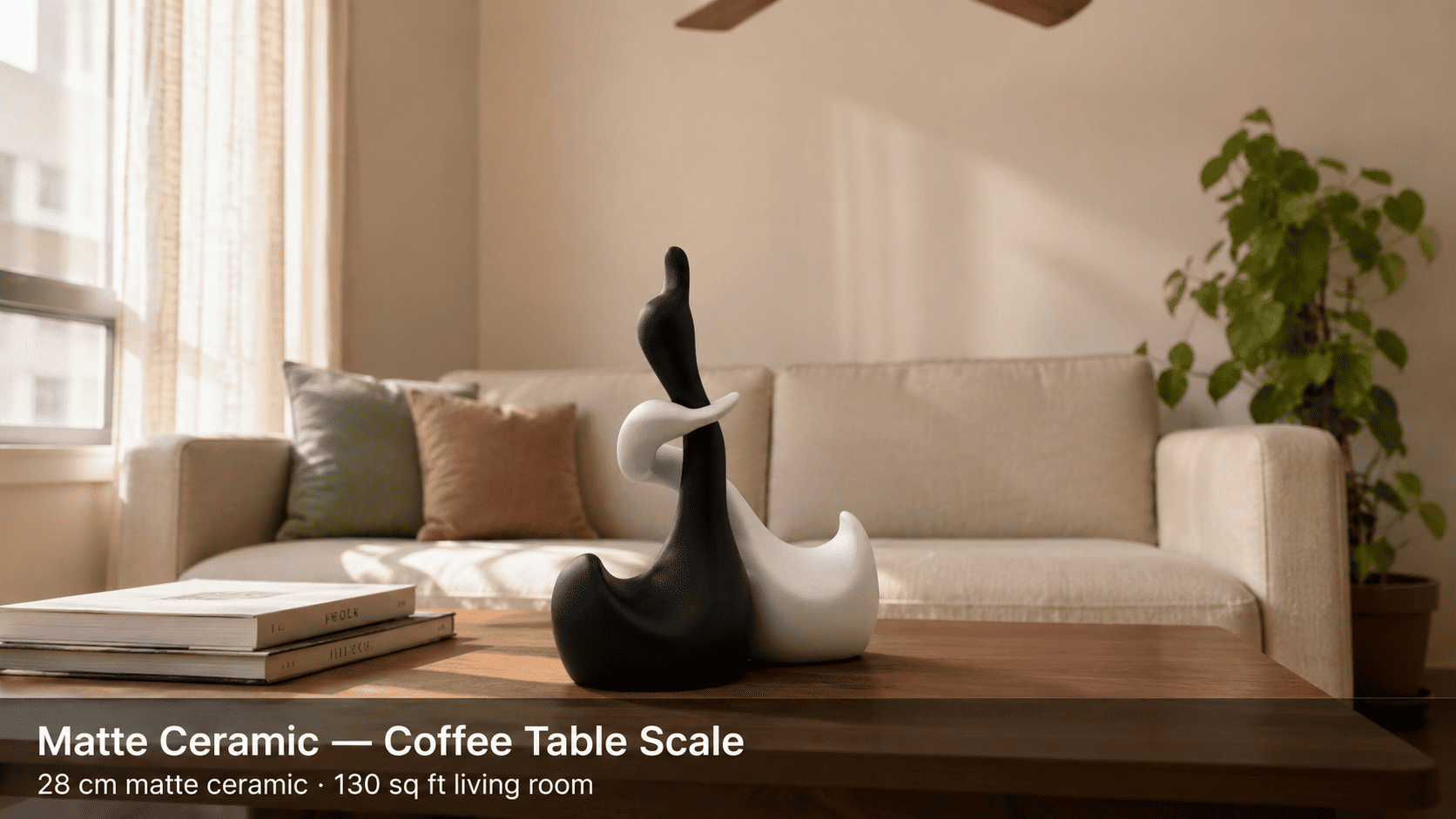
| Coffee table (central) | 60–90 cm wide | 25–34 cm (Large) | 16–21 cm (Medium) — glazed visual weight fills the equivalent space | Ceramic: 85% RH / Resin: 60% RH |
| Console / entry table | 40–60 cm wide | 16–21 cm (Medium) | 10–16 cm (Small) — prevent specular overcrowding on narrow surface | Ceramic: 85% RH / Resin: 60% RH |
| Floating shelf | Under 30 cm wide | 10–16 cm (Small), clustered in 3s | 10–16 cm (Small), 1 piece max — second glazed piece creates mirror competition | Ceramic: 85% RH preferred over resin at 60% RH cap |
| Bookshelf / display unit | 30–45 cm per bay | 16–21 cm (Medium), 1–2 per bay | 10–16 cm (Small), 1 per bay — glazed pieces among books fragment the visual rhythm | Either; maintain 15–35°C for resin |
Because lamp placement, wall colour, and window orientation introduce additional variables specific to each room layout, browse the full size-band, finish, and material selection in Moolwan's living room showpiece collection to verify your final piece choice against your specific surface and light conditions.
Design Rule
When choosing between matte and glazed finishes in compact Indian living rooms, apply Moolwan's Finish Dominance Rule: a room can sustain one specular (glazed) focal piece per 60 sq ft of floor area before reflective competition fragments visual coherence. In a 120 sq ft room, that is two glazed pieces maximum — each on a different surface. Beyond this threshold, every additional glazed piece competes for the eye's attention rather than contributing to it, and the room reads as busy regardless of how well each individual piece is styled.
Does Finish Choice Affect How Long a Showpiece Looks Good — Or Just How It Looks on Day One?
Longevity diverges significantly between matte and glazed finishes when the piece is placed in the conditions typical of Indian living rooms — high-touch horizontal surfaces, seasonal humidity swings, and intermittent direct sunlight. Glazed surfaces maintain their appearance best in stable, low-humidity, low-UV environments: air-conditioned rooms that hold 40–50% RH year-round and receive no direct sunlight. In these conditions, the vitreous glaze layer does not thermally cycle enough to craze, and UV does not discolour the underlying pigments. Outside these conditions — in rooms that operate without AC during monsoon months, or in south- and west-facing rooms that receive afternoon sun — glazed pieces begin to show visible wear within 18–24 months.
Matte ceramics in a high-density 92% clay composition age differently: micro-scratches from surface contact diffuse into the existing surface texture because the matte finish has no uniform reflective baseline to deviate from. This means a matte ceramic showpiece that has been placed on a coffee table for three years — picked up, set down, occasionally shifted — still reads as intentionally finished rather than worn. The investment case is therefore stronger for matte finishes in frequently-used living spaces: a piece that maintains appearance across a 5+ year lifespan does not require seasonal replacement, which is the underlying logic behind Moolwan's climate-rated ceramic specification.
Ready to choose a piece that holds its finish through Indian summers and monsoons without replacement? Shop the full Moolwan living room showpiece collection — climate-rated ceramics in matte and glazed finishes, manufacturer-direct.
Can Matte and Glazed Showpieces Be Mixed on the Same Surface — or Does That Always Look Messy?
Mixing finishes on a single surface is viable under one condition: the matte pieces must outnumber the glazed pieces. The correct ratio is two matte pieces to one glazed piece per surface grouping, because this preserves the diffuse light baseline of the surface — the calm, even tonality established by the matte pieces — while allowing the single glazed piece to function as a deliberate accent rather than a competing focal point. Reversing the ratio (more glazed than matte) creates specular competition: multiple bright hotspots on the same surface, each drawing the eye simultaneously, which reads as visual noise rather than curated arrangement.
Material mixing follows the same logic: resin showpieces (94% epoxy purity, rated to 60% RH) work well as the single glazed-equivalent accent within a predominantly matte ceramic grouping, because their smooth semi-gloss surface provides finish contrast without the full specular intensity of high-fire glazed ceramics. The humidity tolerance gap between the two materials (ceramic to 85% RH vs resin to 60% RH) means that in un-airconditioned rooms that exceed 60% RH during monsoon months, a grouped arrangement should prioritise ceramic pieces for the majority of the composition and reserve any resin pieces for the air-conditioned months.

Frequently Asked Questions
Is matte finish harder to clean than glazed in a living room setting?
Matte ceramic surfaces are marginally more textured than glazed at the microscopic level, which means fine dust settles into surface micro-pores rather than resting on top of a smooth layer. In practice, a dry microfibre cloth removes this dust completely because the particles have not bonded to the surface. Glazed surfaces wipe down with slightly less effort for dry dust but show fingerprints and oily residue — from hands that touch the piece — more visibly because the uniform specular surface reflects every smear. In a high-traffic living room, glazed showpieces require more frequent cleaning to maintain their appearance than matte ceramics engineered to the same 92% clay density specification.
Do glazed showpieces fade in rooms that get direct sunlight through south- or west-facing windows?
Glazed ceramics fired at high temperatures do not fade in the conventional sense — the colourants are embedded into the vitreous glaze layer rather than applied as a surface pigment. However, sustained UV exposure at the intensity typical of Indian south- and west-facing rooms causes two visible changes over 2–3 years: first, a gradual yellowing of white or pale glaze tones because lead-free flux compounds in modern glazes yellow under UV; second, a micro-dulling of the gloss surface as UV photons degrade the surface layer at a rate invisible year-to-year but cumulative over 36+ months. Matte ceramics are not immune but degrade less visibly because they have no uniform reflective baseline to deviate from — the surface change is absorbed into the existing texture rather than appearing as a measurable loss of sheen.
What finish works best for a simple living room with children or pets?
Matte ceramics at a 92% clay composition are the correct specification for households with children or pets because their drop-test threshold (tested to 15 cm drop height) and matte surface concealment of micro-scratches combine to produce the lowest visible wear rate under regular physical contact. Glazed pieces in the same scenario show contact wear — chips at the glaze edge, fingerprint haze on the surface — within the first year of use. If a glazed piece is preferred for aesthetic reasons, placing it on a surface above 90 cm height (a shelf, a mantle, a high console) removes it from the direct contact zone while preserving its visual contribution to the room.
How many showpieces should a simple Indian living room have in total?
A living room of 120–150 sq ft — the median Indian urban apartment layout — sustains three to five showpieces across all surfaces before the room reads as over-styled. The distribution that maintains spatial coherence is one large or medium piece (25–34 cm or 16–21 cm) as a single coffee table anchor, two to three small pieces (10–16 cm) clustered on a shelf or console, and nothing on surfaces that are already performing a functional role — the TV unit, the main dining surface, the reading chair's side table. Moolwan's size guide — Small 10–16 cm, Medium 16–21 cm, Large 25–34 cm — maps directly to these three placement tiers, allowing a buyer to fill all three surface roles without exceeding the visual threshold at which a simple room tips into a styled-showroom look.
A climate-rated matte ceramic showpiece in the 16–21 cm range — placed on a coffee table in a simple Indian living room with a neutral or greige wall — will hold its finish through 5+ years of monsoon humidity cycles and daily use without surface blush, crazing, or visible wear: that is the direct return on choosing a piece engineered for Indian conditions rather than a mass-produced alternative sized for Western interiors. Bring home a curated piece from Moolwan's living room showpiece collection — manufacturer-direct, humidity-rated, available in both matte and glazed finishes across all three size bands. For living rooms that need a complete transformation rather than a single accent, explore the full curation in Moolwan's elegant living room décor edit — or browse the complete range of Moolwan living room items to find complementary pieces across finishes, materials, and surfaces.


