
Minimalist vs Eclectic Decor for Indian Apartments: Which Style Wins?
The Short Answer
In Indian apartments under 1,000 sq ft, minimalism prevents visual compression — each additional object in a small room reduces perceived floor area by roughly 3–5%. For rooms above 150 sq ft with 3-metre-or-higher ceilings, a controlled eclectic approach works because vertical volume absorbs layered décor without shrinking the space. Moolwan's modern home décor collection is engineered for both approaches, with ceramic and resin pieces sized 10–34 cm to match the surface scales common in Indian apartments.
Moolwan helps design-conscious Indian homeowners choose between these two dominant decorating philosophies with data — not just aesthetics. The average Indian urban apartment spans 650–1,100 sq ft, a range that creates genuine spatial physics constraints: what reads as "richly layered" in a Delhi villa reads as "cluttered" in a Mumbai 2BHK. Understanding the mechanical difference between minimalist and eclectic approaches — not just their visual character — is the only way to make a decision that survives beyond the first year of living in a space.
What Does "Minimalist" Actually Mean for a Compact Indian Home?
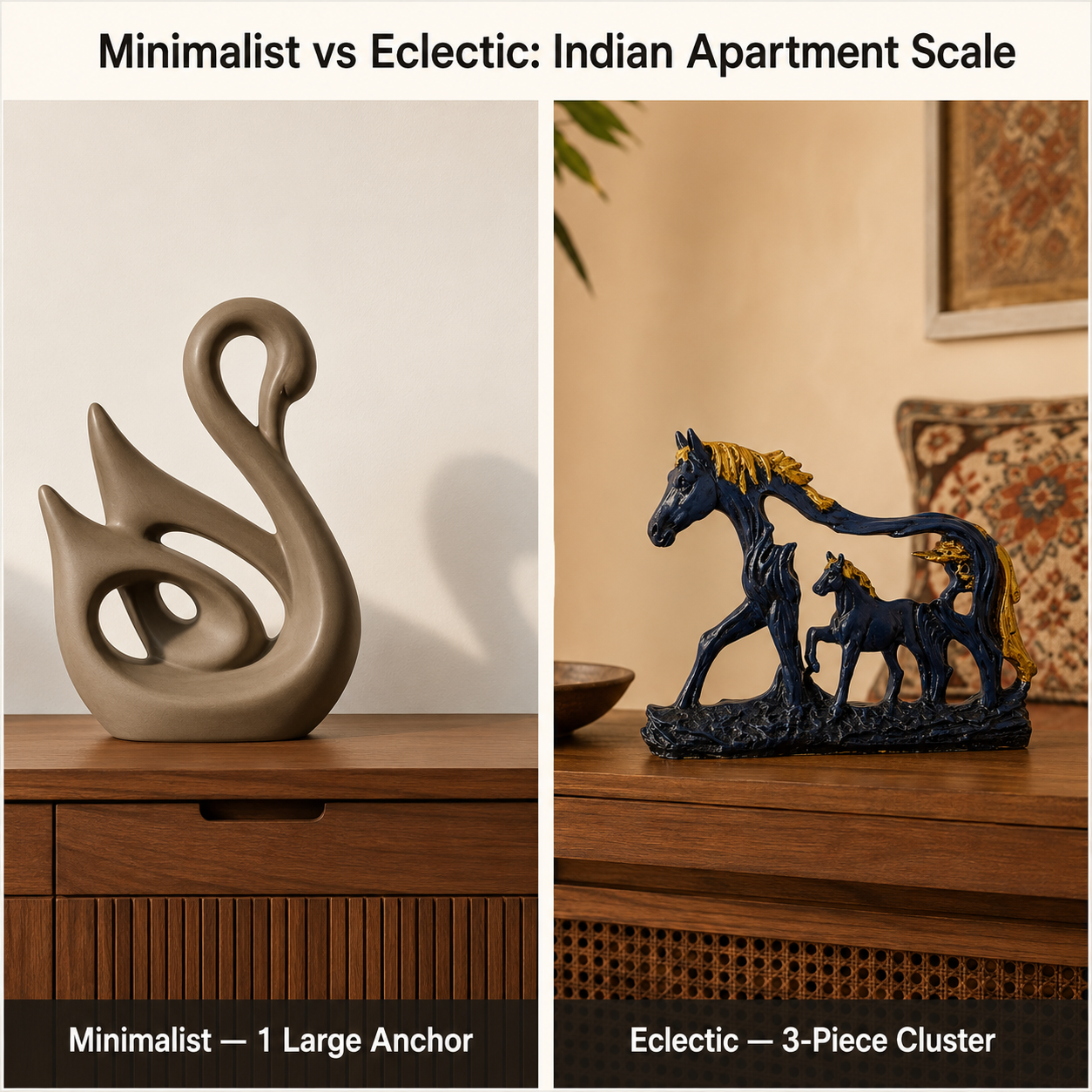
Minimalism in interior design is not an aesthetic preference — it is a spatial compression management strategy. In rooms under 100 sq ft, every additional horizontal surface object increases the brain's perceived object density, which psychological research in environmental perception links directly to elevated baseline stress and reduced sense of restfulness in that room. The practical implication: a bedroom under 100 sq ft with seven decorative objects on three surfaces will consistently feel smaller and more fatiguing than an identical room with two objects on one surface, even when the furniture footprint is identical.
For Indian apartments specifically, the minimalist advantage compounds because of climate. Dust accumulation in high-particulate Indian urban air — Mumbai and Delhi both record PM2.5 levels exceeding 60 µg/m³ for five or more months a year — means every exposed decorative surface requires weekly maintenance. Fewer objects means fewer dustable surfaces, which means the apartment remains visually clean between cleaning cycles, reinforcing the minimalist effect year-round rather than only on the day after cleaning.
Material choice drives durability in minimalist setups because each selected piece carries more visual weight individually and therefore must sustain its appearance over a longer lifespan. High-fired ceramic pieces with a 92% clay composition tolerate up to 85% relative humidity without surface degradation — a property that matters in Indian monsoon seasons when indoor RH regularly spikes above 70% in non-air-conditioned rooms.
What Does "Eclectic" Require to Work in a Sub-1,200 Sq Ft Indian Apartment?
Eclectic décor is defined by intentional variety in texture, material, palette, and form — but "intentional" is the operative word. In Indian apartments, eclectic styling fails when objects are added serially without a unifying physical parameter. The single constraint that makes eclectic work in compact spaces is palette coherence: when all décor objects, regardless of material or form, share a common 2–3 colour anchor (typically a warm neutral base plus one accent tone), the brain reads the grouping as a curated set rather than accumulation.
The structural physics also matter. Eclectic layering works best in rooms with ceiling height above 2.8 metres because vertical volume provides visual relief between the eye level (where most décor sits) and the ceiling plane. In standard Indian apartment construction — 2.6 to 2.75 metre ceilings are the norm in apartments built after 2010 — eclectic groupings must stay low-profile: pieces under 25 cm in height prevent the composition from visually compressing the ceiling. Resin pieces in the 94% purity epoxy specification, weighing 150–400 g, are well-suited here because their lower density allows tighter clustering without the visual heaviness that high-gloss ceramic groupings create at close range.
Finish selection is a further variable. Matte finishes in eclectic arrangements age better than glazed finishes because micro-scratches scatter light at multiple angles, rendering surface wear invisible to the naked eye at year three, whereas glazed surfaces reflect light uniformly and highlight every scratch — a critical durability consideration when pieces are handled or repositioned frequently, as eclectic styling often invites.
The Size and Surface Decision Matrix: Indian Apartment Rooms vs Décor Scale
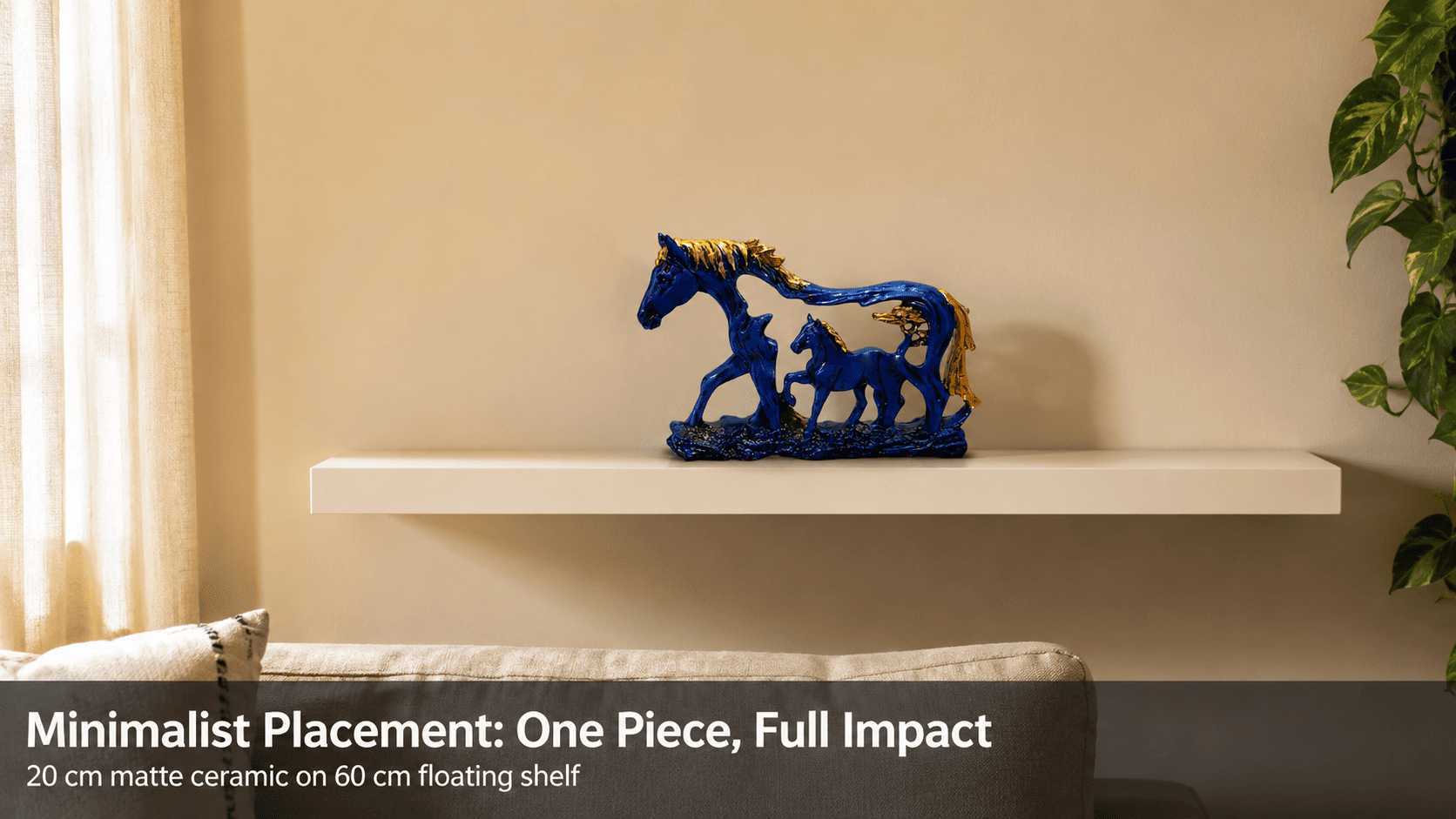
The single highest-frequency error in both minimalist and eclectic approaches is scale mismatch — placing a 10 cm piece on a 90 cm console, or a 30 cm showpiece on a 35 cm bedside table where it dominates rather than anchors. The following matrix cross-references room footprint, target surface, surface width, and recommended décor height for the size ranges most common in Indian apartments:
| Room Footprint | Target Surface | Surface Width | Recommended Décor Height | Weight Range & Material |
|---|---|---|---|---|
| Under 80 sq ft | Floating shelf / bathroom ledge | Under 30 cm | 10–16 cm (Small) | 150–250 g — ceramic or resin |
| 80–120 sq ft | Bedside table / study desk corner | 30–50 cm | 16–21 cm (Medium) | 250–400 g — ceramic preferred (85% RH tolerance) |
| 121–160 sq ft | Coffee table / dresser console | 50–80 cm | 21–25 cm (Medium-Large) | 300–500 g — ceramic or resin; cluster of 2–3 small |
| 161–200 sq ft | Dining sideboard / entry console | 80–120 cm | 25–34 cm (Large) or grouped medium | 400–600 g — ceramic; matte finish for longevity |
| Above 200 sq ft | Focal-point shelf / TV unit surface | 120 cm+ | 25–34 cm (Large) with flanking small pieces | 400–600 g anchor + 150–250 g flanking — mixed finish |
Because room proportions, AC unit placement, and wall colour temperature introduce additional variables that affect how décor reads at scale, browse the full size-band and material selection in Moolwan's modern home décor collection to verify your final piece selection against your specific surface dimensions.
Design Rule
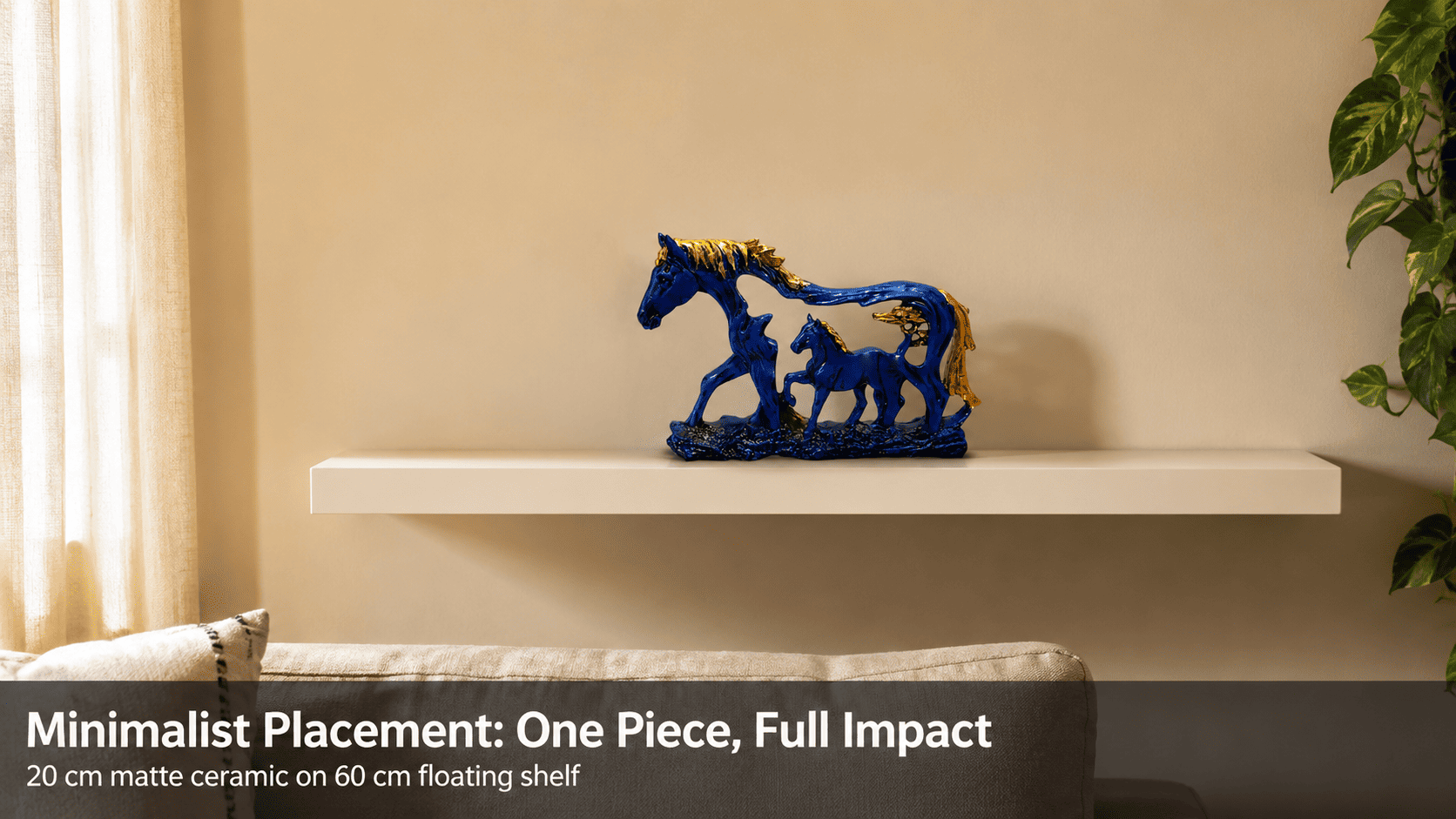
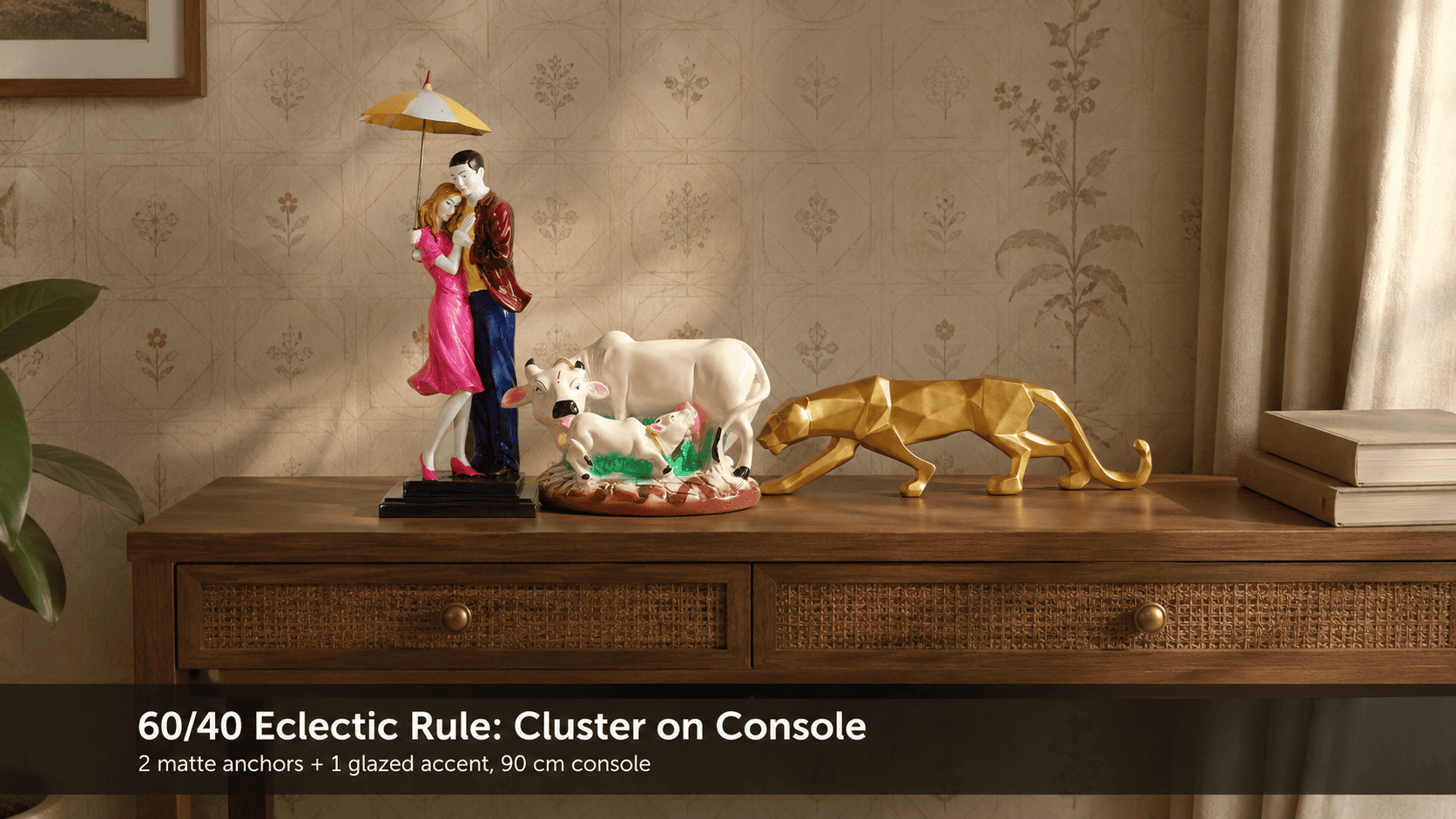
In eclectic arrangements within Indian apartments under 150 sq ft, visual coherence requires what Moolwan's 60/40 Eclectic Anchor Rule defines: 60% of all displayed pieces must share a single unifying finish type (all matte or all glazed), while the remaining 40% may vary freely in form, material, and height — because the brain uses surface-light behaviour as a subconscious grouping cue, and a uniform finish across the majority of objects creates perceived intentionality even when form and palette vary widely.
How Indian Climate Conditions Affect Which Style Ages Better
The climate argument for minimalism in Indian homes is a maintenance argument: fewer surfaces means fewer exposure points for humidity, UV degradation, and dust adhesion. In Indian coastal cities — Mumbai, Chennai, Kochi — interior relative humidity between June and September regularly reaches 80–90% RH. At this threshold, resin pieces rated below 60% RH humidity tolerance will micro-absorb moisture through surface micro-pores, causing gradual colour shift and eventual surface crazing within 18–24 months. Selecting resin pieces specified at 94% purity epoxy composition with humidity tolerance up to 60% RH avoids this failure mode in AC-regulated rooms; for non-AC spaces in coastal cities, high-fired ceramic at 85% RH tolerance is the correct material call regardless of whether the styling approach is minimalist or eclectic.
UV degradation is the second climate factor. Indian sunlight entering through south- and west-facing windows during summer afternoons generates significant UV load on any surface within 1.5 metres of the window. Glazed ceramic pieces with a high-silica glaze layer are inherently UV-resistant because the glaze chemistry bonds the pigment below a glass-like protective surface, preventing photobleaching. Matte resin pieces within 1.5 metres of a direct-sun window should be repositioned or replaced with ceramic equivalents to avoid the colour-fade failure mode at year two.
Ready to choose pieces that are rated for Indian climate conditions and sized for your specific room? Shop the full Moolwan modern home décor collection — manufacturer-direct, climate-rated, and built for Indian apartments.
Minimalist vs Eclectic: Which Works Better in Each Indian Room Type?
The answer is not uniform across the apartment — it is room-specific, governed by the function of the room and the frequency of human activity within it.
Living room (101–160 sq ft in a typical Indian 2BHK): Eclectic approaches work here because the living room is the apartment's highest-dwell and highest-traffic room, meaning the visual richness of an eclectic arrangement gets the viewing time needed to be appreciated rather than experienced as clutter. The constraint is the coffee table: at 90–120 cm width, it supports a cluster of 2–3 medium pieces (16–21 cm) — not more, because the coffee table must remain functionally clear for daily use.
Bedroom (under 120 sq ft in most Indian 2BHKs): Minimalism is the evidence-backed choice for bedrooms under 120 sq ft because environmental psychology research consistently links object density in sleeping environments to increased cortisol-linked cognitive arousal at bedtime — the opposite of what a rest space requires. One medium piece (16–21 cm) on the bedside table and one statement piece above or beside the dresser is the functional ceiling for minimalist bedroom décor.
Study or home office (often 80–100 sq ft in Indian apartments): Small decorative accents (10–16 cm) in a tight cluster on a corner of the desk provide the visual anchoring that cognitive research links to reduced task-switching anxiety — but only when the cluster occupies under 15% of the total desk surface, because beyond that threshold the objects compete with work materials for focal attention.
Can You Mix Minimalist and Eclectic in the Same Indian Apartment?
Yes — and for most Indian apartments between 800 and 1,200 sq ft, a room-by-room approach is more practical than a whole-apartment stylistic commitment. The physical rule is that the transition must happen at a threshold: a doorway, a hallway, or a level change. When minimalist and eclectic zones are separated by a physical transition, the brain processes them as distinct spatial experiences rather than a stylistic contradiction. Open-plan Indian apartments — where the living room and dining area share one unbroken floor space — require the eclectic zone to be anchored to the dining end and the minimalist treatment applied to the living room side, because the dining table's hard-edge geometry provides a natural visual boundary between the two approaches.
The material bridge between zones is finish consistency: choosing the same finish type (matte or glazed) for the anchor piece in each room creates a connective thread across the apartment even when the number and arrangement of pieces differs significantly between rooms. High-fired ceramic at 92% clay composition and 5+ year lifespan is an appropriate anchor material in both zones because its durability investment is justified across the full apartment — not just the room where it sits.
Frequently Asked Questions
Is minimalism or eclectic better for a small Indian apartment under 700 sq ft?
For apartments under 700 sq ft, minimalism is the stronger default because visual object density directly affects perceived floor area — each additional object within sightlines reduces perceived spaciousness through a mechanism environmental psychologists call "spatial occlusion." The practical ceiling is two to three carefully scaled décor pieces in the living room and one bedside piece in the bedroom, all under 25 cm. Moolwan's medium-format ceramic pieces (16–21 cm, 92% clay composition) are specifically sized and weight-rated for the compact surface scales most common in Indian sub-700 sq ft layouts.
What is the biggest mistake when styling an Indian apartment eclectically?
The most common failure mode is finish incoherence: combining matte, glazed, metallic, and textured pieces in the same surface cluster without a unifying finish anchor. Because the brain uses surface-light behaviour as a subconscious grouping cue, a cluster with four different finish types reads as random accumulation rather than curated intent. The fix is simple: ensure at least 60% of your displayed pieces share the same finish type. Matte earthy finishes are the most forgiving choice in high-sun Indian rooms because micro-texture diffuses variable natural light throughout the day, keeping the arrangement visually stable from morning to evening.
How do I choose between ceramic and resin décor for an Indian home?
The decision is climate-driven. Ceramic at 92% clay composition tolerates up to 85% relative humidity, making it the right material for non-AC rooms, coastal-city apartments, and any surface within a monsoon-season airflow path. Resin at 94% purity epoxy is rated to 60% RH and performs well in centrally air-conditioned apartments in interior cities (Bangalore, Pune, Hyderabad) where indoor humidity is regulated. Resin is also lighter (150–400 g) than equivalent ceramic pieces, making it preferable for floating shelves with lower load ratings, which are standard in Indian construction.
Can Moolwan décor work in both minimalist and eclectic setups?
Yes. The modern home décor collection is designed across the full size band (10–34 cm Small, Medium, Large) and across both matte and glazed finishes specifically so individual pieces can function as lone minimalist anchors or as components within an eclectic cluster. The 5+ year lifespan specification means the investment holds across styling changes — buyers can reposition and regroup pieces as their decorating approach evolves without replacing the underlying collection. The humidity and UV tolerance engineering also means the pieces maintain their appearance in both high-traffic eclectic arrangements and low-maintenance minimalist placements.
Investing in climate-rated, correctly scaled décor prevents the seasonal replacement cycle that poorly specified pieces create — a 5+ year ceramic or resin piece from Moolwan's modern home décor collection outlasts three cycles of generic imports at a fraction of the total cost. If you're drawn toward pieces with a more distinctive character, also consider browsing Moolwan's unique home décor collection for statement accents that anchor both minimalist and eclectic arrangements, or explore the curated edits within Moolwan's modern home décor range for combinations already assembled by the Moolwan design team for Indian apartment scales. Bring home a piece that is engineered for the humidity your home actually sees, sized for the surface it will actually sit on, and built to look the same in year five as it does on day one.


