
Minimalist vs Maximalist Home Decor: Which Style Actually Suits an Indian Home?
The Short Answer
For apartments under 1,200 sq ft — the dominant Indian urban footprint — minimalism protects spatial perception because fewer objects prevent visual compression of narrow sightlines. Maximalism works when rooms exceed 150 sq ft per zone and ceilings clear 10 feet. Moolwan engineers climate-rated ceramic and resin showpieces sized for both approaches, rated to 85% RH so pieces outlast the style trend, not just the season.
Indian apartments present a spatial constraint that most Western décor advice ignores: the median urban flat runs between 650 and 1,100 sq ft across all rooms, with living areas typically between 120 and 180 sq ft. Moolwan helps design-conscious Indian homeowners choose between minimalist and maximalist décor approaches with sizing logic, material specs, and surface rules engineered specifically for these room scales — not for the open-plan lofts that dominate international interior design media.
What Is the Real Difference Between Minimalist and Maximalist Décor — Beyond Aesthetics?
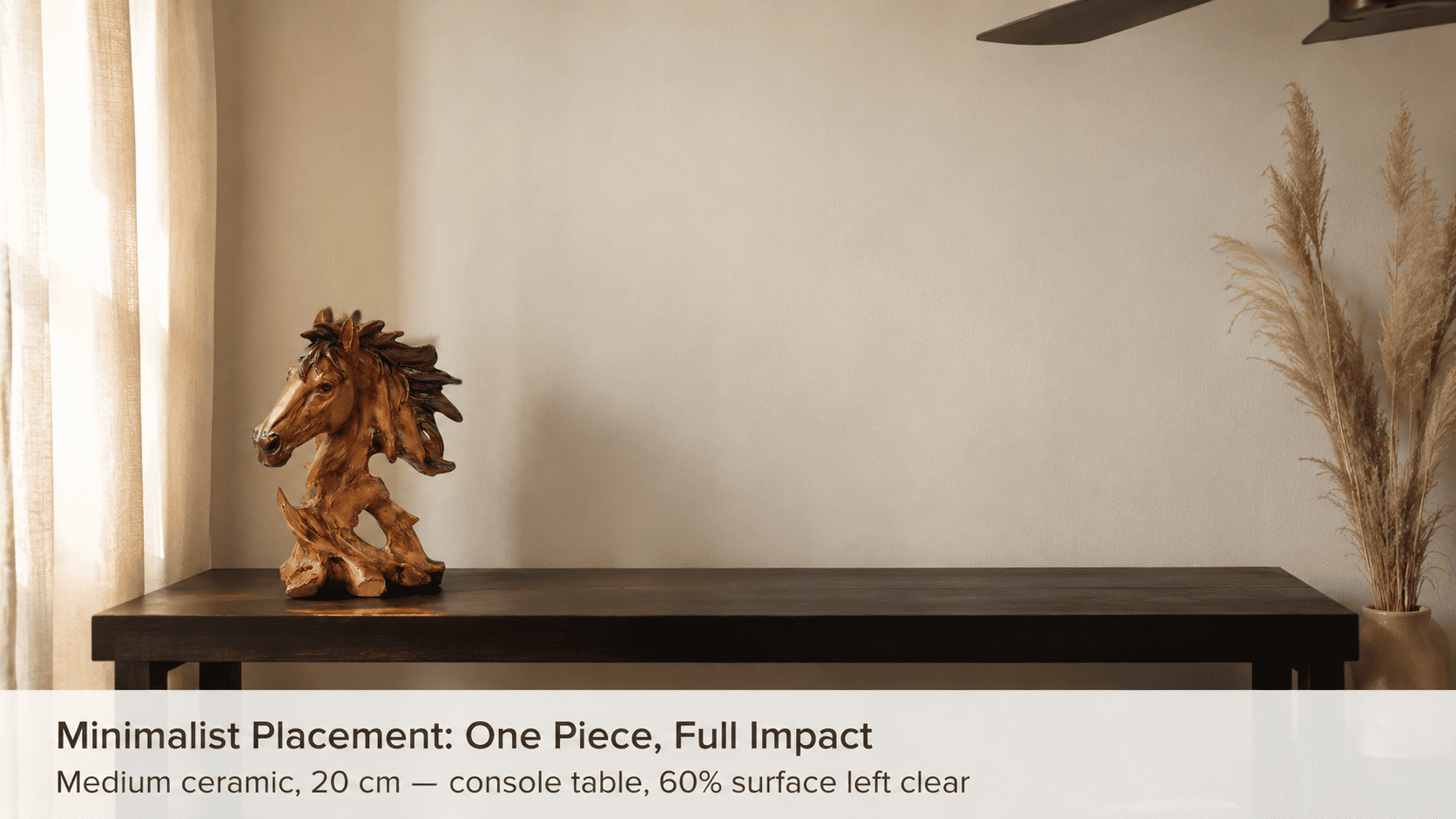
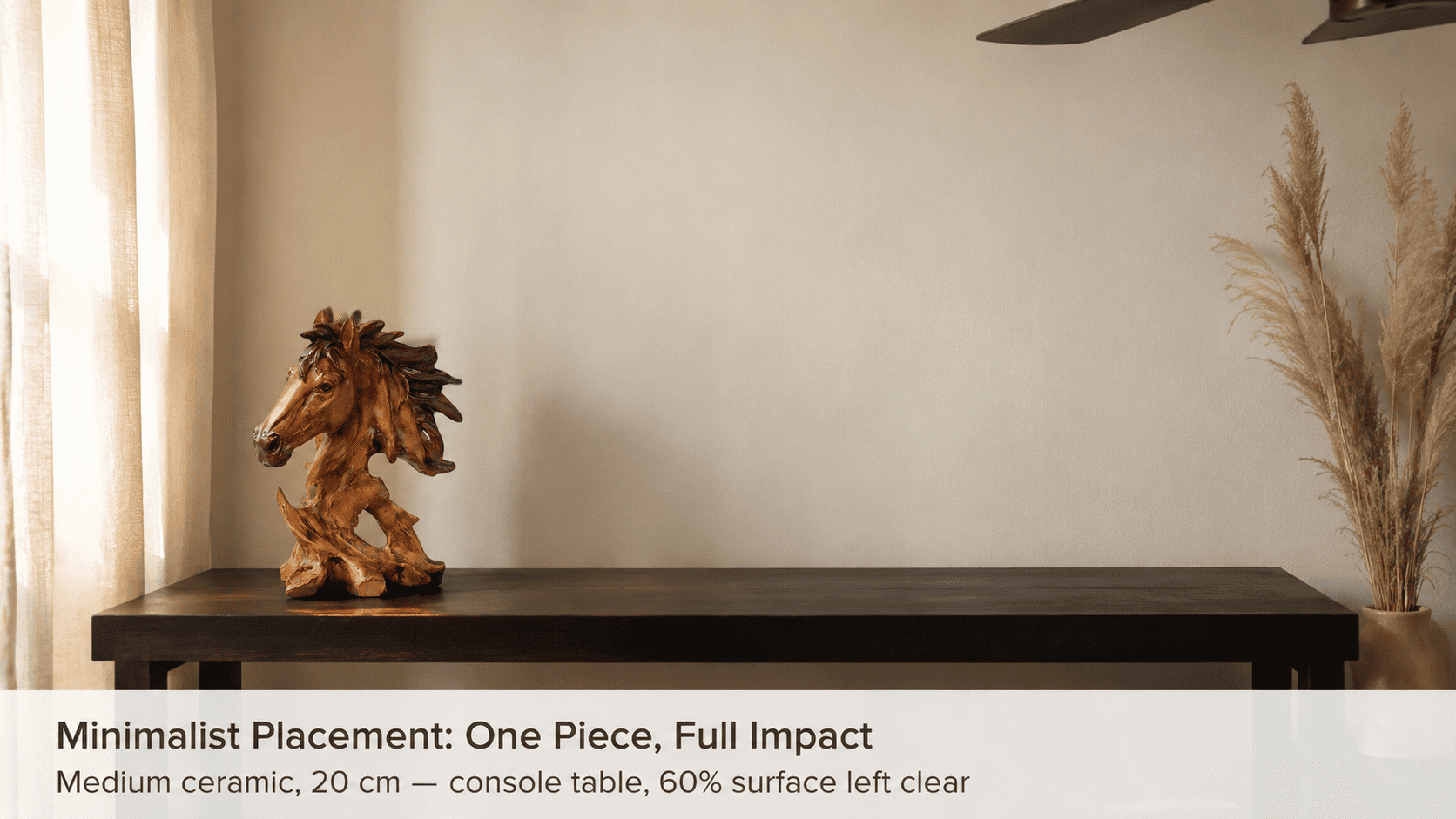
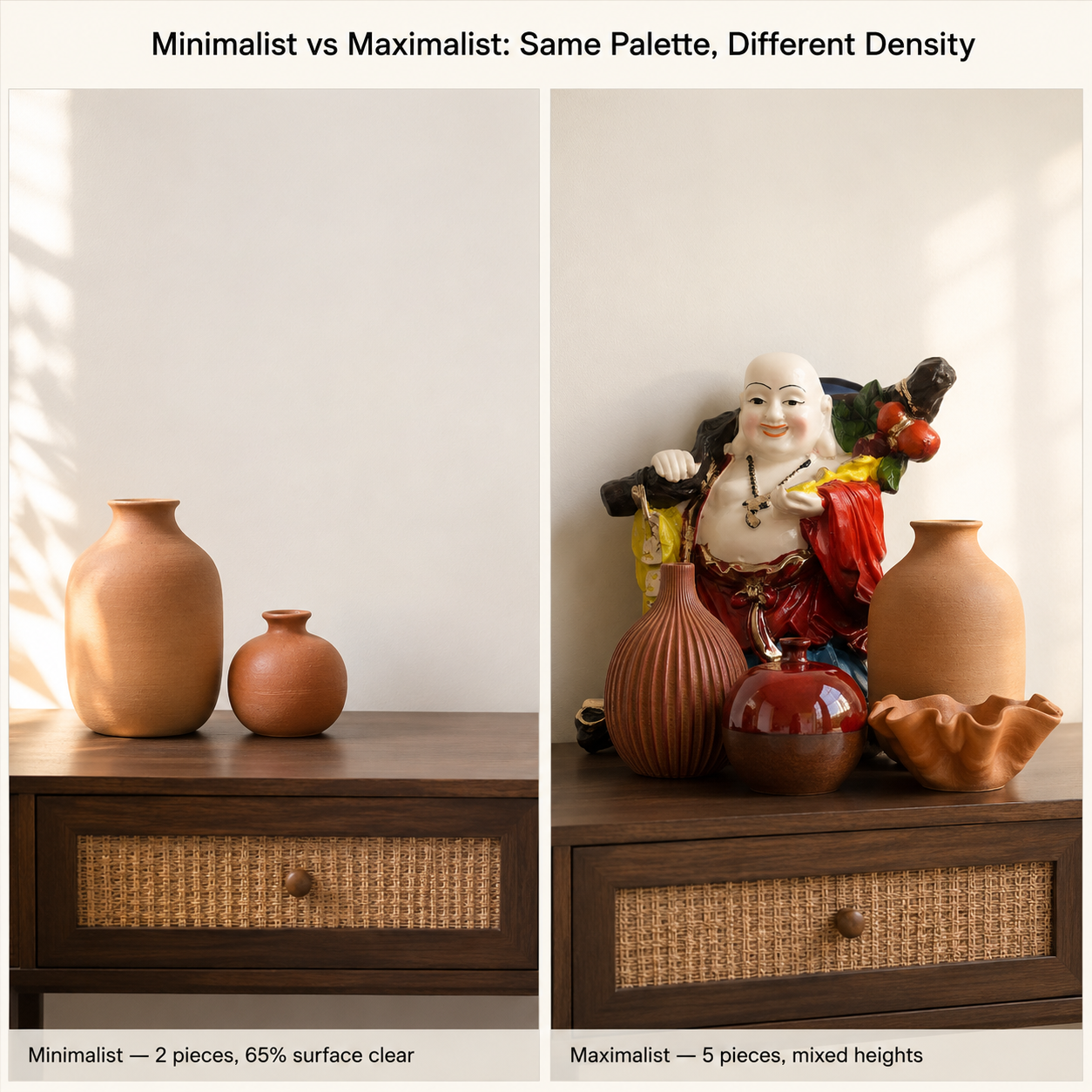
The functional distinction is object density per square metre of visible surface area. Minimalist décor places one to three accent pieces per room zone and deliberately leaves 60–70% of every horizontal surface clear. Maximalist décor layers five or more pieces per zone across varied heights, finishes, and textures, using that density to create visual rhythm rather than visual noise.
The reason this distinction matters in Indian homes specifically is sightline compression. In a room under 140 sq ft, the human eye processes a cluttered foreground as a reduction in perceived depth — a well-documented phenomenon in environmental psychology where object density in the near field shortens the brain's estimate of room length by up to 20%. This is why maximalism requires sufficient room volume to absorb visual weight without triggering compression. A maximalist arrangement that reads as abundant in a 200 sq ft living room reads as cramped in a 120 sq ft one.
Material choices also diverge between the two approaches. Minimalist rooms favour matte, single-finish, neutral-palette ceramics because a matte surface diffuses light at multiple micro-angles, reducing the number of visual focal points. Maximalist rooms use a deliberate mix of glazed ceramics, resin sculptures with high-contrast finishes, and varied textures precisely because the interplay of light reflection across surfaces creates the layered visual interest the style depends on.
Which Style Performs Better in Indian Climate Conditions?
In unconditioned or partially conditioned interiors subject to monsoon cycles, interior surfaces routinely experience 75–90% relative humidity (RH) between June and September. Materials that are not engineered to this threshold absorb moisture at the molecular level, causing resins to cloud, glazes to craze, and wood-based bases to warp — degrading the aesthetic of both styles within two to three seasons.
Moolwan's ceramic collection is fired to a 92% clay composition, which creates a dense non-porous matrix tolerant of up to 85% RH — the upper boundary of sustained indoor monsoon humidity in most Indian metros. The resin collection uses 94% purity epoxy with a pencil hardness rating of 3H, meaning the surface resists surface scoring from daily handling at temperatures between 15°C and 35°C. Both materials perform through the full Indian seasonal range without seasonal replacement, which is the core ROI argument for investing in climate-rated pieces rather than mass-produced décor that degrades under Indian conditions inside eighteen months.
For minimalist arrangements — where each piece carries significant visual weight precisely because it stands alone — material integrity over time is especially critical. A single matte ceramic showpiece that clouds or crazes by year two undermines the entire room composition. For maximalist arrangements, the compounding effect is different: degraded pieces are harder to isolate and replace without disrupting the layered composition, making upfront material quality equally important.
How to Match Décor Style to Room Footprint: A Sizing Matrix
The correct style choice is not purely a taste decision — it is a function of room footprint, surface width, and the number of viable display zones a room contains. The matrix below cross-references these variables against recommended piece count, size band, and material finish for each approach.
| Room Footprint | Décor Approach | Pieces Per Zone | Recommended Size Band | Preferred Finish |
|---|---|---|---|---|
| Under 120 sq ft | Minimalist only | 1–2 pieces | Small (10–16 cm) to Medium (16–21 cm) | Matte, single-palette ceramic |
| 120–150 sq ft | Minimalist preferred; restrained maximalist possible | 2–3 pieces | Medium (16–21 cm) | Matte or lightly textured ceramic |
| 150–200 sq ft | Either style viable | 3–5 pieces | Medium (16–21 cm) to Large (25–34 cm) | Mixed matte and glazed; resin accents |
| 200–300 sq ft | Maximalist suits well | 5–7 pieces | Large (25–34 cm) anchors + medium/small clusters | Glazed ceramic, high-contrast resin, mixed textures |
| 300+ sq ft | Full maximalist viable | 7+ pieces across multiple zones | Large (25–34 cm) statement + varied cluster sizes | Full mixed: glazed, matte, resin, varied palette |
Because ceiling height, natural light entry, and furniture mass introduce additional variables that affect how a room absorbs object density, browse the full size-band and finish selection organised by room footprint in Moolwan's home décor collection to verify your final piece choices against your specific layout.
Design Rule
To prevent visual compression in Indian apartments under 150 sq ft regardless of style preference, apply Moolwan's 60/30/10 Surface Density Rule: keep 60% of every horizontal surface entirely clear, cluster décor within 30% of the surface area, and use the remaining 10% as a transition buffer — an empty margin between the cluster and the surface edge — so the eye reads the composition as intentional rather than packed.
How Do Colour Palette and Finish Choice Differ Between the Two Styles?
Palette density is the second axis of difference after object count. Minimalist rooms work within a two-to-three colour palette — typically a neutral base (warm white, greige, or clay) anchored by a single accent tone — because a restricted palette reduces cognitive load and allows individual pieces to register as considered choices. Maximalist rooms layer four or more tones intentionally, using the contrast between warm and cool tones, or matte and glazed finishes, to generate the visual energy the style depends on.
The Indian interior context adds a specific constraint here: most Indian apartment walls carry warm undertones — builder-grade off-whites and creams that lean yellow — rather than the cool bright whites common in European interiors. Moolwan's ceramic collection in warm earth, terracotta-adjacent, and muted jewel-tone finishes is developed specifically to work with these warm-undertone base walls rather than fight them. A cool-grey matte piece placed against a warm cream wall creates a low-level colour clash that the eye registers as dissonance even when the homeowner cannot identify why the room feels slightly off.
For maximalist arrangements, Moolwan engineers glazed ceramics and resin sculptures with finish palettes calibrated to Indian lighting conditions — specifically to perform under the warm incandescent and warm-white LED lighting that dominates Indian residential spaces, rather than the cool daylight-spectrum lighting more common in European homes where most maximalist décor photography is shot.
Ready to buy a climate-rated décor piece built for the Indian palette? Shop the full Moolwan home décor collection now — manufacturer-direct, humidity-rated, sized for Indian rooms.
Can You Mix Minimalist and Maximalist in One Home?
Yes — and in most Indian apartments, a room-by-room hybrid is the most functional approach. High-traffic, smaller-footprint rooms (entry corridors under 30 sq ft, bathrooms, study alcoves) benefit from minimalist treatment because visual compression is most acute where the sightline is shortest. Larger social rooms — living rooms, dining areas — can absorb a maximalist approach when room footprint allows.
The constraint to maintain is finish-language consistency across the hybrid. If the living room uses glazed ceramics in warm earth tones, the bathroom shelf accent and the study desk piece should draw from the same palette family — even at minimalist object counts — so the home reads as curated rather than eclectic-by-default. Moolwan's ceramic and resin collections are developed in coordinated palette families precisely to support cross-room consistency in this hybrid approach, allowing a homeowner to style three different rooms at three different object densities while maintaining a coherent visual thread.
Which Style Is Easier to Maintain and Refresh Over Time?
Minimalist arrangements are structurally easier to refresh because each piece carries individual weight — swapping one medium showpiece changes the room's focal composition without requiring a full restyle. The investment argument is clear: a single high-fired matte ceramic rated to 85% RH and drop-tested to 15 cm has a documented lifespan of 5+ years, which means the per-year cost of a quality minimalist piece is significantly lower than the cumulative cost of replacing degraded mass-produced pieces every eighteen months.
Maximalist arrangements require a different maintenance logic. Because the visual composition depends on the relationship between pieces — height variation, finish contrast, palette layering — removing or replacing one piece disrupts the overall arrangement. This makes the initial selection more consequential: maximalist rooms reward investing in a cohesive set of pieces at the outset rather than accumulating pieces incrementally. The 94% purity epoxy resin pieces in Moolwan's collection carry a 3+ year indoor lifespan and a 3H surface hardness, meaning the finish integrity of each piece in a maximalist cluster holds long enough for the composition to remain coherent without piecemeal replacement disrupting the whole.
Frequently Asked Questions
Is minimalist or maximalist décor better for small Indian apartments?
For apartments under 1,100 sq ft — the typical Indian urban footprint — minimalism is the safer structural choice because human visual perception compresses perceived room depth when the near field contains high object density. Rooms under 140 sq ft lose up to 20% of perceived depth under maximalist object loads. Moolwan recommends minimalist treatment for rooms under 150 sq ft and a room-by-room hybrid for larger layouts, using climate-rated pieces rated to 85% RH across both approaches.
What size décor pieces work for a minimalist living room in India?
For a living room between 120 and 180 sq ft — the most common Indian apartment living area footprint — one to two pieces in the medium size band (16–21 cm) provide sufficient visual weight without triggering sightline compression. A single large piece (25–34 cm) can anchor a focal zone in rooms over 150 sq ft. The key constraint is surface width: a medium piece requires a minimum surface width of 40 cm to read as intentionally placed rather than crowded onto the surface.
How do I stop a maximalist room from looking cluttered?
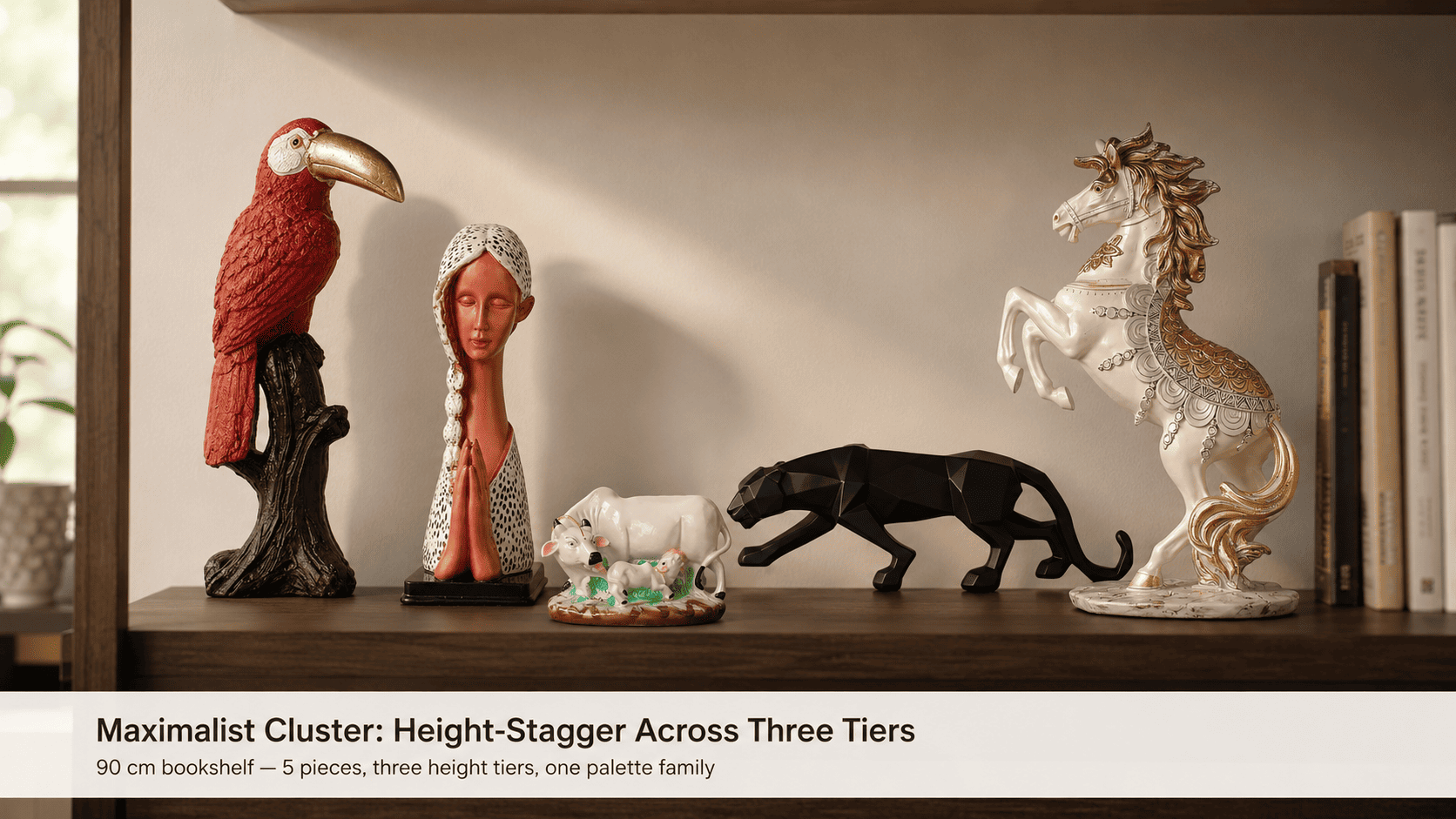
Visual clutter in maximalist arrangements results from two specific failures: inconsistent palette families across pieces, and insufficient height variation within a cluster. Pieces drawn from the same palette family (warm earth tones, or cool jewel tones, not both simultaneously) read as a composed collection rather than an accumulation. Within each cluster, varying piece heights across at least three tiers — small (10–16 cm), medium (16–21 cm), and large (25–34 cm) — directs the eye through the arrangement in a Z-pattern the brain reads as intentional design.
Does maximalist décor cost more than minimalist to furnish a home?
Total outlay is higher for maximalist because object count is higher, but the per-piece cost need not be. The real cost difference emerges at year two to three: maximalist rooms in Indian humidity require climate-rated pieces across every object in the cluster, because a single degraded piece disrupts the composition. Replacing one low-quality piece in a five-piece cluster typically triggers a partial restyle. Investing in humidity-tolerant ceramics and resin pieces at the outset — rated to 85% RH and 3H surface hardness — prevents this cascading replacement cost and lowers the five-year total cost of ownership for a maximalist room significantly.
Choosing the right décor approach for your home is a 5-year investment decision, not a seasonal one — and the pieces you choose need to hold their finish integrity through Indian humidity cycles, not just look good in the store. Bring home a climate-rated showpiece from the Moolwan home décor collection — humidity-rated to 85% RH, drop-tested, and sized specifically for Indian room scales. If you are building a minimalist-leaning room, the curated edit in Moolwan's modern home décor collection offers finish families and size bands suited to single-focal-point compositions. For a full selection of individual accents that work within both minimalist and maximalist arrangements, browse the complete range at Moolwan's modern home décor items — manufacturer-direct, no distributor markup, made for Indian homes.


