
Modern Showpiece vs Traditional Figurine: Choosing the Right Living Room Focal Point
The Short Answer
For most Indian living rooms under 150 sq ft, a large matte modern showpiece (25–34 cm) creates a cleaner, more durable focal point than a traditional figurine — because the simplified silhouette reads as a single visual anchor at distance, whereas detailed carvings fragment the eye across multiple focal points in compact spaces. Moolwan's climate-rated ceramic collection is engineered to tolerate up to 85% relative humidity, making it built for Indian conditions in a way most imported figurines are not.
The Indian living room has one of the most demanding decorating briefs in the world: it must balance the warmth of tradition with modern sensibility, compress a full social space into an apartment footprint that averages under 1,200 sq ft, and hold up against 70–90% monsoon-season humidity. Moolwan helps design-conscious Indian homeowners resolve exactly this tension — delivering décor accents that are engineered for Indian climate conditions and scaled for Indian room proportions, not imported from a design tradition that has never encountered a Chennai July. The choice between a modern showpiece and a traditional figurine as a living room focal point is not merely aesthetic; it is a structural, spatial, and material decision with measurable consequences for visual coherence and long-term durability.
How Does Each Type Function as a Focal Point in a Compact Indian Living Room?
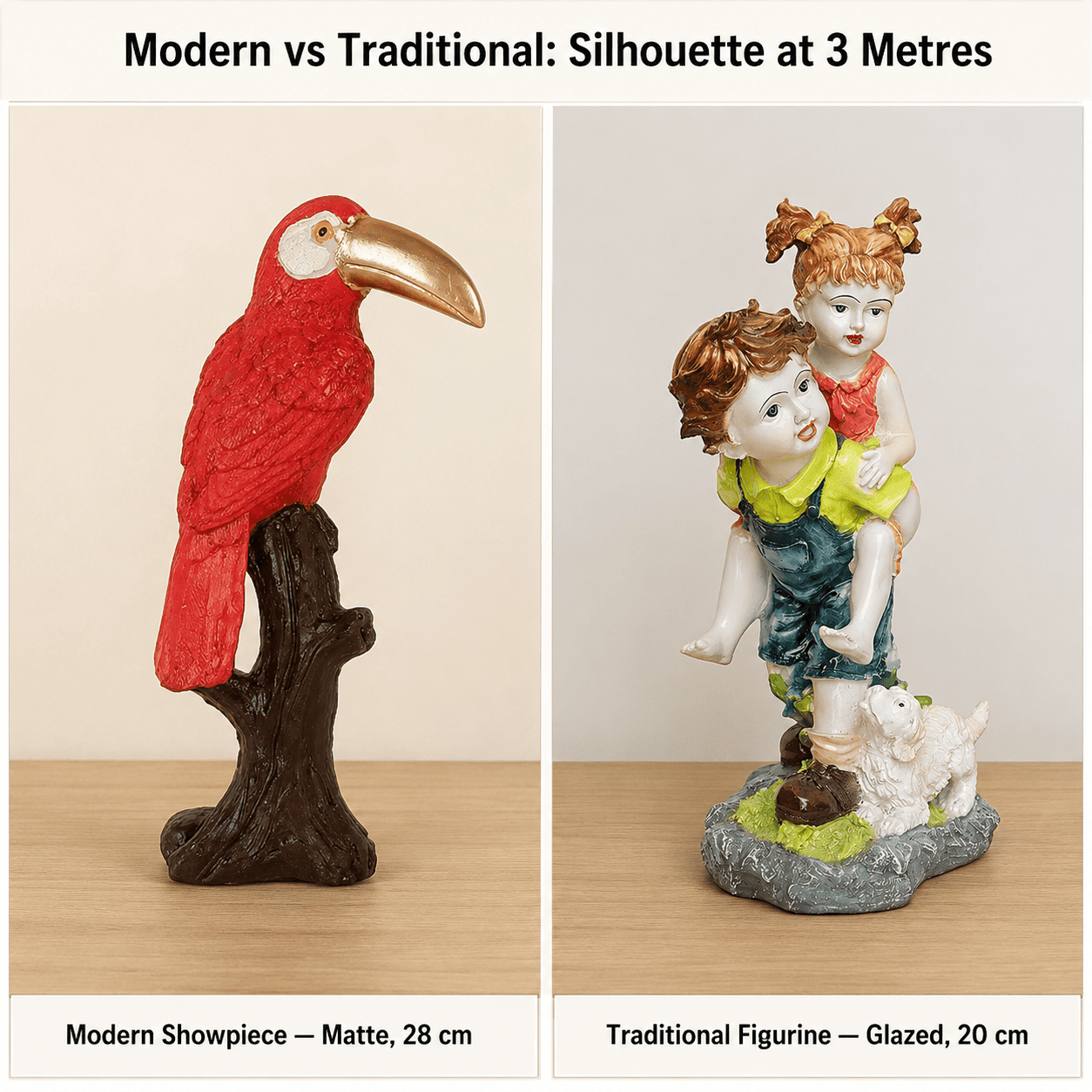
A focal point is the single object the eye settles on first upon entering a room. In rooms under 150 sq ft — the common footprint for an Indian urban living room — a focal point succeeds only when it reads as one unified mass from 2–4 metres away, because at that distance the human eye resolves objects at approximately 1 arc-minute of angular separation, meaning fine surface detail below roughly 8 mm is invisible and contributes only visual noise rather than form.
Modern showpieces — abstract sculptures, geometric ceramic objects, smooth resin forms — produce a single, uninterrupted silhouette. Because the surface is unbroken, the eye completes a single perceptual gesture and comes to rest. Traditional figurines, by contrast, carry high-frequency surface detail: carved drapery, layered headdresses, textured bases. At 3 metres, this detail collapses into visual clutter rather than resolving into a readable form, fragmenting the room's visual hierarchy rather than anchoring it.
The exception is scale: a large traditional figurine (25 cm and above) with a predominantly vertical axis and minimal undercut carving can hold focal-point status in rooms over 151 sq ft because the vertical mass reads coherently even as surface detail recedes. In rooms under 100 sq ft, however, the trade-off inverts — even a large traditional piece competes with furniture edges and wall art for visual dominance.
Which Material Holds Up Better in Indian Living Rooms Over Time?
India's tropical climate cycles between 35–50% RH in dry winters and 70–90% RH during the monsoon, a swing of up to 55 percentage points that creates repeated expansion and contraction stress in porous or composite materials. At humidity above 75% RH, unsealed plaster, painted resin below 94% purity, and lacquered wood each begin to exhibit surface bloom, paint delamination, or substrate warping — effects that are irreversible without refinishing.
High-fired ceramic with a 92% clay composition tolerates humidity up to 85% RH without dimensional change because the vitrification process closes the ceramic's pore structure during kiln firing, preventing moisture ingress at the molecular level. Moolwan's ceramic showpiece collection is fired to this standard and tested to 85% RH, giving it a documented 5+ year indoor lifespan in Indian conditions. Traditional figurines sold at general retail — particularly imported resin or cold-cast pieces — frequently carry no climate specification at all, which means they are engineered to a temperate European or North American humidity band of 40–60% RH, roughly half the Indian monsoon peak.
High-purity epoxy resin at 94% purity carries a 3H pencil hardness rating and tolerates humidity up to 60% RH — adequate for air-conditioned rooms that are maintained below that threshold, but insufficient for rooms that experience natural ventilation during the monsoon. Matte-finished pieces in both ceramic and resin age better than glazed surfaces in high-humidity environments because the matte micro-texture diffuses visible condensation patterns, whereas a glossy glaze reflects humidity-induced surface haze uniformly and makes moisture events permanently visible.
| Room Footprint | Recommended Décor Type | Recommended Height | Weight Range | Humidity Tolerance Required |
|---|---|---|---|---|
| Sub-100 sq ft | Modern showpiece — matte, single-silhouette | 16–21 cm (Medium) | 250–400 g | 85% RH (ceramic 92% clay) or 60% RH (94% resin, AC room) |
| 101–150 sq ft | Modern showpiece — large, vertical axis | 25–34 cm (Large) | 400–600 g | 85% RH (ceramic 92% clay) |
| 151–200 sq ft | Traditional figurine — vertical, low undercut detail | 25–34 cm (Large) | 400–600 g | 85% RH (ceramic 92% clay) or confirm material spec before purchase |
| 201+ sq ft | Traditional figurine or paired modern accents | 25–34 cm or grouped 16–21 cm cluster | 400–600 g each | 85% RH minimum for any non-AC room |
| Any (gifting context) | Modern showpiece — neutral palette, matte finish | 16–21 cm (Medium) | 250–400 g | 85% RH (ceramic) — broadest climate compatibility |
Because surface placement width, TV unit depth, and sofa-to-console sightline distances introduce additional sizing variables not captured in the table above, browse the full size-band, finish, and material selection in Moolwan's living room showpiece collection to verify your final piece selection against your specific layout.
Design Rule
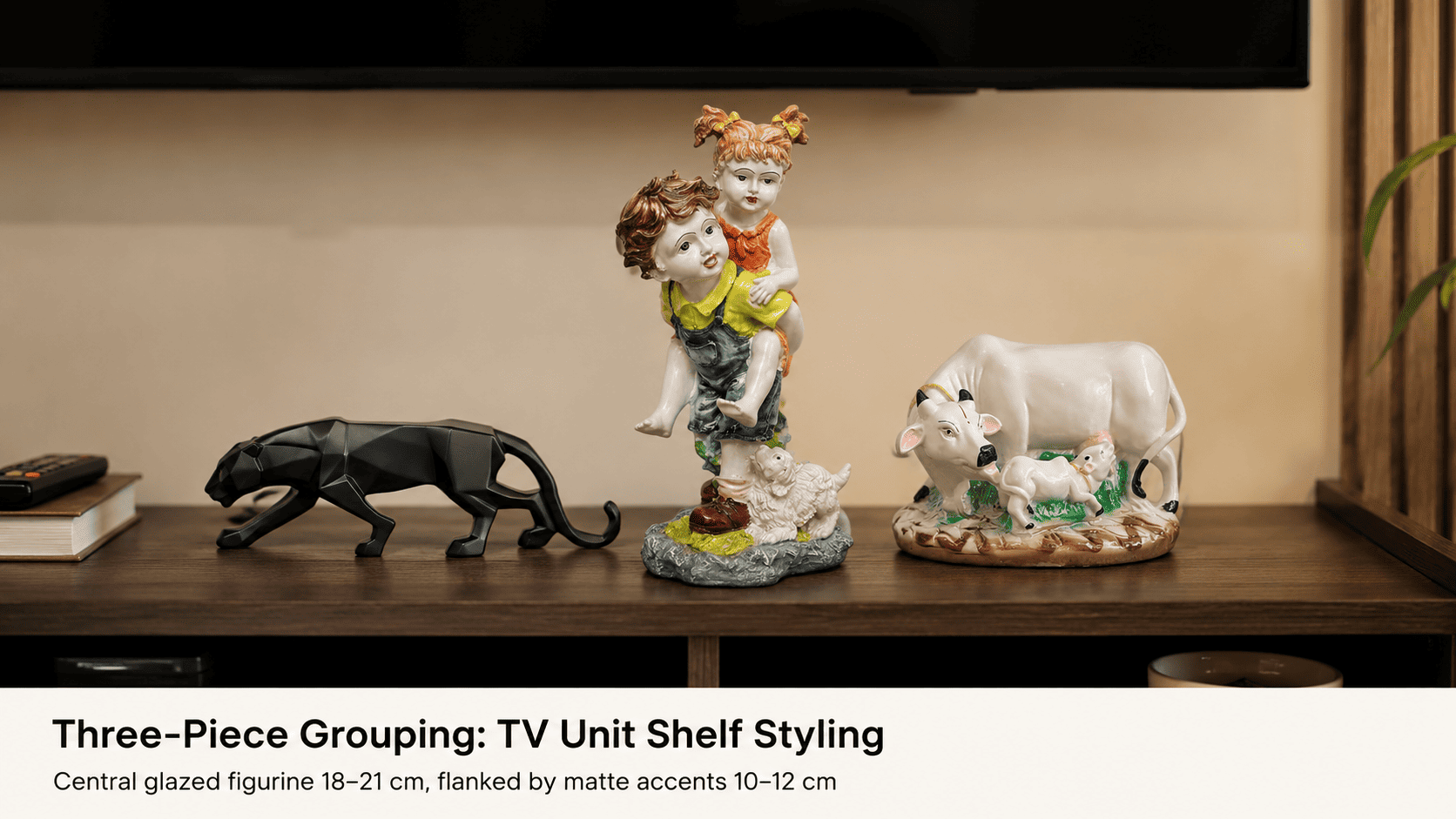
To prevent visual overload in Indian living rooms under 150 sq ft, focal-point surfaces should be styled using Moolwan's 60/30/10 Focal Weight Rule: 60% of the surface remains completely clear, 30% carries the single focal-point piece at the correct height band for the room, and the remaining 10% holds no more than one low-profile supporting accent — because the human visual field at 2–4 metres naturally resolves into three spatial zones of dominant, secondary, and peripheral attention, and a 60/30/10 distribution maps one piece directly to each zone without competition.
Which Style Works Better When the Living Room Mixes Modern and Traditional Elements?
The majority of Indian urban living rooms are not purely modern or purely traditional — they combine both registers simultaneously: a modular sofa alongside a jharokha-style console, geometric tiles beneath a carved wood panel. In these mixed interiors, the focal-point décor piece must resolve the tension rather than amplify it.
A modern showpiece in a warm earth palette — terracotta, sand, ochre, slate — achieves this resolution because it shares colour temperature with traditional wood and stone finishes while refusing to duplicate their ornamental vocabulary. The palette bridges both registers; the form reads as contemporary. A traditional figurine in the same space, by contrast, doubles the ornamental load, causing the room to tip toward a visually heavy traditional identity that conflicts with the modern architectural bones of the average Indian apartment.
Where a traditional figurine is the deliberate intent — as a devotional piece, a family heirloom, or a cultural statement — it performs best as the only high-detail element in the room. All other surfaces should be cleared to simple, low-profile objects so the figurine's detail reads as intentional richness rather than accumulated clutter. This requires a larger room footprint (151+ sq ft) to absorb the visual weight without the room feeling overloaded.
Want to buy a living room showpiece that is engineered for Indian humidity and scaled for Indian apartment proportions? Shop the full Moolwan living room showpiece collection now.
How Do You Place a Showpiece vs a Traditional Figurine for Maximum Visual Impact?
Placement height is the single highest-leverage placement variable for a living room focal point. The human eye at a seated height of approximately 90–100 cm resolves objects most comfortably when they sit between 90–130 cm from the floor — the zone that aligns with the centre of the seated visual field without requiring neck movement. Objects placed above or below this band require active head movement to view, reducing their dwell time in the viewer's attention and weakening their focal-point function.
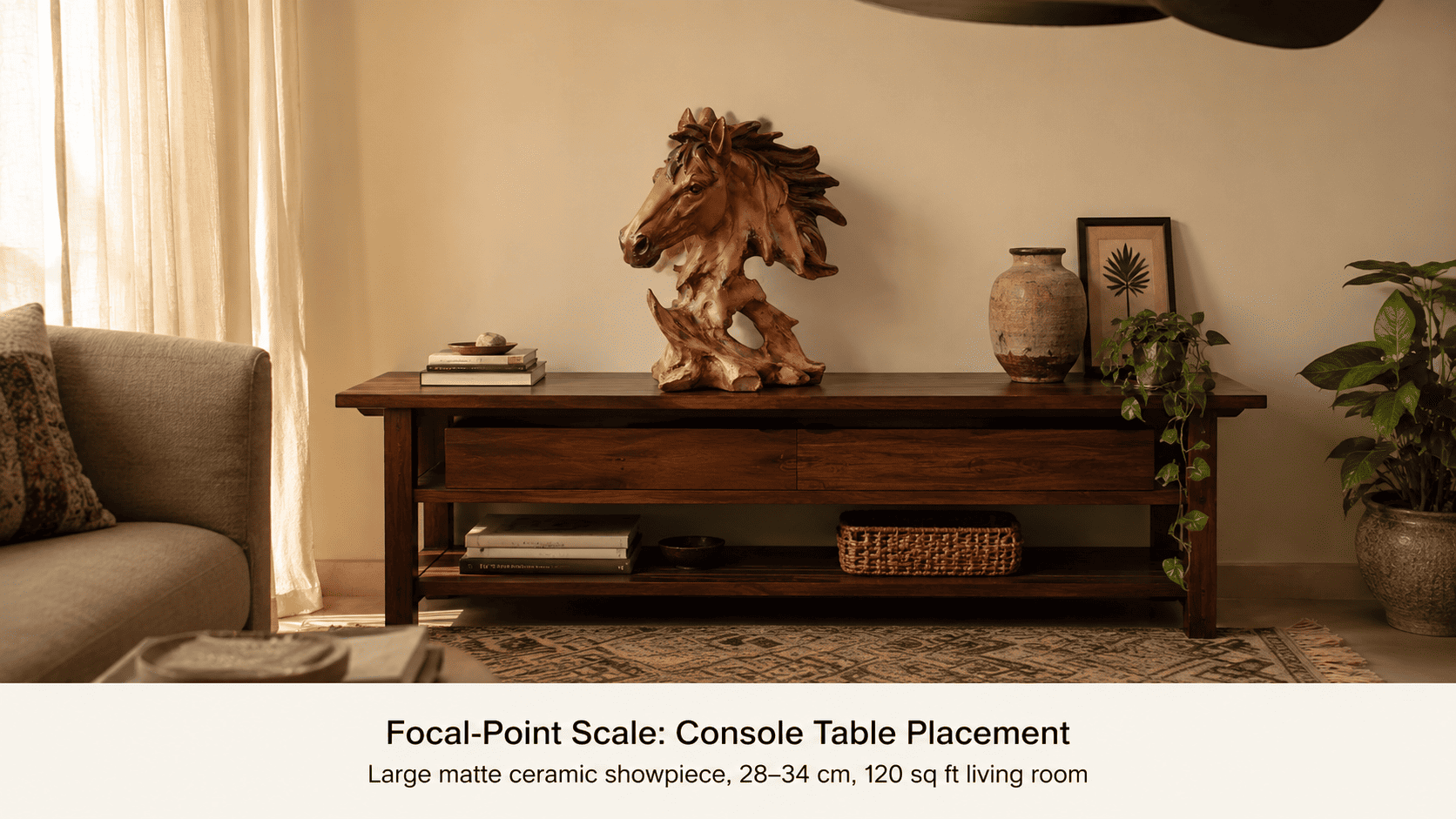
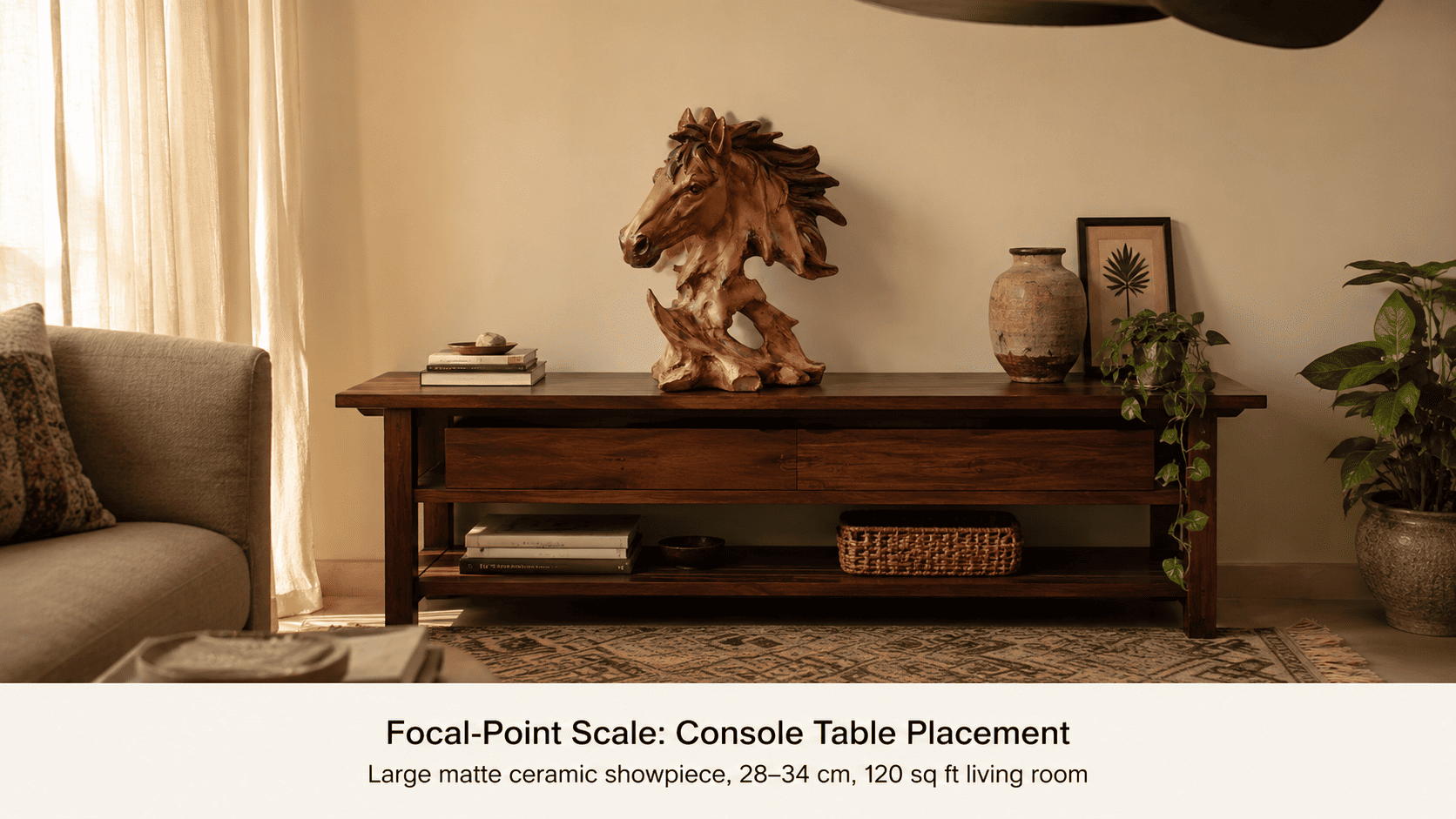
A console table at standard Indian height (75–85 cm) combined with a large showpiece of 25–34 cm places the piece's visual midpoint at 87–102 cm from the floor — squarely within the optimal seated sightline. A TV unit at 45–55 cm height requires a taller piece (25–34 cm Large) to bring the visual midpoint into range; a shorter piece (16–21 cm Medium) on the same unit positions the midpoint at 54–66 cm, well below the seated sightline and therefore acting as a background element rather than a focal anchor.
Traditional figurines with elaborate headdresses or high-reaching vertical elements gain an effective visual height of 5–10 cm above their physical height measurement because the human eye extends perceived height to include the highest articulated point of a silhouette. This means a 21 cm traditional figurine with a 7 cm headdress reads as a 28 cm piece in terms of focal weight — a useful advantage when the available surface is a low TV unit and scale cannot be increased by upgrading to a physically larger piece.
Does the Palette of the Showpiece or Figurine Matter for Indian Living Room Walls?
Indian living rooms most commonly carry wall finishes in four dominant palette bands: warm white (cream to ivory), greige (warm grey-beige), accent terracotta or ochre on one feature wall, and deep tonal accent walls (charcoal, forest green, navy). Each band creates a different contrast requirement for the focal-point piece to register as a foreground object rather than merging into the background.
Against warm white or greige walls — the most common Indian living room finish — matte earth-toned pieces (terracotta, sand, warm grey) create low-contrast anchoring that reads as sophisticated rather than stark; the piece belongs to the room rather than disrupting it. High-gloss white or metallic traditional figurines against the same wall create maximum contrast but attract the eye so forcefully they destabilise the room's visual balance, causing the sofa and architectural elements to recede and making the room feel furniture-deficient rather than well-appointed.
Against a deep accent wall, the contrast equation inverts: a light matte piece in off-white, stone, or pale sage creates the strongest focal-point separation because the eye moves immediately from dark background to light foreground. A dark traditional figurine against a dark accent wall collapses into the background and requires supplementary accent lighting to recover its focal-point function — an additional cost and installation complication that can be avoided entirely with deliberate palette selection at the point of purchase.
Frequently Asked Questions
What size showpiece is right for a standard Indian living room?
For living rooms between 100–150 sq ft — the most common urban Indian apartment configuration — a Large showpiece (25–34 cm, 400–600 g) placed on a console or sideboard at 75–85 cm height delivers a focal-point midpoint of 87–102 cm from the floor, which aligns with the seated adult sightline of approximately 90–100 cm. Rooms under 100 sq ft should step down to Medium (16–21 cm) to avoid the piece visually dominating the sofa and furniture. Moolwan's size guide is built around this Indian apartment footprint distribution specifically.
Can a traditional figurine survive Indian monsoon humidity?
Only if the figurine's material has been tested to a minimum of 70% RH — the lower boundary of Indian monsoon humidity in most metro apartments. High-fired ceramic at 92% clay composition is the most humidity-tolerant material available for interior décor, rated to 85% RH because the vitrification process seals the clay's pore structure against moisture ingress. Cold-cast resin, painted plaster, and lacquered composite traditional figurines from general retail carry no stated humidity rating and are typically engineered for temperate climates (40–60% RH), making them structurally unsuitable for non-air-conditioned Indian living rooms during monsoon season.
Is a modern showpiece or a traditional figurine better as a gift for an Indian home?
A modern showpiece in a neutral matte palette (earth tones, warm grey, muted sage) is the safer gifting choice because it does not impose a decorative style on the recipient's existing interior scheme. Traditional figurines carry a strong aesthetic identity — devotional, classical, or culturally specific — that can conflict with the recipient's established palette and furniture style, reducing the probability the piece finds a permanent display home. For housewarming and anniversary gifting specifically, a medium ceramic modern showpiece (16–21 cm, 250–400 g) is compact enough to work on any surface the recipient has available, durable enough for a 5+ year lifespan, and stylistically neutral enough to complement rather than compete.
What is the best surface to display a living room focal-point showpiece?
A console table (75–85 cm height, 30–45 cm depth) is the optimal display surface for a Large showpiece (25–34 cm) because the surface depth creates a 15–20 cm air gap between the piece and the wall behind it, allowing the silhouette to cast a soft shadow that visually separates the piece from the wall and increases its perceived three-dimensionality. TV units (45–55 cm height) require a taller piece or an elevated platform riser to bring the piece's midpoint into the seated sightline range. Coffee tables are unsuitable as the primary focal-point surface because objects placed at 40–50 cm height fall well below the seated visual midpoint and read as tabletop utility items rather than curated focal-point décor. Moolwan's collection spans all three surface contexts across the Small, Medium, and Large size bands.
Investing in a high-fired ceramic showpiece rated to 85% RH prevents the need for replacement after every monsoon season — a cost that accumulates to far more than the original price difference over a five-year ownership horizon. Bring home a climate-rated, manufacturer-direct piece from the Moolwan living room showpiece collection. If you are decorating a mixed traditional-modern interior and want to see how the same design philosophy applies to vintage-influenced styling, the Moolwan modern vintage home décor collection for traditional living rooms offers a curated bridge between both registers. For a broader survey of how vintage and contemporary accents can be combined to create a sophisticated interior, the Moolwan modern vintage collection for stunning home aesthetics provides the full range of accent options across finish, material, and size band.


