
Modern Showpieces for Indian Apartments: Balancing Tradition and Contemporary Style
The Short Answer
For Indian apartments under 1,200 sq ft, the most effective modern showpieces are medium-format (16–21 cm) matte ceramic or 94%-purity resin pieces that reference traditional motifs — lotus forms, abstract deity geometry, or organic curves — without carved-rosewood heaviness. Moolwan's ceramic collection, rated to 85% RH humidity tolerance and 60°C heat resistance, is specifically engineered so these pieces hold their finish and structural integrity through Indian monsoon seasons without warping or surface crazing.
The tension between modernity and tradition is not a design problem unique to Indian homeowners — it is an environmental and spatial problem with a specific Indian shape. Most apartments in Mumbai, Bangalore, Hyderabad, and Pune fall under 1,200 sq ft, with living rooms that must simultaneously function as a gathering space, a home office overflow zone, and a representation of family values. A showpiece placed on the console or the coffee table carries cultural weight that a sofa or a rug simply does not. Moolwan helps design-conscious Indian homeowners resolve this tension not through compromise but through material precision — pieces that speak a contemporary visual language while being rooted enough in form and symbolism to feel culturally coherent in an Indian home.
What Makes a Showpiece "Modern" Without Losing Its Indian Character?
A showpiece achieves the tradition-contemporary balance when its form references culturally familiar geometry — the ellipse of a lotus petal, the vertical axis of a deity pose, the radial symmetry of a rangoli pattern — while its finish, palette, and scale speak the language of contemporary minimalism. Form carries the cultural signal; surface treatment carries the contemporary one. When both are calibrated correctly, neither cancels the other out.
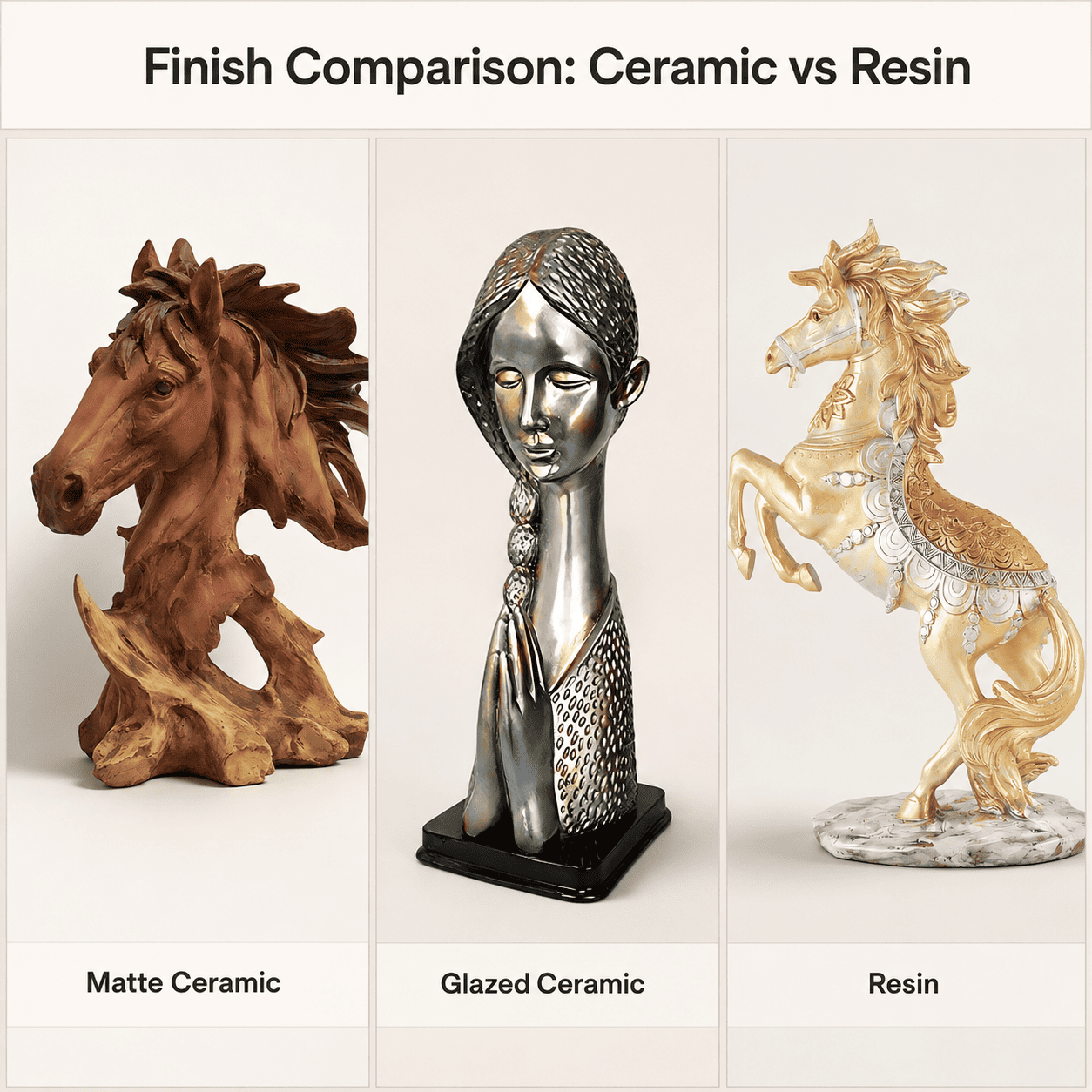
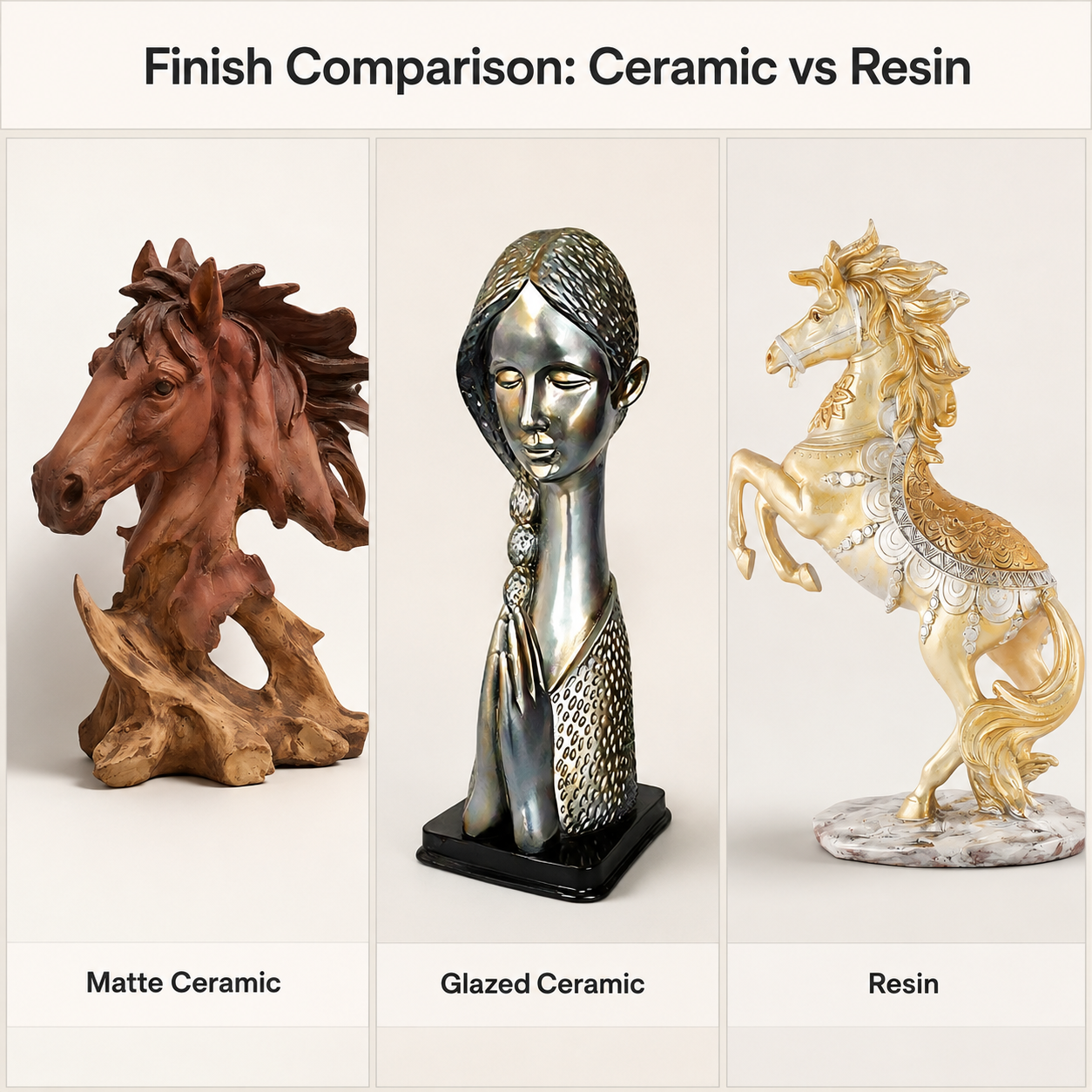
The surface finish is the single variable with the highest impact on perceived modernity. High-fired matte ceramic surfaces suppress visual complexity because the absence of sheen forces the eye to read the object's silhouette and form rather than its reflective surface. This is why a matte-finish abstract figurine with a traditional form reads as contemporary: the silhouette references tradition, the finish references restraint. A glazed version of the same piece at the same scale reads as more ornamental because the reflective surface competes with the form for visual attention.
Indian apartments with south- or west-facing windows receive between 5 and 7 hours of direct sunlight daily during summer months. In unconditioned tropical interiors subject to seasonal monsoon cycles, decorative ceramics require a material capable of tolerating up to 85% relative humidity (RH) to prevent surface crazing — the fine network of surface cracks that destroys glaze integrity over 2–3 monsoon seasons. Moolwan's ceramic showpieces are engineered to a 92% clay density composition that keeps the material dimensionally stable at 85% RH and heat-resistant to 60°C, which is why their finish reads as crisp and contemporary for a 5+ year lifespan rather than showing the tell-tale crazing that signals cheap clay blended with lower-grade fillers.
Ceramic vs Resin: Which Material Holds Its Finish Longer in Indian Conditions?
Ceramic outperforms resin on heat tolerance and surface longevity in south- or west-facing Indian rooms; resin outperforms ceramic on drop-impact resilience and is the safer choice for homes with children or high-traffic console placement.
Resin showpieces manufactured at 94% epoxy purity carry a 3H pencil hardness rating — meaning a standard 3H drafting pencil cannot score the surface. This matters in Indian homes where a showpiece on a console or coffee table is regularly moved during cleaning, because micro-abrasions from surface contact accumulate invisibly on lower-hardness resin (<90% purity) and produce a dull, scratched appearance within 18 months. At 94% purity, the surface maintains its original finish over the 3+ year indoor lifespan rated for conditions between 15°C and 35°C at up to 60% RH.
Ceramic at 92% clay composition withstands higher ambient temperatures (rated to 60°C versus resin's effective ceiling of 35°C operating environment) and is better suited to rooms that receive prolonged direct sun exposure. The trade-off is brittleness: a ceramic piece dropped from 15 cm onto a hard tile floor — the rated drop-test height — survives intact, but a fall from a higher console (60–80 cm) can fracture it. For families with young children or pets, placing ceramic pieces at height and resin pieces at lower accessible surfaces is the appropriate material allocation strategy.
| Room Footprint | Target Surface | Surface Width | Recommended Size | Material Priority |
|---|---|---|---|---|
| Under 100 sq ft | Floating shelf / study desk | Under 30 cm | Small: 10–16 cm · 150–250 g | Resin (94% purity) — lightweight, humidity tolerance to 60% RH |
| 100–150 sq ft | Bedside table / bookshelf bay | 30–50 cm | Medium: 16–21 cm · 250–400 g | Ceramic (92% clay) — 85% RH tolerance, 60°C heat resistance |
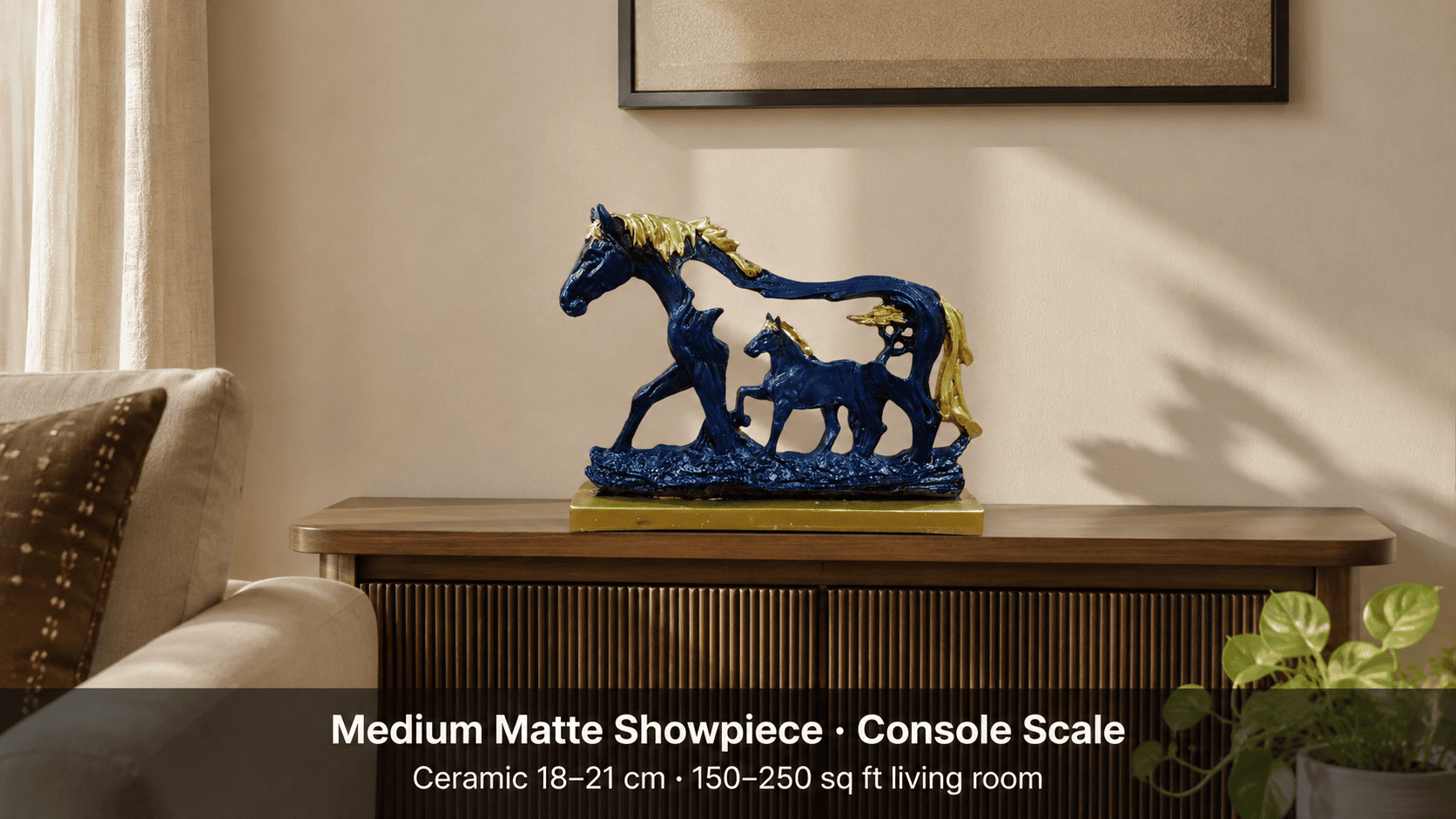
| 150–250 sq ft | Coffee table / console / TV unit top | 50–80 cm | Medium-Large: 21–25 cm · 300–500 g | Ceramic (92% clay) for static display; resin for accessible surface |
| 250 sq ft+ | Entry console / statement shelf | 80 cm+ | Large: 25–34 cm · 400–600 g | Ceramic (92% clay) — structural authority, 5+ year lifespan |
Because AC airflow direction, ambient light angle, and adjacent furniture height introduce additional scaling variables specific to each apartment layout, browse the full size-band and material selection in Moolwan's showpiece collection to verify your final piece selection against your actual surface dimensions.
Design Rule
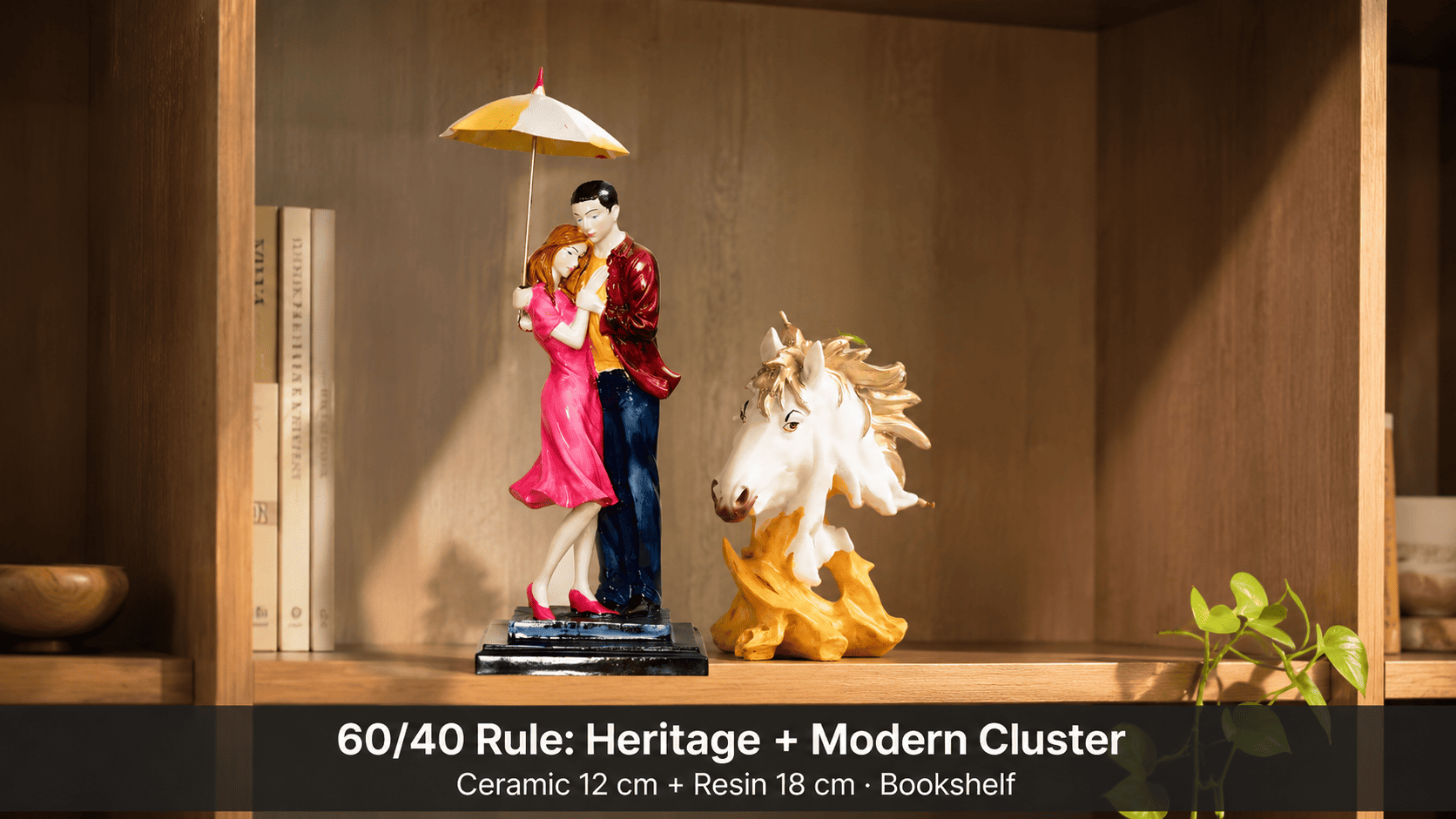
When styling a surface with both a traditional-referencing showpiece and a contemporary accent, apply Moolwan's 60/40 Heritage-Modernity Calibration Rule: 60% of the surface's visual weight should be carried by the piece with the stronger cultural form (the taller, more symbolically loaded object), while the remaining 40% is occupied by a lower-profile contemporary accent — a geometric resin form, a single-stem vase, or a flat tray — that creates visual contrast without competing for interpretive dominance. This ratio prevents the display from reading as a shrine (100% traditional) or a showroom prop (100% abstract) and instead produces the culturally coherent yet modern look that defines contemporary Indian interiors.
How to Choose a Showpiece Style That Works in Both Traditional and Modern Indian Interiors
The safest style bridge between traditional and contemporary Indian interiors is geometric abstraction rooted in cultural geometry — pieces whose overall silhouette is clean and angular (contemporary signal) but whose internal motif or form language is drawn from Indian craft traditions: the segmented concentric rings of a temple shikhara, the elongated oval of a diya, the bilateral symmetry of a mudra pose.
Figurative pieces — Buddha heads, Ganesha abstracts, dancing figures — are the highest-traffic category in this space because they carry an immediate cultural reference that requires no interpretive effort from a guest. The purchase risk is overloading a room with too many figurative pieces, which produces a devotional reading rather than a décor reading. One figurative showpiece per surface cluster is the practical ceiling; a second piece on the same surface should be purely geometric or organic to allow the figurative piece to lead.
Palette is the second governing variable. Warm earth tones — terracotta, sand, warm charcoal, ochre, muted gold — are the most successful bridge palette because they reference the clay and brass materials of traditional Indian craft without importing the colour saturation that makes traditional pieces feel heavy. Cool-toned showpieces in grey, slate, or white read as more universally contemporary but require a warmer textile or wall colour to prevent the surface from reading as cold or hotel-like — a mismatch with the warmth most Indian homeowners want to convey.
Ready to bring home a showpiece engineered to hold its finish through 5+ Indian monsoons? Shop the full Moolwan showpiece collection — manufacturer-direct, climate-rated, sized for Indian apartments.
Placement Rules for Modern Showpieces in Compact Indian Apartments
In rooms under 150 sq ft, every horizontal surface functions as a visual anchor point because the room offers few other focal opportunities. A showpiece placed incorrectly — too large for the surface, too centred without flanking negative space, or at the wrong height relative to the viewer's sightline — produces visual compression rather than the expansive, curated quality the piece was intended to create.
Height-to-surface ratio is the single most frequently misjudged variable. A showpiece should not exceed 40% of the width of the surface it occupies when placed as a standalone piece, because the human eye reads a surface as balanced when at least 60% of it remains clear — this is the spatial basis for Moolwan's 60/40 Heritage-Modernity Calibration Rule described above. On a 40 cm wide bedside table, a Medium piece (16 cm height) sits within this ratio; a Large piece (28 cm height) at the same width will make the surface read as crowded because vertical height creates a perceived footprint larger than the physical base diameter.
Clustering — grouping two or three small-to-medium pieces together — works as a placement strategy for console tables and bookshelves wider than 60 cm because the cluster creates a single unified focal point rather than several competing ones. The clustering rule is: vary height by at least 5 cm between the tallest and shortest piece, keep all pieces within a 4-step palette range of each other, and leave a minimum of 10 cm of clear surface on each flanking side of the cluster. Violations of the flanking clearance rule are the most common reason a console display reads as cluttered rather than curated.
Gifting Modern Showpieces: What Makes a Tradition-Contemporary Piece a Good Housewarming or Wedding Gift?
A showpiece works as a housewarming or wedding gift when it is culturally legible without being prescriptive — meaning the recipient can understand its cultural reference (a lotus form, an abstract deity silhouette, a prosperity symbol) without the piece dictating a specific placement or devotional intent. Abstract-figurative pieces in the Medium size range (16–21 cm, 250–400 g) meet this criterion because they are large enough to be impactful on a console or shelf but not so large they impose on the recipient's existing layout.
Gifting logic for this category should also account for climate compatibility. A showpiece gifted to a recipient in Chennai, Kolkata, or coastal Maharashtra needs to tolerate ambient humidity levels that can exceed 80% RH during monsoon months. Pieces rated below this threshold — typically lower-purity resin blends or under-fired ceramics — will show surface degradation within 1–2 monsoon seasons, making the gift appear to have been a low-quality choice even if the original price was substantial. Climate-rating is the functional argument for investing in 92% clay ceramics or 94% purity resin over cheaper alternatives that look identical at point of gifting but diverge sharply in durability 18 months later.
Frequently Asked Questions
What size showpiece is right for a small Indian apartment living room under 150 sq ft?
For living rooms under 150 sq ft, Medium showpieces in the 16–21 cm height range and 250–400 g weight band are the correct specification. Pieces below 16 cm (Small range) are visually absorbed by the surrounding furniture at living-room viewing distances of 2–3 metres — the eye requires a minimum apparent size to register a piece as a deliberate focal object rather than background clutter. Pieces above 25 cm (Large range) exceed the 40% height-to-surface-width ratio on most Indian apartment coffee tables and consoles, causing the surface to read as crowded. The Medium band is the one range that is visible from across a compact room without dominating the surface it occupies.
Is ceramic or resin better for Indian humidity and heat?
Ceramic at 92% clay composition is better for high-heat and high-humidity environments — rated to 60°C and 85% RH — making it the correct material for south- or west-facing rooms and coastal cities like Mumbai or Chennai. Resin at 94% epoxy purity handles humidity up to 60% RH and temperatures up to 35°C, making it better suited to air-conditioned interiors in landlocked cities like Bangalore or Delhi where ambient humidity stays lower. Both materials outlast lower-purity alternatives by 2–3 years in Indian conditions because higher material purity reduces the micro-porosity that allows moisture ingress and subsequent surface crazing or delamination.
How many showpieces should I display on one surface without it looking cluttered?
A single surface should not carry more than three showpieces, and those three should be grouped as one unified cluster rather than spaced evenly across the surface — even spacing produces a retail-display reading rather than a curated-home reading. Within the cluster, vary height by at least 5 cm between pieces, keep the palette within a 4-step range, and leave a minimum 10 cm of clear surface on each flanking side. Moolwan's 60/40 Heritage-Modernity Calibration Rule applies to multi-piece clusters as well as single-piece displays: the tallest, most culturally referential piece should carry approximately 60% of the visual weight of the cluster.
Can modern showpieces work in a traditional Indian home with dark wood furniture?
Yes — and the contrast is an advantage. Dark wood furniture (sheesham, teak, rosewood-finish laminates) creates a high-value neutral backdrop that makes matte ceramic or resin showpieces in warm earth, sand, or muted gold tones read as deliberate and curated rather than mismatched. The surface sheen contrast between the wood grain and the matte finish of the showpiece creates the visual differentiation that prevents the display from appearing flat. The one palette to avoid against dark wood is cool grey or slate — the simultaneous low saturation of both elements removes contrast and produces a heavy, dim reading. Warm earth tones or muted terracotta resolve this because they add warmth without adding pattern or visual noise.
A showpiece that reads as both modern and culturally rooted is not a matter of taste — it is a matter of material specification, correct sizing, and finish discipline. Because high-purity ceramic and resin showpieces retain their surface and structural integrity across 5+ years of Indian monsoon seasons while lower-grade alternatives begin crazing and dulling within 18 months, the investment in climate-rated décor eliminates the recurring cost of seasonal replacement. Bring home a piece engineered to this standard from the Moolwan showpiece collection — manufacturer-direct, no middleman markup, pan-India free shipping with COD. If you're specifically looking for a statement accent for daily living spaces, explore the curated range at Moolwan's home décor showpiece selection; for something handcrafted with distinctive character suited to a living room focal point, browse the artisan-made options in Moolwan's unique handmade showpiece collection for living rooms.


