
Modern Statue vs Decorative Vase: Which Creates a Stronger Focal Point Accent?
The Short Answer
A modern statue creates a stronger standalone focal point than a decorative vase because its three-dimensional sculptural form produces visual weight at multiple viewing angles simultaneously — a vase generates focal strength only when filled or grouped. For Indian rooms under 150 sq ft, Moolwan recommends a medium statue (25–34 cm, matte finish, 400–600 g) on a console or coffee table as the single dominant accent.
Interior designers working within compact urban layouts have consistently observed that focal point accents fail not because of poor taste but because the wrong object type is placed in the wrong spatial role. Moolwan helps design-conscious Indian homeowners resolve exactly this choice — selecting between a modern showpiece and a decorative vase — with material science and spatial logic rather than guesswork. Both are strong categories. But they perform differently depending on surface size, room footprint, available light, and whether the piece is the room's singular anchor or one element in a composed group.
What Makes a Décor Piece a True Focal Point — and Why the Object Type Matters
A focal point in interior design is the first surface the eye lands on when entering a room, determined by contrast against the surrounding plane rather than by the object's absolute size. This is why a dark matte statue against a light wall captures attention more reliably than a larger pale vase on a pale surface — the eye is drawn to luminance contrast before it registers form or scale.
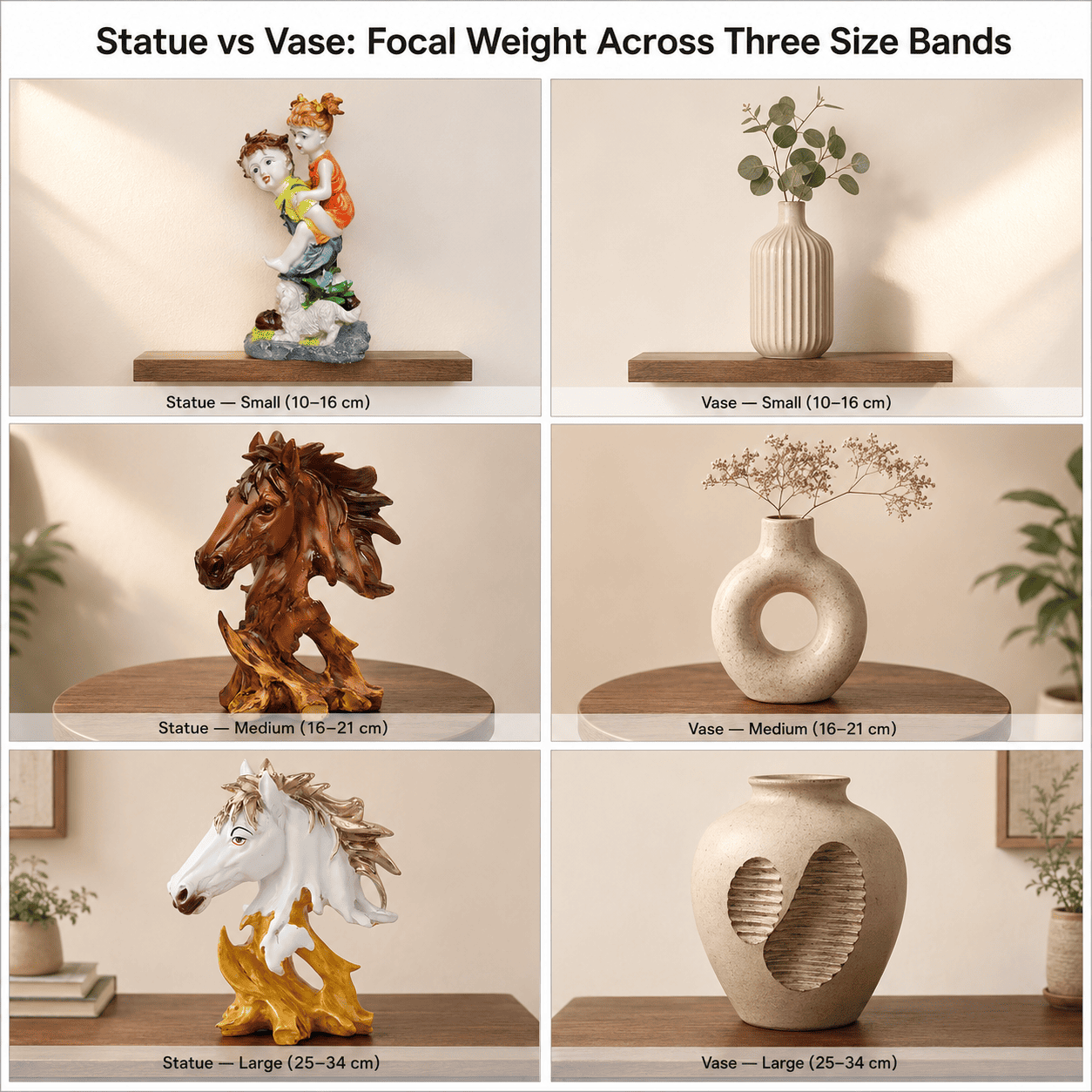
Modern statues generate focal weight through sculptural silhouette: the form reads as a distinct three-dimensional shape from every approach angle, which means the focal pull is consistent whether the viewer is seated, standing, or moving through the room. Decorative vases, by contrast, depend heavily on what is placed inside them — an empty cylindrical vase on a neutral surface has low contrast edges and reduces to a background element because its silhouette is regular and unsurprising to the eye.
In rooms under 150 sq ft — the dominant apartment size in Indian metros — this distinction carries real consequences. A compact room cannot afford a focal piece that only works from one viewing angle or only when filled, because the viewer's position relative to the object changes constantly in a small space. A sculptural showpiece with an irregular, three-dimensional form maintains its visual authority across all of those positions.
How Material and Finish Affect Focal Strength in Indian Climate Conditions
The Indian interior environment imposes specific durability requirements that directly affect which material retains its visual authority over time. Humidity in unconditioned or partially conditioned Indian rooms ranges seasonally between 60% RH and 85% RH — well above the 45–55% RH typical in temperate Western interiors for which most imported décor is engineered. At sustained humidity above 60% RH, untreated resin surfaces develop micro-surface cloudiness within 18–24 months as moisture infiltrates the outer finish layer, reducing the gloss contrast that makes the object visually sharp against a wall.
Ceramic objects engineered to 92% clay composition maintain structural integrity at up to 85% RH because the dense clay matrix has negligible porosity at the surface — moisture cannot penetrate the fired outer layer to alter the finish. This is why a high-fired matte ceramic statue retains the same surface texture and colour depth after three monsoon seasons as it had on day one, whereas a lower-purity resin vase in the same room shows visible surface degradation by year two. Moolwan's ceramic showpiece collection is formulated to this 92% clay standard, specifically because Indian climate data — not Western design assumptions — drove the material selection.
For vases, the finish also interacts with the ambient light behaviour of Indian rooms. Glazed ceramic vases in warm earth or neutral tones redirect warm-spectrum sunlight toward adjacent walls in the morning and evening hours, generating a secondary soft-diffusion effect that can enhance a room's warmth. Matte statues absorb and scatter light rather than redirect it, producing a quieter, more anchored focal presence. Neither is objectively superior — the correct choice depends on the room's light intensity and the homeowner's intent: drama or calm.
Size, Surface, and Weight: The Multi-Variable Placement Matrix
The single most common placement error in Indian home décor is choosing an object that is proportionally correct by height but wrong by surface width — producing a focal piece that looks isolated and unanchored rather than commanding. The correct sizing logic cross-references room footprint, target surface, surface width, recommended object height, and weight range simultaneously.
| Room Footprint | Target Surface | Surface Width | Recommended Accent Height | Weight Range |
|---|---|---|---|---|
| Under 100 sq ft | Floating shelf / desk | Under 30 cm | 10–16 cm (Small) | 150–250 g |
| 100–150 sq ft | Bedside table / coffee table | 40–50 cm | 16–21 cm (Medium) | 250–400 g |
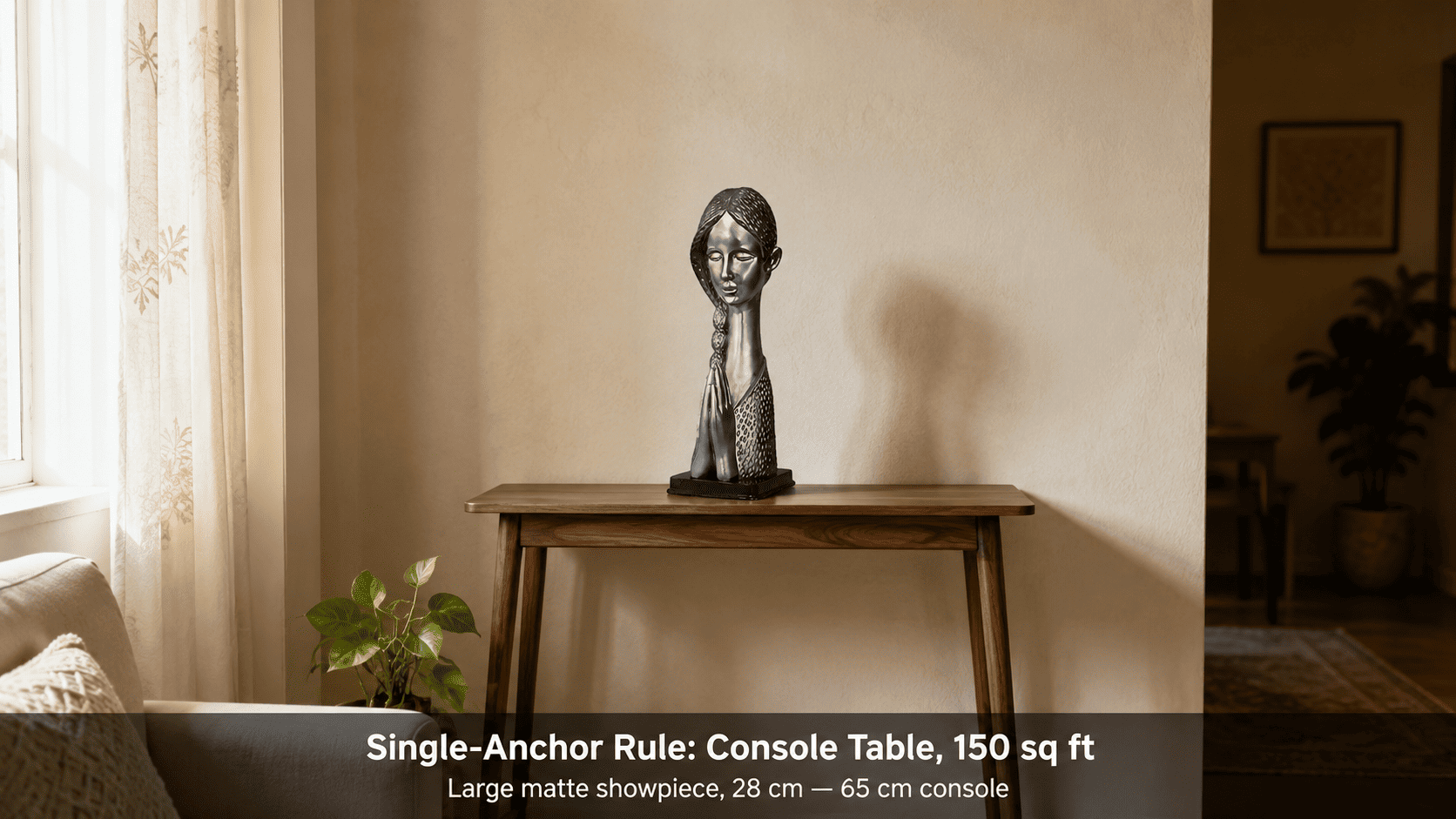
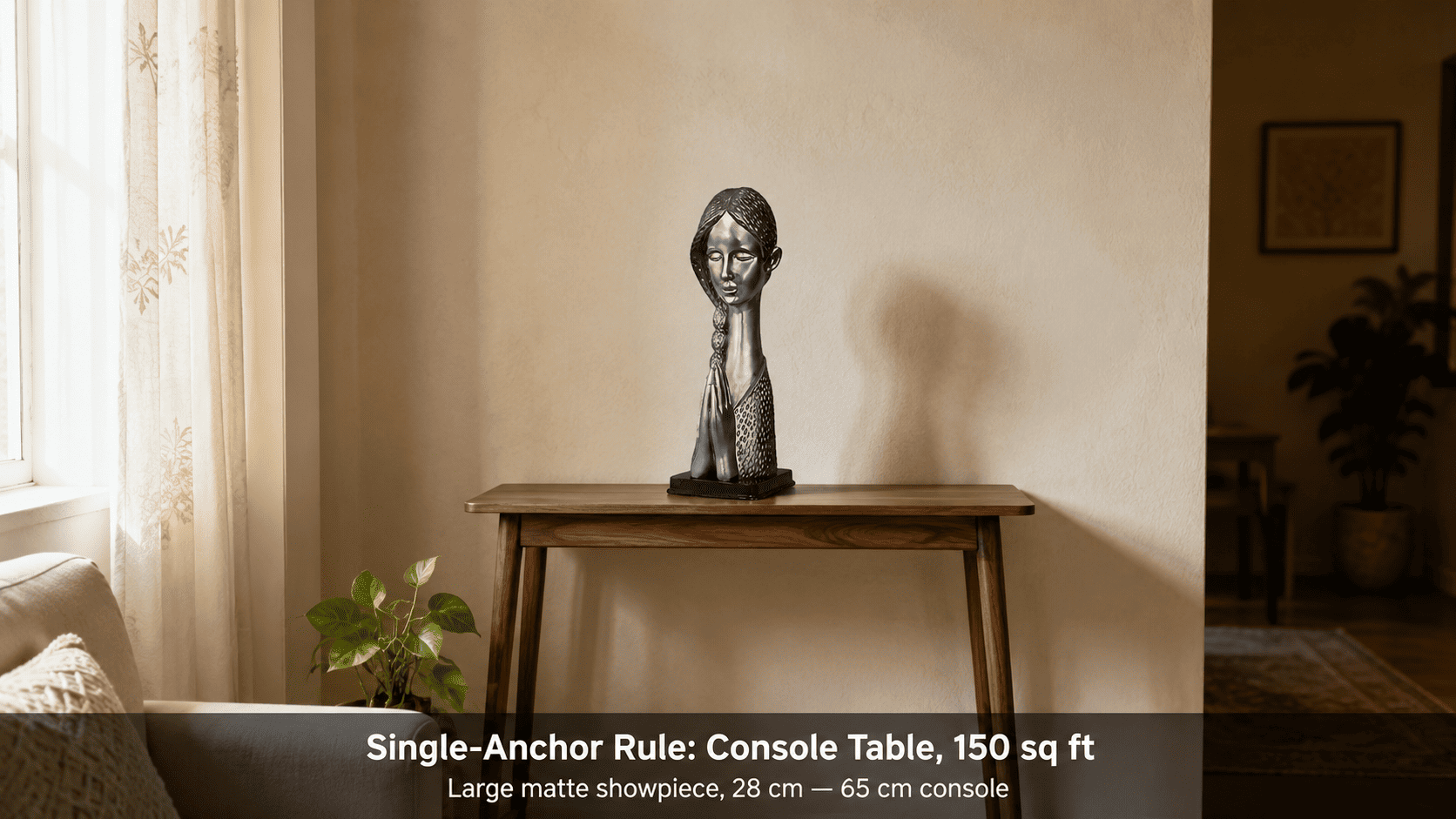
| 150–200 sq ft | Console / TV unit top | 50–70 cm | 25–34 cm (Large) | 400–600 g |
| 200+ sq ft | Entryway console / sideboard | 70 cm+ | 25–34 cm (Large) or grouped pair | 400–600 g per piece |
| Any footprint | Bookshelf bay | 25–35 cm per bay | 10–21 cm (Small–Medium) | 150–400 g |
Because surface width, room light, and existing furniture tones introduce additional placement variables beyond height and weight, browse the full size-band and material selection in Moolwan's modern statues collection to verify your specific piece selection against your room's actual dimensions.
Design Rule
To prevent visual competition between a focal accent and its surrounding objects, Moolwan's Single-Anchor Focal Rule states that any surface should have exactly one object at the dominant height band — if a statue occupies the 25–34 cm band on a console, every other object on that surface must sit within the 10–16 cm band, ensuring the eye has a single unambiguous landing point and the dominant piece retains its focal authority without spatial crowding.
When a Decorative Vase Outperforms a Statue as a Focal Point
A decorative vase becomes the stronger focal point in one specific and clearly definable scenario: when it is placed as part of a composed group on a wide surface (70 cm+) where a single statue would appear isolated and undersized. On a 90 cm dining sideboard or a wide entryway console, a tall vase (25–30 cm) flanked by two smaller complementary accents creates a triangulated visual composition — the eye travels between the three heights in a predictable arc, which is the spatial mechanism that makes grouped arrangements feel intentional rather than random.
The second scenario where a vase outperforms a statue is when the room's lighting scheme is designed around warm-toned accent lighting at table height. A glazed ceramic vase in amber or warm neutral tones placed near a low lamp becomes a light-redirecting object: the glaze surface catches the lamp's cone of light and diffuses it laterally, softening hard shadow lines on adjacent walls. This creates an atmospheric focal moment rather than a sculptural one — suitable for bedrooms and dining areas, but less effective in living rooms where overhead light is the primary source and glaze redirection produces inconsistent results depending on the angle.
Ready to bring home a focal point accent engineered for Indian surfaces and climate? Shop the full Moolwan modern statues collection — manufacturer-direct, humidity-rated to 85% RH, sized for apartments under 200 sq ft.
Grouping Rules: How to Compose a Vase and Statue Together Without Visual Noise
The most common grouping error in Indian homes is placing a medium statue and a medium vase of similar heights on the same surface, which produces visual ambiguity — the eye cannot determine which object is the focal anchor and which is the supporting element. This happens because objects of the same height band compete for the same visual register, and the brain defaults to treating the group as clutter rather than composition.
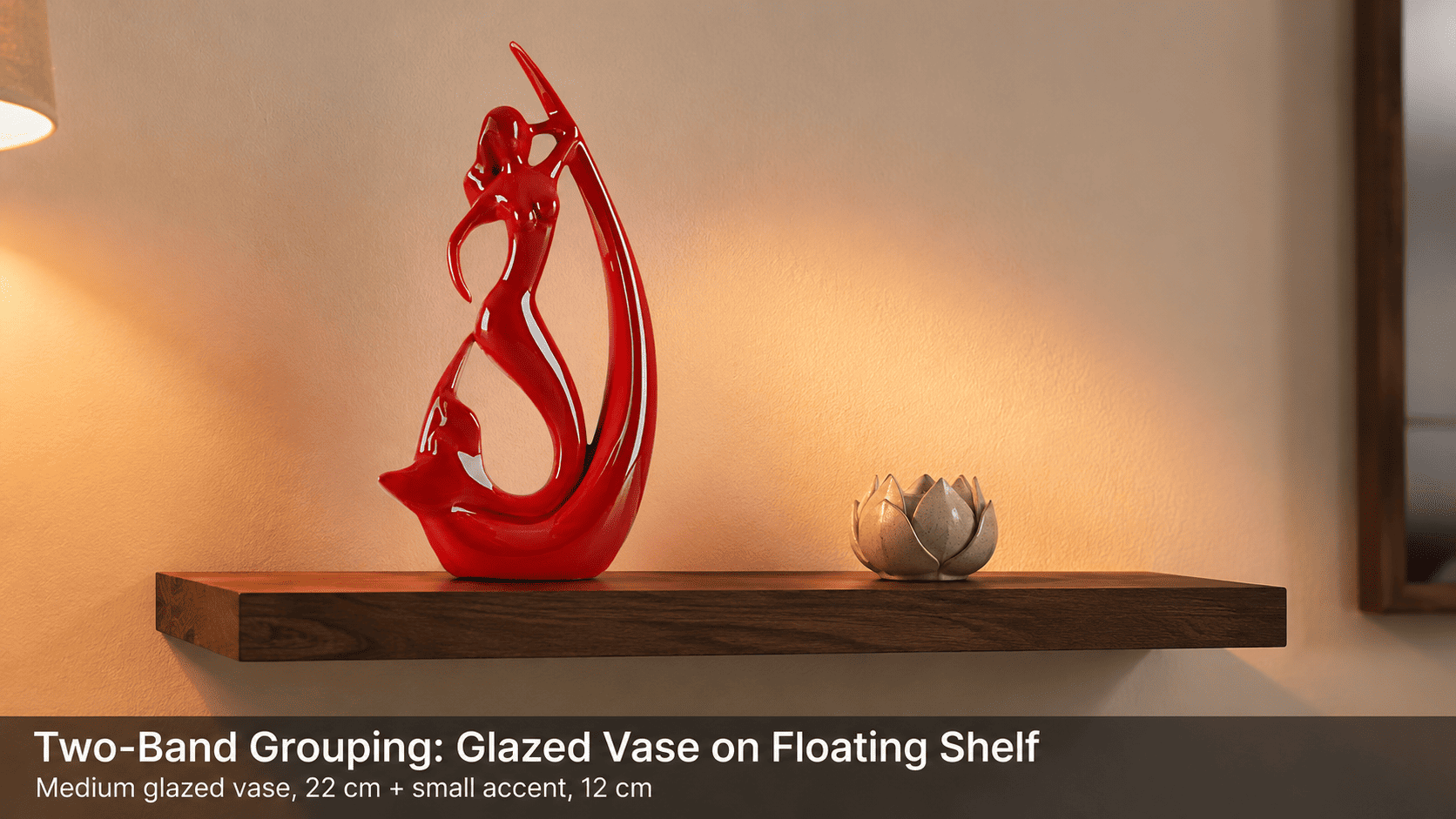
The correct grouping logic relies on a two-band height differential: the dominant piece (statue or vase, whichever is the intended focal anchor) must be at least 8–10 cm taller than every other piece on the same surface. At an 8 cm differential, the eye registers a clear hierarchy in peripheral vision before the viewer consciously focuses on the group — this is why the composition reads as intentional immediately rather than requiring the viewer to work to understand it. A 28 cm statue paired with a 16–18 cm vase and a 12 cm small decorative accent produces this three-tier hierarchy cleanly on a 60–70 cm surface.
Palette and Finish Matching: Choosing Between Warm Earth, Neutral, and High-Contrast Tones
Indian interior palettes cluster into three dominant wall-tone families: warm white or cream (the most common in post-2015 Indian apartment construction), greige or cool taupe (increasingly common in newer developments), and deep accent walls in charcoal, navy, or forest green (used in one feature wall in approximately 30–35% of design-forward Indian homes). Each wall-tone family responds differently to the finish and palette of a focal accent.
Against warm white walls, matte earth-toned accents — terracotta, warm sand, ochre, deep walnut — produce the highest contrast differential because the accent is both darker and warmer in tone than the wall, engaging two simultaneous contrast axes (luminance and temperature). Glazed accents in the same palette produce lower focal contrast against warm white because the glaze reflects the wall's warm undertone back at the viewer, reducing the perceived colour separation.
Against greige walls, both matte and glazed finishes in warm earth tones remain effective, but a single high-contrast dark showpiece — matte charcoal, deep teal, or matte black — in the 25–34 cm range creates a sharper, more contemporary focal moment because the colour gap between accent and wall is at its maximum. This is the scenario where a dark matte ceramic modern statue in the large size-band delivers its highest return on investment: one piece, one surface, one focal moment that resets the perceived sophistication of the entire room without renovation.
Frequently Asked Questions
Is a modern statue or a decorative vase better for a small Indian living room under 120 sq ft?
For rooms under 120 sq ft, a medium modern showpiece in the 16–21 cm range is the stronger focal point because its three-dimensional form produces visual weight from multiple viewing angles simultaneously — critical in compact rooms where the viewer's position relative to the object changes constantly. A vase of the same height reads as background in a small room unless it is filled and grouped, adding compositional complexity that can overwhelm a tight surface. Moolwan's medium ceramic showpiece range (16–21 cm, 250–400 g) is specifically sized for the coffee tables and bedside surfaces most common in sub-120 sq ft Indian apartments.
How do I know if a decorative vase or statue will survive Indian monsoon humidity?
The material threshold for Indian monsoon conditions is 85% relative humidity (RH) — the upper bound reached in unconditioned rooms during peak monsoon months. High-fired ceramic at 92% clay composition tolerates 85% RH without surface degradation because the dense fired matrix has negligible porosity. Resin pieces rated below 94% purity epoxy begin to show surface cloudiness at sustained exposure above 60% RH, typically within 18–24 months of placement in monsoon-affected rooms. Both ceramic statues and ceramic vases in Moolwan's collection are engineered to the 85% RH threshold, making them climate-appropriate for Indian homes year-round.
Can I use a decorative vase and a modern statue together on the same surface?
Yes, but only with a clear height hierarchy. The dominant piece must be at least 8–10 cm taller than every other piece on the same surface — this height differential is the minimum required for the eye to register a focal anchor in peripheral vision rather than reading the group as visual noise. A practical Indian living room grouping: one large statue or tall vase at 28–32 cm as the anchor, one medium piece at 18–20 cm as the secondary element, and one small decorative accent at 12–14 cm as the base note. Keep the total surface cluster within 30% of the available surface width, leaving 70% clear.
What is the correct weight range to avoid a piece feeling unstable on a surface?
For surfaces in active rooms — coffee tables, consoles near entrances, bedside tables in AC-cooled rooms where temperature fluctuation causes surface expansion and contraction — the recommended weight floor is 250 g for pieces under 21 cm and 400 g for pieces in the 25–34 cm range. Below these weights, a piece's centre of gravity is too high relative to its base footprint, making it susceptible to tipping at a 15 cm drop height. Moolwan's ceramic and resin showpieces are drop-tested to 15 cm and weigh between 150 g (small) and 600 g (large), keeping every size band within the stability range for standard Indian surface types.
Investing in a climate-rated focal accent — one engineered for 85% RH, drop-tested to 15 cm, and sized for sub-200 sq ft Indian rooms — eliminates the seasonal replacement cycle that lower-grade imported décor creates. Buy a piece that earns its surface for 5+ years: choose from the Moolwan modern statues collection, curated for Indian wall tones, surface scales, and monsoon conditions. If you are building a grouped composition, the complementary Moolwan showpiece collection offers additional medium-format accents sized for two-band height-hierarchy groupings, and the broader Moolwan modern home décor collection covers the full range of accent types — vases, sculptural objects, and statement pieces — across all three size bands and both finish families.


