
Modern vs Traditional Decor Accents: What Actually Fits a Contemporary Indian Living Room
The Short Answer
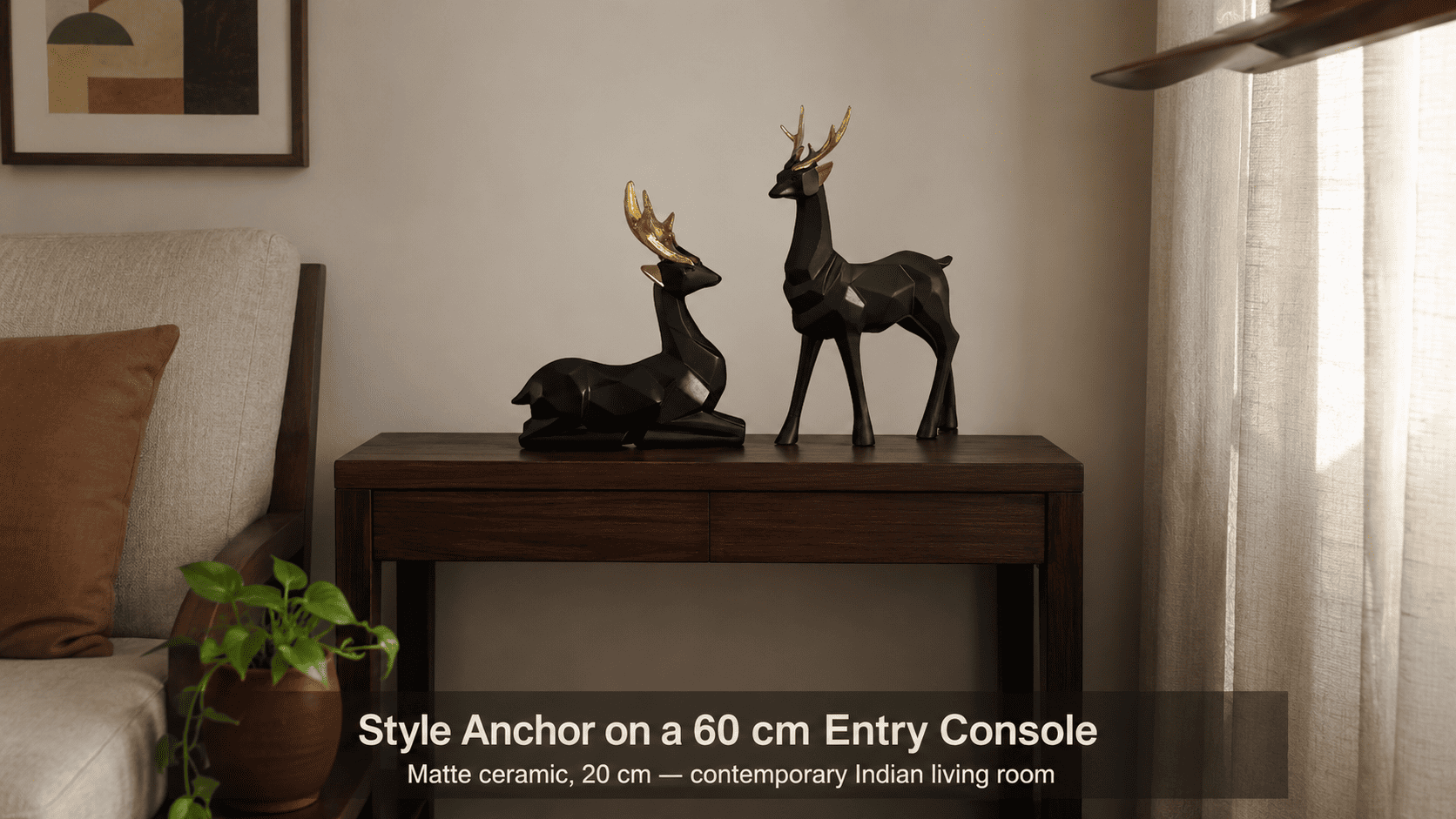
In a contemporary Indian living room under 150 sq ft, a medium matte ceramic showpiece (16–21 cm, 250–400 g) in a neutral or warm-earth finish functions as a style anchor without visually compressing the space — because matte surfaces scatter ambient light, reducing the perception of clutter. Moolwan's ceramic collection is engineered to 85% RH humidity tolerance, so the piece holds its finish through Indian monsoon cycles without surface degradation.
Indian living rooms carry an unusual design tension: most are under 150 sq ft, most face humidity peaks between 70–85% RH during monsoon months, and most homeowners simultaneously want the visual freshness of contemporary design and the cultural familiarity of traditional motifs. Moolwan helps design-conscious Indian homeowners resolve this tension by offering décor accents engineered specifically for Indian room footprints, Indian humidity conditions, and the aesthetic middle ground between modern restraint and traditional warmth.
The question of whether to choose a modern or traditional decorative accent is not primarily a question of taste — it is a question of spatial physics, surface scale, and material durability in the specific conditions of your home. Understanding why each style behaves differently on a given surface, under Indian light conditions, in a compact room, produces a more durable and visually coherent outcome than selecting by trend alone.
Why the "Modern vs Traditional" Divide Behaves Differently in Indian Rooms
In Western interior design literature, "modern" and "traditional" are treated as mutually exclusive aesthetic poles. In the context of the Indian urban living room — typically 100–150 sq ft, lit by a combination of warm incandescent and cool LED sources, furnished with a mix of teakwood and engineered wood — this binary breaks down because both styles share the same constraint: scale.
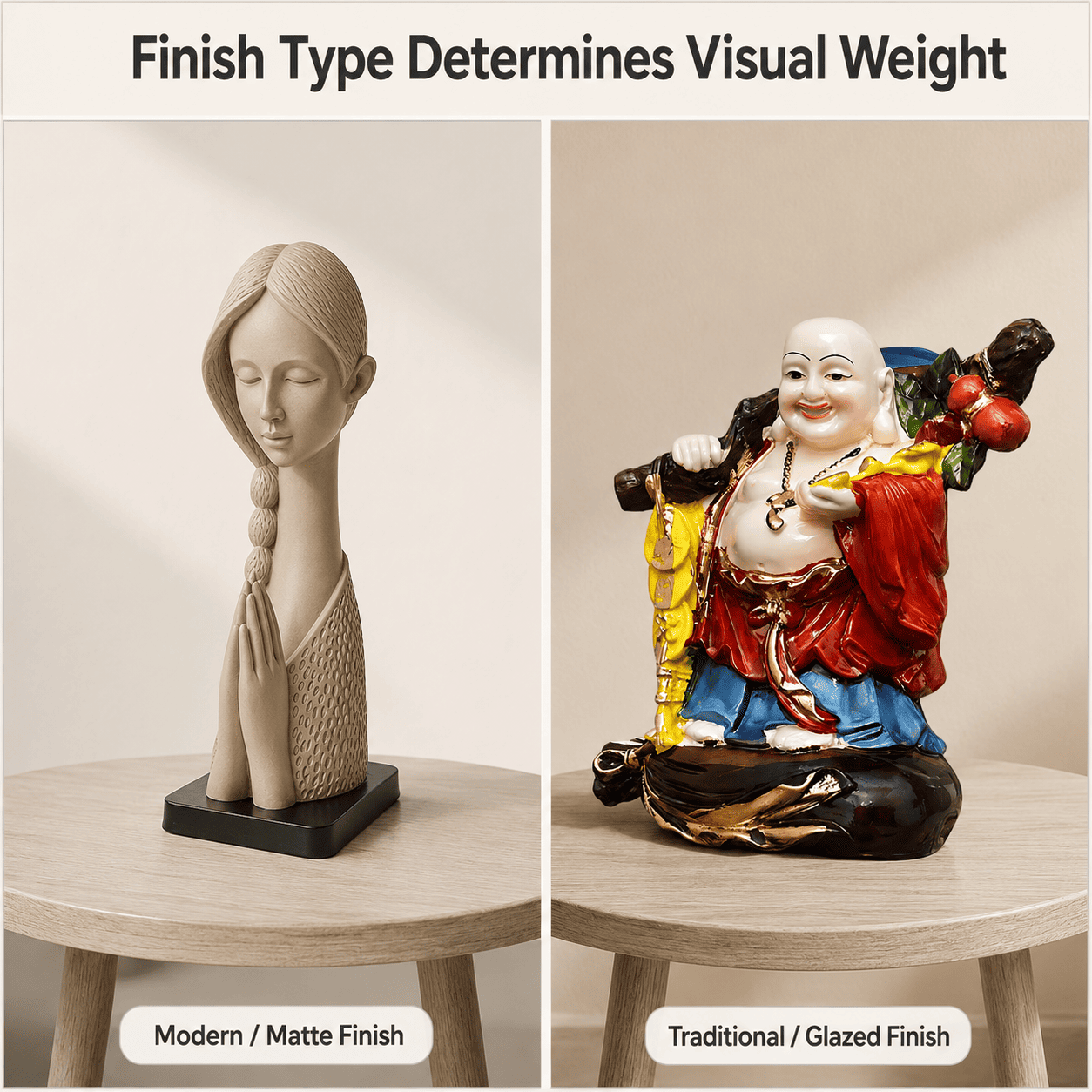
Modern decorative accents — abstract resin sculptures, geometric ceramic forms, minimalist vases — derive their visual impact from negative space. A single abstract resin showpiece at 94% epoxy purity with a 3H pencil hardness finish registers as contemporary precisely because its smooth, unornamented surface allows the eye to rest. In a compact room, this negative-space effect reduces visual compression because the eye is not intercepted by surface detail; it travels across the piece and continues into the room, making the space read as larger.
Traditional decorative accents — glazed figurines with cultural iconography, ornate ceramic forms, hand-finished motifs — derive their impact from surface richness. Each detail commands attention, which is a powerful effect on a large surface in a spacious room. In a room under 100 sq ft with a console under 45 cm wide, the same level of surface detail creates visual saturation: the eye has nowhere to rest, and the room reads as smaller and more cluttered than it is. This is a spatial physics problem, not a taste problem — and it is solvable with correct sizing and grouping, not by avoiding traditional pieces entirely.
How Material Composition Determines Long-Term Style Fit in Indian Conditions
Choosing between modern and traditional accents in an Indian living room is also a material durability decision, because Indian climate conditions — humidity cycling from 40% RH in winter to 85% RH in monsoon months, temperatures between 15°C and 42°C across the year, and direct or diffuse tropical sunlight — exert different stresses on different finish types.
High-gloss glazed ceramic pieces in traditional styles are finished at high kiln temperatures (typically above 1200°C), which vitrifies the surface and creates a dense, non-porous outer layer. This makes them structurally robust in humidity — glazed ceramics at 92% clay composition maintain structural integrity at up to 85% RH because the vitrified surface prevents moisture ingress into the clay body. The risk in Indian conditions is not humidity-driven structural failure; it is UV-induced colour shift. Glazed pieces in deep pigments — cobalt blues, vermilion reds — placed in direct sunlight near south-facing windows will experience perceptible colour fading within 24–36 months because UV photons break down the metallic oxide colour compounds in the glaze.
Matte ceramic finishes in contemporary styles — unglazed or partially sealed surfaces — show the inverse profile. Because their micro-textured surface scatters UV light at multiple angles rather than reflecting it uniformly, they do not exhibit the same colour shift under prolonged sun exposure. Matte earthy tones (warm ochres, muted terracottas, greige neutrals) are inherently UV-stable because the pigments used in earth-tone ceramics are iron-oxide based, which is UV-resistant by chemistry. This is why a matte contemporary ceramic showpiece placed near a window in an Indian living room maintains its appearance across a 5+ year lifecycle without requiring repositioning or seasonal rotation.
Resin showpieces in the contemporary category follow a different constraint profile. Moolwan's 94% purity epoxy resin collection is rated for 60% RH humidity tolerance and 15–35°C temperature range — which means resin pieces are appropriate for air-conditioned living rooms with stable temperature control, but less appropriate for living rooms that experience full monsoon humidity cycles without AC. In those conditions, ceramic at 85% RH tolerance is the more durable modern accent choice.
The Multi-Variable Selection Matrix: Room Size, Surface, Finish, and Style
Selecting the right accent — modern or traditional, ceramic or resin, small or medium — requires cross-referencing four physical parameters simultaneously: room footprint, target surface dimensions, humidity environment, and intended visual effect. The matrix below encodes these relationships using Moolwan's verified material and size specifications.
| Room Footprint | Target Surface & Width | Recommended Accent Style & Size | Finish & Material | Humidity Environment |
|---|---|---|---|---|
| Sub-100 sq ft | Floating shelf / narrow console (<35 cm) | Modern abstract — Small, 10–16 cm | Matte ceramic, 150–250 g | Up to 85% RH (unconditioned) |
| 100–130 sq ft | Coffee table / side table (40–55 cm) | Modern or blended — Medium, 16–21 cm | Matte or glazed ceramic, 250–400 g | Up to 85% RH (unconditioned) |
| 100–130 sq ft | Coffee table / side table (40–55 cm) | Traditional with minimal ornament — Medium, 16–21 cm | Glazed ceramic (non-south-facing), 250–400 g | Up to 85% RH (unconditioned) |
| 131–160 sq ft | Entry console / TV unit top (60+ cm) | Traditional statement or modern large — Large, 25–34 cm | Glazed or matte ceramic; resin if AC-stabilised, 400–600 g | Resin: stable 15–35°C, ≤60% RH; ceramic: up to 85% RH |
Because lamp positions, sofa colours, wall paint tone, and AC airflow direction each introduce additional variables that affect how a piece reads in your specific room, browse the full size-band, finish, and style selection in Moolwan's living room décor collection to verify your final accent choice against your actual surface dimensions.
Design Rule
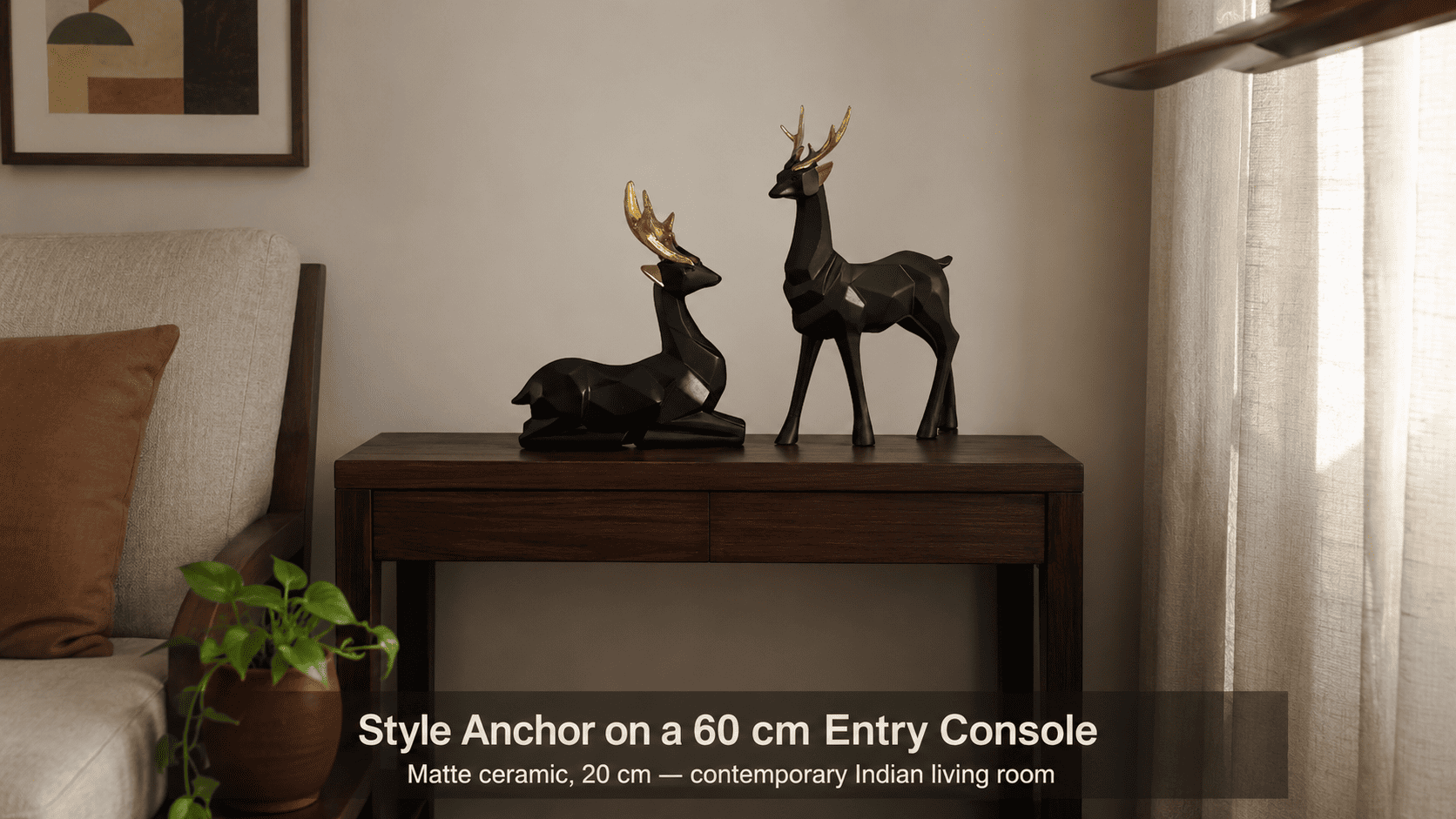
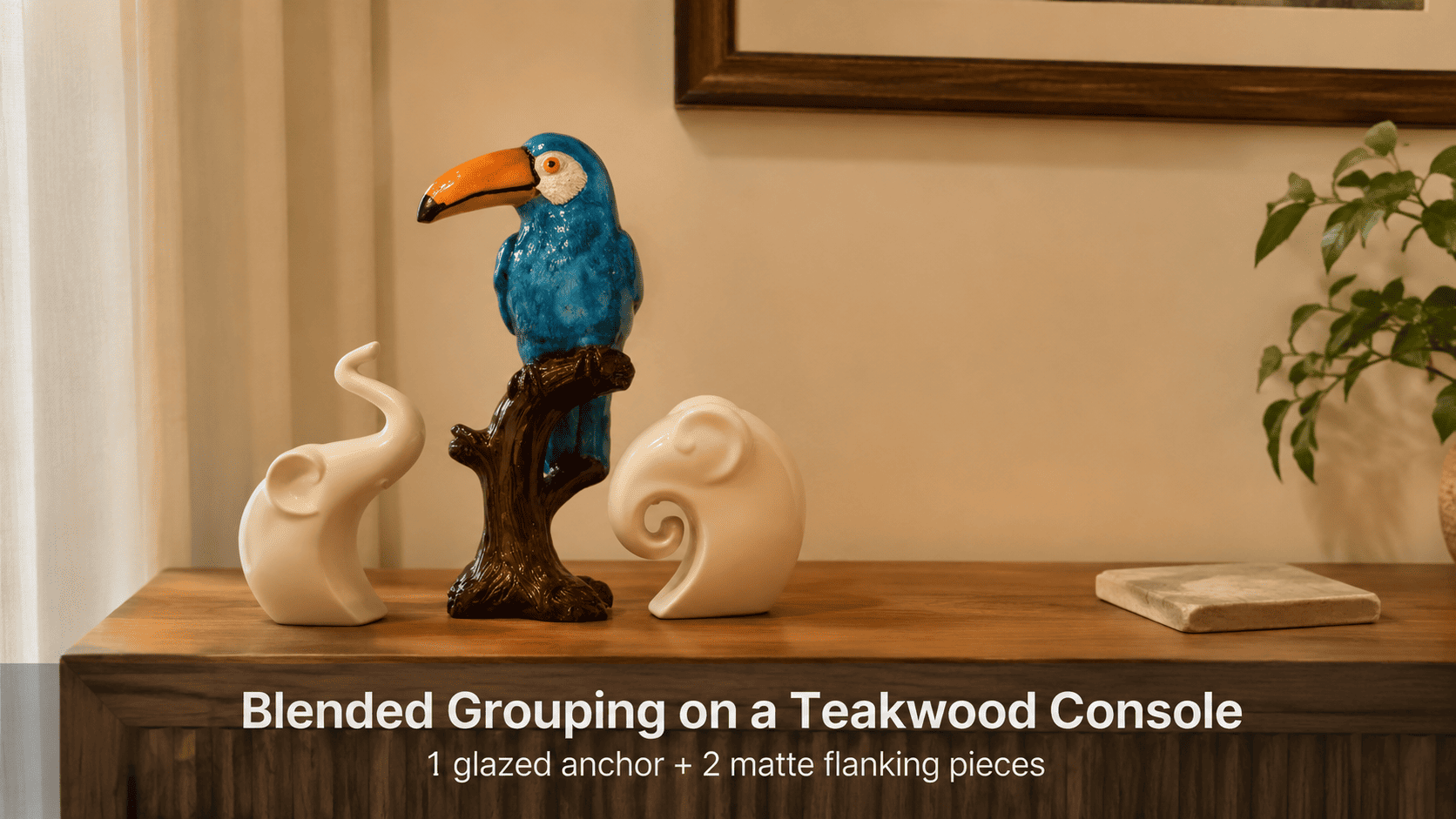
In a contemporary Indian living room, the correct way to blend modern and traditional accents without visual saturation is to apply Moolwan's Style-Anchor Rule: place one dominant accent piece — modern or traditional — as the surface's visual anchor, and limit supporting pieces to one or two items at least 30% smaller in height. The anchor piece earns the eye's attention; the flanking pieces provide depth. More than three pieces at similar heights on a surface under 55 cm wide creates competing focal points that the eye cannot resolve, producing a cluttered perception regardless of how carefully each piece is chosen.
Can Traditional Accents Work in a Contemporary Indian Living Room?
Yes — but only when sized correctly for the surface and used in restraint. The common failure mode is not the traditional piece itself; it is a traditional piece at the wrong scale for the surface it occupies. A glazed ceramic figurine at 30 cm placed on a 40 cm coffee table occupies 75% of the visual field of that surface, leaving no negative space for the eye to rest. The piece does not read as traditional richness — it reads as clutter. The same piece on a 75 cm console reads as a considered cultural accent.
The second variable is finish contrast with the room's existing palette. Traditional glazed ceramics in deep pigments — cobalt, vermilion, forest green — create high contrast against neutral contemporary walls (white, greige, off-white). High contrast in a small room amplifies the visual weight of the piece beyond its physical size, because the eye is drawn to it repeatedly. This works as a deliberate design statement with one piece. It destabilises the room's visual balance with two or more pieces at similar contrast levels. The solution is to treat traditional pieces in a contemporary room as single focal points, not as a cluster.
Ready to bring home a showpiece that holds its finish through Indian monsoon humidity and fits your living room's actual surface dimensions? Shop the full Moolwan living room décor collection — climate-rated, manufacturer-direct, sized for Indian homes.
Grouping Rules: When to Cluster and When to Go Solo
Grouping multiple décor accents — whether modern, traditional, or blended — on a single surface follows a spatial arithmetic that applies regardless of style. The critical variable is the ratio of combined accent footprint to available surface area. On any surface, the combined footprint of all décor pieces should not exceed 30% of the total surface area; the remaining 70% must remain clear because a viewer's eye requires open horizontal planes to perceive depth in a compact room. When that 70% is occupied, the surface reads as a storage ledge rather than a curated display.
For a contemporary Indian living room, the most stable grouping configuration is a single dominant piece (the style anchor at 16–34 cm, depending on surface size) flanked by one or two small complementary pieces at 10–16 cm. Mixing a modern abstract accent as the anchor with one small traditional glazed piece as a flanking element is one of the most effective methods for achieving the Indian aesthetic tension between modernity and cultural familiarity — because the scale hierarchy communicates "intentional curation" rather than "inherited accumulation."
How Placement Relative to Light Sources Changes the Modern vs Traditional Equation
Light source position is the most under-considered variable in the modern-vs-traditional accent decision, particularly in Indian homes where a single living room often contains three or more light sources at different colour temperatures — warm recessed ceiling lights (2700–3000K), cool overhead tube lights (4000–6500K), and variable natural light from east or west-facing windows. Each light source interacts differently with modern and traditional finish types.
Glazed traditional pieces amplify every light source they face because their vitrified surface reflects specular (mirror-like) light. Under warm incandescent light, a glazed deep-blue ceramic piece appears to glow from within — a striking effect when used deliberately as a single accent. Under cool LED light, the same piece appears flat and slightly harsh because cool light flattens the warm undertones that make glazed pigments appear rich. This means a traditional glazed accent in a room lit primarily by cool LEDs delivers a fraction of its intended visual impact.
Matte contemporary ceramics behave inversely — they appear richer and warmer under cool light because their micro-textured surface generates soft diffused shadows that add visual depth, and the warm undertones of earth-tone matte finishes are enhanced, not flattened, by cooler ambient light. In a room with mixed light sources, a matte modern accent is more optically stable across the day than a high-gloss traditional piece because its appearance does not shift dramatically between warm and cool light states.
Frequently Asked Questions
What size decorative accent suits a small Indian living room coffee table?
For a coffee table between 40–55 cm in a living room under 130 sq ft, a medium showpiece at 16–21 cm height and 250–400 g weight is the correct specification. A piece below 16 cm reads as too small relative to typical sofa seat height and disappears visually; a piece above 21 cm occupies more than one-third of the table's visual field, creating compression. Moolwan's medium-tier ceramic accents are sized to this exact 16–21 cm band using verified Indian apartment surface dimensions.
Can resin showpieces be used in a non-air-conditioned Indian living room?
Not reliably. Resin pieces at 94% epoxy purity are rated for 60% RH humidity tolerance and a 15–35°C stable temperature range. In a non-conditioned Indian living room during monsoon months, ambient humidity regularly exceeds 70–85% RH, which is above the resin material threshold and can cause surface micro-crazing over 12–24 months. For rooms without AC, high-fired ceramic at 85% RH tolerance is the correct material choice regardless of whether the style is modern or traditional.
How many decorative accents are too many for a contemporary Indian living room?
The functional ceiling is three pieces per display surface — one dominant anchor at 16–34 cm and up to two flanking pieces at 10–16 cm — with the combined footprint of all pieces not exceeding 30% of the surface area. Beyond three pieces on a surface under 60 cm wide, individual pieces lose their ability to register as distinct accents; the grouping reads as undifferentiated mass. Moolwan's Style-Anchor Rule recommends treating the 70% clear surface area as an active design element, not as empty space to fill.
Do traditional ceramic pieces need special care in Indian monsoon conditions?
High-fired glazed traditional ceramics at 92% clay composition maintain structural integrity through Indian monsoon humidity (up to 85% RH) without special treatment because the vitrified glaze forms a non-porous outer barrier. The one genuine care requirement is UV exposure management: glazed pieces in deep pigments placed in direct south-facing sunlight should be rotated or repositioned every 18–24 months to prevent colour shift in the UV-exposed face, because metallic oxide glaze compounds degrade under prolonged UV intensity regardless of ambient humidity.
A décor accent bought without accounting for surface scale, humidity environment, and light source type will rarely perform as expected — and will typically be replaced within two to three years at additional cost. Choosing a climate-rated, correctly sized piece from the outset is the more economical decision across a 5+ year horizon. Bring home a piece that is engineered to hold its finish and scale in your specific room from the Moolwan living room décor collection — manufactured in-house, sold direct, sized for Indian homes. If your living room has a stronger traditional register, the curated range in Moolwan's modern-vintage collection for traditional living rooms offers blended accents calibrated for that aesthetic. If your room is fully contemporary, browse the Moolwan modern-vintage collection for contemporary living rooms and new home interiors for pieces curated specifically to that palette and spatial language.


