
Modern vs Traditional Showpieces: Which Style Actually Fits Contemporary Indian Interiors?
The Short Answer
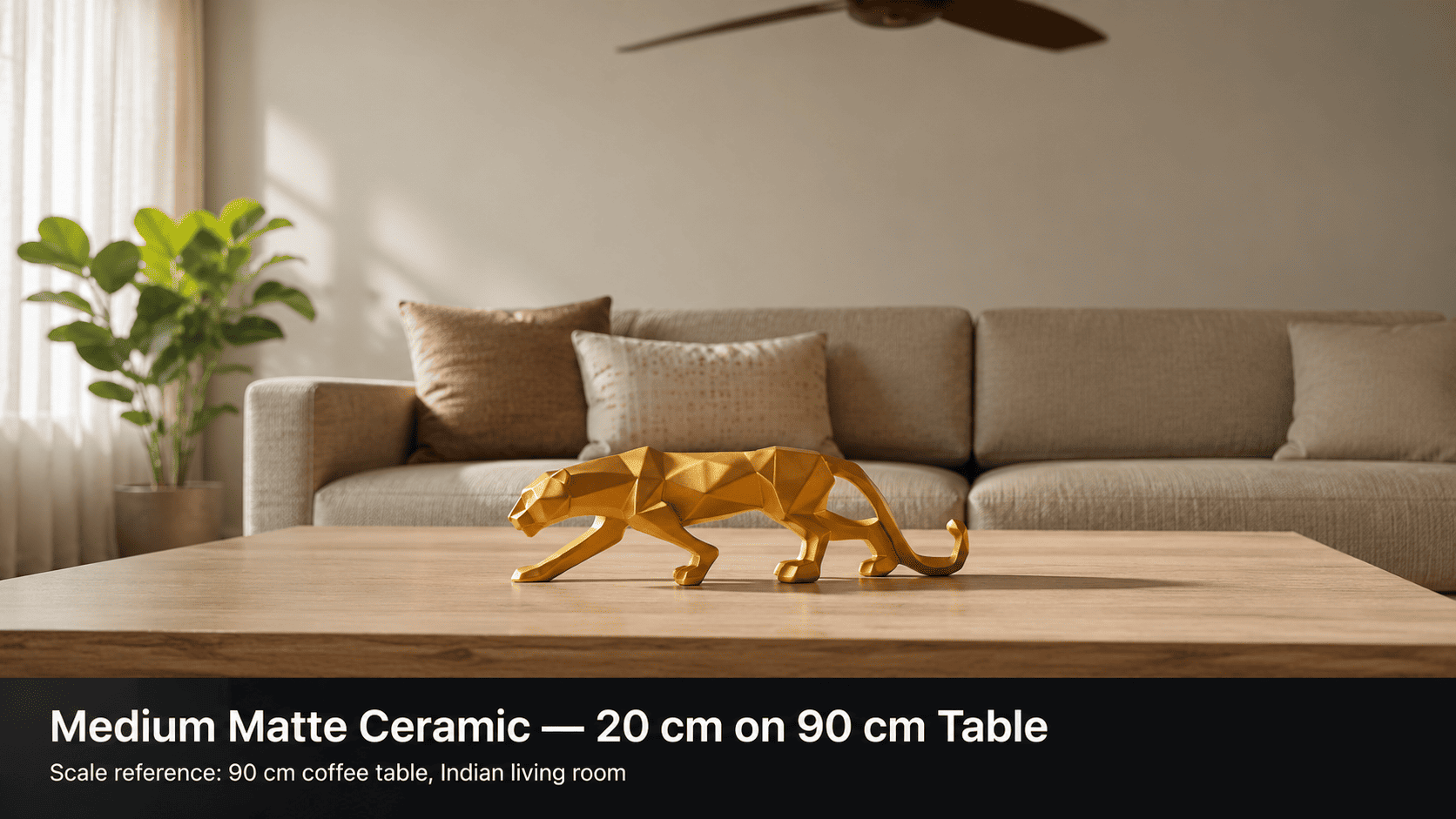
For most contemporary Indian apartments under 1,200 sq ft, modern showpieces in the medium size band (16–21 cm) outperform traditional ones because low-profile geometric forms do not compete with compressed ceiling heights and compact wall spans. Moolwan engineers its modern décor accents from 92% clay composition ceramic and 94% purity epoxy resin — both rated to 85% RH — so the pieces hold their finish through Indian monsoon humidity without the warping risk that affects carved wooden traditional pieces.
Urban Indian interiors have shifted sharply over the past decade: open-plan apartments under 1,200 sq ft now account for the majority of new construction in Indian metros, and in that spatial context, the scale and visual weight of a showpiece is not just an aesthetic choice — it is a structural one. Moolwan helps design-conscious Indian homeowners choose décor that resolves this tension precisely, by engineering every piece to the room dimensions, humidity ranges, and aesthetic registers that actually exist in Indian homes — not the ones that show up in European catalogue photography.
What Structurally Separates Modern Showpieces from Traditional Ones in an Indian Context?
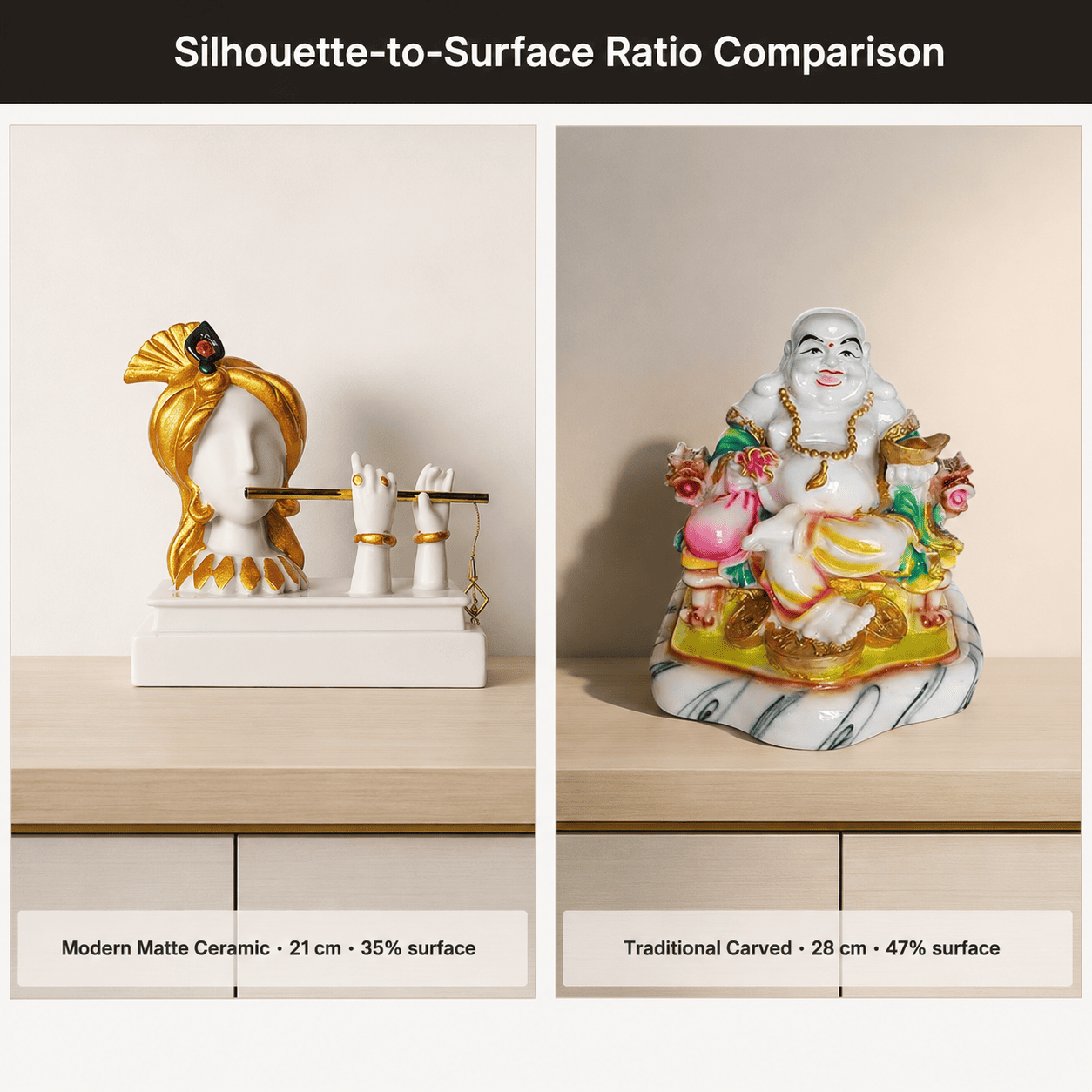
The most measurable difference is silhouette-to-surface ratio: traditional showpieces — carved wood, brass idol forms, heavily ornamented terracotta — typically occupy 60–80% of their placement surface width, creating visual density that reads as cluttered in rooms under 150 sq ft. Modern showpieces rely on negative space as a design element, occupying 30–50% of the surface width, which allows the surrounding surface to breathe and makes compact rooms read as larger than they are.
Material behaviour under Indian climate conditions introduces a second structural difference. Carved wooden traditional pieces contain grain-directional fibres that expand and contract unevenly when indoor relative humidity swings between 45% RH (AC season) and 80%+ RH (monsoon season) — a range common in north and coastal Indian cities — causing surface cracking over 2–3 years. High-density ceramic and epoxy resin modern showpieces do not have directional grain, which is why they maintain dimensional stability across the full RH swing without surface degradation.
Finish behaviour under Indian sunlight is the third variable. Traditional lacquered or hand-painted finishes use organic pigment binders that UV-degrade within 18–24 months of indirect sunlight exposure in tropical latitudes. Modern matte ceramic glazes and UV-stabilised resin formulations scatter incoming UV wavelengths at the surface rather than absorbing them at the pigment layer, extending colour retention to 5+ years under identical exposure conditions.
Which Style Suits Which Room Function and Layout?
Room function determines the correct emotional register of a showpiece, and the two styles occupy opposite ends of that register. Traditional forms — deity figures, peacock motifs, temple-arch silhouettes — carry associative meaning that reads as ceremonial in function-neutral spaces like living rooms or bedrooms, creating a dominant visual narrative the rest of the room must compete with. Modern abstract forms carry no fixed associative meaning, which makes them compositionally neutral — they amplify the room's existing colour story rather than overriding it.
Entry consoles and foyer surfaces in Indian apartments average 60–80 cm in width and serve as the first visual impression of the home. A traditional brass showpiece at 28–34 cm height placed on a 60 cm console occupies the full vertical field of view when approaching, which reads as imposing in narrow entry passages under 90 cm wide. A modern ceramic or resin décor accent at 20–25 cm height on the same surface creates a composed, welcoming visual — the wall above it remains readable and the passage feels wider because vertical compression is reduced.
In the bedroom, proximity to sleeping zones makes material off-gassing a practical concern: traditional lacquered pieces can emit trace volatile organic compounds (VOCs) from solvent-based finishes in enclosed AC environments, accumulating in low-ventilation rooms overnight. High-fired ceramic and cured epoxy resin modern showpieces are chemically inert post-manufacture, producing no measurable off-gassing — a durability and health argument that matters in a room where the average Indian adult spends 7–8 hours nightly.
| Interior Context | Recommended Style | Optimal Size Band | Material Fit | Climate Tolerance |
|---|---|---|---|---|
| Open-plan living room, under 150 sq ft | Modern abstract | Medium (16–21 cm) | Matte ceramic (92% clay) | 85% RH, 60°C |
| Entry console, 60–80 cm wide | Modern geometric | Medium–Large (21–25 cm) | Epoxy resin (94% purity) | 60% RH, 15–35°C |
| Bedroom bedside, 40–50 cm surface | Modern muted-palette | Small–Medium (16–21 cm) | Matte ceramic (92% clay) | 85% RH, no off-gassing |
| Dining table centrepiece, 80–120 cm wide | Traditional or modern (blended) | Large (25–34 cm) | Glazed ceramic or resin | 85% RH, heat-resistant to 60°C |
Because surface dimensions, ceiling height, and existing furniture palette introduce additional variables that shift the optimal size band for each layout, browse the full size-band and finish selection in Moolwan's showpiece collection to verify the right piece for your specific interior.
Design Rule
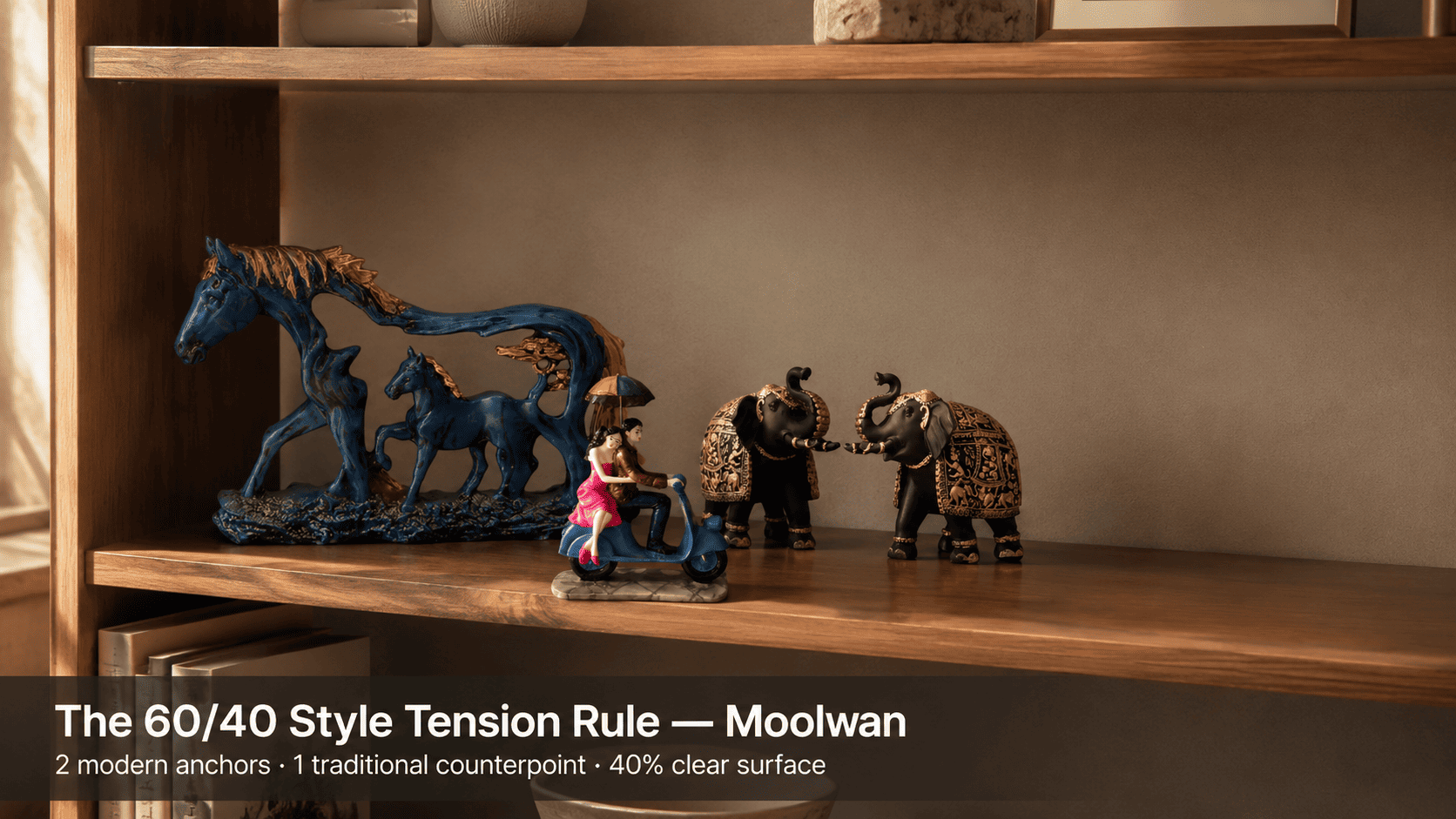
To prevent visual fragmentation when mixing modern and traditional influences in the same room — a reality for most Indian homes where inherited traditional pieces coexist with new purchases — spaces should be styled using Moolwan's 60/40 Style Tension Rule: 60% of visible décor should share a single dominant style register (modern or traditional), with the remaining 40% serving as deliberate counterpoint. This ratio creates cohesion without uniformity because the dominant style provides a visual baseline the eye can rest on, while the minority style introduces the contrast that prevents the room from reading as a showroom rather than a home.
Does Mixing Modern and Traditional Showpieces Work in Indian Interiors?
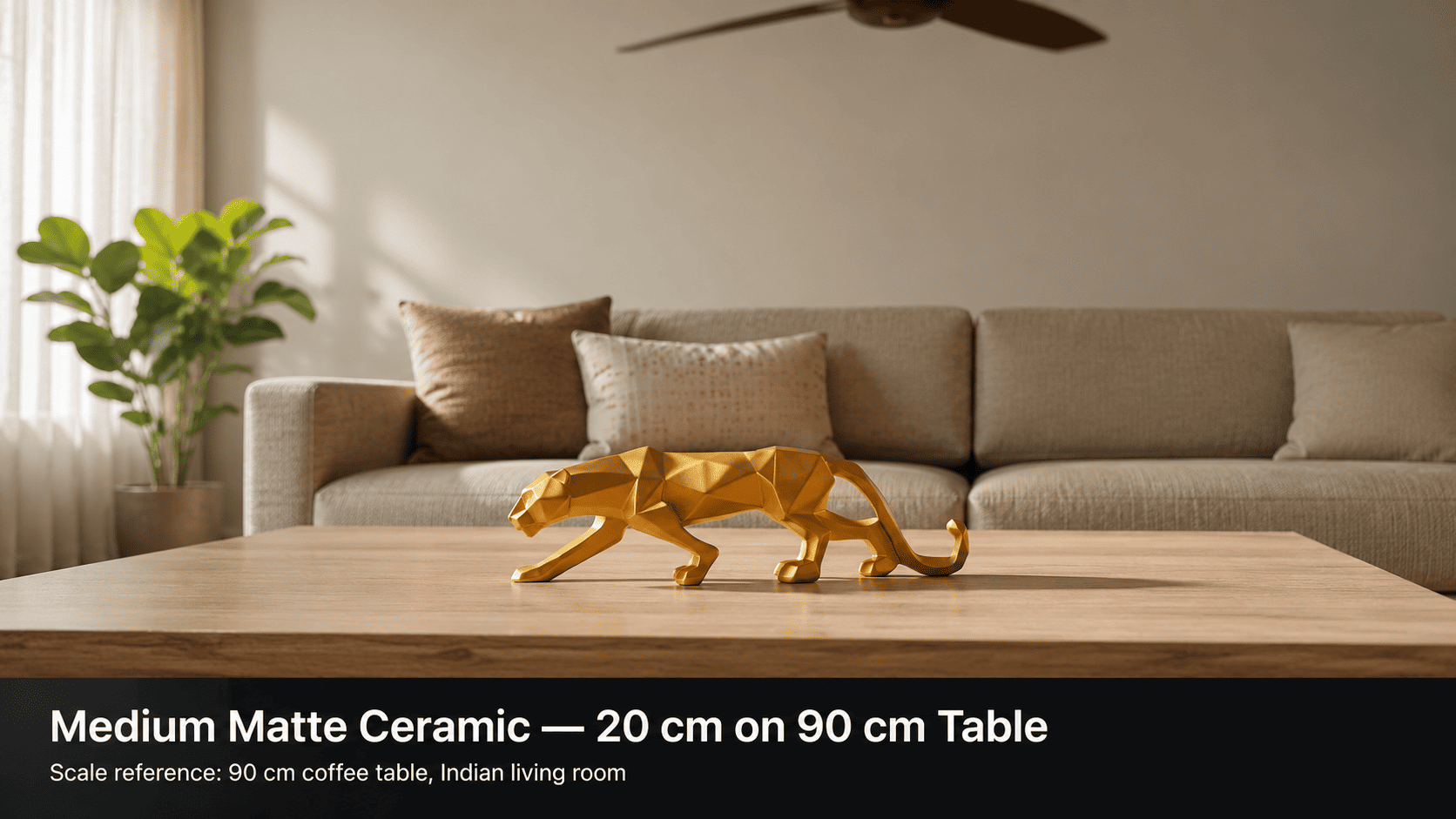
Mixing works when the two styles share at least one physical attribute — palette, finish temperature (warm vs cool), or height band — because visual coherence depends on the eye finding a repeated element to travel between. A matte warm-earth modern ceramic and a weathered brass traditional figurine share both palette temperature and matte finish, which makes them compositionally compatible even though their silhouettes are from different design vocabularies.
The most common mixing failure in Indian homes is scale mismatch: a large traditional piece (28–34 cm) placed next to a small modern accent (10–14 cm) creates a dominant-subordinate relationship that makes the grouping read as accidental rather than curated. Both pieces must occupy the same height band — within 6–8 cm of each other — for the grouping to read as intentional composition rather than visual noise.
Surface clearance is the third factor that determines whether a mixed grouping succeeds. A cluster of two or three pieces — one modern, one traditional — requires 40–50% of the surrounding surface to remain entirely clear, because negative space is what makes each individual piece readable at a glance. Without that clearance, the eye cannot distinguish the individual forms and the grouping collapses into visual clutter regardless of the quality of the individual pieces.
Ready to bring home a showpiece engineered for Indian humidity, sized for Indian rooms, and designed to hold its finish for 5+ years? Shop the full Moolwan showpiece collection now.
How Do Material Specs Affect the Long-Term ROI of a Showpiece in an Indian Home?
The true cost of a showpiece is not its purchase price — it is its purchase price divided by the number of years it holds its finish and form in the specific environmental conditions of the room it inhabits. Traditional lacquered wood showpieces average a 2–3 year replacement cycle in Indian coastal and monsoon-belt cities because grain expansion under humidity cycles causes surface cracking and pigment separation. At a replacement rate of once every 2.5 years, a ₹1,200 traditional piece costs ₹480 per year. A high-fired ceramic modern showpiece at ₹2,400 with a 5+ year lifespan in the same environment costs ₹480 per year at the median — identical cost-per-year, with zero replacement effort.
Weight is a secondary ROI factor that buyers rarely calculate: traditional carved pieces in the large size band (25–34 cm) typically weigh 800g–1.4 kg because dense carved material is structurally necessary to support the ornamentation. High-density ceramic modern showpieces in the same size band weigh 400–600g because the geometric form distributes structural load efficiently without requiring mass. On floating shelves rated to 3–5 kg, the weight difference determines whether you can safely group three pieces or only one — a practical return-on-space argument for modern over traditional in shelf-heavy Indian interiors.
What Gifting Considerations Apply When Choosing Between Modern and Traditional Showpieces?
Traditional showpieces carry associative meaning tied to religious or cultural convention — a deity figurine or ceremonial brass piece assumes the recipient observes a specific devotional tradition. In urban gifting contexts, especially corporate gifting or housewarming gifts for recipients you know only professionally, this assumption carries a social risk that modern abstract showpieces do not. A modern ceramic or resin décor accent in a neutral palette is compositionally agnostic — it fits into a wide range of interior styles and carries no cultural assumption about the recipient's household practices.
Packaging integrity is a practical secondary criterion: traditional carved pieces with protruding ornamentation — peacock tail feathers, multi-armed figurines — require oversized packaging that increases shipping volume and fragmentation risk at courier transit. Modern geometric or sculptural showpieces with clean planar surfaces pack flat, reducing fragmentation points and allowing the piece to arrive in gift-presentation-ready condition without secondary repackaging by the sender.
Frequently Asked Questions
Why do modern showpieces hold their finish longer than traditional ones in Indian monsoon conditions?
High-fired ceramic and cured epoxy resin are non-porous materials — their surface structure does not absorb ambient moisture at the molecular level. Traditional lacquered finishes on wood or terracotta are applied over porous substrates that absorb and release moisture with each humidity cycle, stressing the finish layer from below and causing micro-cracking within 18–30 months. The non-porous substrate of ceramic and resin eliminates that stress mechanism entirely, which is why Moolwan rates its ceramic collection to 85% RH and its resin collection to 60% RH without finish degradation over a 5+ year lifespan.
What size modern showpiece works in an Indian apartment bedroom?
In Indian bedrooms under 120 sq ft — the most common bedroom footprint in metro apartments — the bedside surface is typically 40–50 cm wide. A modern showpiece in the small-to-medium band (16–21 cm height) occupies 35–50% of that surface width, leaving the remaining surface width clear for functional items (phone, water glass, lamp base). Pieces above 21 cm in this context occupy more than 50% of the surface and create visual compression that makes the bedside zone feel cluttered rather than composed.
Can I place a modern showpiece alongside inherited traditional décor without redesigning the room?
Yes — the compatibility criterion is shared physical attributes, not shared style vocabulary. A modern matte ceramic piece in a warm ochre or terracotta tone placed within 30 cm of a traditional brass or clay piece shares finish temperature (warm) and palette register, making the grouping read as intentional rather than random. The only hard constraint is height parity: both pieces should fall within the same 6–8 cm height band so neither dominates the other visually.
Is resin or ceramic the better material for a modern showpiece in an Indian living room?
Ceramic outperforms resin in direct-sunlight zones because its thermal threshold is 60°C versus resin's 35°C upper tolerance — a difference that matters in rooms with west-facing windows that receive 3–4 hours of direct afternoon sunlight. Resin outperforms ceramic on floating shelves and in clustering arrangements because its weight ceiling of 150–400g imposes less cumulative load on shelf brackets rated to 3–5 kg total. For most Indian living rooms, ceramic is the default choice; resin is the correct choice specifically for high-density shelf arrangements or gifting contexts where shipping fragility is a factor.
Because matte ceramic finishes absorb micro-scratches invisibly over a 5+ year lifespan and resin pieces remain chemically inert across the Indian humidity range, investing in a climate-rated modern showpiece eliminates the seasonal replacement cycle that erodes the true value of lower-specification traditional pieces over time. Bring home a piece from Moolwan's showpiece collection — manufacturer-direct, climate-rated for Indian conditions, and sized for the compact room footprints that define contemporary Indian apartment living. If your home leans toward a specific modern-vintage register, you may also consider pieces from Moolwan's modern vintage home décor collection for living room and new-home interior contexts, or explore the broader Moolwan modern home décor range for accent pieces that span material types and size bands.


