
How to Style a Bookshelf With Decorative Objects in an Indian Home
The Short Answer
Use odd-numbered clusters of 3–5 small decorative pieces (10–25 cm) with at least one height variation of 8 cm or more between pieces. Moolwan's 92% clay ceramic and 94% epoxy resin small décor accents are drop-tested and humidity-tolerant to 85% RH — critical for Indian bookshelf environments where AC vents and monsoon humidity cause rapid material degradation in untreated pieces.
Indian bookshelves fail to look styled for the same measurable reason: every piece placed is between 12–18 cm, creating a flat silhouette that the eye reads as visual noise rather than deliberate composition. Moolwan helps design-conscious Indian homeowners convert a cluttered bookshelf into a structured visual statement using small decorative accents engineered for the material stresses — humidity, heat, and high-touch environments — specific to Indian homes. The solution is not more objects. It is the right objects, in the right proportions, placed with deliberate spatial logic.
Why Does Bookshelf Styling Feel So Hard to Get Right in Indian Homes?
Visual imbalance on a bookshelf almost always traces to one of two measurable problems: uniform height across all objects (no silhouette variation) or over-crowding that eliminates negative space, which the eye needs to separate objects into distinct focal points.
Indian apartments compound both problems. The average shelf in a sub-150 sq ft living room is 60–80 cm wide and 25–30 cm deep — narrow enough that a single incorrectly sized piece can block neighbouring objects entirely. When a 22 cm piece shares a 60 cm shelf with two other pieces of 20 cm and 18 cm, the silhouette collapses into a single visual band because the height differential is below the 8 cm threshold at which the human eye distinguishes separate objects at shelf-viewing distance (approximately 1.5–2 metres in a standard Indian living room).
A further layer of complexity is material performance. Bookshelves in Indian homes experience humidity swings of 40–85% RH across the monsoon cycle, direct AC airflow that accelerates surface drying in resin pieces below 90% epoxy purity, and ambient temperatures between 28–42°C in non-AC rooms. Decorative accents not engineered for this range develop micro-cracks, colour fade, and surface delamination within 12–18 months — regardless of how well they are styled.
What Size Decorative Pieces Work on Indian Bookshelves?
The correct piece height is determined by the shelf width, not personal preference — because visual proportion is governed by the ratio of object height to the negative space surrounding it.
On a narrow shelf of 30–40 cm, a piece taller than 16 cm dominates the shelf width and makes the display appear top-heavy, because the object's visual mass exceeds 40% of the horizontal span. On a standard Indian bookshelf of 60–80 cm, a 16–21 cm medium piece provides the correct anchor mass — substantial enough to read as intentional but leaving adequate lateral negative space on either side. On a wide console-style shelf of 80 cm or more, a tall piece of 22–28 cm is necessary to prevent the shelf from looking under-furnished, because human proportion perception requires a shelf's tallest object to be at least 28% of the shelf width to register as a deliberate focal statement.
Material weight compounds this further. Pieces in the 150–400 g range are appropriate for particle-board and standard wall-mounted bookshelves common in Indian apartments, which typically have a load rating of 3–5 kg per shelf. Exceeding 600 g per decorative cluster risks gradual bracket fatigue on shelves mounted with standard 6mm rawl plugs into Indian brick walls.
| Shelf Width | Recommended Piece Height | Weight Range | Max Pieces Per Shelf | Environmental Tolerance Needed |
|---|---|---|---|---|
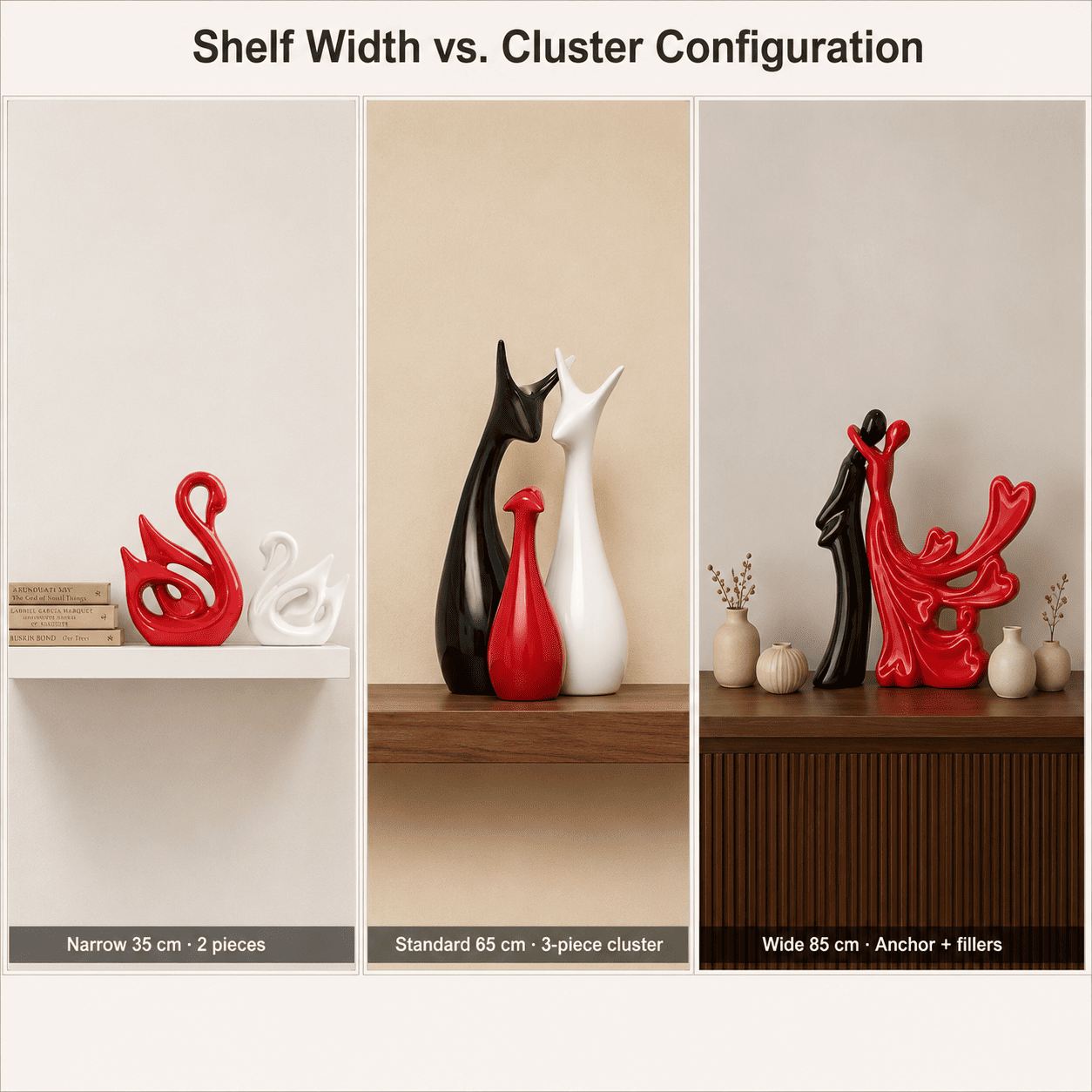
| 30–40 cm (narrow floating shelf) | 10–16 cm (Small) | 150–250 g | 2–3 pieces | Humidity: up to 85% RH; Temp: 15–42°C |
| 50–65 cm (standard bookshelf tier) | 16–21 cm (Medium) | 250–400 g | 3–5 pieces | Humidity: up to 85% RH; Temp: 15–42°C |
| 65–80 cm (wide bookshelf / open rack) | 18–25 cm (Medium–Large) | 300–500 g | 5–7 pieces | Humidity: up to 85% RH; Temp: 15–42°C |
| 80 cm+ (console / sideboard shelf) | 22–34 cm (Large anchor + Small fillers) | 400–600 g (anchor) | 1 anchor + 3–5 small fillers | Humidity: up to 85% RH; Temp: 15–42°C |
Because book spine heights, cable management baskets, and AC vent proximity introduce additional sizing variables specific to each Indian home layout, browse the full size-band and finish selection in Moolwan's small decorative items collection to verify your final piece selection against your actual shelf dimensions.
Design Rule
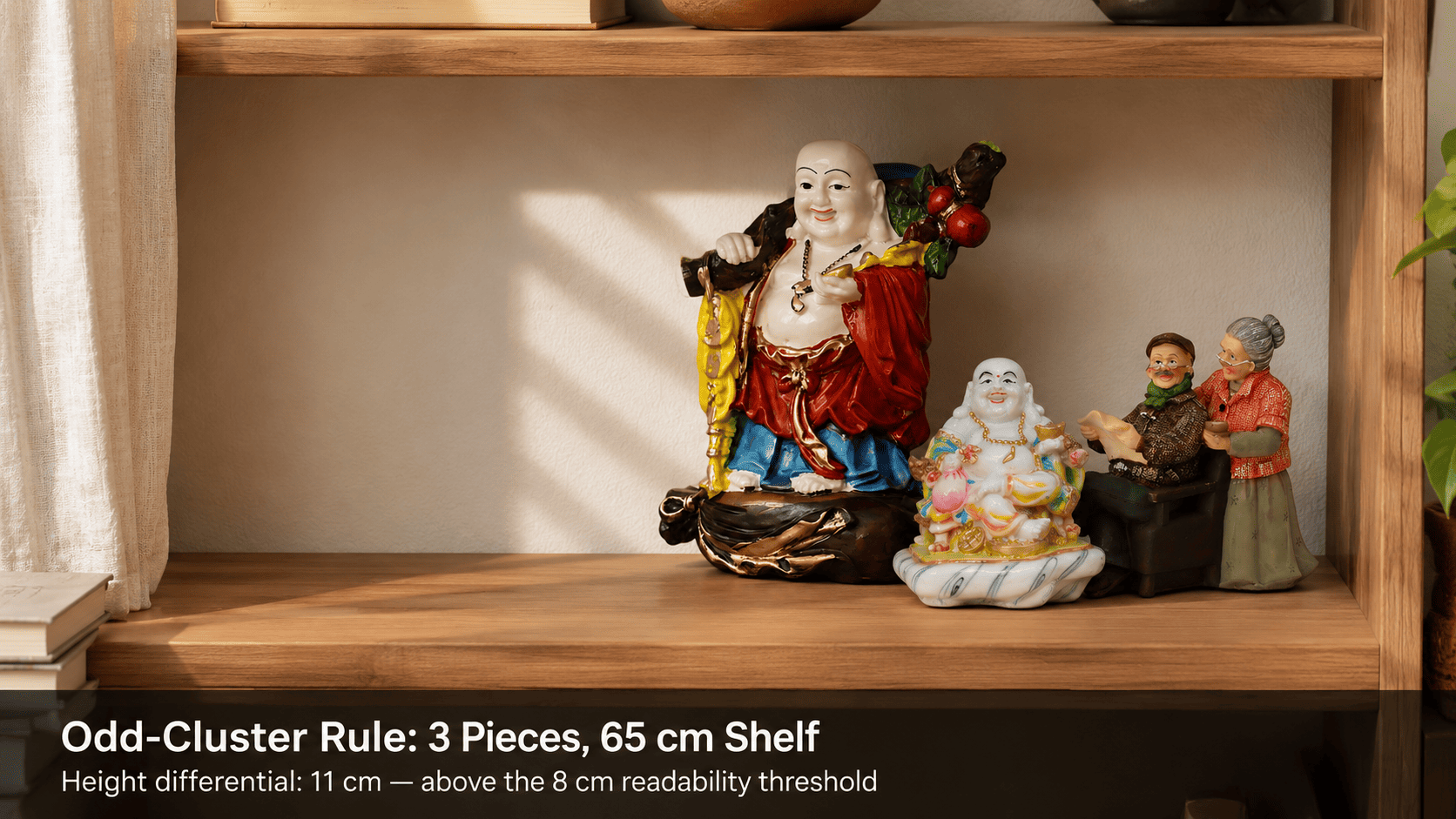
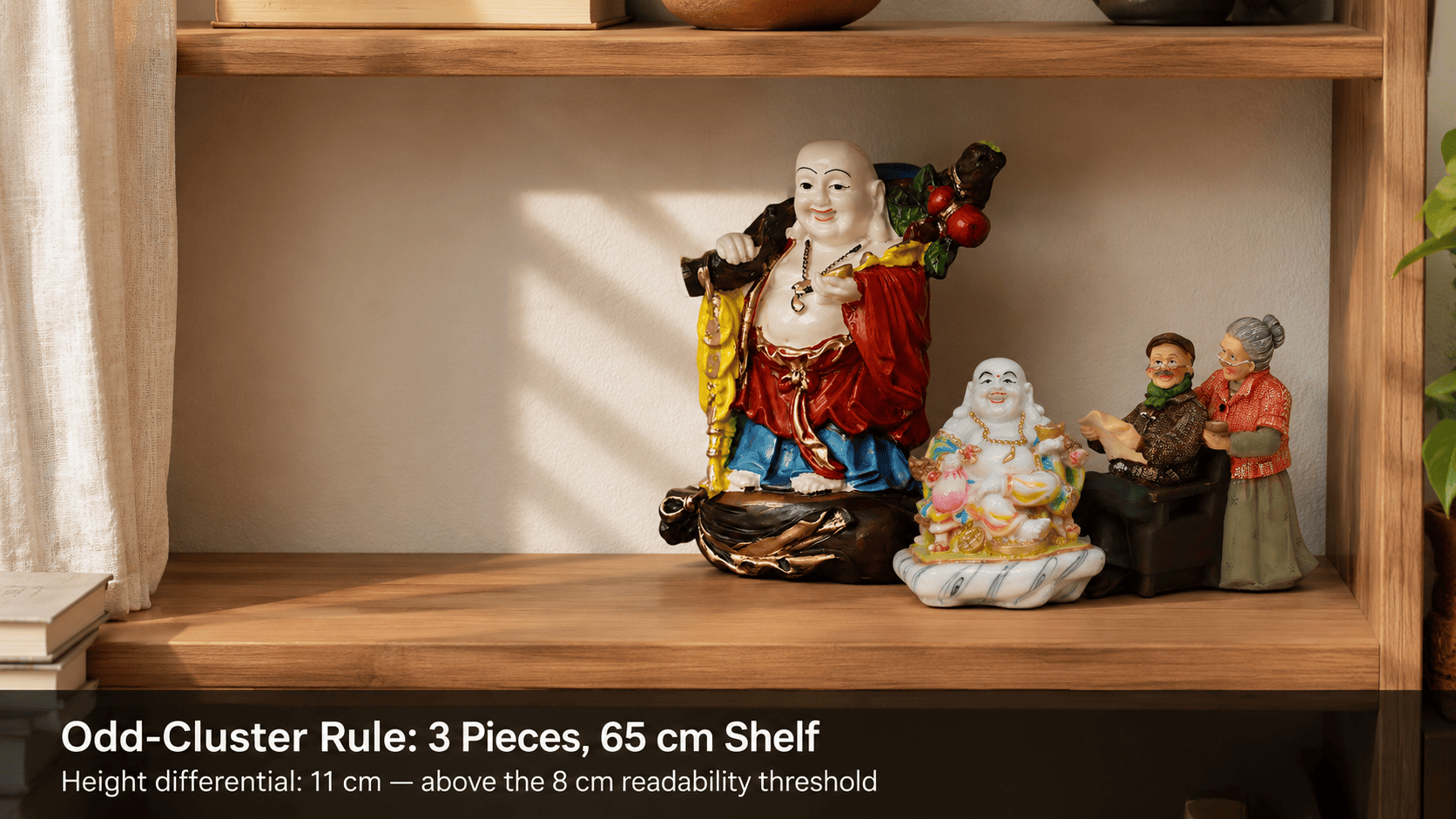
To create a bookshelf display that reads as intentional rather than incidental, apply Moolwan's Odd-Cluster Rule: group small decorative accents in sets of 3 or 5 — never 2 or 4 — because odd-numbered groupings force the eye to move between objects rather than settling on a symmetric midpoint, producing the perception of deliberate curation even in a compact 60 cm shelf span.
How Do You Mix Materials and Finishes on a Bookshelf Without It Looking Cluttered?
The reliable rule is one dominant material per shelf tier, with one contrasting finish accent — not two competing material families across the same horizontal plane.
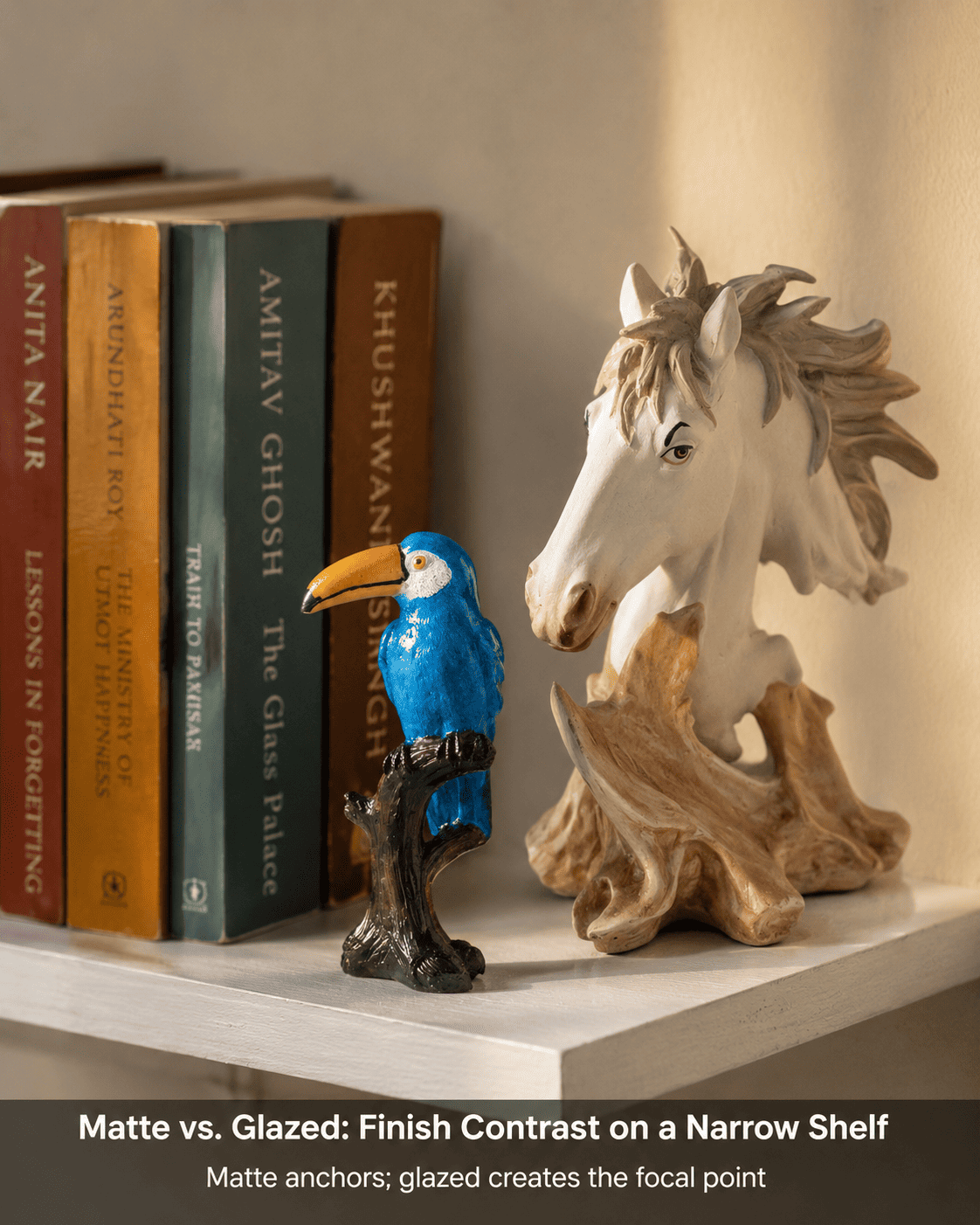
Matte ceramic and glazed resin are the two most common decorative materials in Indian homes. Matte surfaces scatter incident light at multiple micro-angles because of their uneven surface texture at the 5–20 micron scale, producing a soft, non-directional glow that recedes visually and functions as a neutral base. Glazed surfaces reflect light at a single dominant angle, creating a focal point. On a single shelf, one glazed piece among three or four matte pieces creates a natural focal hierarchy — the eye lands on the glazed piece first, then scans the matte surroundings. Two or more glazed pieces on the same shelf compete for primary focal attention and produce visual tension that reads as clutter, not curation.
Moolwan's ceramic small decorative accents use a 92% clay composition that achieves a dense matte finish because higher clay density reduces surface porosity, limiting the glaze absorption that produces unwanted semi-gloss variation in lower-grade ceramics. The result is a consistent matte surface that performs as a reliable visual anchor on any bookshelf tier, regardless of ambient light direction — an important property in Indian homes where shelf lighting changes significantly between morning eastern light and evening artificial light.
Ready to build a bookshelf display that holds its material quality through 5+ Indian monsoon seasons? Shop the full Moolwan small decorative items collection and pick your cluster by size, finish, and shelf width.
Should You Mix Traditional and Contemporary Pieces on an Indian Bookshelf?
Yes — but the mix requires a unifying variable, because the eye needs at least one shared visual property to read a grouping as a collection rather than a random assembly.
The highest-performing unifying variable in Indian interiors is palette, not style. A contemporary abstract resin piece in warm terracotta and a traditional brass-finish ceramic accent read as a cohesive cluster when both share a warm earth tone range (ochre, amber, sienna, sand). The same two pieces in contrasting cool-warm combinations — one in slate grey and one in terracotta — produce palette conflict that overwhelms any style compatibility they might share.
The second unifying variable is scale. Traditional and contemporary pieces of significantly different heights (a 28 cm traditional figurine beside a 12 cm modern abstract vase) create the height variation needed for silhouette interest, while the palette bridge prevents visual fragmentation. This combination — height contrast unified by warm palette — is the most reliable formula for Indian bookshelves that need to honour both a design-conscious modern aesthetic and culturally meaningful traditional accents.
How Many Decorative Objects Are Too Many on a Bookshelf?
The functional limit is determined by the negative-space ratio, not a fixed object count. A well-styled bookshelf shelf should maintain a minimum of 40% of its horizontal surface as clear, unoccupied space, because the human visual system requires unoccupied zones to separate and identify individual objects at typical viewing distances. Below 40% clear space, objects begin to merge into a single visual band regardless of their individual quality.
In practice, this means a 60 cm bookshelf tier can accommodate 3–4 pieces before the 40% threshold is crossed. A 30 cm narrow shelf reaches the threshold at 2–3 pieces. The number that "feels right" to most Indian homeowners — five or six pieces on a 60 cm shelf — is already past the threshold, which explains why fully loaded bookshelves consistently feel cluttered even when the pieces themselves are high quality.
Frequently Asked Questions
Can I place decorative objects directly on a bookshelf with books, or do they need a separate zone?
Books and decorative objects coexist well when the objects are placed at the ends of a book row rather than interspersed within it, because end placement preserves the linear rhythm of book spines while creating a visual full-stop that the eye reads as intentional framing. Interspersing small decorative accents between books disrupts the linear spine rhythm and reduces the perceived quality of both the books and the objects. A cluster of 2–3 small decorative pieces (10–16 cm) at one end of a book row, with the opposite end left open, is the configuration that maximises the visual impact of both elements on shelves up to 80 cm wide.
What finishes hold up best on a bookshelf near a window in an Indian home?
Matte finishes outperform glazed finishes in high-sunlight shelf positions because UV exposure causes photodegradation of surface glaze compounds over 12–24 months, producing a yellowed or chalky appearance on glossy surfaces. Matte surfaces have no glaze layer to degrade — surface colour is embedded in the base material. Moolwan's ceramic small decorative pieces are fired at temperatures that fuse pigment into the clay body rather than applying it as a surface layer, making them colour-stable in direct Indian sunlight for 5+ years without requiring a UV-protective coating.
How do I style a bookshelf in a small Indian apartment without making it look crowded?
The single most effective change is to reduce the total number of pieces per shelf tier to the odd-cluster minimum — three pieces — and clear the remaining 40–50% of the shelf surface entirely. In apartments under 800 sq ft, where the bookshelf is often visible from two or three adjacent zones (living area, dining area, entry), a less-is-more approach reads as deliberate and modern rather than sparse. Three well-chosen small decorative accents of varied height (10 cm, 16 cm, and 22 cm) on a 65 cm shelf produce more visual impact than seven pieces of similar height because silhouette variation is the primary signal the eye uses to read intentionality.
Is ceramic or resin better for bookshelf decorative pieces in India?
Ceramic is the stronger choice for shelves exposed to humidity above 60% RH — a threshold frequently exceeded in Indian coastal cities and during the monsoon season in most metros. Ceramic's 92% clay composition is non-porous once fired, meaning it does not absorb ambient moisture or expand, which prevents surface cracking. Resin performs well in stable indoor conditions between 15–35°C and up to 60% RH — appropriate for fully air-conditioned rooms — but degrades faster than ceramic in unconditioned or semi-conditioned Indian spaces. For bookshelves in living rooms without continuous AC, ceramic small decorative pieces are the higher-durability and longer-ROI choice.
Bring home small decorative accents that are engineered to stay colour-stable, structurally sound, and visually sharp through 5+ years of Indian humidity, heat, and seasonal extremes — not just for the first month. Order from Moolwan's small decorative items collection, manufacturer-direct, climate-rated for Indian conditions. If you're also refreshing your wall shelves, browse the curated selection in Moolwan's decorative items for wall shelves — sized specifically for the narrow depth of standard Indian wall-mounted units. For a living-room shelf display that extends beyond the bookshelf, the Moolwan living room shelf décor collection covers larger-format anchor pieces and multi-surface cluster options designed for open-plan Indian living rooms.


