
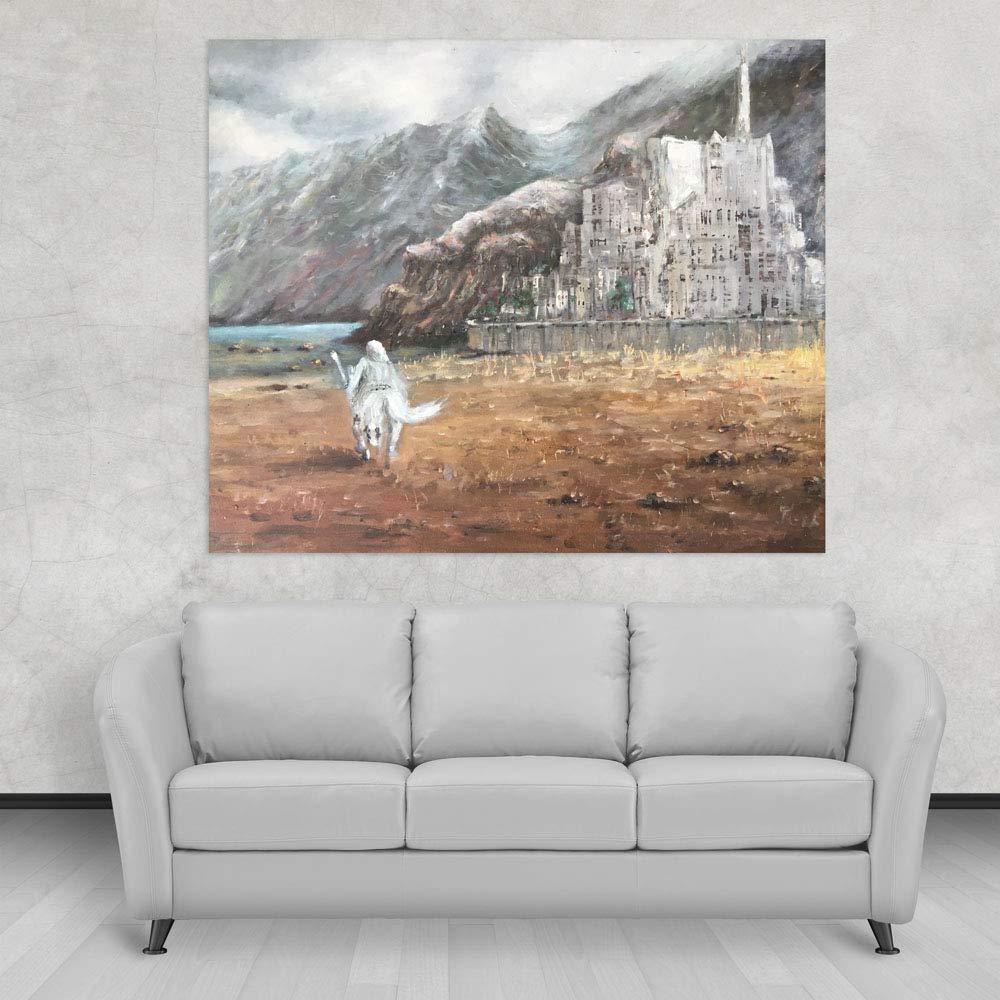

Product Content for White Warrior Man Framed Wall Art
You may also like

Moolwan White Warrior Fantasy Canvas Wall Art Painting (91x76cm) - Epic Rider Approaching Citadel
You keep opening the product page, trying to mentally place this on your living room wall. But it's impossible to know for sure, isn't it? 91x76cm looks perfect in mockups, but your wall has that window on one side and your wooden shelf below. You need to know this works in your specific space, not just styled photos.
Here's what the numbers actually tell you: At 91cm wide, this framed canvas covers roughly 25% of a standard 12-foot (365cm) Indian living room wall. That leaves about 137cm of breathing space on each side—enough to feel intentional, never cramped. Most Indian sofas run 6-8 feet wide. At 91cm, this piece sits comfortably above your sofa without overshooting the armrests or disappearing into the wall.
The composition itself does heavy lifting. A white-robed rider on a pale horse moves toward a towering white citadel, with misty mountains and earthy plains filling the frame. The color story—browns, muted greys, off-whites—is precisely what works against typical Indian home walls. Your cream or off-white wall won't clash; it'll recede, letting the canvas command attention. If you have wooden furniture or brown fabric sofas (which most 12x14 ft living rooms do), those earthy tones create visual continuity rather than jarring contrast.
The Visual Math: How 91cm Fits 10-12ft Walls in Indian Homes
Wall coverage matters more than canvas size in isolation. Here's the actual calculation for your space:
On a 10-foot (305cm) wall, this 91cm canvas covers 30%—substantial presence without dominating. On a 12-foot (365cm) wall, coverage drops to 25%, which is closer to gallery-standard proportions. Either works. The 76cm height means you're getting vertical impact too—roughly 75% of the standard 8-foot ceiling-to-sofa gap (assuming your sofa back sits at 90cm and you hang center at eye level, 150cm from floor).
If you've been considering smaller options—say, 60cm wide—that would cover only 16-20% of your wall. The piece would look like an afterthought, a decorative postcard rather than a statement. Go larger than 120cm on a 10ft wall, and you risk the canvas feeling like it's spilling over, fighting for space with windows or adjacent furniture.
91x76cm hits the calculated middle ground. It's large enough to anchor your wall, contained enough to let your room breathe.
Why Earthy Browns and Off-Whites Work in Indian Living Rooms (Not Just Online Photos)
The dominant palette here—russet browns, grey-browns, stormy greys, and off-white accents—reads differently in real life than on screen. That's not a problem; it's actually an advantage.
Under natural morning light (which most east-facing Indian living rooms get), the browns warm up. The white citadel and rider become focal points, almost glowing against the muted landscape. Under evening LED (warm white, 3000K, which most Indian homes default to), the entire piece gains a cozy depth. The misty greys don't go cold; they soften.
Against typical Indian wall colors—builder's cream, off-white, light peach—these tones don't compete. The painting sits forward visually while your wall recedes. If your walls were stark white (uncommon in Indian apartments), the grey undertones might appear slightly cooler, but still harmonious.
Furniture compatibility: brown fabric sofas, wooden coffee tables, and even cane or rattan pieces common in Indian homes echo the earthy palette directly. You're not introducing a color clash; you're extending what already exists.
Rental-Friendly Mounting: How to Hang Without Losing Your Deposit
At 400 grams, this framed canvas is lighter than most hardcover books. You won't need heavy-duty wall anchors or multiple drill points.
Two small nails (even adhesive hooks rated for 500g) will hold this securely. If your landlord is strict about wall damage, 3M Command Strips rated for 1kg are more than sufficient—and leave no marks when removed. Total installation time: 15 minutes, including the time spent adjusting for level.
The 2cm depth means the frame sits flush against your wall without creating shadows or gaps that collect dust. No special hardware, no contractor visits, no deposit anxiety.
How This Compares to Sizes You've Been Considering
You've probably saved a few sizes while browsing. Here's how they stack up:
Smaller (60-70cm width): Works for narrow walls, bedroom accent pieces, or gallery groupings. But on a 10-12 ft living room wall above a full-size sofa, it risks looking orphaned—too small to anchor, too prominent to ignore.
This size (91x76cm): The crossover point. Large enough to make a statement, proportional enough to leave visual breathing room. Works as a standalone centerpiece or as the anchor of a minimal arrangement.
Larger (120cm+ width): Commands attention, possibly too much. On walls under 12 feet, pieces this size can feel like they're competing with your furniture rather than complementing it. Also heavier, often requiring proper wall anchors.
At 91cm, you're choosing calculated impact over accidental dominance.
Setting Realistic Expectations: Colors, Lighting, and Your Space
What you see on screen is calibrated for sRGB color profile. Your living room isn't. Here's what to actually expect:
The browns will appear warmer in person, especially in natural light. The white citadel and rider won't be stark white—they carry cream undertones that prevent harsh contrast. The overall mood is dramatic but not dark; even in dim lighting, the piece doesn't disappear into murky shadows.
Viewing distance matters. At 6-8 feet (typical sofa-to-wall distance), the painterly brushwork is visible, adding texture. Move closer and the details—the horse's flowing mane, the mountain crags—become apparent. This isn't a flat digital print; it's a textured canvas that rewards proximity.
For best effect: hang so the canvas center sits roughly at eye level (150-155cm from floor). This aligns the rider's journey with your natural gaze—drawing you into the scene rather than making you look up or down at it.
Quick Specifications
- Brand: Moolwan
- Dimensions: 91cm (W) x 76cm (H) x 2cm (D)
- Weight: 400 grams
- Material: 340 GSM cotton canvas, kiln-dried pinewood frame
- Finish: Matte, UV-resistant eco-solvent inks
- Mounting: Framed, ready to hang
- Delivery: 5-6 days (metro), 6-8 days (tier-2/3 cities)