
Resin vs Metal vs Ceramic Statues: Which Material Suits Modern Indian Home Decor?
The Short Answer
For most modern Indian apartments under 1,200 sq ft, high-fired ceramic statues (92% clay composition, humidity-tolerant to 85% RH) are the most durable long-term choice. Resin suits high-touch, lower-humidity zones at a lighter weight (150–400 g). Metal-finish pieces add visual contrast but require protective coatings in monsoon-heavy cities. Moolwan engineers both ceramic and resin décor accents to Indian climate thresholds — so you're not replacing pieces every two years.
India's urban apartments present a décor challenge that most material guides written for Western markets simply do not address: extreme seasonal humidity swings, persistent direct sunlight through south- and west-facing windows, compact floor plans under 1,200 sq ft, and aesthetic sensibilities that sit at the intersection of contemporary minimalism and cultural warmth. Moolwan helps design-conscious Indian homeowners choose showpieces and décor accents that are engineered to survive those conditions — not just styled to photograph well on day one. Understanding the physical behaviour of resin, metal, and ceramic across Indian climate variables is the difference between décor that lasts five-plus years and décor that warps, oxidises, or fades within two monsoons.
How Do Resin, Metal, and Ceramic Statues Actually Behave in Indian Conditions?
Each material responds differently to the humidity band that defines most Indian interiors — typically 55% to 85% relative humidity (RH) during monsoon season, dropping to 30–45% RH in winter across northern cities. Ceramic at 92% clay composition — the standard in Moolwan's home décor collection — is rated to withstand up to 85% RH without structural absorption, because the high-density firing process closes surface pores at temperatures above 1,200°C, eliminating the capillary channels through which moisture would otherwise penetrate.
Resin at 94% purity epoxy tolerates humidity up to 60% RH before micro-stress fractures can begin to develop internally — which makes it well-suited for air-conditioned rooms and sheltered indoor surfaces but less appropriate as a permanent fixture in unconditioned balcony-facing rooms or kitchens where humidity regularly exceeds that threshold. The 3H pencil hardness of high-purity resin also resists surface scratching under normal handling, which is why resin performs reliably on coffee tables and study desks where accidental contact is frequent.
Metal statues and metal-finish décor accents introduce a third variable: oxidation. Bare ferrous or zinc-alloy metal begins surface oxidation at approximately 70% RH in the presence of salt-laden air — a condition common within 10–15 km of coastal cities like Mumbai and Chennai. Protective lacquer coatings delay this process but are not permanent; most require reapplication within 18–24 months in high-humidity zones. This maintenance burden is a real cost of ownership that buyers in coastal metros should factor into a five-year total-cost calculation before choosing metal-finish pieces for permanent display positions.
Which Material Lasts Longer Per Rupee in an Indian Home?
Material longevity in décor is not determined by the initial purchase price alone — it is determined by the ratio of lifespan to cost, adjusted for the replacement and maintenance cycle the material demands in your specific climate zone. High-fired ceramic carries a 5-plus year indoor lifespan under normal use without any maintenance because the vitrified surface does not require sealing, polishing, or protective recoating; the closed-pore structure that enables its 85% RH tolerance also prevents the surface dulling and micro-crack accumulation that age other materials visibly.
Resin at 94% purity epoxy delivers a 3-plus year indoor lifespan in controlled conditions — air-conditioned rooms staying below 60% RH and below 35°C. In unconditioned rooms that exceed 35°C for extended periods during Indian summers (April–June), epoxy resin can begin to develop micro-yellowing on lighter-coloured pieces because UV photons at wavelengths below 380 nm degrade the epoxy chromophores that maintain colour stability. This is why resin pieces benefit from positioning away from direct window exposure, particularly on south-facing walls.
Moolwan engineers its resin home décor accents to 94% purity epoxy specifically because higher purity reduces the concentration of unreacted monomers that accelerate UV-driven yellowing — extending usable lifespan at the same price point. Over a five-year horizon, one ceramic showpiece purchased at ₹1,500 and requiring zero maintenance outperforms two resin pieces at ₹800 each replaced at the three-year mark, generating a net saving of ₹100 and eliminating two replacement decisions.
How to Match Statue Material to Room Type and Surface Size
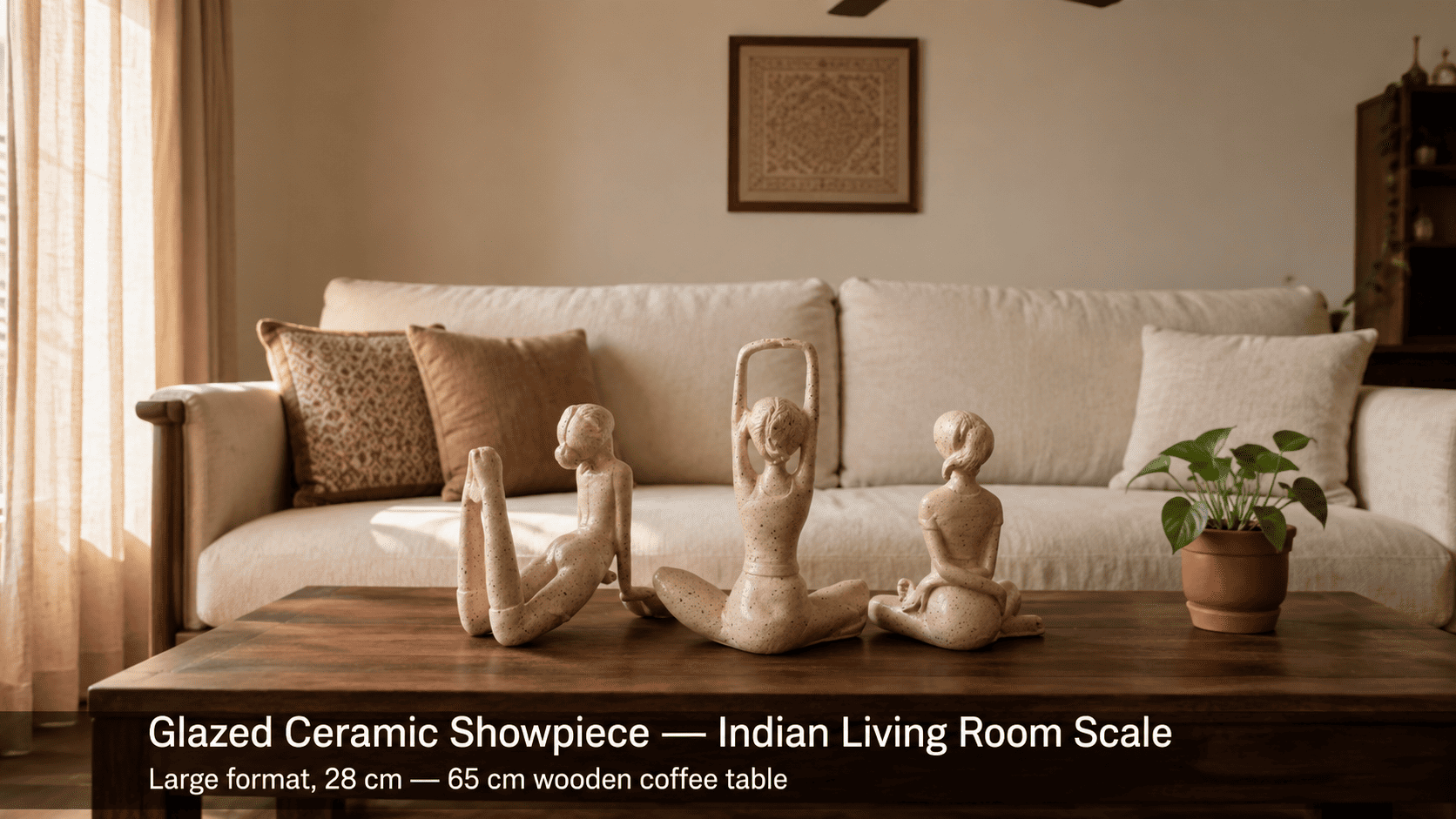
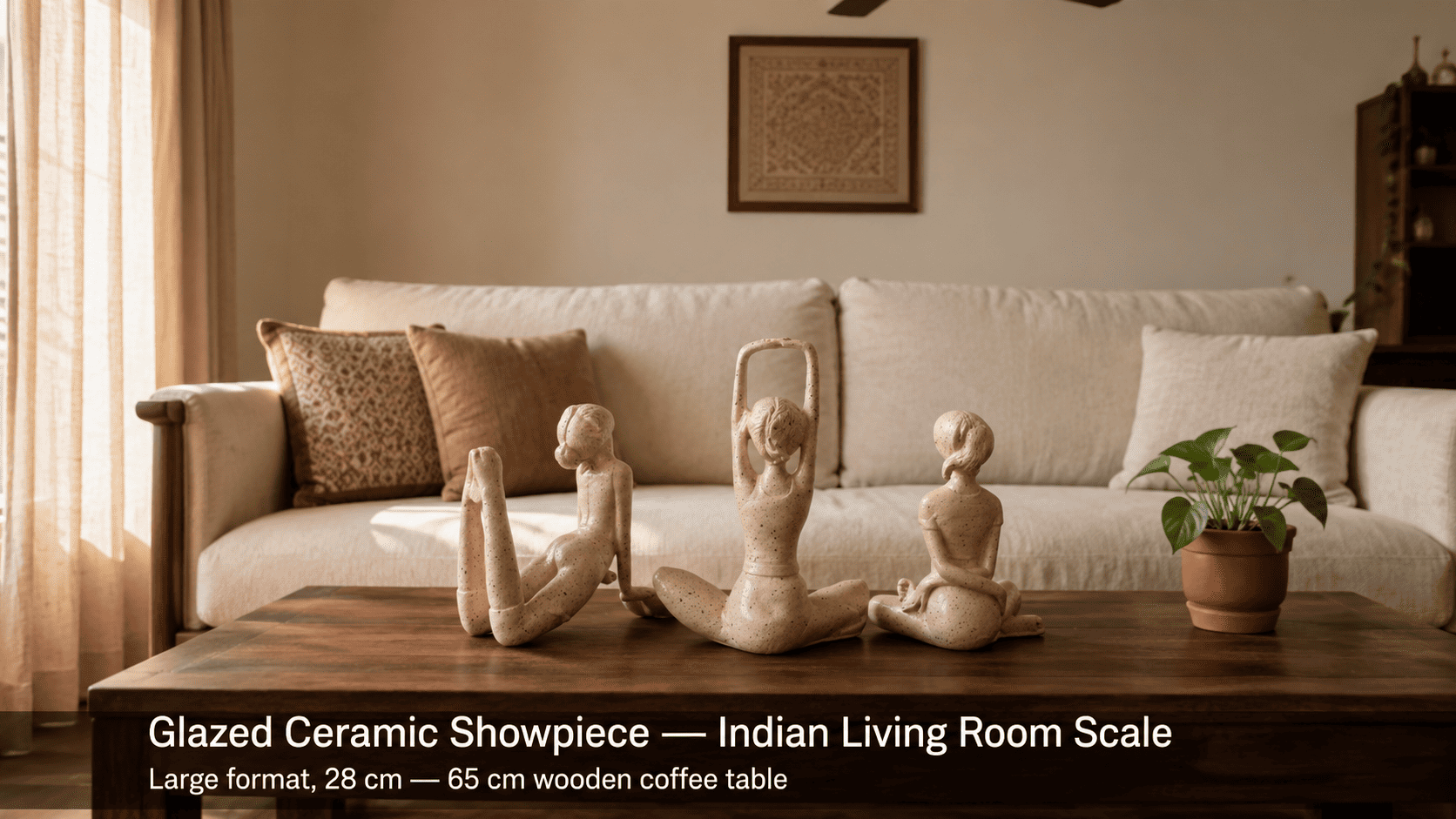
The correct material choice is not universal — it varies by the room's humidity profile, the surface dimensions the piece will occupy, and the visual weight the room's layout can absorb. A 34 cm tall ceramic focal-point piece on a 60 cm dresser console in a bedroom with an AC running eight-plus hours daily is a different decision from a 12 cm resin accent on a 28 cm floating shelf in a balcony-adjacent living space. The table below cross-references these variables using real specification data from Moolwan's home décor collection.
| Room Type | Target Surface | Surface Width | Recommended Material | Recommended Size & Weight |
|---|---|---|---|---|
| AC bedroom (humidity <60% RH) | Bedside table | 40–50 cm | Resin or Ceramic | 16–21 cm (Medium), 250–400 g |
| Living room, unconditioned or coastal | Coffee table / focal console | 60+ cm | Ceramic (85% RH rated) | 25–34 cm (Large), 400–600 g |
| Study / home office (AC, <35°C) | Desk or floating shelf | 28–45 cm | Resin (3H hardness for high-touch) | 10–16 cm (Small), 150–250 g |
| Kitchen counter / bathroom shelf | Counter or open shelf | Under 30 cm | Ceramic (closed-pore, moisture-resistant) | 10–16 cm (Small), 150–250 g |
Because surface dimensions, AC usage hours, and coastal proximity all shift the optimal material band for your specific home, browse the full material, size, and finish selection in Moolwan's home décor collection to verify the right piece for your layout before purchasing.
Design Rule
When placing statues or décor accents across multiple surfaces in the same room, apply Moolwan's 3-Surface Anchoring Rule: limit active décor display to a maximum of three surfaces per room, choose one material as the dominant (occupying two of the three surfaces), and use the contrasting material on the third surface only — because visual coherence in compact Indian rooms under 150 sq ft depends on material repetition creating a perceptual thread, while a single contrasting accent creates intentional focal tension without fragmenting the overall palette.
Does Statue Finish — Matte, Glazed, or Brushed — Affect Durability and Ageing?
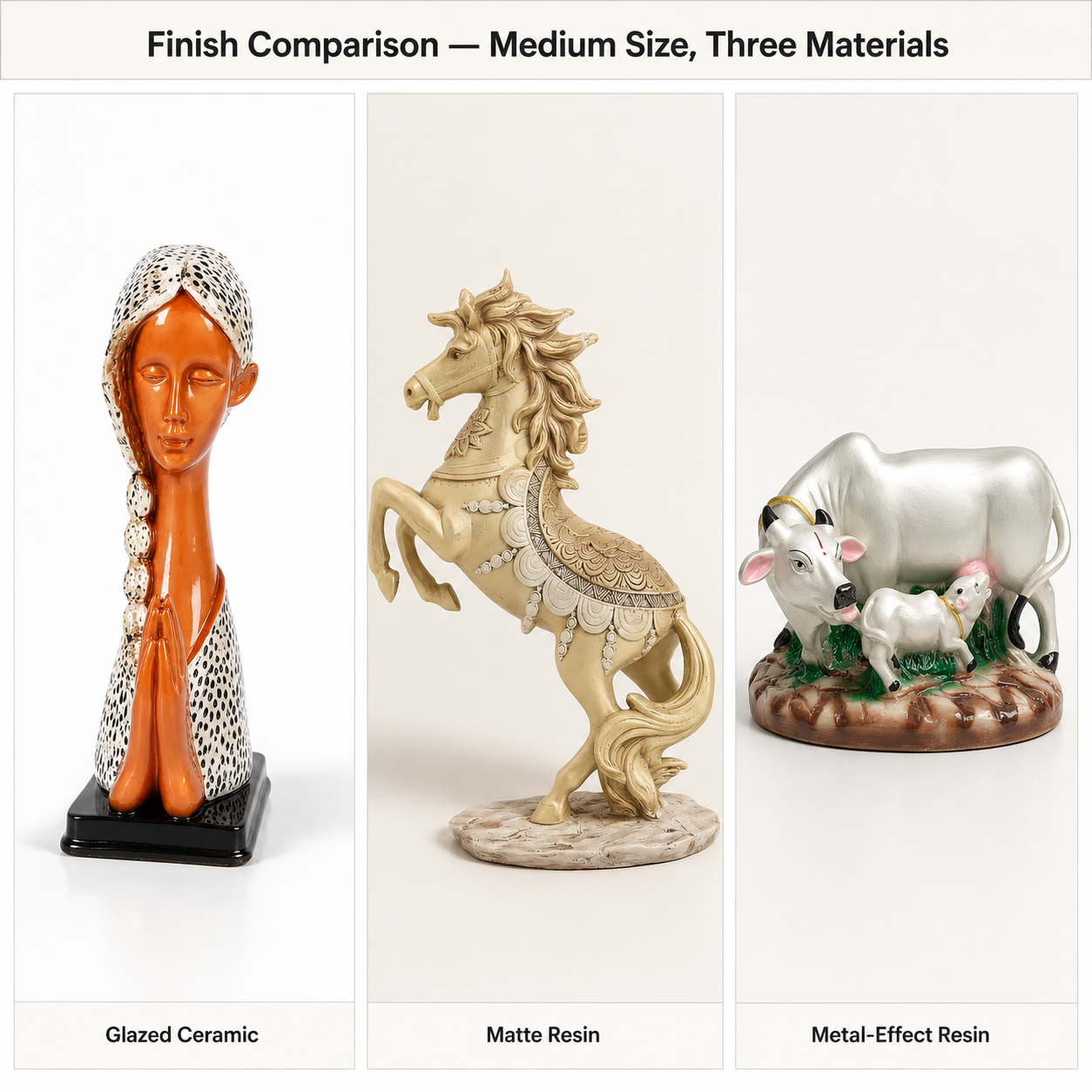
Finish type determines how a piece ages visually over a 3–5 year indoor lifespan, independent of the base material. Matte finishes on ceramic and resin age more gracefully than glazed or high-gloss finishes because the micro-textured surface scatters incident light at multiple angles simultaneously — a property called diffuse reflectance — which renders the micro-scratches accumulated through normal handling invisible to the naked eye at distances of 60 cm or more. A glazed or high-gloss surface, by contrast, reflects light at a uniform angle, and any micro-scratch disrupting that uniform reflection becomes visible as a dull streak or bright flare depending on viewing position.
Brushed metal-effect finishes on resin pieces occupy a middle ground: the intentional linear texture of a brushed finish introduces controlled directionality to light reflection, which makes shallow surface scratches less noticeable than on smooth gloss but more noticeable than on true matte. For living rooms with multiple natural and artificial light sources — the norm in open-plan Indian apartments — matte or satin-matte finishes are more forgiving across changing light conditions throughout the day.
For Indian homes where dust accumulation between cleaning cycles is a real variable (daily in many cities), glazed ceramic surfaces are easier to wipe clean because the non-porous glaze layer prevents particulate matter from bonding to the surface. Matte resin, while visually more forgiving of scratches, can trap fine dust in surface micro-texture and require a soft-bristle brush rather than a simple damp cloth for thorough cleaning. This is a maintenance trade-off buyers should weigh based on their cleaning frequency rather than purely on visual preference.
Ready to bring home a showpiece engineered to last 5-plus years in Indian humidity? Shop the full Moolwan home décor collection — manufacturer-direct, climate-rated, sized for Indian rooms.
Where Do Metal-Finish Statues Work Best in a Modern Indian Home?
Metal-finish statues — whether solid metal or resin pieces with a metal-effect coating — perform best as accent pieces in low-humidity, well-ventilated indoor positions: bookshelf niches, enclosed display cabinets, or air-conditioned study alcoves where ambient RH stays consistently below 55%. In these conditions, the oxidation risk that makes bare metal problematic in coastal cities is substantially reduced, and the visual contrast a dark bronze or brushed-gold finish provides against neutral greige or off-white walls creates the focal tension that modern minimalist interiors depend on for visual interest.
The weight range of metal-finish resin pieces (typically 150–400 g for small-to-medium formats) makes them well-suited for floating shelves with load ratings of 1–2 kg per bracket, which is the typical rating for plaster-drywall floating shelves common in Indian apartment construction. Solid metal statues in large formats (25–34 cm) can exceed 600 g and approach 1–1.5 kg, which requires verification of wall-anchor load ratings before placement — a step most buyers skip and then regret when a bracket pulls away from a hollow plaster wall.
How to Cluster Multiple Statues Without Making a Room Feel Cluttered
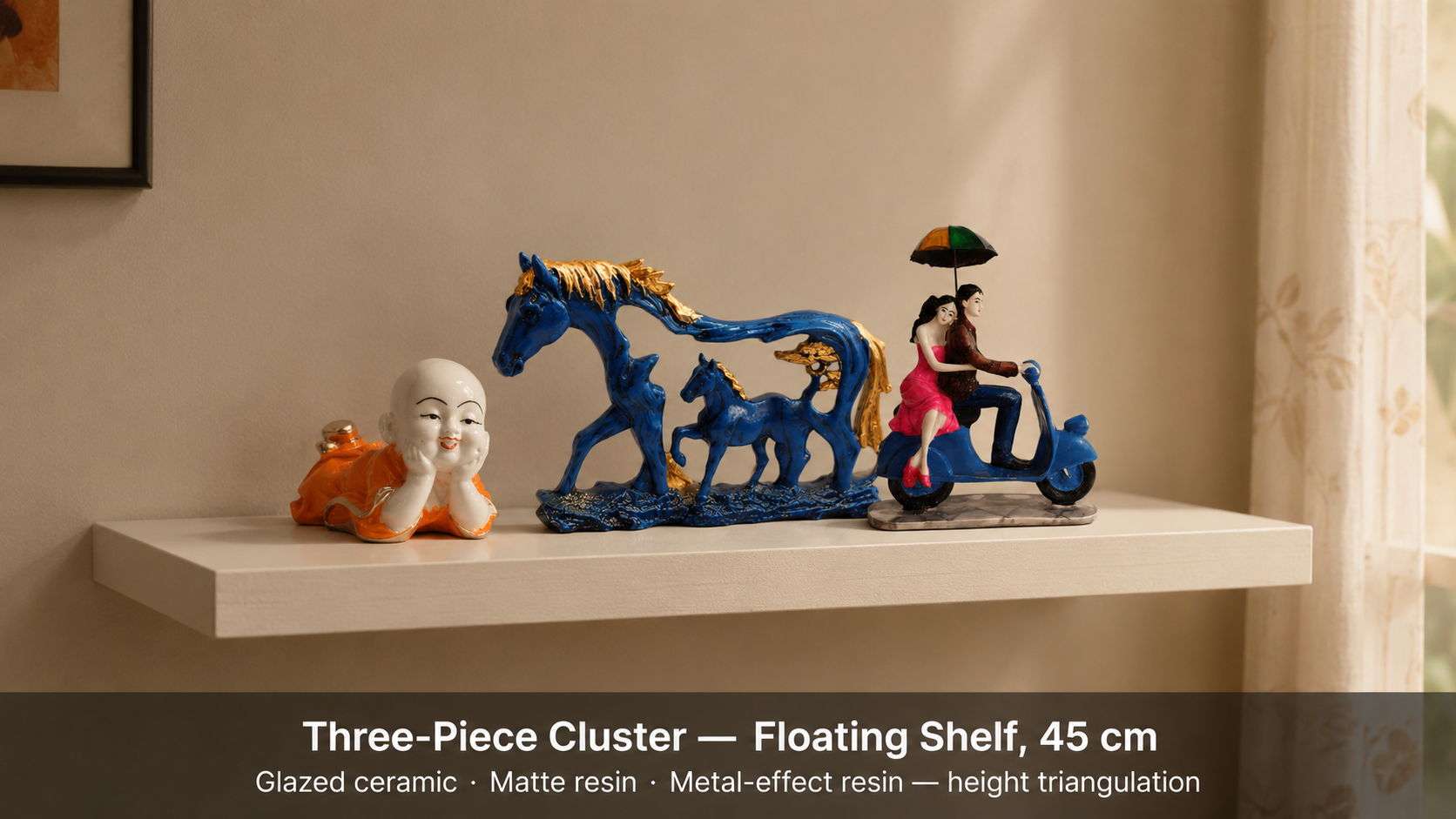
Grouping three or more décor accents on a single surface is the most common decorating mistake in compact Indian apartments because buyers place pieces at equal spacing and equal height, which creates a visual register that the brain reads as "display cabinet" rather than "curated composition." The principle that prevents this is called visual triangulation: arrange pieces so that their top edges form an imaginary triangle — one tall piece (25–34 cm), one medium (16–21 cm), and one small (10–16 cm) — which creates a rhythmic height variation that directs the eye through the composition rather than across it at a flat horizontal scan.
Material contrast reinforces this compositional hierarchy: placing a glazed ceramic tall piece next to a matte resin medium piece creates a surface-texture contrast that separates the two objects perceptually, even when the colour palettes are similar. This perceptual separation prevents groupings of 2–3 pieces from merging into a single undifferentiated visual mass at normal viewing distances of 1.5–2 m, which is the typical sofa-to-console distance in Indian living rooms under 150 sq ft.
Frequently Asked Questions
Is ceramic or resin better for a humid city like Mumbai or Kolkata?
Ceramic is the more durable choice in cities where monsoon-season humidity regularly exceeds 70–80% RH. High-fired ceramic at 92% clay composition is rated to 85% RH because the vitrification process at temperatures above 1,200°C eliminates the surface porosity through which moisture would otherwise be absorbed. High-purity resin (94% epoxy) tolerates up to 60% RH — adequate for air-conditioned interiors in these cities but insufficient for unconditioned rooms during peak monsoon. Moolwan engineers both materials to declared RH thresholds so buyers have a factual basis for placement decisions, not just a style preference.
Can I use metal statues in a coastal Indian city?
Bare or minimally coated metal statues begin surface oxidation at approximately 70% RH in salt-laden coastal air — conditions that exist year-round within 10–15 km of the Indian coastline. If a metal-finish piece is specifically desired for coastal homes, select resin-base pieces with a metal-effect coating rather than solid metal, and position them in air-conditioned rooms where RH stays below 55%. Inspect the lacquer coat annually and reapply if surface dulling or spot oxidation appears — typically every 18–24 months in coastal environments.
What size statue works on a standard Indian coffee table?
A standard Indian apartment coffee table measures 90–120 cm in length and 45–60 cm in width. At this surface scale, a large format décor accent (25–34 cm height, 400–600 g) provides sufficient visual presence without occupying more than 30% of the table's surface area — the threshold beyond which a single piece begins to compress the usable surface. For rectangular coffee tables, a grouping of one large (28–34 cm) and one small (10–14 cm) piece creates height variation while keeping the combined footprint under 40% of the table length.
Does Moolwan offer home décor pieces suitable as housewarming or wedding gifts?
Yes. Ceramic and resin home décor accents in the medium-to-large size band (16–34 cm) work well as housewarming and wedding gifts because they are neutral to the recipient's existing furniture palette, lightweight enough (250–600 g) for safe courier shipping, and positioned at a price point — manufacturer-direct, without distributor markup — that delivers visible quality at a gift-appropriate budget. Climate-rated construction (85% RH for ceramic, 60% RH for resin) means the piece is genuinely useful rather than decorative-only, which is the quality marker that distinguishes a meaningful gift from a generic one.
Choosing a showpiece that survives five-plus Indian monsoons without replacement is a better investment than cycling through cheaper pieces every two years — and the maths holds at every price band when you buy manufacturer-direct. Bring home a climate-rated ceramic or resin décor accent from the Moolwan home décor collection, where every piece is sized for Indian rooms, rated for Indian humidity, and priced without distributor markup. If you're comparing styles, the Moolwan modern home décor range curates contemporary abstract and sculptural accents for living rooms and consoles, while the Moolwan modern home décor items collection offers a broader selection across size bands and finishes — both worth browsing before your final decision.


