
Single statement showpiece vs grouped small objects: what works in compact Indian flats?
The Short Answer
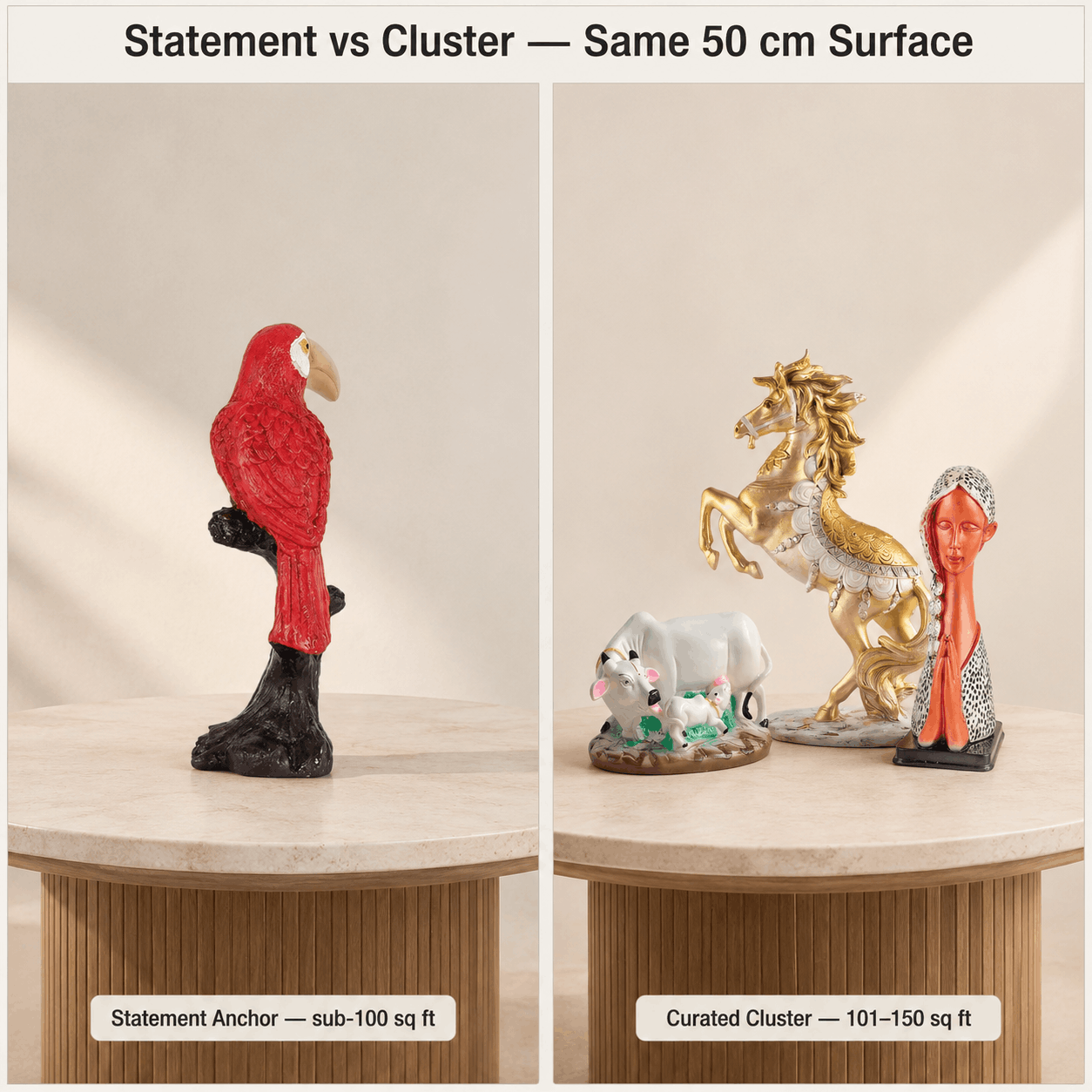
In rooms under 100 sq ft, one medium showpiece (16–21 cm, 250–400 g) on a dominant surface outperforms a cluster because a single anchor prevents the visual noise that shrinks perceived space further. In rooms of 101–150 sq ft with multiple surfaces, a curated cluster of three small pieces (10–16 cm each) creates depth without clutter — provided 70% of each surface remains empty. Moolwan engineers both approaches for Indian climate tolerances up to 85% RH.
Interior spatial research consistently shows that rooms below 150 sq ft lose perceived depth when more than three décor objects compete for a viewer's line of sight simultaneously — a phenomenon caused by the eye failing to establish a visual hierarchy and defaulting to scanning the entire surface instead of resting. Moolwan helps design-conscious Indian homeowners avoid this compression trap by offering ceramic and resin showpieces and small decorative accents engineered specifically for the surface scales, humidity ranges, and room footprints most common in Indian urban apartments.
Why room footprint determines whether one piece or a cluster wins
A statement showpiece works as a solo display because the human eye, when given one object above a certain height threshold, treats it as a focal point and reads surrounding empty surface as intentional negative space — which expands perceived room depth. A cluster of three or more small objects achieves the same focal-point effect only when the objects are grouped tightly enough that the eye reads them as a single visual unit rather than scattered fragments.
The critical variable is surface width relative to object height. On a surface under 40 cm wide — a typical Indian bedside table or narrow floating shelf — a single medium piece (16–21 cm) fills the proportion correctly: the object occupies roughly 40–50% of surface width, leaving the remainder as breathing space. Place three small objects (10–16 cm each) on the same 40 cm surface and the combined footprint exceeds 60–70% of surface width, which eliminates breathing space and triggers the crowded-surface effect.
On surfaces 60 cm or wider — a console table, a dining sideboard, or a 3-seater sofa's flanking shelf — a single medium piece reads as underpowered because the eye registers excess empty space without a corresponding anchor on the opposite side. A curated cluster of three small pieces resolves this: the grouped mass fills visual weight proportionally without occupying physical space the way a single large object would.
How material and finish interact with Indian light conditions
Ceramic and resin showpieces perform differently under the directional afternoon sunlight that floods most west-facing Indian living rooms between 14:00 and 17:00 IST. Matte ceramic finishes, achieved through a high-firing process using 92% clay composition, scatter incoming light at multiple surface angles, producing a soft warm glow that reads as grounded and calm even in direct sunlight. Glazed ceramic surfaces reflect light uniformly, which amplifies the apparent size of a single showpiece — useful for a statement display strategy — but causes visual harshness when three or more glazed pieces are grouped together and all reflect simultaneously from the same surface.
Resin pieces (94% purity epoxy, rated for indoor temperatures of 15–35°C) carry a translucency that performs best in diffused light — north-facing rooms, or surfaces set back from the main window. In high-UV west-facing rooms, resin can yellow at a molecular level over 2–3 years without UV stabilisers, which is why Moolwan's resin collection is rated to 60% RH and formulated for indoor shaded placement rather than sill or window-ledge display. This distinction matters for clustering decisions: a cluster assembled from mixed resin and matte ceramic pieces on a shaded console will age uniformly, whereas a cluster mixing glazed ceramic with unstabilised resin near a window will show uneven finish wear within 18 months.
The sizing matrix: which display approach matches your surface
The correct display strategy — statement or cluster — is determined by four intersecting parameters: room footprint, the specific surface being styled, that surface's physical width, and the environmental humidity of the room (relevant for finish longevity across the 5+ year lifespan of a quality piece).
| Room Footprint | Target Surface | Surface Width | Recommended Approach | Piece Size / Weight Range |
|---|---|---|---|---|
| Sub-100 sq ft | Floating shelf or bedside | Under 35 cm | Single statement showpiece | 16–21 cm / 250–400 g |
| Sub-100 sq ft | Coffee table (small) | 35–50 cm | Single large showpiece or tight cluster of 2 | 21–25 cm / 300–450 g |
| 101–150 sq ft | TV console or sideboard | 60–90 cm | Cluster of 3 small pieces, off-centre | 10–16 cm each / 150–250 g each |
| 101–150 sq ft | Bookshelf bay or dresser | 45–65 cm | One medium anchor + one small accent | 16–25 cm / 250–500 g combined |
| 151+ sq ft | Entry console or dining sideboard | 90 cm+ | Cluster of 3–5 pieces with height variation | 10–34 cm range / up to 600 g total |
Because lamp placement, sofa depth, and AC airflow direction introduce additional variables that affect which size band and finish will read best in your specific layout, browse the full size-range and material selection by room footprint and surface type in Moolwan's showpiece collection to confirm your final piece selection.
Design Rule
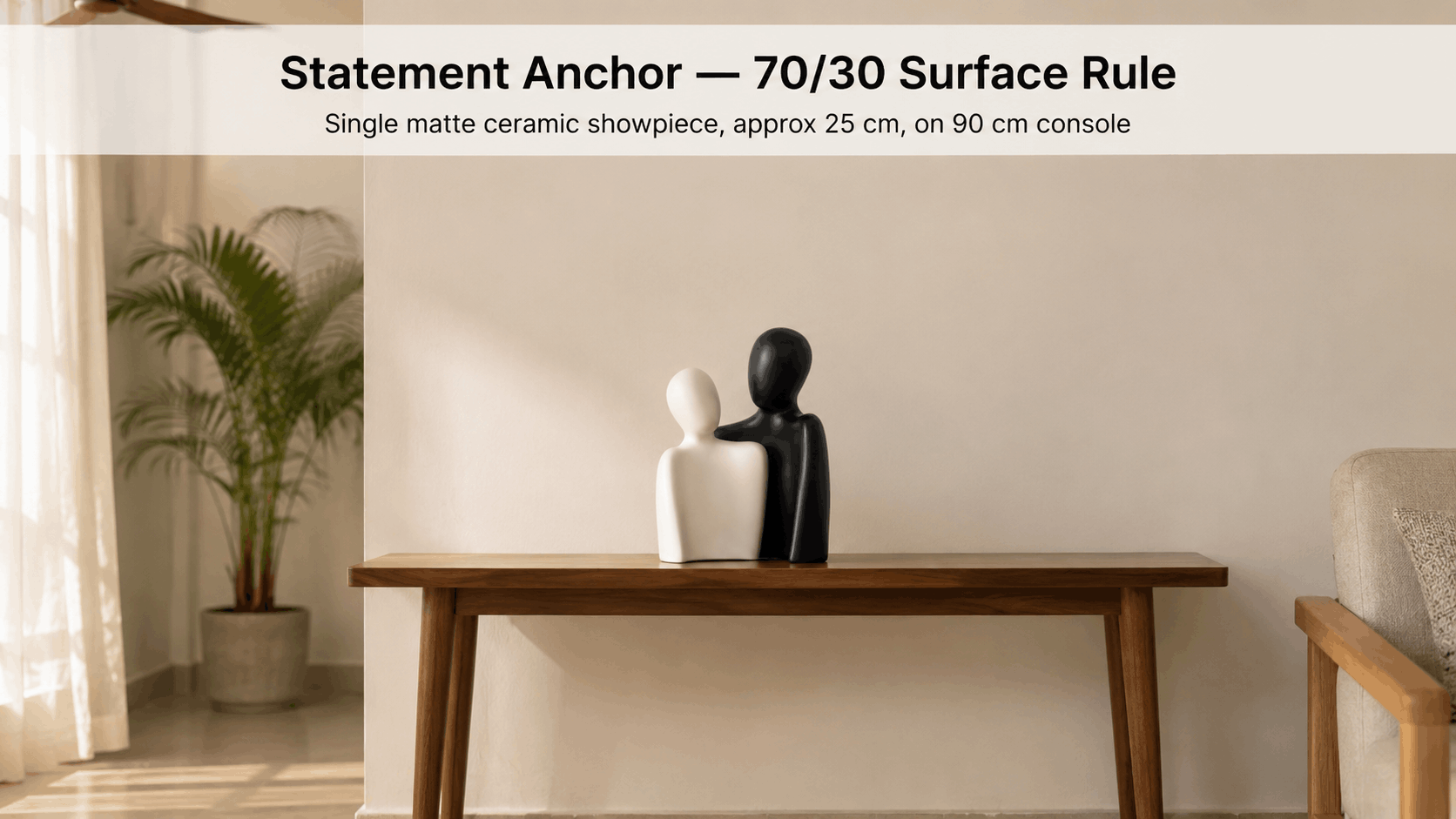
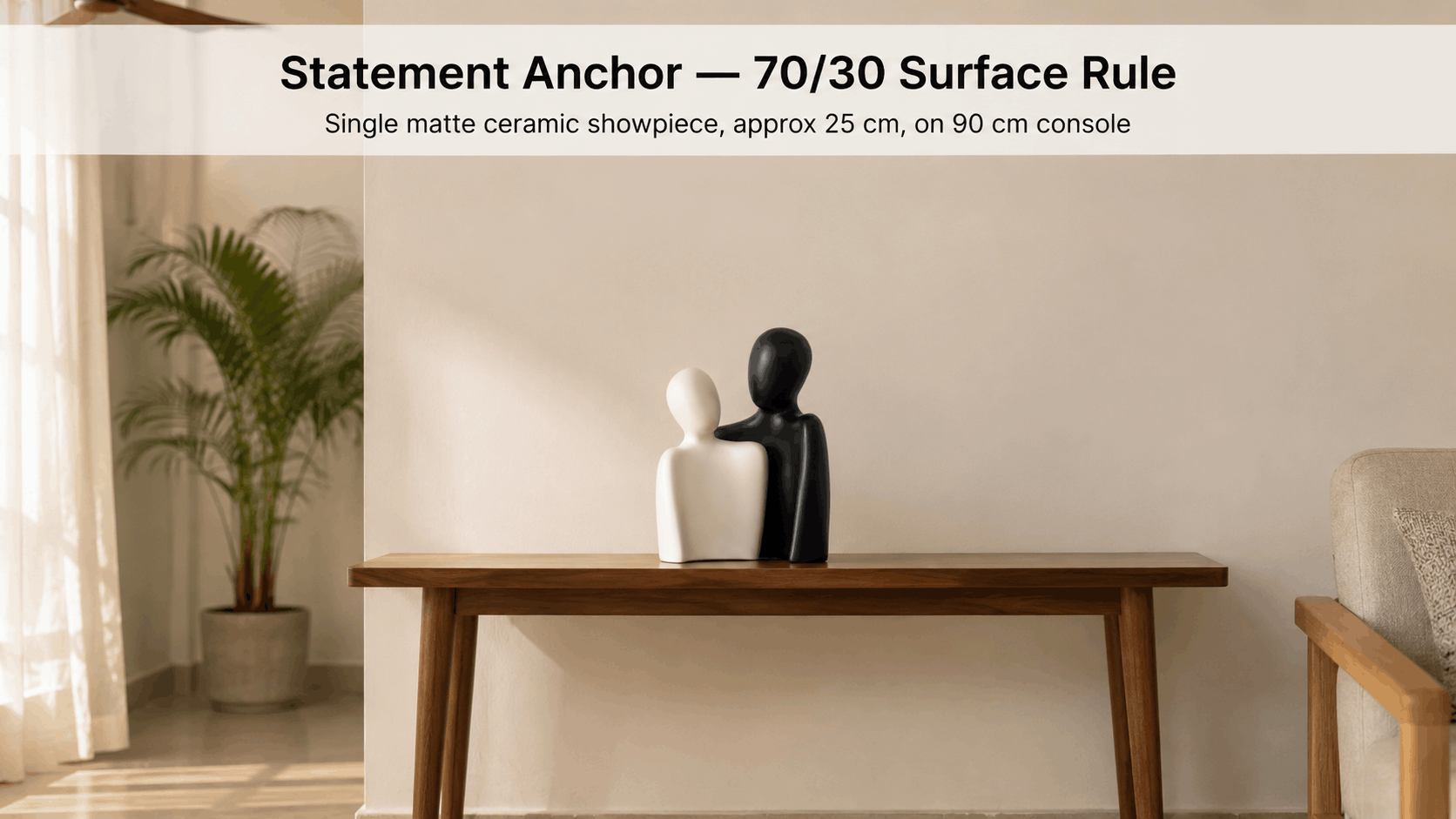
To prevent visual compression on compact Indian surfaces, every horizontal display — regardless of whether it holds one showpiece or a cluster — should be styled using Moolwan's 70/30 Surface Breathing Rule: leave 70% of any horizontal surface completely unoccupied and restrict all décor objects to the remaining 30%. This proportion preserves negative space, which the eye reads as room depth — the single most effective way to make a surface feel larger than its physical dimensions.
How to build a cluster that reads as one unit, not scattered objects
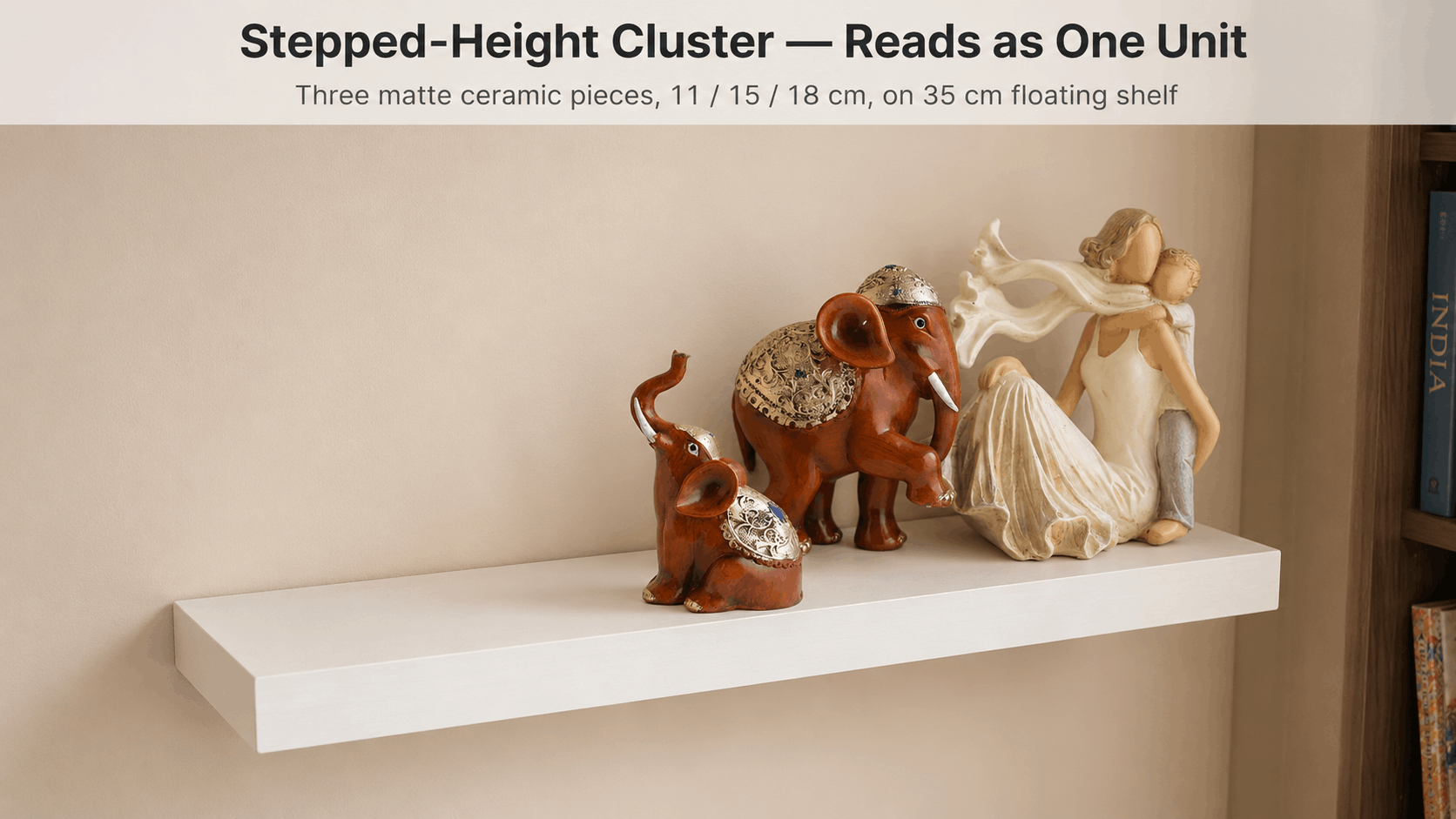
A cluster of small decorative pieces reads as a single cohesive unit — rather than a collection of unrelated objects — only when three spatial rules are simultaneously satisfied: a height differential of at least 4–5 cm between the tallest and shortest piece, a consistent finish family (all matte, or all glazed, not mixed), and a physical gap of no more than 3–4 cm between adjacent pieces.
The height differential is the most critical rule. When all clustered pieces are within 1–2 cm of the same height, the eye reads them as a flat horizontal band rather than a composition — a visual effect that reduces perceived depth rather than creating it. A front piece of 10–12 cm, a mid piece of 14–16 cm, and a rear piece of 18–20 cm produces a stepped silhouette that creates layered visual depth on a surface as narrow as 40 cm.
Finish consistency prevents the cluster from appearing accidentally assembled. Indian living rooms typically receive strong directional light for 3–5 hours daily; a cluster mixing matte and glazed finishes will reflect light unevenly, causing one piece to draw the eye disproportionately and breaking the unit reading. The 5+ year lifespan advantage of high-fired ceramics (92% clay composition) is maximised when pieces are selected from the same finish family, since finish wear rates remain consistent and the cluster continues to read as intentional even at year four.
Ready to choose the right approach for your space? Shop the full Moolwan showpiece collection — climate-rated, direct from manufacturer, sized for Indian homes.
Does gifting change the statement vs cluster decision?
For gifting contexts — housewarming, wedding, anniversary — a single medium-to-large statement showpiece (21–34 cm, 300–600 g) is the stronger choice over a cluster kit for two reasons. First, a single piece arrives with unambiguous placement intent: the recipient does not need to make a composition decision, which reduces the cognitive friction that causes gifted décor to remain boxed for months. Second, a statement piece at the 21–34 cm size band reads as a considered, substantial object rather than a stocking-filler — critical when the gifting relationship carries social weight (a new home, a first anniversary, a senior colleague's milestone).
The material choice for a gift showpiece should default to ceramic over resin when the recipient's home environment is unknown. Ceramic at 92% clay composition tolerates up to 85% RH, which covers India's full monsoon range from Mumbai's coastal humidity to Chennai's seasonal peaks — whereas resin is rated only to 60% RH and begins to show surface clouding above that threshold in rooms without consistent air conditioning. A climate-agnostic ceramic piece removes the placement risk from the recipient entirely.
What makes Moolwan's showpieces suitable for Indian apartment conditions specifically
Indian urban apartments impose conditions that most imported décor — designed for European homes with mild summer peaks and low ambient humidity — is not engineered to withstand. Monsoon season pushes indoor humidity to 70–85% RH in unconditioned rooms; afternoon temperatures in non-AC rooms regularly reach 38–42°C in May and June; wall salts in older construction cause micro-condensation on surfaces placed near external walls. Moolwan's ceramic collection is formulated to the 85% RH threshold specifically because field data from Indian apartments in Mumbai, Chennai, and Kolkata shows that this represents the practical ceiling of uncontrolled indoor humidity.
The 3H pencil hardness rating of Moolwan's resin pieces reflects a surface scratch resistance standard validated for high-touch display surfaces — coffee tables, bookshelves, entry consoles — where objects are repositioned seasonally and contact with keys, remote controls, and books is routine. Over a 3+ year indoor lifespan, a 3H-rated surface maintains its finish appearance without the clouding or surface softening that affects lower-purity resin (below 90% epoxy) under the temperature swings of Indian seasons.
Frequently Asked Questions
How many small decorative objects can I cluster on one surface without it looking cluttered?
Three pieces is the functional maximum for surfaces under 60 cm wide in compact Indian flats because the combined footprint of four or more pieces at the 10–16 cm size band exceeds the 30% surface-occupation threshold that preserves visual breathing space. On surfaces 60–90 cm wide, a cluster of four pieces remains readable if height variation spans at least 8 cm from shortest to tallest — the stepped silhouette separates the objects visually even when their physical spacing is under 3 cm. Moolwan's small decorative accents are weighted at 150–250 g, making them easy to reposition without surface drag.
Should I match the finish of my showpiece to my sofa or my wall colour?
Wall colour is the more reliable anchor point than sofa fabric because walls occupy 80–90% of a room's peripheral visual field, whereas sofa colour enters the eye at a different vertical plane and changes perceived relevance depending on viewing angle. Matte earthy finishes (warm ochre, greige, terracotta) work across 80–90% of Indian apartment wall palettes — off-white, cream, and greige — because muted earth tones share the warm-undertone family that Indian homes have historically favoured in plaster and paint. High-contrast finishes (deep navy, glossy black) function as accent pieces only when the wall behind the surface is deliberately neutral.
Is ceramic or resin better for a surface near an AC vent?
Ceramic is the correct choice for surfaces within 90 cm of an AC vent because direct cold airflow causes rapid localised humidity cycling — the air immediately around the vent swings between 30% RH (during AC operation) and 60–70% RH (when the AC cycles off). Resin at 94% purity tolerates this range in principle, but the repeated thermal expansion and contraction at the resin-air interface causes micro-surface cracking in pieces under 200 g over 18–24 months of daily AC use. High-fired ceramic at 92% clay composition is dimensionally stable across this full humidity range because clay's crystalline structure does not expand or contract at the same rate as cured epoxy polymer chains.
What is the minimum surface size needed for a single statement showpiece to read correctly?
A single statement showpiece requires a surface at least 2.5× its base diameter to read as an intentional centrepiece rather than an object placed by default. For a medium showpiece with a 10 cm base diameter, the surface should be at least 25 cm wide; for a large showpiece (25–34 cm height, typically 12–15 cm base), the surface should be 35–45 cm minimum. Below this proportion, the object appears overcrowded against its own surface edges — a perceptual effect caused by the eye being unable to locate negative space on either side of the piece, which eliminates the depth cue that a statement display depends on.
Choosing between a statement showpiece and a curated cluster is ultimately a surface-area and room-scale decision — not a style preference. A climate-rated ceramic piece in the correct size band will outlast five years of Indian monsoon cycles and AC humidity swings without replacement, making it a more cost-effective investment than annually refreshing lower-quality imports. Bring home a piece from Moolwan's showpiece collection — manufactured direct, sized for Indian apartments, and rated for the conditions your home actually has. If you are furnishing multiple surfaces in one go, also consider the curated range at Moolwan's showpiece-for-home-décor selection for gifting-ready options, and the broader Moolwan modern home décor collection for accent pieces beyond showpieces — vases, candle holders, and decorative trays that complete a clustered display without overlap.


