
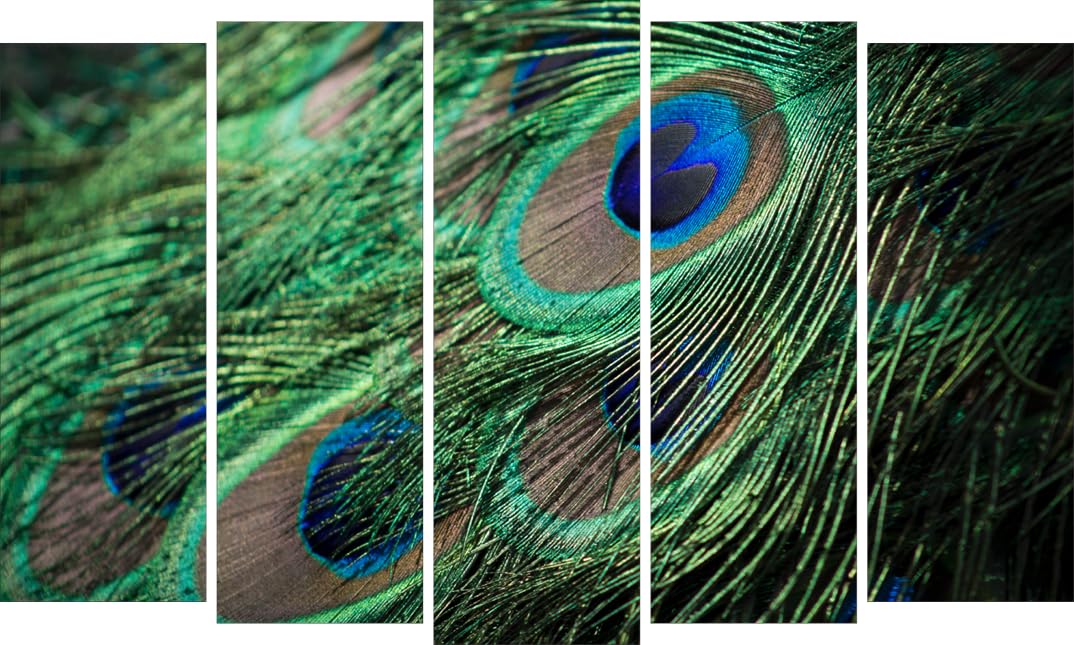
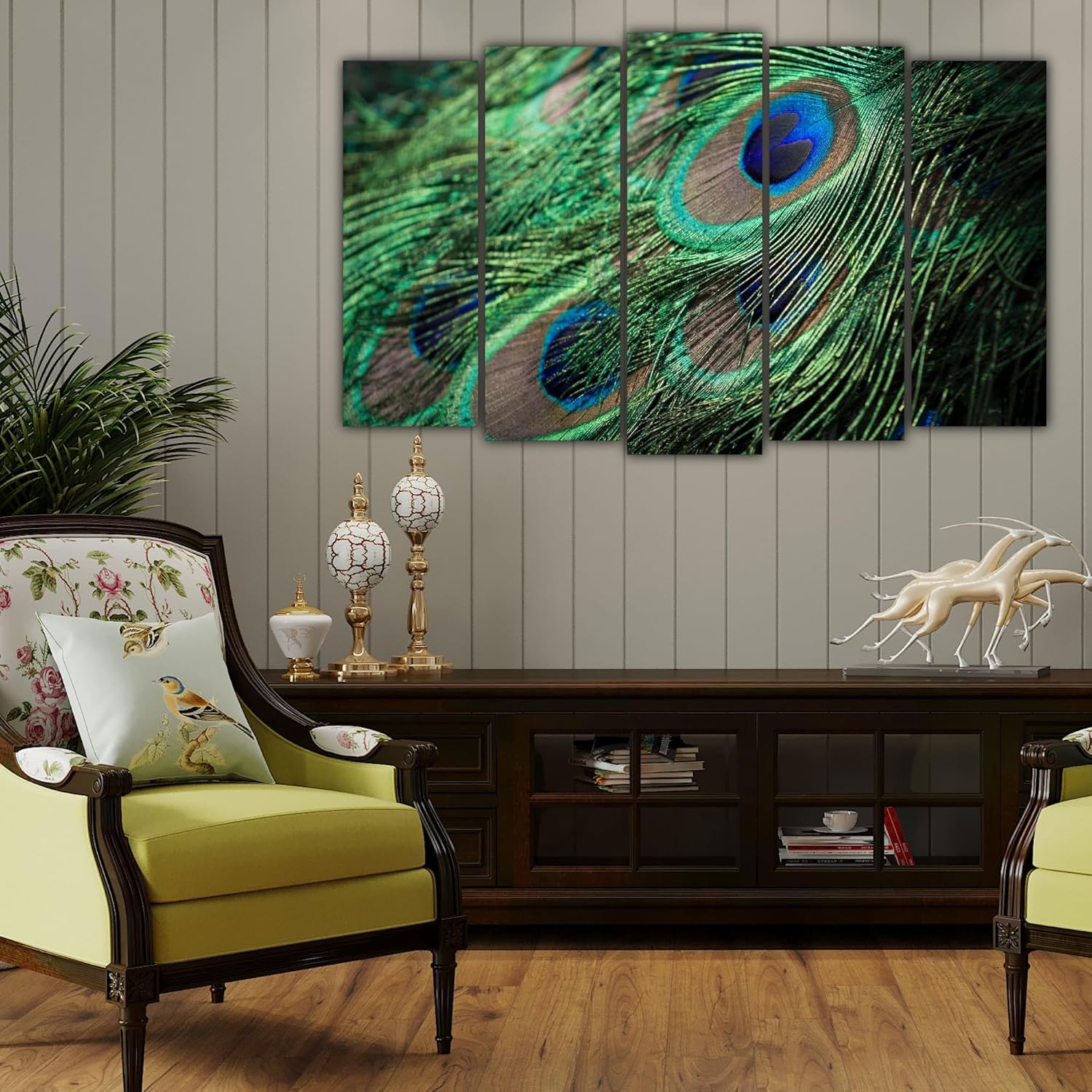
Strut Your Stuff: Peacock Feathers Photography Framed Wall Art in Multi-Panel Majesty (150x76cm)
You may also like

Strut Your Stuff 5-Panel Peacock Feather Photography Canvas Wall Art (127x76cm) - Nature Photography Print
THE SPECIFIC FIT RECOGNITION
You might have browsed dozens of peacock wall art options by now. Some were too small—60cm looked lost on your 12-foot living room wall, floating awkwardly with too much empty space around it. Some were too large—150cm would work, but only if your wall is completely blank with no windows, no side furniture, no other elements competing for space. You probably kept coming back to this size—127cm—because it feels substantial without being overwhelming. But you want to be sure.
Here's why this is the one: 127cm covers about one-third of a standard 12-foot (360cm) living room wall—leaving 115cm of breathing room on each side. This creates visual balance without crowding. Your wall probably has other elements—maybe a window 3-4 feet from your sofa edge, maybe side tables with lamps, maybe a wall-mounted AC vent you're working around. The 127cm width works with these elements instead of fighting them. And at 76cm tall, this fits comfortably under 8-10 foot ceilings without reaching awkwardly high. The five-panel vertical layout (each panel about 24cm wide with thin gaps) creates height emphasis that makes your room feel taller, more spacious.
And the colors—these aren't the bright, almost neon peacock blues you see in cheaper prints that clash with everything. These are jewel-tone blues. Deep, saturated blues with emerald greens and burnt-gold accents that read as rich, not garish. Your living room walls are probably cream, off-white, or light beige—most Indian apartments are. Your furniture is probably wooden (teak or sheesham) or brown/beige fabric. These peacock feather colors will feel like they were chosen specifically for that combination, not like you forced a bold statement piece into a space that wasn't ready for it.
DIMENSIONAL MATHEMATICS - WHY 127CM WORKS ON 12-FOOT LIVING ROOM WALLS
Why 127cm Works on 12-Foot Living Room Walls (and What Happens If You Go Smaller or Bigger)
Your living room wall is probably 10 to 12 feet wide (300-360cm in most Indian 2BHK and 3BHK apartments). The ceiling is probably 8 to 10 feet high. Here's the visual math:
127cm canvas on a 12-foot (360cm) wall:
116cm of space on the left side
116cm of space on the right side
Coverage ratio: Canvas covers 35% of wall width
Effect: Anchored, intentional, balanced—not floating, not dominating
Now consider your furniture arrangement:
Your sofa is probably 6-8 feet (180-240cm) wide, sitting 6-12 inches from the wall
Hanging height: 20-25cm above sofa top puts canvas center at 140-160cm from floor (perfect eye level when viewed from 8-10 feet away)
Side elements: You probably have a side table (18-24 inches wide), floor lamp, or window within 3-4 feet of sofa edge
The 127cm width spans the main seating zone without crowding your side furniture or blocking architectural elements
If you went with 90cm instead:
25% wall coverage—looks like an accent piece, not a focal point
On a 12 ft wall, you'll have 135cm of empty space on each side
Effect: Your eye constantly notices all that empty wall space
Specific problem: You'll probably end up buying matching side pieces to fill the void, spending more money to fix the proportion issue
If you went with 150cm instead:
42% wall coverage—works if you have a completely blank wall
But if you have a window 4 feet from your sofa, or side tables and lamps, the 150cm width will feel tight
Effect: Makes the room feel fuller, but potentially cramped
Specific problem: You'll constantly be adjusting furniture positions to make it work, or the canvas will visually crowd out your window
The 127cm is the balanced choice: fills the wall without dominating it, works above standard Indian sofas without overwhelming the room, leaves space for side tables and floor lamps to exist comfortably.
And at 76cm tall, this sits proportionally under 8-10 foot ceilings. From your sofa (8-10 feet away), you see the complete composition—the repeating peacock eye patterns creating rhythm across all five panels. Walk up close, you see the photographic detail—the individual feather barbs, the color gradients in each eye. Both viewing distances matter, and this size works for both.
The five-panel vertical layout creates another benefit: instead of one wide horizontal rectangle, you get five 24cm-wide vertical panels. This draws the eye upward, making your ceiling feel higher than it actually is. In apartments with standard 8-9 foot ceilings, this vertical emphasis makes the room feel more spacious.
THE QUALITY QUESTION - PHOTOGRAPHY PRINT VS PAINTED CANVAS
Why Photography-Based Canvas Looks Different (and Why That Matters for Peacock Feathers)
You've probably seen painted peacock canvas art—artistic interpretations with brushstrokes, abstract peacock forms, stylized feather patterns. Those have their place. But this is photographic printing on canvas, and that distinction matters when your subject is peacock feathers.
Here's why: peacock feathers are nature's masterpiece of microscopic detail. Each "eye" has concentric rings of color—burnt sienna fading to mint green, electric blue grading to deep indigo, metallic gold highlights catching light at specific angles. The individual barbs create texture. The way light refracts through the feather structure creates that signature iridescent shimmer.
Painted interpretations simplify this. They capture the general form, the basic color palette, but they lose the photographic detail that makes peacock feathers mesmerizing up close.
Photographic printing preserves it. When you stand two feet from this canvas, you see the actual feather structure. The color gradients aren't brush-blended approximations—they're captured directly from real peacock plumage. The texture isn't painted texture—it's the actual visual texture of overlapping barbs and barbules.
This is printed using eco-solvent inks on 340 GSM cotton canvas. Not dye-based inks that fade in six months. Not thin poster-weight canvas that looks cheap. The same quality standards as Moolwan's painted canvas collection—UV-resistant inks, moisture-resistant coating, 1.5-inch kiln-dried pinewood frames—but with photographic-level detail instead of artistic interpretation.
Why does this matter in your home? Because peacock imagery in Indian culture carries significance. It's not just decoration—it represents beauty, grace, protection (peacock feathers in pooja rooms), cultural pride (national bird). A photographic print feels more authentic than a stylized artistic version. It feels like bringing actual peacock beauty into your home, not someone's artistic idea of what peacock beauty looks like.
And aesthetically: the photographic realism means this works in both traditional and contemporary interiors. In a traditional home with antique furniture and silk curtains, it reads as respectful nature documentation. In a modern minimalist apartment, it reads as sophisticated nature photography. Painted peacock art tends to lean one direction or the other—this adapts to your existing aesthetic.
COLOR & DESIGN PSYCHOLOGY - JEWEL TONES IN INDIAN HOMES
Why These Specific Blues and Greens Actually Work in Your Home (When Most Don't)
Here's the color problem with most peacock art: the blues are too cool-toned. Pure cyan, bright turquoise, electric blue—these look stunning in photos shot with perfect white balance and professional lighting. In your actual living room with cream walls, warm LED bulbs (3000K), and brown wooden furniture? They look jarring. They feel cold. They don't integrate.
These peacock feather colors are different.
The blues here aren't pure blues—they're blues with warmth. There's enough violet and indigo in the deep blue "eyes" that they don't read as stark. The emerald greens have enough yellow undertone that they lean warm, not clinical. The gold accents (from the feather shafts and highlights) tie everything together with warmth.
In your cream-walled living room: The golds echo your wall tone. The greens provide color without clashing. The blues add depth without feeling cold.
Against wooden furniture: The natural browns in your teak coffee table or sheesham TV unit complement the burnt sienna tones in the feather details. This isn't fighting your furniture—it's working with it.
Under warm LED lighting (evening): The colors deepen. The blues look richer, almost navy in shadow areas. The greens glow. The golds shimmer. This is when guests see your walls, and this is when the photographic detail really shows.
In natural daylight (afternoon): The colors brighten without washing out. If your living room faces east or west and gets 2-3 hours of direct sun, the UV-resistant inks mean these colors won't fade or shift. Two years from now, the blues will still be blues, not that faded grayish-blue you see in cheap marketplace prints.
The 5-panel layout also affects color perception: Because the peacock eye pattern repeats across five separate panels, you get rhythm and movement. Your eye travels left to right, catching different peacock eyes, different color intensities, different feather angles. This creates visual interest without chaos—structured beauty, not random color splashes.
Cultural context matters too: Peacock colors in Indian aesthetics have history. These aren't imported Pinterest trends. Peacock blues and greens appear in traditional silk sarees, temple paintings, Tanjore art, miniature paintings. Using peacock imagery in your home feels culturally grounded, not like you're copying Western design blogs. Your mother-in-law will see peacock feathers and think "beautiful, auspicious" not "why did they choose this modern thing?"
INSTALLATION REALITY - HANGING 5-PANEL CANVAS IN RENTALS
How to Actually Hang This Without Losing Your Rental Deposit
You're in a rental. Your deposit is ₹40,000 or ₹60,000 and you'd very much like to get it back. So when you see "5-panel wall mounting required," your immediate anxiety is: "That's 10 anchor holes. Am I about to ruin this wall?"
Here's the actual reality: Yes, this requires more holes than single-panel canvas. But the holes are still small, still easily patchable, still deposit-safe.
What you're actually drilling:
10 anchor holes total (2 per panel for 5 panels)
Each hole: 6mm diameter, 30-40mm deep
For comparison: The holes from your curtain rod brackets are bigger (8-10mm). The holes from mounted shelves are bigger (10-12mm). These canvas anchor holes are smaller than the holes left by standard picture frame nails.
The included hanging template solves the alignment anxiety. This is the part that stops most people from attempting multi-panel installation—getting all five panels level, evenly spaced, perfectly aligned. The template is a paper guide showing exactly where to drill for each panel. You tape it to your wall at the height you want, mark all 10 drilling points with a pencil, remove the template, drill. No measuring, no math, no hoping you got the spacing right.
Installation sequence:
Decide on height (20-25cm above sofa top is standard)
Tape template to wall at that height, use a level to ensure it's straight
Mark all 10 drilling points through the template
Remove template
Drill the 10 holes (6mm drill bit for drywall, 6mm masonry bit for concrete)
Insert wall anchors (included—both concrete and drywall types)
Screw in hooks
Hang each panel on its two hooks
Step back, admire, make micro-adjustments if needed
Time required: 25-30 minutes for someone doing this for the first time. 15-20 minutes if you've hung canvas before.
When you move out: Fill the 10 holes with wall putty (₹50 from any hardware store), sand smooth with fine sandpaper, touch up with a tiny bit of paint. Your landlord will never notice. Total repair cost: ₹200 and 30 minutes.
For concrete walls (common in older buildings): Use the included masonry anchors and a 6mm masonry drill bit. The process is identical, just slightly slower drilling.
For drywall (common in newer apartments): Use the included plastic drywall anchors. These expand behind the drywall when you insert the screw, distributing weight safely.
Weight distribution: This 5-panel canvas weighs 3kg total. That's 600g per panel, distributed across two anchor points per panel. Each anchor is holding 300g. This is well within the safe load for both drywall and concrete anchors. Your canvas isn't going anywhere.
And if you're truly paranoid about drilling? Command strips rated for 2kg work for individual panels of this canvas. You'd need 10 strips total (2 per panel). But honestly, at this price point and for something you'll have on your wall for years, proper anchors are worth the 10 small holes.
COMPARISON - 5-PANEL PHOTOGRAPHY VS OTHER PEACOCK OPTIONS
How This Compares to Other Peacock Wall Art You've Probably Seen
You've been browsing. You've seen the options. Here's how this stacks up:
Strut Your Stuff 5-Panel Photography (127x76cm, ₹2,496):
35% coverage on 12 ft walls
Photographic detail—you see individual feather barbs
5-panel vertical layout creates height emphasis
Jewel-tone colors (deep blues, emerald greens, golds)
Each panel 24cm wide—creates rhythm and movement
Best for: Living rooms with 8-10 ft ceilings where you want height emphasis
Single-Panel Painted Peacock (120x80cm, similar price):
33% coverage on 12 ft walls
Artistic interpretation—brushstrokes visible
Single canvas—simpler to hang (2 holes vs 10)
Colors tend toward brighter, more saturated
Best for: If you prefer painted art style over photographic realism
Single-Panel Photography (150x100cm, ₹4,200-₹4,596):
42% coverage on 12 ft walls
Same photographic detail as this
Larger visual impact, but requires more blank wall space
Single panel 150cm wide—creates horizontal emphasis
Best for: Larger rooms (14+ ft walls) or if you have completely blank walls
3-Panel Peacock Abstract (90cm total width, ₹2,200):
25% coverage on 12 ft walls
Looks too small on standard living room walls
Abstract style—no photographic detail
Best for: Smaller walls (hallways, bedrooms) or as accent pieces
The 127cm 5-panel photography hits the middle ground: substantial enough to be a focal point (not an accent piece like 90cm), proportional enough to work with standard Indian furniture layouts (not overwhelming like 150cm), photographic enough to show detail (not simplified like abstract), segmented enough to create visual interest (not static like single-panel).
If your wall is 12 feet, your ceiling is 8-9 feet, and you have standard furniture with side tables and lamps, this is the size and format that works without requiring you to rearrange your entire room.
REALISTIC EXPECTATIONS - WHAT THIS LOOKS LIKE IN YOUR ACTUAL HOME
What This Will Actually Look Like Under Your Lighting, With Your Walls, In Your Real Room
Product photos are professionally shot. Perfect lighting, perfectly styled blank walls, carefully coordinated furniture. Your home isn't that. So here's what this peacock canvas will actually look like in your real living room:
In morning light (if your room faces east): Colors appear slightly cooler and brighter. The blues look vivid. The greens look fresh. The photographic detail is most visible—you'll notice the feather texture clearly. This is the best light for appreciating the photography aspect.
In afternoon light (if your room faces west): Colors warm up significantly. The deep blues shift toward violet. The greens look richer. The gold accents catch the light and almost shimmer. If you have 2-3 hours of direct afternoon sun hitting this wall, this is when the UV-resistant inks matter—cheap canvas would be visibly fading within 6 months. This won't.
In evening/artificial light (warm LED, 3000K—most common in Indian homes): The entire piece deepens. Blues look almost navy in the darker portions. Greens glow warmly. Golds blend with your cream walls. This is when guests typically visit, and this is when the colors look most cohesive with Indian furniture and décor. The 5-panel format creates subtle shadows between panels, adding depth.
Against cream walls (most common): The peacock colors pop without clashing. The cream provides neutral space that lets the jewel tones be the focus. You don't need to paint your walls or change your existing décor—this integrates as-is.
Against off-white walls: Similar to cream, but colors appear slightly cooler. Still works beautifully—the warmth in the blues and greens prevents them from feeling stark.
Against light yellow walls (that builder-standard shade many apartments have): The yellow wall tone harmonizes with the gold feather accents. The blues and greens provide cool-toned contrast that prevents the room from feeling too warm. This combination actually works better than most people expect.
Above brown/beige sofas (most common Indian furniture): The natural browns in your sofa complement the burnt sienna and brown tones in the peacock feather shafts and shadows. This looks intentional, like you chose the canvas to work with your furniture, not despite it.
With wooden furniture (teak, sheesham, mango wood coffee tables and TV units): The nature photography theme echoes the natural wood. It feels cohesive—both elements celebrate natural beauty. This is why peacock photography works better than, say, geometric abstracts in traditionally furnished Indian homes.
The honest test: Three months after you hang this, when you're no longer consciously noticing it every time you enter the room, does it still make the space feel complete? Or does it start to feel like visual clutter you're tuning out? Quality canvas art that's properly sized for your space becomes part of the room's permanent atmosphere. It's just there, making everything feel more finished, without demanding constant attention.
CLIMATE SURVIVAL - PEACOCK CANVAS THROUGH INDIAN MONSOONS
Will This Survive Mumbai Monsoons, Delhi Summers, and Bangalore's Humidity Swings?
Peacock feather photography on canvas faces the same climate challenges as any canvas art in Indian conditions. The difference is whether it's built to handle them.
Your climate reality:
Mumbai: 80% humidity during monsoons, salt air year-round
Bangalore: 15°C night to 28°C afternoon temperature swings
Delhi: 5°C winters, 45°C summers, sudden monsoon downpours
Chennai: Relentless UV exposure plus 80% coastal humidity
Pune/Hyderabad: Dust followed by heavy rain
How this canvas handles it:
Moisture-resistant coating: The polymer seal on the canvas surface prevents humidity absorption. During monsoons, water vapor can't penetrate the canvas fibers. This prevents the rippling and warping you see in cheap canvas after one monsoon season. Test: if you were to put a water drop on the surface (don't actually do this), it would bead up and sit there instead of soaking in.
Kiln-dried pinewood frame: The frame wood is dried to 12% moisture content before assembly. This is below India's typical atmospheric moisture levels (14-18%), which means the wood won't absorb humidity and expand. Your frame stays dimensionally stable through multiple monsoon cycles. Cheap canvas uses raw or poorly dried wood—you'll see warping within 6-12 months.
UV-resistant eco-solvent inks: These won't fade in direct sunlight. If your living room wall faces east or west and gets afternoon sun, this canvas will look the same two years from now. The blues stay blue (not faded gray-blue), the greens stay vibrant (not washed-out mint), the details stay sharp (not sun-bleached into blur).
Sealed edges: The canvas wraps around the frame edges and those edges are sealed. Dust can't accumulate between canvas and frame. Insects can't nest in the gap (yes, silverfish love dark canvas-to-wall spaces in humid climates). Moisture can't enter from behind.
The practical test: After two monsoon seasons in Mumbai or two summers in Delhi, will this still be drum-tight with consistent colors? With proper climate-appropriate construction, yes. With marketplace cheap canvas, absolutely not—you'll be replacing it.
WHO THIS IS ACTUALLY FOR
Is This Peacock Canvas Right for Your Specific Space?
Not every canvas works in every home. Here's who this works for:
This works beautifully if you:
Have 10-12 ft living room walls with 8-10 ft ceilings (standard 2BHK/3BHK)
Want a focal point above your sofa that's substantial but not overwhelming
Appreciate nature photography over abstract or heavily stylized art
Have cream, off-white, or light-colored walls
Have brown, beige, or wooden furniture that you want to complement (not replace)
Want something culturally appropriate that family members will approve of
Are in a rental and need deposit-safe installation (small patchable holes)
Value photographic detail that looks good both from across the room and up close
This might not work if you:
Have very small walls (under 8 feet wide—go with 90cm instead)
Have very large walls (14+ feet wide—consider 150cm or multiple pieces)
Have extremely modern minimalist aesthetics with stark white walls and metal furniture
Prefer completely abstract art with no recognizable subjects
Want something with cooler tones (grays, blacks, whites)
Can't install anything on walls (though Command strips work for this weight)
The style fit: Peacock imagery in Indian homes has cultural grounding. This isn't trying to be Scandinavian minimalism or industrial loft aesthetics. It's nature photography that works in actual Indian apartments with actual Indian furniture. If you want your wall art to feel like it belongs in your home rather than looking like you imported someone else's aesthetic, this is a safe choice.
The practical fit: At ₹2,496 for 127x76cm with quality materials and climate-appropriate construction, this is priced as a medium-term investment (3-5 years), not a disposable decorative piece (6-12 months). If you're the kind of person who's still researching after three weeks because you want to get it right the first time, that carefulness will be rewarded here—this is built to last as long as your attention to detail suggests you need it to.
WHAT PAST CUSTOMERS ACTUALLY EXPERIENCED
We asked people who bought Moolwan's peacock and nature photography canvas 6-12 months ago what surprised them:
"The photographic detail was sharper in person than online. You can see individual feather barbs when you stand close. Eight months later with afternoon sun on that wall, the colors haven't shifted at all."
— Meera, Bangalore (purchased peacock photography canvas)
"The 5-panel installation was easier than I thought. The template made it foolproof. I was done in 25 minutes including drilling."
— Rajesh, Mumbai (purchased multi-panel nature canvas)
"My mother-in-law loves it. I was worried peacock colors would be too bold but she said it 'suits the house' and brings good energy."
— Priya, Pune (purchased peacock canvas)
"Survived one full monsoon season with zero warping. The cheap peacock canvas I had before started rippling after the first monsoon."
— Arun, Chennai (purchased photography canvas)
"The frame quality is solid. You can tell it's real wood, not MDF with vinyl. Sits perfectly flush against the wall."
— Kavita, Hyderabad (purchased 127cm canvas)
THE PRACTICAL STUFF YOU ACTUALLY CARE ABOUT
Shipping time: 5-6 days to metro cities (Mumbai, Delhi, Bangalore, Chennai, Hyderabad, Pune). Add 1-2 days for tier-2/3 cities. You'll receive tracking within 24 hours of order.
Packaging: Triple-layer protection—bubble wrap + cardboard corner protectors + outer carton. The 5-panel canvas ships as assembled panels, protected individually and boxed together. Shipping is rough on multi-panel pieces—this packaging is why yours arrives undamaged.
COD available: Yes, across all Indian cities where courier services operate. Delivery person will let you inspect the outer box for major damage before payment. If the carton is crushed or torn, refuse delivery and contact customer service.
Video your unboxing: Start recording before cutting the tape. Show all box sides, then unwrap. If there's damage, video proof makes replacement claims instant. Without video, proving shipping damage is nearly impossible.
Replacement policy: Full replacement for manufacturing defects (print errors, frame issues, canvas tension problems) and shipping damage (bent frames, torn canvas, broken corners). Requires unboxing video. Replacement ships within 2-3 days of approved claim.
What's NOT covered: Buyer's remorse ("it looks bigger/smaller than expected"), subjective color complaints ("the blue looks different on my screen" when it matches product photos), damage after installation, normal wear after 6+ months.
Color accuracy: Your phone/laptop screen affects how colors appear. Product photos are shot in calibrated natural daylight. If your screen is set to "warm" or "cool" temperature, the canvas will look different than the photo on your specific screen. The actual canvas matches properly calibrated displays. The blues are deep jewel-tones (not bright cyan), the greens are emerald (not lime), the golds are burnt metallics (not yellow).
Cleaning: Dust with dry microfiber cloth every 2-3 weeks. No water. No chemicals. No polish. The moisture-resistant coating means dust sits on the surface—wipes away clean.
WHY MOOLWAN INSTEAD OF MARKETPLACE PEACOCK CANVAS FOR ₹1,200
You've seen similar peacock canvas on marketplace sites for ₹1,200-₹1,500. Similar photos, similar size descriptions. So why spend ₹2,496 here?
Because you're not comparing the same product. You're comparing a product photo to an actual canvas that will hang on your wall for 3-5 years.
What the ₹1,300 price difference actually buys:
Manufacturing consistency, not random sourcing: Marketplace sellers switch suppliers monthly based on who's cheapest. You don't know what canvas weight, what inks, what frame quality you're getting. Moolwan manufactures in-house—every peacock canvas uses the same 340 GSM cotton, eco-solvent inks, kiln-dried pinewood. Consistency is guaranteed, not luck-based.
Climate-tested materials: Marketplace canvas is optimized for generic conditions. The inks aren't UV-rated. The wood isn't moisture-treated. Six months of Indian monsoons will show you why it was cheaper—rippling, fading, warping.
Complete installation hardware included: Marketplace listings say "hardware included" then send two tiny hooks that can't hold 3kg safely. Moolwan includes proper concrete anchors, drywall anchors, D-rings, and the critical piece—the alignment template. You're not making extra trips to figure out what to buy.
Real customer service: When marketplace canvas arrives damaged (happens often with fragile 5-panel pieces), you're fighting third-party sellers through ticket systems. Maybe they respond, maybe they don't, maybe you get refunded, maybe you don't. Moolwan's replacement policy is clear: video your unboxing, show damage, get replacement shipped.
Properly sized for Indian spaces: The 127x76cm dimension is calculated for Indian 12 ft walls and 8-10 ft ceilings. The 5-panel vertical format is designed for height emphasis in standard apartment ceiling heights. These aren't international sizes randomly converted—these are tested proportions for actual Indian homes.
The ₹1,300 difference isn't markup. It's the cost of not replacing faded, warped canvas after 8 months. It's not losing a Saturday hunting for the right wall anchors. It's your canvas still looking sharp and professional 2 years from now instead of looking like something you've been meaning to replace.
THIS IS WHERE YOU DECIDE
You've read 2,800 words about peacock feather canvas. You know about GSM weights, UV-resistant inks, kiln-dried frame wood, 5-panel alignment templates, and coverage ratios for 12-foot walls.
You know more about canvas quality than 95% of people who buy wall art online.
So here's the decision: you can keep scrolling. Save this to your "maybe later" list. Revisit it next month during another browsing session. Keep that wall empty while you continue researching.
Or you can acknowledge that you've done the work. You know this is the right size for your 12 ft wall. You know the quality will survive Indian monsoons. You know installation is straightforward with the template. You know ₹2,496 is fair for canvas that lasts years, not months.
Your wall has been empty long enough. You've been comparing options long enough. You know what you need.
The decision isn't whether to buy wall art. It's whether you're ready to stop researching and start living in a room that finally feels complete.
QUICK SPECS SUMMARY
Product: Strut Your Stuff 5-Panel Peacock Feather Photography Canvas Wall Art
Size: 127cm (W) x 76cm (H) x 0.6cm (D)
Weight: 3 kg
Panels: 5 vertical panels (approximately 24cm wide each)
Format: Nature photography print on canvas
Canvas: 340 GSM cotton with moisture-resistant polymer coating
Inks: Eco-solvent, UV-resistant (no fading in direct sunlight)
Frame: 1.5-inch kiln-dried pinewood (12% moisture content)
Colors: Deep jewel-tone blues, emerald greens, burnt golds
Wall coverage: 35% of 12 ft (360cm) walls—balanced, not overwhelming
Best for: Living rooms, bedrooms, offices with 8-10 ft ceilings
Installation: 25-30 minutes, includes template + concrete & drywall anchors
Climate: Tested for 70-85% humidity, 5°C-45°C temperature range
Price: ₹2,496
Shipping: 5-6 days to metros, 6-8 days to tier-2/3 cities
COD: Available
Warranty: Full replacement for manufacturing defects and shipping damage
SEARCH-FRIENDLY FAQ SECTION
Will 127cm peacock canvas look too big above my 6-foot sofa?
No. The 127cm width actually works well above 6-8 foot sofas. It provides visual balance without overwhelming. The key is wall width, not just sofa width—on a 12 ft wall, 127cm covers 35%, leaving breathing room for side furniture and other elements.
How is photography canvas different from painted peacock art?
Photography canvas shows actual peacock feather detail—individual barbs, natural color gradients, realistic texture. Painted art offers artistic interpretation. Both are valid; photography feels more authentic and works in both traditional and modern settings.
Can I hang this in a rental apartment without losing my deposit?
Yes. The 10 anchor holes (6mm diameter, 30-40mm deep) are easily patchable with wall putty when you move out. Smaller than curtain rod holes. Total repair cost: ₹200 and 30 minutes.
Will the colors fade in direct sunlight?
No. The eco-solvent UV-resistant inks are designed to withstand direct sun exposure without color shift. Even with 2-3 hours of afternoon sun daily, colors remain stable for years.
How long does shipping take?
5-6 days to metro cities (Mumbai, Delhi, Bangalore, Chennai, Hyderabad, Pune). Add 1-2 days for tier-2/3 cities. Tracking provided within 24 hours.
Is the 5-panel format hard to install?
No. The included template shows exactly where to drill all 10 holes. You tape the template to your wall, mark the spots, drill, hang. 25-30 minutes total, no professional needed.
Will this survive Mumbai monsoons without warping?
Yes. The moisture-resistant canvas coating and kiln-dried wood frame (12% moisture content) prevent humidity absorption and warping. Tested for 70-85% humidity conditions.
What if the canvas arrives damaged?
Video your unboxing from start (before cutting tape). If damaged, send video to customer service for instant replacement claim. New canvas ships within 2-3 days.