
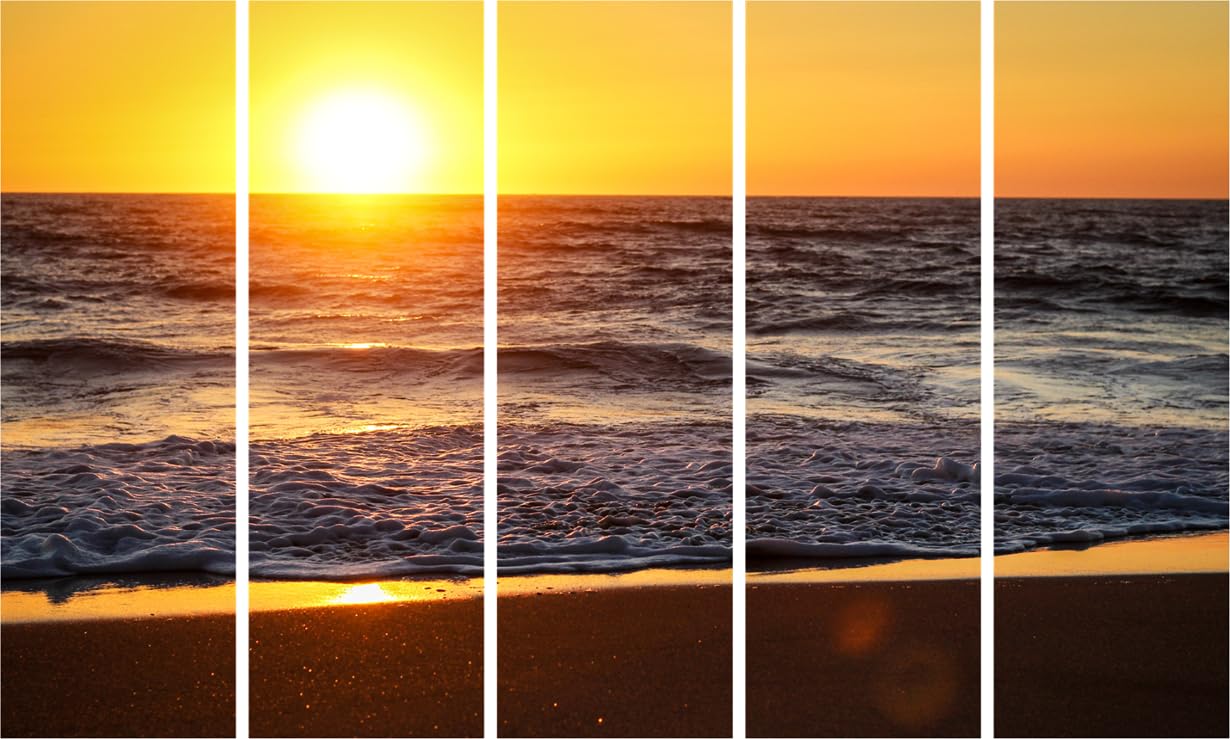
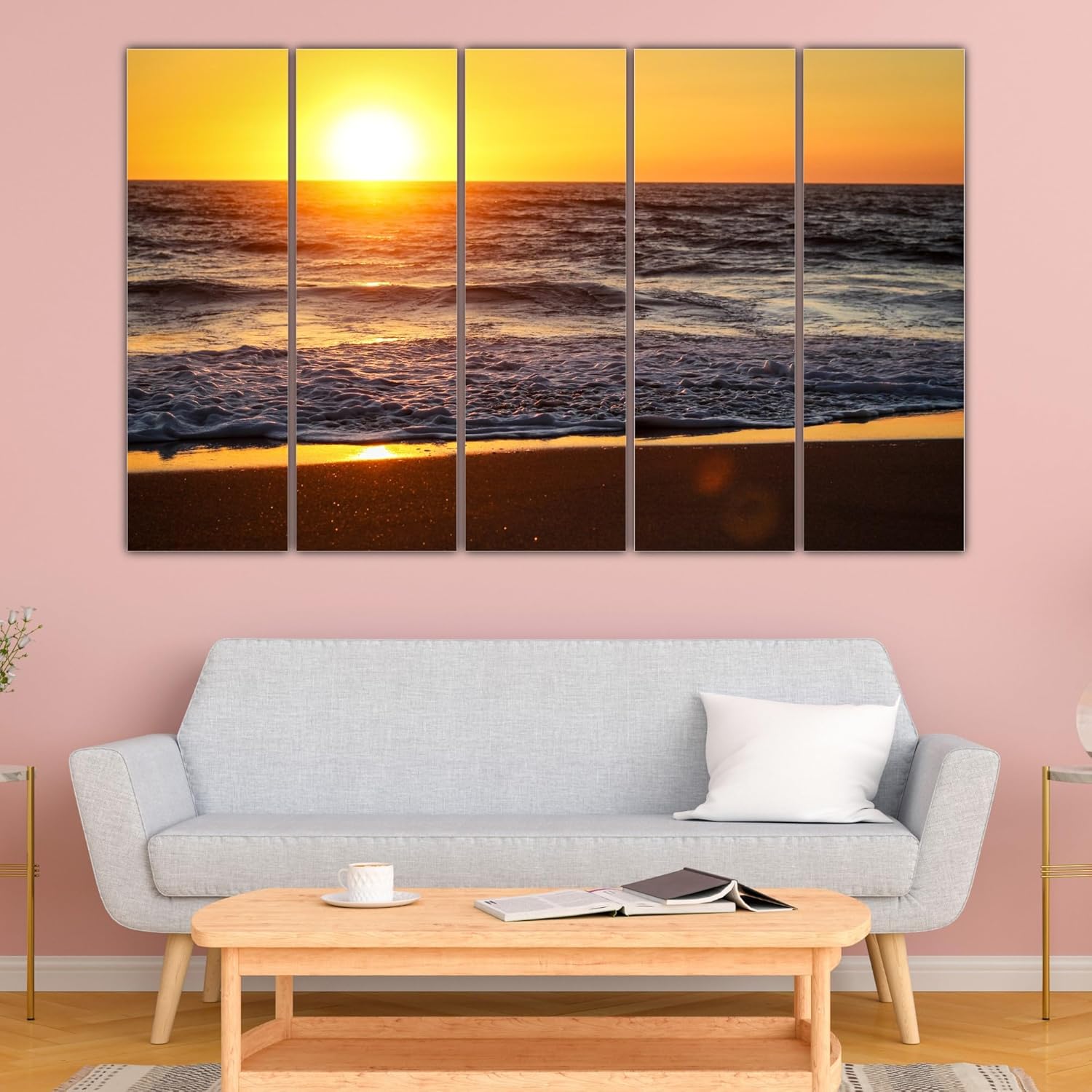
Sunset Soiree Multi-Frame Wall Art That'll Make Your Walls Blush (150x76cm Framed)
You may also like

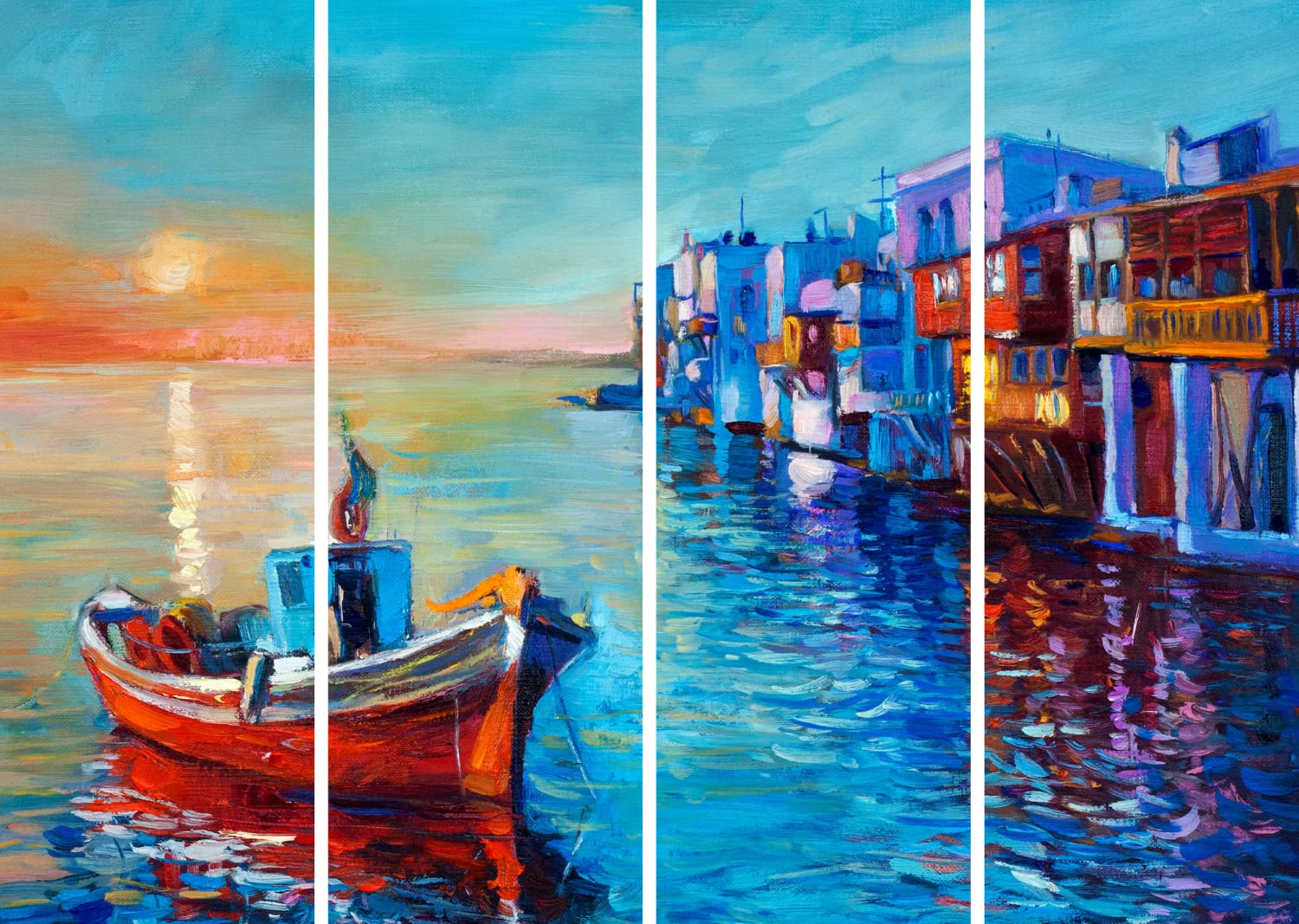
Moolwan 5-Panel Beach Sunset Canvas Wall Art Painting (150x76cm) - Multi-Frame Ocean Horizon Art
You might have browsed dozens of sunset canvas paintings by now. Some were too small—lost on your wall like an afterthought. Some were overwhelming—dominating the room instead of complementing it. You probably kept coming back to pieces around 150cm—because intuitively, it feels right for a standard Indian living room wall. But you want to be sure before spending on something you'll look at every single day.
Here's what makes this 150cm 5-panel beach sunset different from the thirty-odd options you've probably saved: the proportions are designed for how Indian homes are actually built. Your living room wall is probably around 12 feet wide. Your sofa is probably 6-8 feet. Your ceiling is probably 9-10 feet. This canvas sits in that sweet spot where it commands attention without overwhelming your space.
The five-panel split creates visual rhythm—each vertical frame captures a different moment of the scene. The sun sits perfectly across the second and third panels. The foam-tipped waves roll through panels three and four. The wet sand reflection anchors the final panel. It's not just a sunset; it's five coordinated pieces that work as one continuous horizon.
Why 150cm Works on 12-Foot Walls (and What Happens If You Go Smaller or Bigger)
Your wall is probably around 360cm (12 feet). This 150cm canvas covers approximately 42% of that width—leaving 105cm of breathing room on each side. That's the visual balance interior designers call "comfortable presence."
Go smaller—say 100cm—and you're at 28% coverage. The art starts looking lonely, floating in empty space. Your guests' eyes won't know where to focus.
Go bigger—say 180cm—and you're at 50% coverage. Now it feels aggressive. The wall becomes "the sunset wall" instead of a living room with beautiful art.
At 150cm, you get presence without dominance. The math works: 105cm left, 150cm canvas, 105cm right. Symmetrical. Intentional. Balanced.
The 76cm height matters too. Hung at eye level (centre at 150cm from floor), the top edge sits around 188cm—comfortably below a standard 9-foot ceiling with 85cm clearance. No cramped feeling. No awkward gaps.
The Colour Science: How Golden Sunset Tones Look Against Cream Walls
Most Indian homes have cream, off-white, or light yellow walls. Here's why that works in your favour with this piece.
The golden-orange sky creates warmth without clashing. Against cream walls, these sunset tones feel like natural extensions of your existing palette—not sudden interruptions. The deep ocean blue provides contrast without coldness. It anchors the warm tones and prevents the piece from feeling one-note.
The tan sandy beach and white wave foam? They bridge the gap between your wall colour and your furniture. If your sofa is brown leather or beige fabric (as most Indian living room sofas are), these sandy tones create visual continuity from wall to seating.
In morning light, the oranges appear more golden. In evening LED light, they deepen toward amber. Both work. The ocean blue stays consistent throughout—it's the stabilising element that keeps the piece grounded regardless of lighting.
Rental-Friendly Mounting: How to Hang Without Losing Your Deposit
This weighs 3kg total—distributed across five panels. Each panel carries roughly 600 grams. That's lighter than most framed photographs.
For mounting, you need five small nails or picture hooks. No heavy-duty anchors. No drilling into concrete. Standard wall plugs work perfectly on Indian walls (brick with plaster coating).
The pre-framed construction means zero assembly. No stretching canvas, no buying separate frames, no trying to align five loose pieces. Everything arrives mounted on 1.5-inch pinewood frames, ready to hang.
Total wall damage: five small nail holes. Easily filled with white putty before move-out. Your ₹50,000 rental deposit stays safe.
Installation time: 15-20 minutes. Measure 150cm from floor to centre point. Mark five level points 30cm apart. Hammer hooks. Hang panels. Done.
How This Compares to the 127cm and 180cm Sizes You've Been Considering
vs 127cm (smaller): You lose 23cm of visual impact. On a 12-foot wall, 127cm covers 35% instead of 42%. The five-panel effect feels compressed. The sun appears smaller. The waves feel rushed. If your wall is 10 feet or smaller, 127cm works better. For standard 12-foot walls, you'll likely wish you'd gone bigger.
vs 180cm (larger): You gain 30cm but potentially overwhelm the space. 180cm works beautifully in dedicated media rooms or walls over 14 feet. For typical Indian living rooms with windows, doors, and furniture competing for attention, 150cm is the safer choice.
vs single-panel canvas: Multi-panel creates depth perception. Your eye travels across five frames, experiencing the sunset as a journey rather than a snapshot. Single panels feel flatter, more poster-like.
vs marketplace canvas at ₹800: The difference is in what you don't see initially. Cheap canvas fades within 18 months—especially in Indian humidity. The inks bleed. The frame warps. This uses UV-resistant eco-solvent inks on 340 GSM cotton canvas with moisture-resistant coating. The pinewood frame is kiln-dried to 12% moisture content—it won't warp when Mumbai monsoons hit 85% humidity.
What This Will Look Like in Your Living Room (Not Just Online Photos)
Real expectations for real Indian homes:
The colours are vibrant but not neon. This isn't a digitally enhanced screensaver. It's a beach sunset that looks photographed, not illustrated.
The canvas has texture. You'll see the weave pattern up close. From your sofa (2-3 metres away), the texture blends into smooth gradients.
The frame adds 3cm on each side. So the visible art is actually 144cm wide within a 150cm framed piece. Account for this in your measurements.
Panel gaps are approximately 2cm each. Four gaps = 8cm of white wall showing between panels. This is intentional—it's what creates the multi-panel effect. It's not a defect.
Direct sunlight will create minor glare on the splash-proof surface. Position away from windows that get afternoon sun, or angle slightly downward.
From across a 14x16 foot living room, you'll see the full panoramic effect. From 1 metre away, you'll notice the brushstroke-style print texture. Both viewing distances work—this piece is designed for Indian room proportions where you experience both perspectives daily.
Quick Specifications
- Dimensions: 150cm (W) x 76cm (H) x 0.6cm (D)
- Weight: 3000 grams (3 kg total)
- Panels: 5-panel multi-frame design
- Canvas: 340 GSM cotton with moisture-resistant coating
- Frame: 1.5-inch kiln-dried pinewood
- Ink: UV-resistant eco-solvent (fade-resistant)
- Surface: Splash-proof vivid printing
- Mounting: Pre-framed, ready to hang
- Delivery: 5-6 days metro cities, 6-8 days tier-2/3