
Right Bedroom Furniture Layout for Your Room Size | Moolwan
The Right Bedroom Furniture Layout for Every Indian Room Size
The Short Answer
In Indian bedrooms under 150 sq ft — the national apartment norm — the bed must occupy the longest unbroken wall, leaving a minimum 24-inch (60 cm) clearance path on at least one side, because anything narrower forces lateral shuffling that degrades daily movement. Moolwan's bedroom décor pieces are sized and weighted (150 g–600 g) specifically for the compact surface scales these layouts create: bedside tables under 50 cm wide, dresser consoles under 90 cm wide.
Across India's metro and tier-1 cities, 2BHK and 3BHK apartments routinely deliver individual bedrooms between 90 and 160 sq ft — and the furniture layout decisions made in that constrained footprint determine whether a room functions comfortably or creates friction every single day. Moolwan helps design-conscious Indian homeowners turn these dimensional constraints into deliberate, liveable layouts by combining spatial engineering with décor that is sized, weighted, and styled for the exact surfaces these layouts produce. The rules below are not aesthetic preferences — they are derived from ergonomic clearance standards and the physical realities of Indian room proportions.
Where Should the Bed Go in a Small Indian Bedroom?
The bed should be placed against the longest unbroken wall, with its headboard flush to that wall, leaving the maximum possible floor area for movement on the remaining three sides.
Standard ergonomic guidance from residential space planning puts the minimum functional clearance at 24 inches (60 cm) on the primary egress side of the bed — the side most frequently exited during the night. This number exists because the human hip width averages 14–16 inches and requires an additional 8–10 inches of swing clearance for lateral movement without turning sideways. In sub-120 sq ft bedrooms, placing the bed on anything other than the longest wall collapses this clearance to under 18 inches on at least one side, which forces occupants to turn and shuffle — a daily ergonomic deficit that compounds over years of use.
The secondary wall, typically the wall opposite the door or the wall adjacent to the window, should remain clear of large furniture for two reasons: it preserves natural light penetration across the room depth, and it provides the only viable zone for a dresser or wardrobe without blocking the primary movement path. In rooms where the window and door share adjacent walls, this principle becomes even more important — the bed anchored to the far wall from the door creates a visual axis that makes the room read as longer than it is, a perceptual expansion worth preserving in constrained square footage.
How Do You Arrange a Wardrobe and Dresser Without Blocking Movement?
The wardrobe should occupy the wall directly opposite the bed or the wall adjacent to the entry door — never the wall flanking the primary egress side of the bed.
A standard 2-door sliding wardrobe occupies 180–200 cm in width and requires zero swing clearance (unlike hinged wardrobes, which require a 50–55 cm door arc). In rooms under 120 sq ft, a hinged-door wardrobe placed on the side wall reduces the functional clearance from the ergonomic minimum of 60 cm to roughly 5–10 cm when both doors are open simultaneously, rendering the room temporarily impassable. Sliding wardrobes eliminate this constraint entirely and are the structurally superior choice for Indian apartment bedrooms below 130 sq ft.
The dresser or chest of drawers — typically 80–100 cm wide and 45–50 cm deep — creates a secondary visual surface that must be placed where its depth does not intrude into a clearance path. The wall adjacent to the wardrobe, or the wall facing the foot of the bed, are the two viable positions. Placing a dresser at the foot of the bed is structurally acceptable when the room length allows at least 90 cm between the bed frame end and the dresser front — less than this and the zone feels like a corridor rather than a room. In rooms above 150 sq ft, this foot-of-bed position doubles as a natural display surface for medium bedroom décor showpieces in the 21–25 cm height range, which are large enough to anchor visually from the bed without requiring the viewer to move closer to read the piece.
What Are the Exact Clearance and Sizing Numbers by Room Footprint?
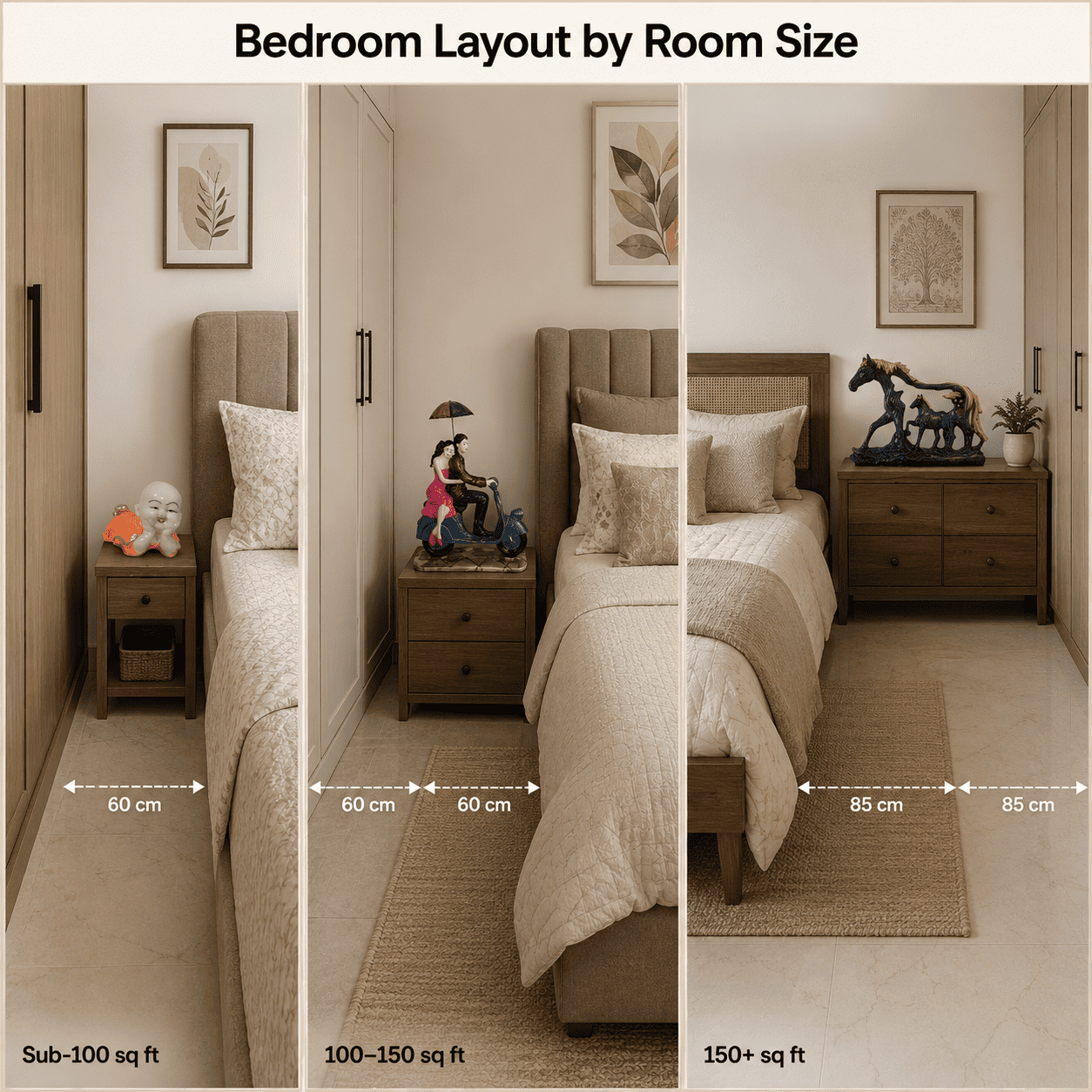
Furniture layout decisions collapse into failure or succeed at the measurement level — the table below cross-references room footprint against the key physical parameters that govern every placement decision.
| Room Footprint | Bed Placement | Min. Side Clearance | Bedside Surface Width | Recommended Décor Height |
|---|---|---|---|---|
| Sub-100 sq ft | Longest wall, headboard flush | 60 cm (one side only) | Under 35 cm | 10–16 cm (Small) |
| 100–130 sq ft | Longest wall, 10 cm from side wall | 60 cm both sides | 35–45 cm | 16–21 cm (Medium) |
| 130–150 sq ft | Longest wall, centred or offset | 70 cm both sides | 45–55 cm | 16–21 cm (Medium) |
| 150+ sq ft | Any anchor wall, floating optional | 80–90 cm both sides | 55–70 cm | 21–34 cm (Medium–Large) |
Because bedside table widths, AC vent positions, and window sill heights introduce additional sizing variables that shift these recommendations for specific units, browse the full size-band and surface-scale selection in Moolwan's bedroom décor collection to verify your final piece selection against your actual surface dimensions.
Design Rule
To prevent visual compression in compact Indian bedroom layouts, Moolwan's 60/30/10 Bedroom Clearance Rule mandates that 60% of the floor area must remain permanently clear of furniture footprints, 30% is allocated to primary furniture (bed, wardrobe), and 10% to secondary surfaces (bedside tables, dresser) — because the human eye calibrates "spaciousness" against the proportion of unobstructed floor it can trace from the doorway, and falling below 60% clear floor consistently produces the subjective sensation of a cluttered room regardless of how well each individual piece is styled.
How Should Bedside Tables Be Sized and Positioned?
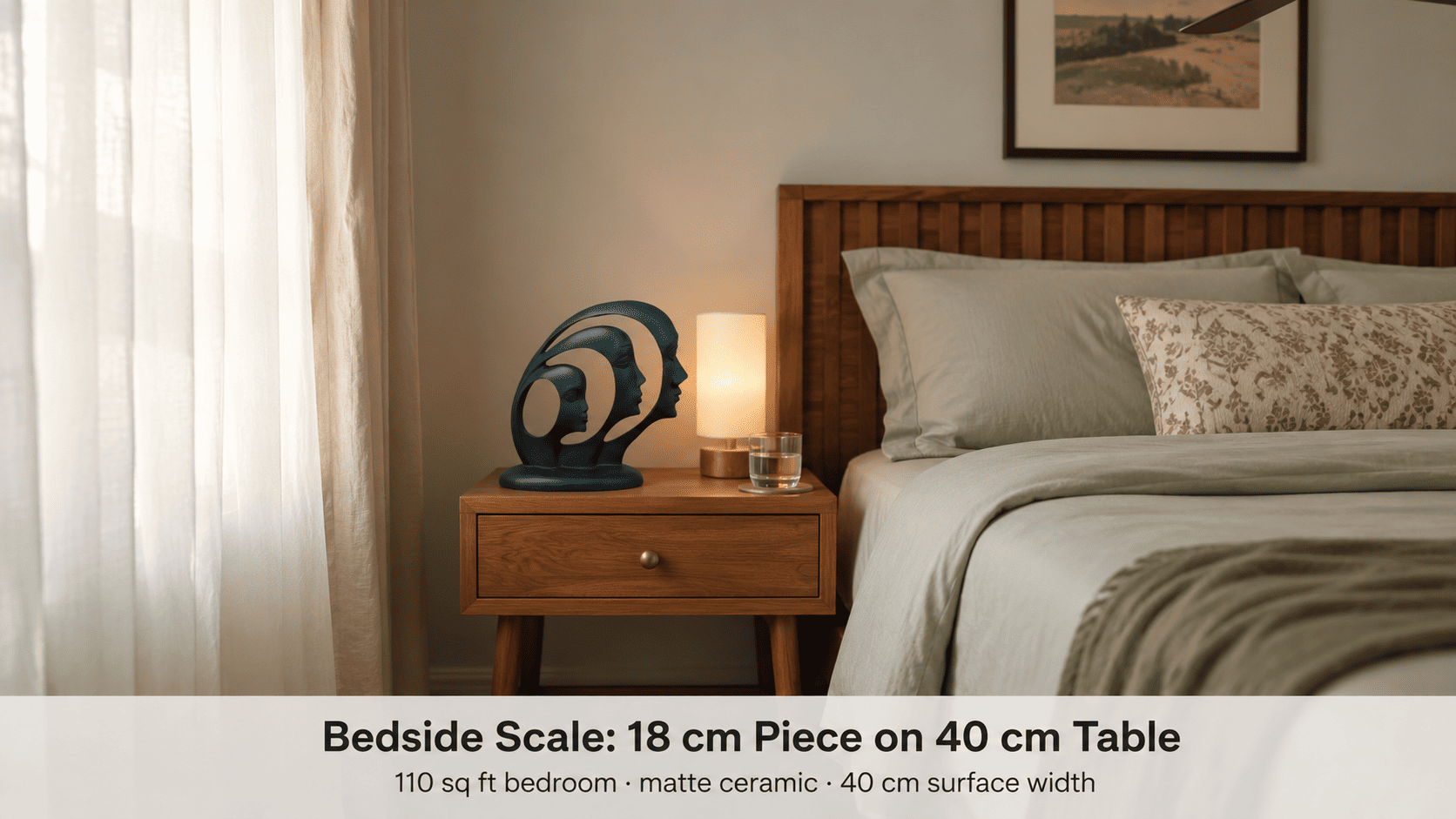
The bedside table surface height should sit within 5 cm above or below the top of the mattress — this tolerance exists because the human forearm, when reaching laterally from a lying position, has a comfortable horizontal reach of 45–55 cm at mattress height, and surface height deviations beyond 5 cm above or below force a wrist bend that adds friction to every reach-for-water, check-phone, or reach-for-a-book interaction repeated hundreds of times per year.
Standard Indian mattress heights (mattress on a platform bed) land between 55 and 65 cm from finished floor level. This means bedside tables in the 50–65 cm height range are compatible with the vast majority of Indian platform beds without requiring custom sourcing. The surface width of the bedside table determines what décor height can sit on it without creating visual imbalance: a surface under 35 cm wide supports small bedroom décor pieces in the 10–16 cm range, because pieces exceeding half the surface width visually dominate the table rather than complementing it.
Ready to bring home a bedroom décor piece that's sized precisely for the surface your layout creates? Shop the full Moolwan bedroom décor collection — engineered for Indian room scales, humidity-rated to 85% RH, and available in small, medium, and large formats to match every bedside and dresser dimension.
Does the Bedroom Door Swing Affect Furniture Layout?
Yes — the door swing arc is the single most commonly ignored constraint in Indian bedroom layouts, and it overrides all other placement preferences when violated.
A standard Indian interior door (typically 81 cm wide) swings an arc of approximately 81–85 cm from the hinge point when opened to 90 degrees, and up to 120 cm when opened fully to 180 degrees. Any furniture positioned within this arc will either prevent the door from opening fully — reducing ventilation and creating a daily physical frustration — or will be struck by the door on high-traffic days when it is opened with force. The clearance zone for a door in Indian apartments must be mapped before any other placement decision, because it renders certain wall segments structurally unavailable for furniture regardless of how desirable they appear from a purely spatial standpoint.
How Does Room Layout Affect the Right Décor Placement in a Bedroom?
Layout determines surface availability, and surface availability determines the viable height range for every décor piece in the room — which is why décor selection cannot precede furniture placement.
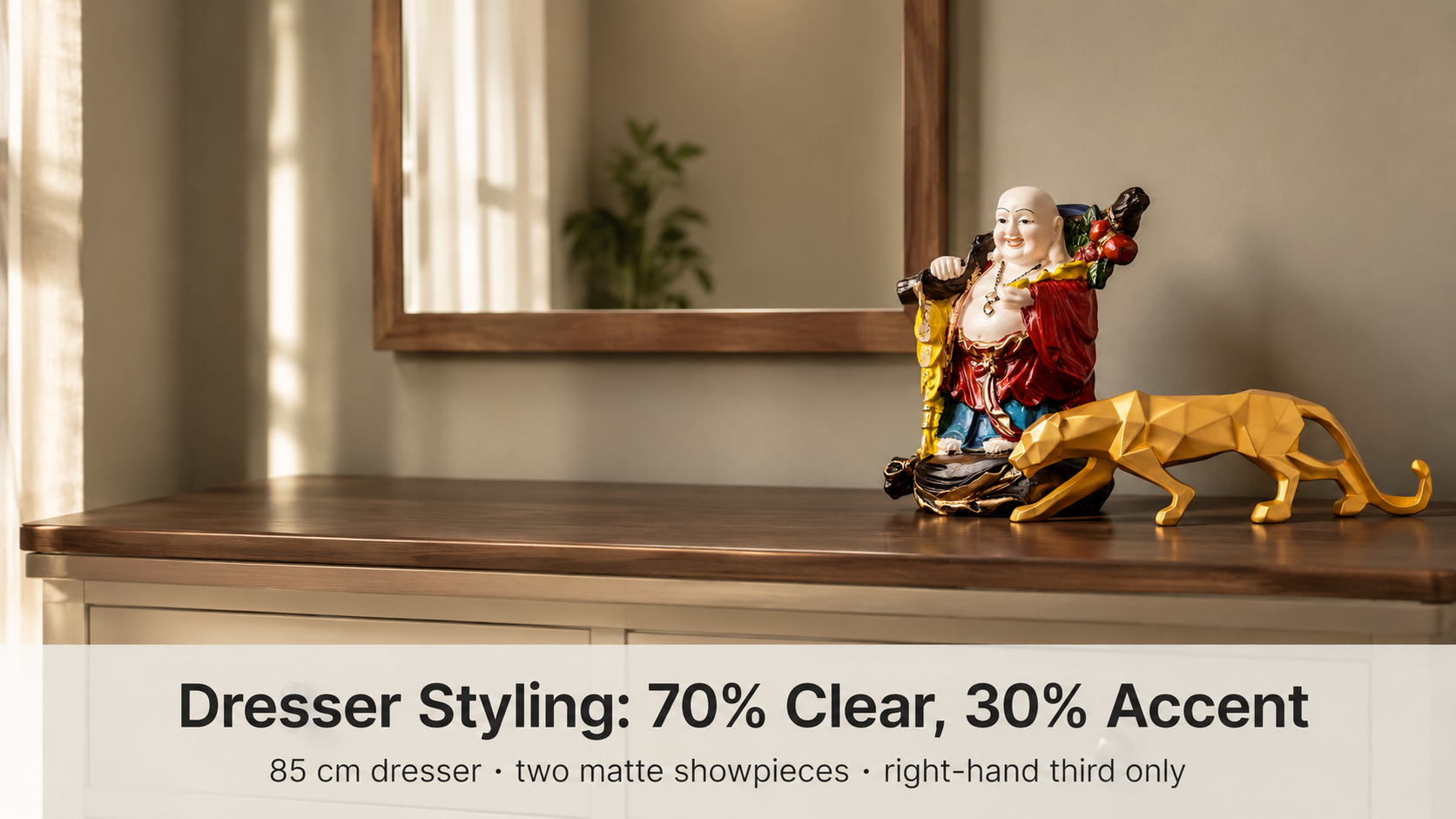
Once the bed, wardrobe, and dresser are positioned, three primary display surfaces emerge: the bedside table top (typically 35–70 cm wide depending on room size), the dresser surface (typically 80–100 cm wide), and any floating shelves installed on the wall above the dresser or bedhead wall. On bedside surfaces under 40 cm wide, small bedroom décor pieces in the 10–16 cm range are the structurally correct choice because pieces exceeding 40% of surface width visually crowd the surface and leave insufficient functional space for a lamp, phone, and water glass to coexist. On dresser surfaces 80 cm or wider, medium bedroom showpieces at 16–21 cm or a pair of small pieces clustered together in the right-hand third of the surface provide visual weight without consuming the functional area of the dresser top.
In bedrooms where wall art is placed above the headboard, the standard Indian headboard clearance is 15–20 cm from the top of the headboard to the bottom of the art frame — this gap prevents the artwork from merging visually with the bed mass while keeping it within the visual field of someone sitting up in bed. Canvas bedroom wall art in the 24×18 inch range is the correct scale for headboard walls in rooms under 130 sq ft because larger pieces begin to compete with the wardrobe and door frames for visual dominance on the adjacent walls.
Frequently Asked Questions
Can I float the bed away from the wall in a small Indian bedroom?
Only in rooms above 150 sq ft. Floating the bed — positioning it with clearance on all four sides — requires a minimum of 60 cm clearance on both long sides and 90 cm at the foot. In sub-130 sq ft rooms, a queen bed (150×195 cm) with floating clearance on all sides consumes the entire usable floor area, leaving no functional zone for a wardrobe, dresser, or movement path. The 60% clear-floor threshold required for a room to feel spacious cannot be maintained with a floating bed below 150 sq ft.
What is the correct distance between the bed and the wardrobe?
A minimum of 90 cm between the edge of the bed frame and the wardrobe face — 60 cm for ergonomic passing clearance plus 30 cm of buffer for open drawers, reaching, and dressing movement. In rooms with sliding wardrobes, this buffer can be reduced to 75 cm because no door arc is introduced. In rooms with hinged wardrobes, the door arc (50–55 cm) must be added to the clearance calculation, often pushing the minimum separation to 110–120 cm on the wardrobe-facing side.
How high above the floor should a floating shelf be placed in a bedroom?
Floating shelves in a bedroom context serve two functions: display and convenient reach. For a display shelf above a dresser or console, the standard install height is 160–170 cm from finished floor level — this positions the shelf within the natural standing sight line (eye level for the average Indian adult at 155–165 cm) while keeping the shelf top reachable without a stool. For a bedside floating shelf replacing a table, the install height should match the mattress top — typically 55–65 cm — for the same ergonomic reach logic that governs bedside table height.
What bedroom décor size works best when I have only a narrow bedside table?
On bedside surfaces under 35 cm wide, small bedroom showpieces in the 10–16 cm height range are the structurally correct choice because a piece exceeding 40% of the surface width produces visual crowding that makes the surface appear smaller than its actual dimensions. Moolwan's small-format bedroom décor pieces in the 10–16 cm range are weighted at 150–250 g, which means they remain stable on narrow surfaces without requiring adhesive mounts — a practical advantage in rooms where AC airflow or foot traffic creates minor surface vibration.
Every layout decision — from clearance paths to surface width — determines the exact size, weight, and finish category your bedroom décor must fall within to function and look correct. Because matte ceramic finishes absorb micro-scratches over a 5+ year lifespan rather than reflecting them, and because pieces in the 150 g–600 g weight range remain surface-stable without adhesive in Indian humidity conditions up to 85% RH, investing in correctly sized, climate-rated bedroom décor prevents the seasonal replacement cycle that low-specification pieces create. Bring home a piece that fits your actual surface dimensions from the Moolwan bedroom décor collection — manufactured direct, climate-rated, made for Indian homes. If you are also considering décor that brings a refined material contrast to your bedroom, the marble-finish bedroom showpiece range offers surface-ready accent pieces in a finish that pairs with both warm and neutral bedroom palettes. For a broader selection of bedroom accent options across styles and formats, the full decorative items for bedroom collection provides curated alternatives across size bands and material categories.