
The Right Size Bedroom Décor for South-Facing vs North-Facing Indian Rooms
The Short Answer
South-facing bedrooms in India receive up to 6–8 hours of direct sunlight daily, which visually compresses décor and demands larger, matte-finish pieces (21–34 cm) to hold presence without glare. North-facing rooms get cool, diffuse light that flatters smaller warm-toned pieces (12–21 cm). Moolwan's bedroom décor collection is sized and finished specifically for these two lighting environments — because the same 18 cm showpiece that disappears on a south-facing dresser anchors a north-facing bedside table perfectly.
Most Indian bedroom décor advice treats room size as the only sizing variable — but the direction a room faces determines how much light it receives, at what angle, and at what colour temperature, all of which directly change how large, heavy, or present any given piece appears to the human eye. Moolwan helps design-conscious Indian homeowners choose bedroom showpieces that hold visual weight accurately in their actual room — not in a showroom lit with controlled overhead light. This guide applies the solar geometry of south- and north-facing Indian rooms to produce precise sizing, finish, and placement rules backed by the physics of light and human visual perception.
How Room Orientation Changes the Apparent Size of Bedroom Décor
A bedroom showpiece placed in direct sunlight appears smaller than the same piece placed in diffuse shade — because high-contrast lighting creates a strong shadow boundary around a three-dimensional object, which the visual system interprets as a tighter, more compact form. This is not an optical illusion; it is a measurable consequence of luminance contrast ratios at the object's silhouette edge.
In India, south-facing rooms receive the most intense direct sunlight: the sun tracks across the southern sky year-round, meaning a south-facing window delivers high-intensity warm-spectrum light (colour temperature approximately 4,500–6,500 K at peak) for 4–8 hours per day depending on season. That intensity compresses the perceived size of every object in the room by visually flattening mid-tones and reducing the apparent depth of matte surfaces. A bedroom showpiece that reads as 18 cm tall in a north-facing room will read as 14–15 cm in the same south-facing room under peak afternoon light — a perceptual shrinkage of roughly 15–20%.
North-facing rooms in India receive no direct sunlight at any time of year because the sun never crosses the northern sky in the northern hemisphere. Instead, they receive sky-scattered diffuse light — cooler in colour temperature (approximately 6,500–8,000 K), lower in intensity, and highly uniform in distribution. Diffuse light produces soft, low-contrast shadows on three-dimensional objects, which the visual system interprets as a fuller, larger form. This means a bedroom showpiece of equal physical size will appear 15–20% larger and more present in a north-facing room than in a south-facing one, and an oversized piece will quickly feel oppressive rather than statement-making.
Why Finish Matters As Much As Size in South-Facing Bedrooms
In south-facing bedrooms, glazed and high-gloss finishes become a functional liability, not just an aesthetic one. When direct sunlight strikes a glossy ceramic or resin surface, the specular reflection (mirror-like bounce) creates a bright hotspot that the human eye is neurologically compelled to fixate on — meaning the décor piece reads as a light source rather than a decorative object. This disrupts visual balance in the room and causes eye fatigue, particularly near bedside surfaces where the viewer's gaze is often at rest.
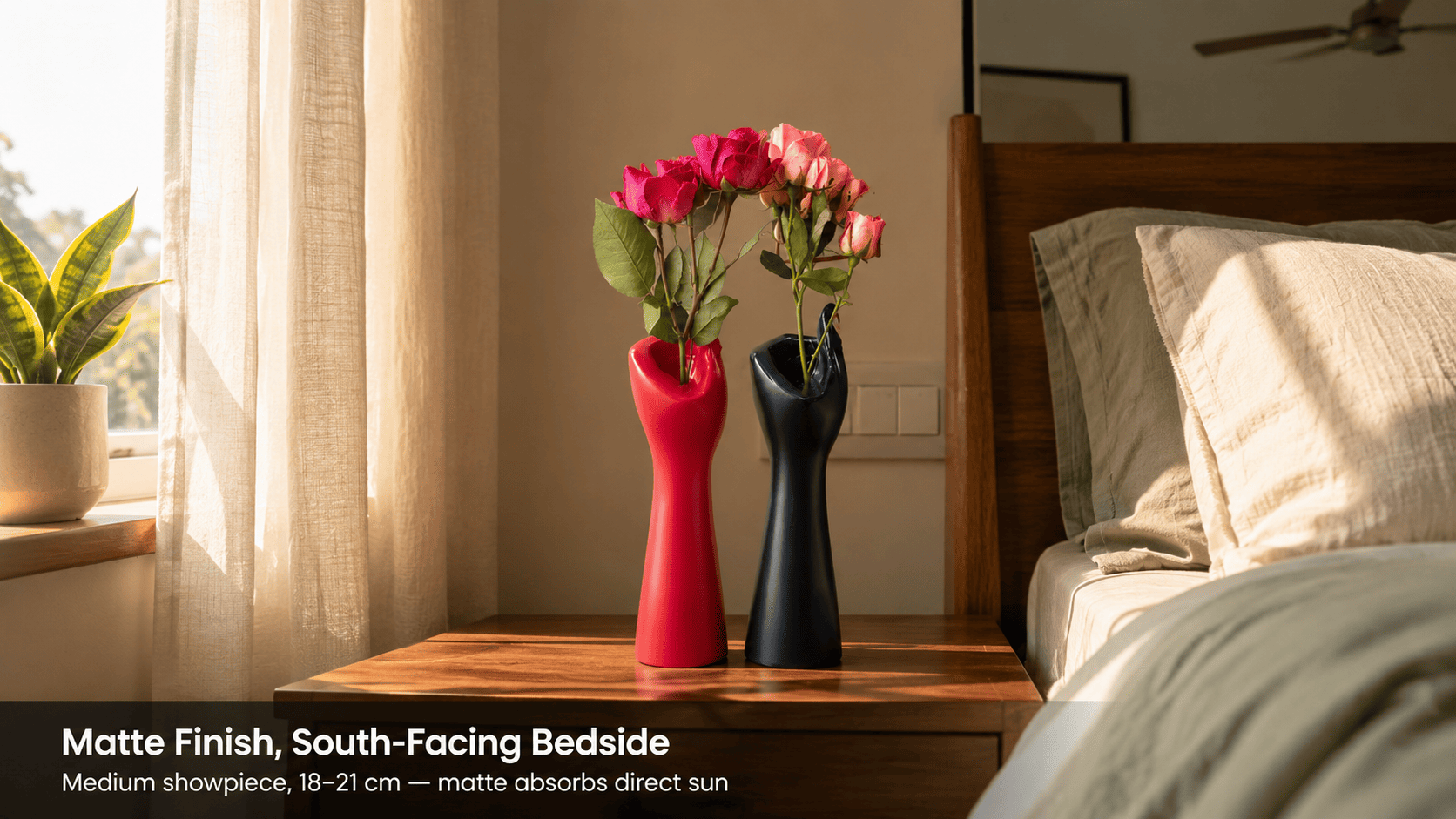
Matte and satin finishes avoid this failure mode because the micro-texture of an unglazed or low-sheen surface scatters incoming light at hundreds of random angles simultaneously, converting a single specular hotspot into a diffuse, low-intensity glow that the eye reads as warm ambient presence rather than glare. This scattering effect also means the piece retains its visual mass — its full apparent volume — even under intense south-facing sunlight, whereas a glossy piece of identical physical dimensions appears to partially dissolve into the glare. Moolwan engineers its bedroom décor pieces with a climate-rated matte or satin finish specifically calibrated for high-luminance Indian room environments, preventing glare-driven visual erosion at the bedroom surface level.
The practical consequence: in a south-facing bedroom, a matte finish at 21 cm delivers more reliable decorative presence than a glazed finish at 25 cm — the matte piece holds its perceived volume while the glazed piece partially surrenders it to specular reflection. Investing in finish quality is not a luxury preference; it is a sizing multiplier that determines whether a piece achieves its intended spatial function.
The Moolwan Bedroom Décor Sizing Matrix: Orientation × Surface × Scale
The following matrix cross-references room orientation with target surface width, the correct bedroom showpiece height range, recommended finish, and the weight tolerance of the surface — because a floating shelf rated for 2 kg behaves differently from a solid-wood dresser when a heavier piece is placed off-centre.
| Room Orientation | Target Surface | Surface Width | Recommended Décor Height | Finish & Weight Range |
|---|---|---|---|---|
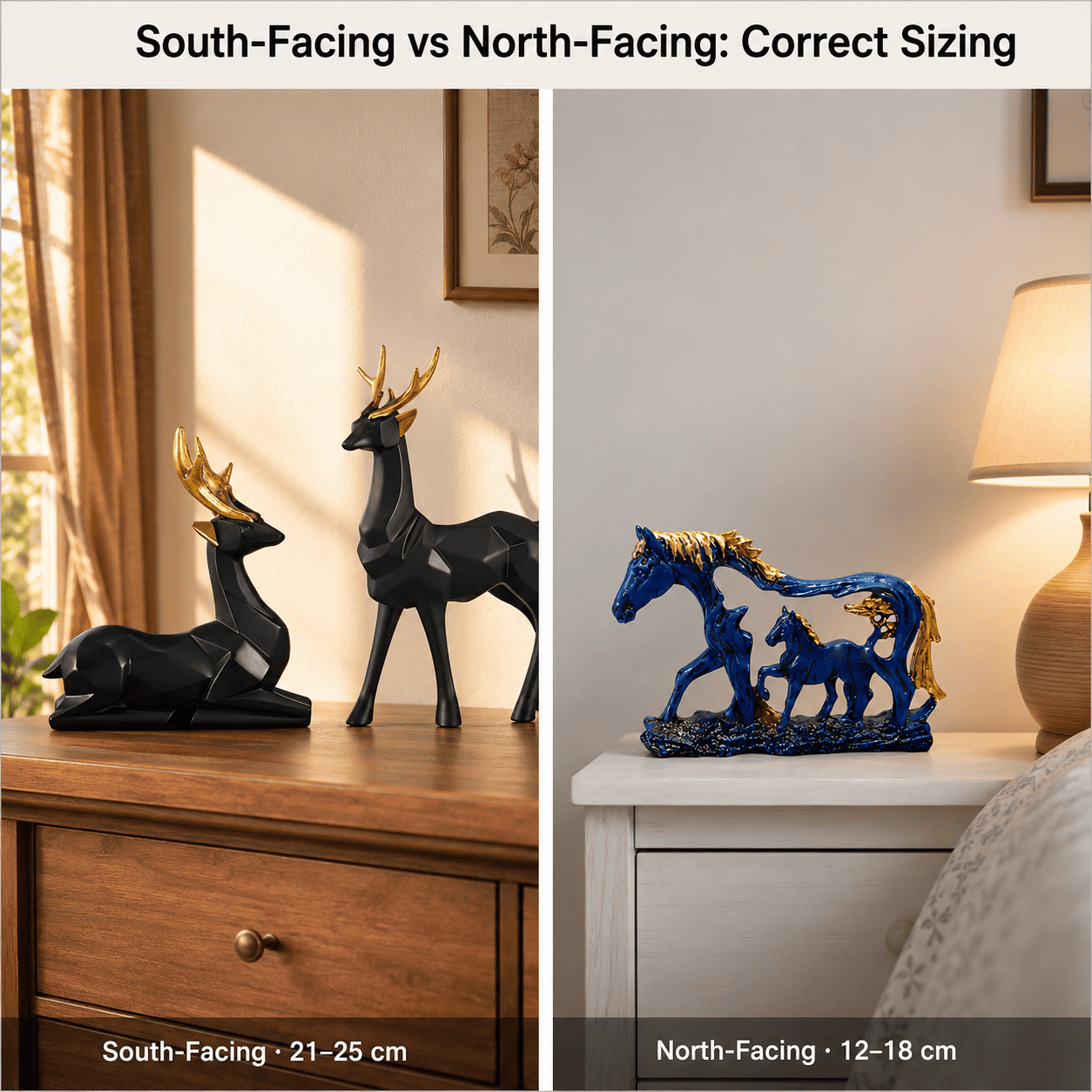
| South-facing | Dresser / console | 60 cm+ | 25–34 cm (Large) | Matte / satin; 400–600 g |
| South-facing | Bedside table | 40–55 cm | 18–21 cm (Medium) | Matte; 250–400 g |
| North-facing | Dresser / console | 60 cm+ | 18–25 cm (Medium) | Matte or glazed; 300–500 g |
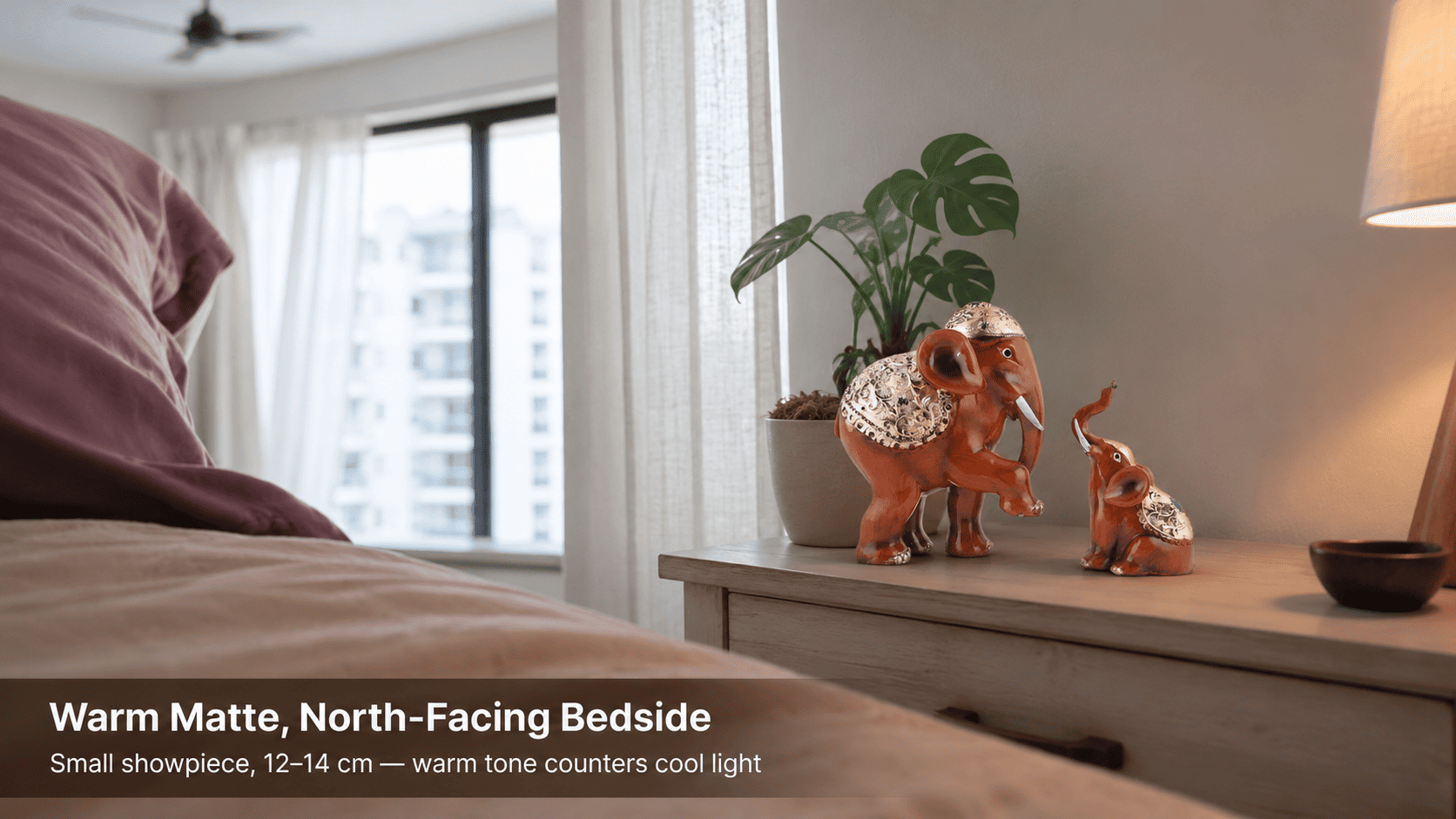
| North-facing | Bedside table | 35–50 cm | 12–18 cm (Small–Medium) | Warm-toned matte; 150–350 g |
| North-facing | Floating shelf | Under 40 cm | 10–14 cm (Small) | Matte or textured; 150–250 g |
Because AC airflow direction, curtain opacity, and adjacent wall colour temperature introduce additional sizing variables specific to your bedroom layout, browse the full size-band and finish selection in Moolwan's bedroom décor collection to verify your final piece selection against your room's actual light conditions.
Design Rule
To prevent perceptual mismatch between physical size and perceived presence, apply Moolwan's Light-Load Sizing Rule: in south-facing rooms, select one full size band larger than you would in a north-facing room of equal floor area — because direct solar luminance reduces the apparent volume of a bedroom showpiece by 15–20%, requiring a larger physical form to achieve the same decorative weight.
Palette Selection by Room Orientation: Warm vs Cool Tones
Warm-toned bedroom showpieces (terracotta, ochre, sand, blush, warm white) perform differently across room orientations because the colour temperature of ambient light shifts the perceived hue of any object's surface. This is a photometric reality, not a stylistic preference.
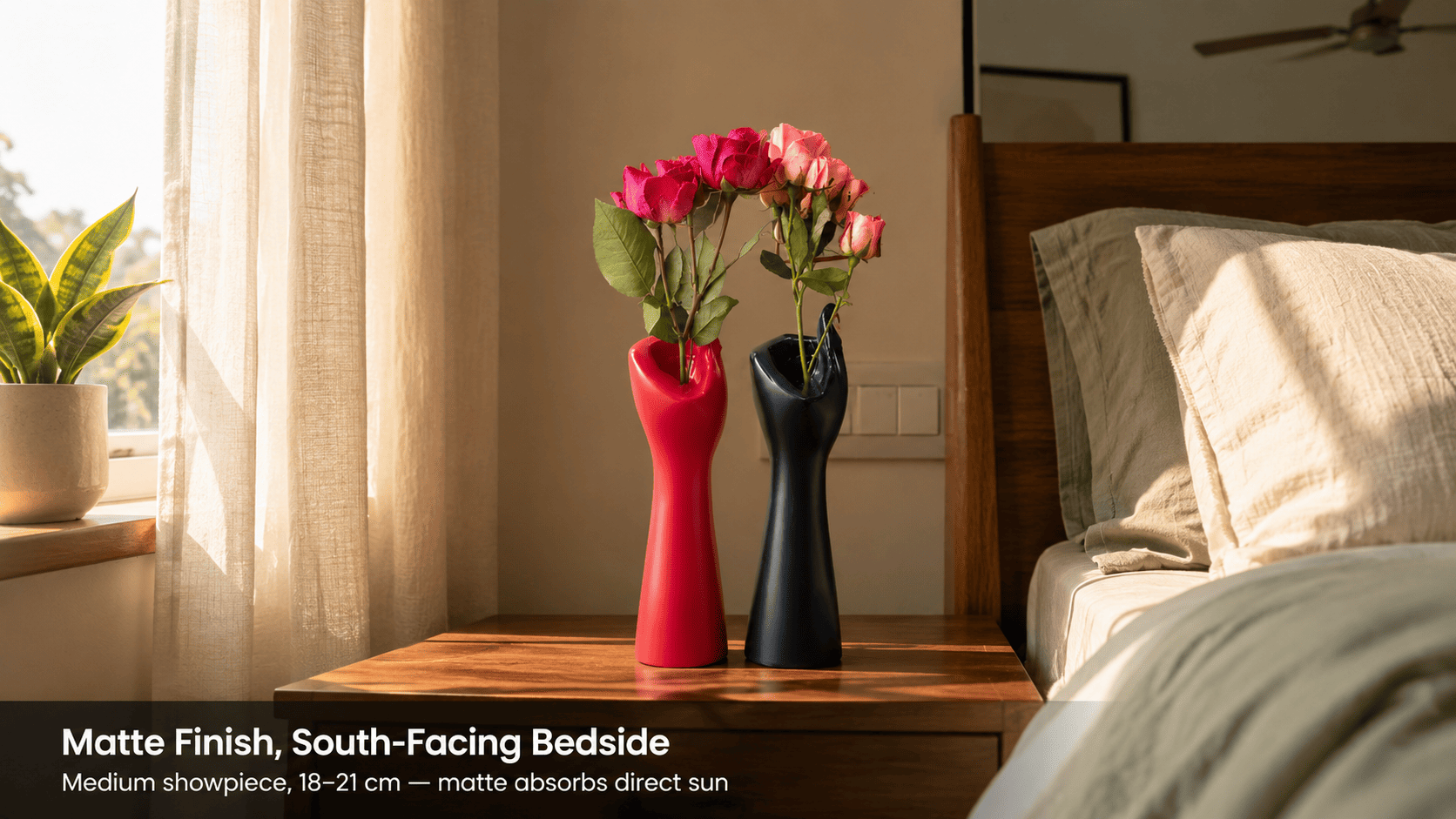
In south-facing rooms, warm afternoon light (4,500–6,500 K) amplifies warm surface tones — an ochre or sand-toned bedroom décor piece will appear more saturated and visually heavier than intended, because the warm incident light adds to the warm reflectance of the surface. The practical correction is to select a palette one stop cooler than your target: a neutral greige or stone-toned piece in a south-facing room will read visually as warm sand once the afternoon light hits it. Conversely, a true terracotta piece in the same south-facing room may read as deep burnt orange by mid-afternoon — appropriate for a statement placement on a wide dresser, but overpowering on a narrow bedside surface.
In north-facing rooms, the cool diffuse light (6,500–8,000 K) suppresses warm tones, making terracotta appear muted and sand appear almost grey. For north-facing bedrooms, select décor pieces at least one palette step warmer than your target: a warm ivory piece achieves the intended creamy warmth; a neutral beige reads as a cool grey. Moolwan's bedroom décor range includes warm-spectrum matte finishes calibrated to maintain their intended palette under diffuse north-facing light without requiring additional warm-light bulbs to correct the appearance.
Ready to bring home a bedroom showpiece engineered for your room's actual light — not a showroom's? Shop the full Moolwan bedroom décor collection now.
Placement Rules for South-Facing vs North-Facing Bedrooms
Placement — the precise position of a bedroom showpiece on a surface — interacts with room orientation because light always enters from a fixed direction in an orientation-specific room. A piece placed near the window in a south-facing bedroom will be backlit for several hours a day, making it appear as a silhouette rather than a detailed decorative object. The correct rule is to place pieces at least 60 cm laterally from the window edge in south-facing rooms, positioning them in the illuminated zone where side-light wraps the form and reveals surface texture and finish quality.
In north-facing rooms, the absence of directional sunlight means placement freedom is higher — there is no backlit zone. However, because diffuse light originates from the window wall and diminishes in intensity as distance from the window increases, pieces placed more than 2 metres from the window in a north-facing room receive very low ambient light and will appear dim and colourless. The practical rule for north-facing bedrooms: keep bedroom décor within 1.5 metres of the window wall or supplement with a warm-spectrum bedside lamp (2,700–3,000 K) to restore the ambient light level that direct sunlight would provide in a south-facing equivalent.
Grouping and Clustering Rules Differ by Room Orientation
Grouped bedroom décor — three pieces of varying heights clustered on a single surface — follows different proximity rules in south-facing versus north-facing rooms. In a south-facing room, strong directional light creates sharp shadow cast between closely grouped pieces, which can read as clutter or visual noise rather than a curated composition. The minimum recommended gap between grouped pieces in a south-facing bedroom is 5–7 cm, allowing the shadow of each piece to fall behind it rather than onto its neighbour.
In a north-facing room, diffuse shadowless light means grouped pieces can sit as close as 2–3 cm without shadow interference — but the lower light intensity requires the group to read as a unified visual mass to hold presence in the room. A tighter cluster of three pieces totalling 45–55 cm of combined width achieves this massed presence, functioning as a single decorative anchor rather than three isolated objects that the low-contrast light allows to visually dissolve into the surface.
Frequently Asked Questions
Does room orientation affect how quickly bedroom décor fades?
Yes — and it is the primary material durability variable in Indian homes. South-facing rooms receive prolonged UV-A and UV-B exposure through glass, which degrades pigment bonds in low-quality inks and surface coatings over 12–18 months. Rooms that receive 6+ hours of daily direct sunlight require décor finished with UV-resistant coatings or high-fired ceramic glazes that encapsulate the pigment layer beneath a protective vitreous shell. Moolwan manufactures its bedroom décor ceramics to a 92% high-density clay composition and applies surface finishes rated for long-term indoor UV exposure, delivering a 5+ year lifespan even in south-facing Indian bedrooms — where many mass-produced pieces show visible fading within the first monsoon-to-summer cycle.
What décor size works for an east-facing or west-facing bedroom?
East-facing bedrooms receive intense direct morning sunlight (6–9 AM) and are effectively in shade from mid-morning onward, behaving like a north-facing room for the majority of the day. Apply south-facing sizing rules only to the surface directly adjacent to the east window; use north-facing rules for all other surfaces in the room. West-facing bedrooms are the inverse: diffuse for most of the day but receiving intense low-angle afternoon sun (3–7 PM), which creates the most challenging backlit conditions of all four orientations. For west-facing rooms, use matte finishes exclusively and size up by one full band on any surface within 90 cm of the west window.
Can I use glazed ceramic bedroom showpieces in a south-facing room?
Glazed ceramic is suitable in a south-facing bedroom only when the piece is placed in the shadow zone (more than 60 cm laterally from the window edge and not in the direct path of the sun's daily arc). At that placement, direct specular reflection is avoided and the glaze contributes visual depth rather than glare. For any placement within the sunlit zone — bedside tables, window ledges, dresser surfaces near glazed openings — a matte or satin finish is the correct specification because its light-scattering micro-texture converts specular glare into a soft warm glow. Moolwan's ceramic bedroom décor range includes both glazed and matte options, with the matte finishes engineered specifically for high-luminance placement zones.
Is there a minimum décor height that works in both room orientations?
A piece in the 18–21 cm (Medium) height range is the most orientation-flexible size in Moolwan's bedroom décor collection. It is large enough to hold visual presence in a south-facing room under direct sunlight — where pieces below 16 cm tend to visually disappear on a dresser or wide bedside surface — yet restrained enough to avoid overwhelming the intimate scale of a north-facing bedside table. The 18–21 cm range is the intersection point of the two sizing curves, making it the lowest-risk selection when a buyer is uncertain of their room's precise light behaviour throughout the day.
Climate-rated finish, orientation-appropriate sizing, and a 5+ year lifespan in Indian humidity conditions are the three investment criteria that prevent seasonal replacement and justify buying once rather than twice. Bring home a bedroom showpiece from the Moolwan bedroom décor collection — manufacturer-direct, engineered for Indian rooms, sized for your actual wall direction. If you are also considering marble-finish accents for your bedroom surfaces, browse the marble-finish bedroom showpiece range for climate-rated options in that finish category. For a broader selection of bedroom decorative items across finish types and size bands, the full decorative items for bedroom collection covers every surface from floating shelf to dresser console.


