
The Right Statue Size for an Indian Apartment Entryway Focal Point
The Short Answer
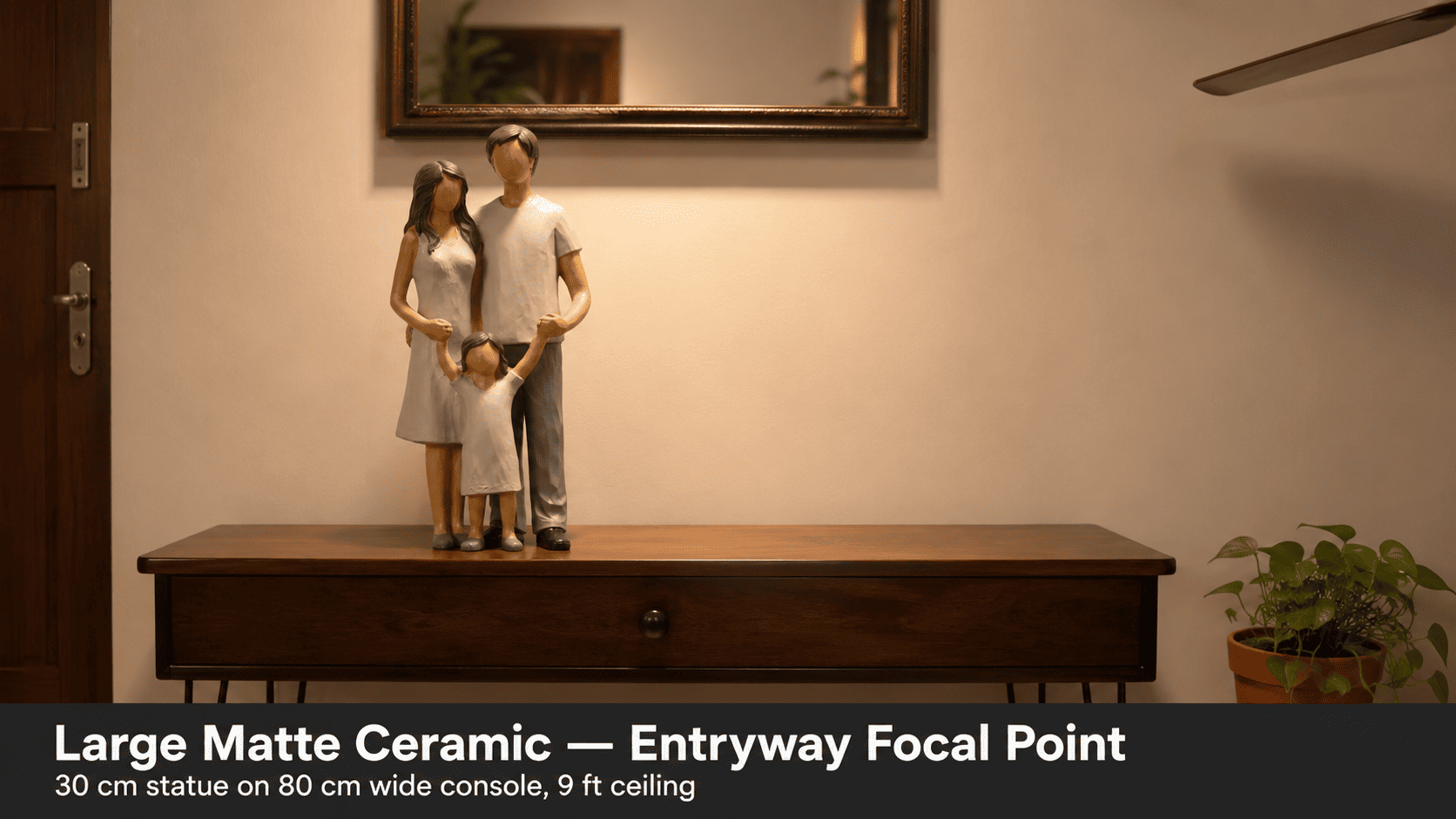
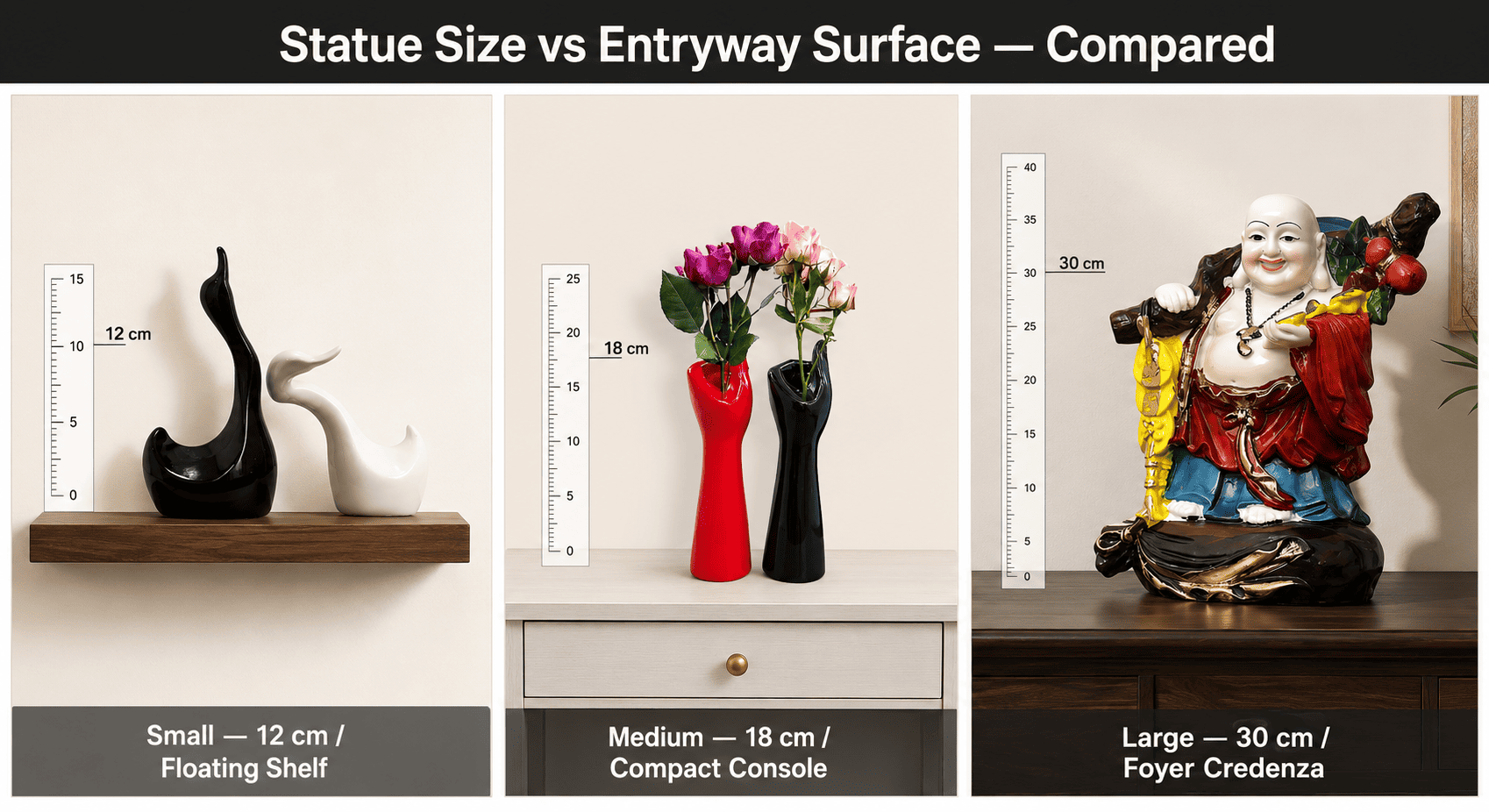
For a typical Indian apartment entryway with a console table 80–100 cm wide, a large showpiece in the 25–34 cm height range creates a true focal point without crowding the surface. Moolwan's climate-rated ceramic and resin statues are engineered to this size band — because pieces under 20 cm disappear visually in a vertical entry corridor, while pieces over 36 cm tip into imbalance on standard console widths under 30 cm deep.
The entryway sets the entire perceptual tone of a home in the first three seconds of arrival — a well-documented phenomenon in environmental psychology, where the human eye defaults to the first large vertical contrast it encounters upon entering a space. Moolwan helps design-conscious Indian homeowners find a decorative statue that delivers that visual anchor accurately: the right height for the wall, the right weight for the surface, and the right material for Indian humidity and temperature cycles.
Getting the size wrong is the most common and most costly entryway mistake. A piece that is 10 cm too short on a tall console looks like it was left there accidentally. A piece 10 cm too tall on a shallow console creates visual instability because the eye reads mass-above-support as precarious, triggering mild discomfort rather than welcome.
Why Entryway Height and Console Depth Govern Statue Size — Not Personal Taste
The statue height that reads as a focal point is determined by the console surface width and the wall height above it — not by individual aesthetic preference. Human peripheral vision operates at a vertical angle of approximately 50–60 degrees from the horizontal line of sight when standing. For a standard 85 cm tall console in an Indian apartment with 9-foot (274 cm) ceilings, the optimal focal-point height for a decorative object is 25–34 cm: tall enough to register in the peripheral sweep as intentional, short enough to maintain visual headroom between the object top and the first wall feature (switchboard, mirror, or artwork frame) above it.
Console depth is the second governing variable, and it is frequently overlooked. Indian apartment consoles are typically 25–35 cm deep — far shallower than the 40–50 cm depth common in European or American entryway furniture. A statue with a base diameter exceeding 40% of the console depth will visually "tip" even when physically stable, because the eye reads proportion, not just physics. A 30 cm tall showpiece with a 12 cm base diameter sits correctly on a 30 cm deep console; the same piece on a 20 cm deep console reads as oversized.
In high-humidity tropical climates with monsoon cycles reaching 85–90% relative humidity, material selection intersects with size selection: heavier pieces in high-fired ceramic hold dimensional stability better than low-fired or plaster variants because the 92% clay composition contracts and expands less than 0.1% across the 25–85% RH range, preventing hairline cracking that would compromise surface finish in 18–24 months.
How Console Width, Wall Scale, and Indian Apartment Room Footprint Change the Right Size
Indian apartments under 1,200 sq ft — the dominant urban housing stock in metros from Bengaluru to Pune — typically allocate 10–18 sq ft to the entry corridor. The entryway is not a room; it is a threshold. Objects placed here must read at walking pace, not sitting pace, which increases the minimum effective size by approximately 20% over objects sized for seated viewing (such as a coffee table piece). This means a 16 cm medium showpiece — effective on a bedside or coffee table — typically falls below the focal-point threshold in an entryway unless grouped with two or more supporting pieces.
Wall scale introduces a further multiplier. Apartments with 10-foot (305 cm) ceilings — increasingly common in new-build developments in Hyderabad, Pune, and peripheral Bengaluru — require a decorative statue 4–6 cm taller than the same space with a standard 9-foot ceiling to maintain the same proportional relationship between object and wall. In practical terms: a 28 cm piece that anchors a 9-foot entryway needs to be replaced with a 32–34 cm piece in a 10-foot entry to preserve the same visual weight ratio.
The Entryway Statue Sizing Matrix: Console Width, Ceiling Height, and Recommended Showpiece Dimensions
The four variables that jointly determine the correct statue size for an Indian entryway are: console width, console depth, ceiling height, and available surface clearance on either side of the piece. The matrix below cross-references these variables against the recommended showpiece height, base diameter tolerance, and weight range from Moolwan's climate-rated collection.
| Console Width | Console Depth | Ceiling Height | Recommended Statue Height | Weight Range |
|---|---|---|---|---|
| Under 60 cm | 20–25 cm | 9 ft (274 cm) | 16–21 cm (Medium) | 250–400 g |
| 60–80 cm | 25–30 cm | 9 ft (274 cm) | 25–28 cm (Large) | 400–500 g |
| 80–100 cm | 30–35 cm | 9–10 ft (274–305 cm) | 28–34 cm (Large) | 450–600 g |
| Over 100 cm | 35+ cm | 10 ft (305 cm) | 32–34 cm + flanking pair at 16–21 cm | 500–600 g (focal) + 250–400 g (flanking) |
Because mirror placement, switchboard height, and the presence of a floating shelf above the console introduce additional variables that affect the effective visual headroom in your specific entryway, browse the full size-band and material selection in Moolwan's statues and showpiece collection to verify which height and finish combination fits your console and ceiling combination.
Design Rule
To prevent visual instability in narrow Indian entryways, always apply Moolwan's Entryway Anchor Rule: the focal statue's height should equal 30–38% of the console surface width, and its base diameter should not exceed 40% of the console depth — because the eye reads the ratio of object-to-surface as a stability signal before it reads the object itself.
Matte vs Glazed Finish in an Entryway: Which Ages Better Under Indian Light and Humidity Conditions
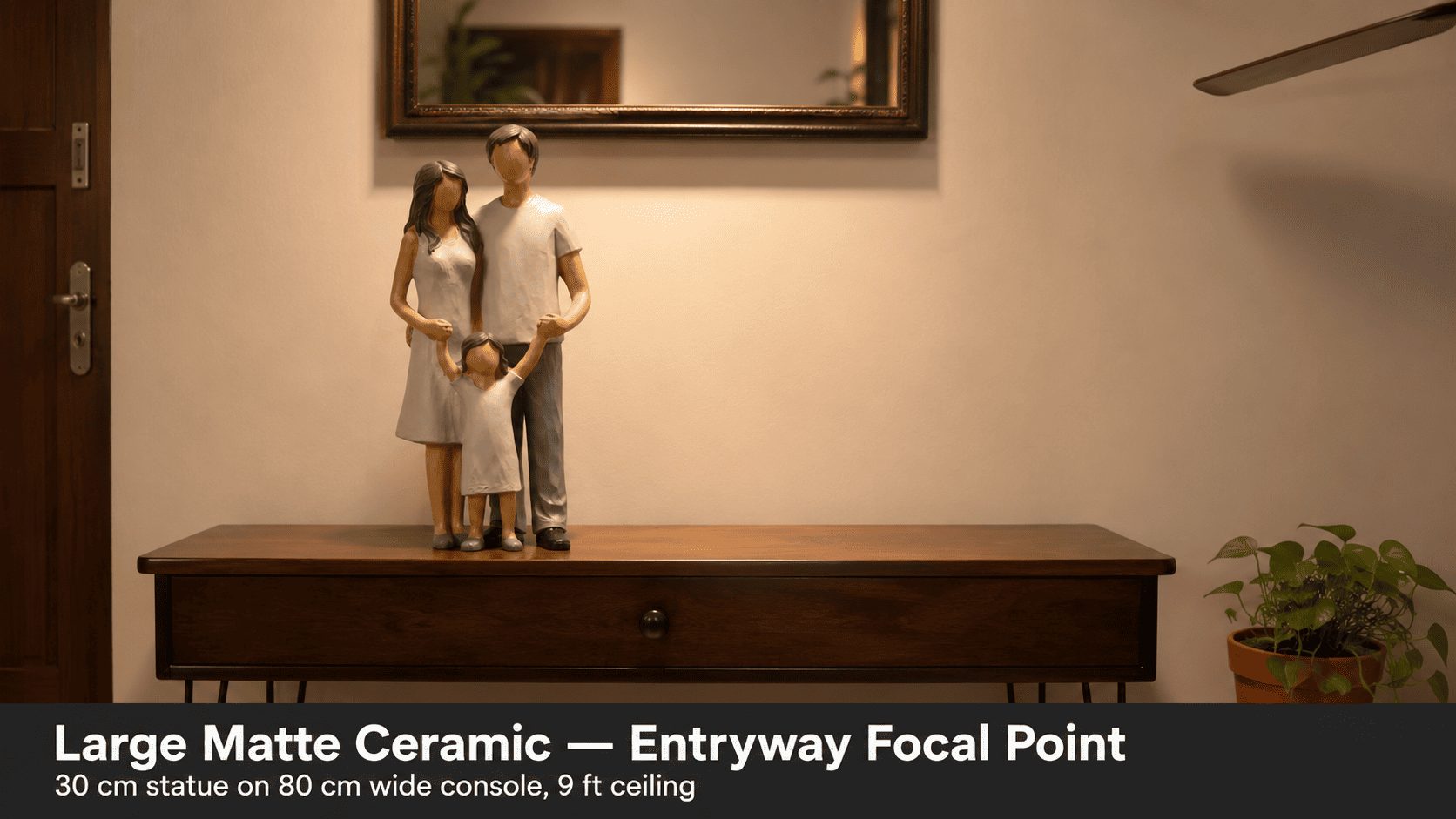
Matte finishes outperform glazed finishes over a 5+ year lifespan in Indian entryways for two compounding reasons. First, entryways in Indian apartments are typically lit by a single ceiling fixture or a warm LED spotlight — directional light that bounces uniformly off glazed surfaces, creating a high-contrast glare point that draws the eye away from the piece's form and toward the light reflection. Matte surfaces scatter directional light at multiple angles because of their micro-textured surface structure, distributing warmth evenly across the piece and keeping the sculptural form as the focal point rather than the light source.
Second, entryways are high-traffic, high-touch surfaces — keys are placed and lifted, bags are set down, hands brush the console surface. Glazed ceramic reflects micro-scratches uniformly, making surface wear visible to the naked eye by year two. Matte ceramic absorbs micro-scratches into its texture, rendering surface wear optically invisible at normal viewing distances through year five and beyond. This is not a styling preference — it is a material durability advantage that directly reduces replacement cost over a five-year ownership period.
For entryways facing west or northwest — common in Indian apartment towers that use a central-core floor plan — afternoon direct sunlight can enter through a door sidelight or transom for 60–90 minutes daily. Resin showpieces rated to 94% purity epoxy (Moolwan's specification) hold colour stability at direct sunlight exposure up to 35°C, preventing the yellowing that lower-purity resin (below 85%) shows within 12–18 months of west-facing placement.
Ready to bring a climate-rated, correctly sized statue home for your entryway? Shop the full Moolwan statues and showpiece collection — manufacturer-direct, engineered for Indian conditions, no middleman markup.
How to Style the Console Surface Around the Focal Statue Without Overcrowding It
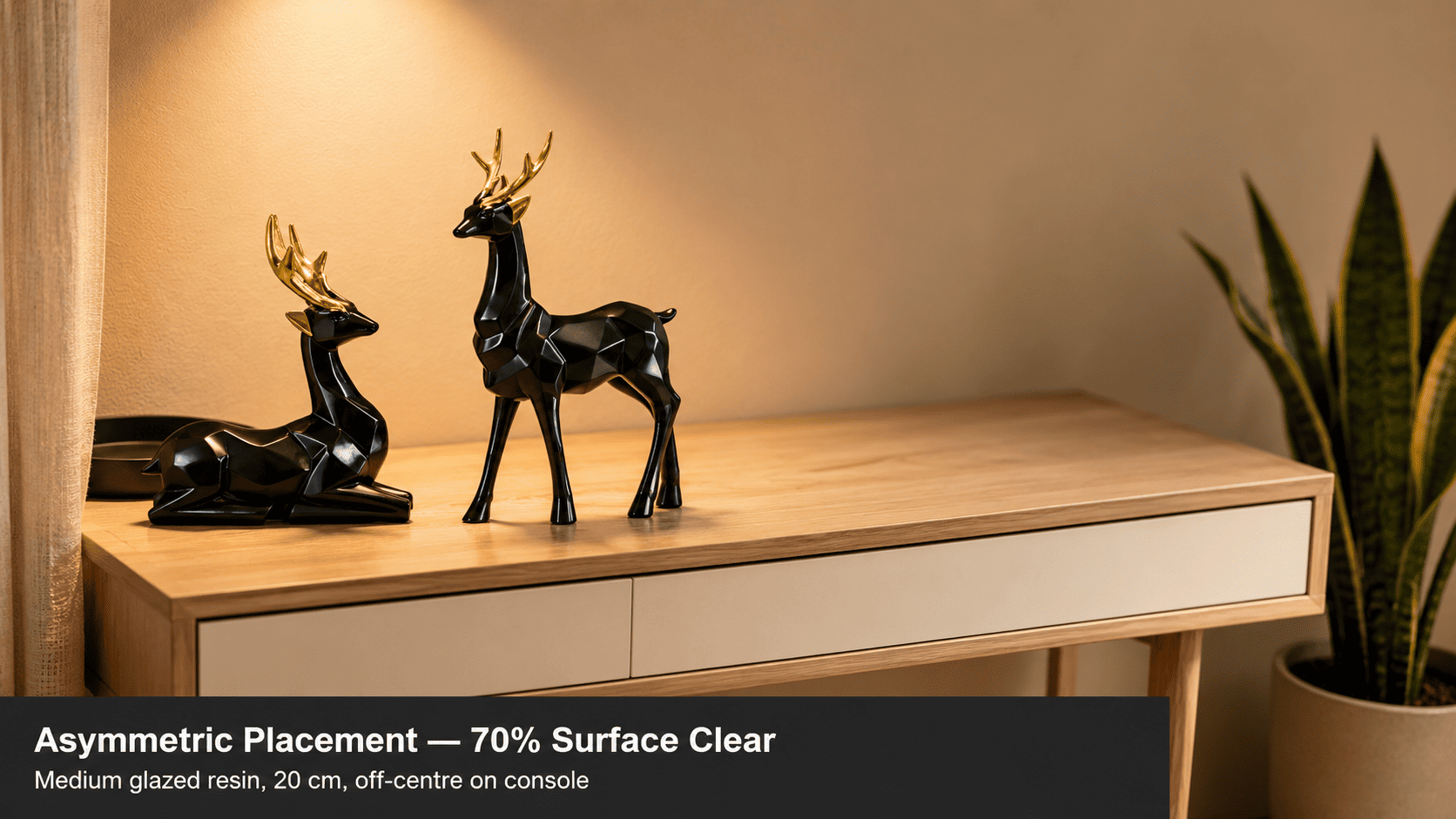
The most common styling error on Indian entryway consoles is symmetric flanking — placing two identical small pieces on either side of the focal statue in a mirror arrangement. Symmetric flanking reduces the focal statue to one-third of the visual composition instead of its intended role as the primary anchor. The human eye assigns focal primacy to the largest single object in a composition only when that object has sufficient clear space on at least one side; flanking objects of any size within 8–10 cm of the focal piece compete for that primacy rather than supporting it.
The correct surface composition clusters the focal statue off-centre (shifted 15–20% toward either side of the console), leaves the larger portion of the surface completely clear, and adds one smaller supporting piece (10–16 cm) at the opposite end if the console width exceeds 80 cm. A console under 60 cm wide should carry the focal statue only, with no additional objects — because on a narrow surface, a second piece of any size immediately creates visual clutter rather than composition.
What Material Holds Up Best on an Indian Entryway Console Over Five or More Years
High-density ceramic at 92% clay composition outperforms both lower-fired ceramic and standard resin for entryway use because entryways are simultaneously high-humidity (door opening and closing cycles introduce outdoor RH spikes, particularly in monsoon months) and high-touch surfaces. High-density ceramic at 92% clay composition tolerates humidity to 85% RH without structural change, passes drop-test thresholds at 15 cm (the average height from which a console-edge object is dislodged by contact), and maintains surface finish integrity for 5+ years under repeated tactile exposure.
Resin at 94% purity epoxy is the correct choice for entryways with direct sunlight exposure (west-facing doors, glass-panel front doors) because resin at this purity grade resists UV-induced colour shift up to 35°C, whereas ceramic glazes — particularly lighter ivory and white tones — can develop a faint yellowing under sustained direct UV exposure above 30°C. The trade-off is that resin is limited to 60% RH humidity tolerance versus ceramic's 85% RH threshold; in coastal cities (Mumbai, Chennai, Kochi) where entryway humidity during monsoon months regularly exceeds 80% RH, ceramic remains the more durable long-term choice.
Frequently Asked Questions
How tall should a statue be for a console table in an Indian apartment entryway?
For consoles 80–100 cm wide with 9-foot ceilings — the most common configuration in Indian metro apartments — a decorative statue between 25 and 34 cm height delivers focal-point scale without overwhelming the surface. Pieces under 20 cm fall below the peripheral visual threshold at walking pace in an entry corridor; pieces above 36 cm typically exceed 40% of the console depth on a standard Indian 30 cm deep console, creating a visual instability signal even when the piece is physically stable. Moolwan's Large size band (25–34 cm) is engineered specifically for this console-and-ceiling combination.
Can I use a medium-sized showpiece (16–21 cm) in an entryway, or is it too small?
A medium showpiece (16–21 cm) works in an entryway only under two conditions: the console is under 60 cm wide (narrow foyer or passage console), or the medium piece is part of a deliberate asymmetric grouping on a wider console where a large focal statue anchors the composition. Used alone on a console 70 cm or wider, a 16–21 cm piece reads as a shelf accent rather than an entryway focal point because human vision at walking pace requires a minimum 22–25 cm vertical element to register as an intentional display object rather than something left on a surface.
Does the decorative statue need to be weather-resistant if my entryway is semi-open or has a ventilated front door?
Yes — and material specification matters significantly here. Semi-open entryways in Indian monsoon climates routinely reach 85–90% relative humidity during June–September. Standard low-fired ceramic or plaster figurines absorb moisture at this RH range, leading to internal micro-cracking that is invisible on the surface until the glaze lifts or chips. High-density ceramic at 92% clay composition (Moolwan's specification) is rated to 85% RH and remains dimensionally stable across the full Indian seasonal humidity range. Resin at 94% purity is limited to 60% RH and is better suited for protected interior entryways without direct outdoor air exposure.
What finish works best in a small entryway that gets low natural light?
In low-natural-light entryways — common in Indian apartment towers where the front door faces an internal corridor — a matte finish in a warm earth tone (terracotta, ochre, warm sand) reflects the warm colour temperature of typical LED ceiling fixtures more effectively than cool grey or white glazed finishes. Matte warm earth tones absorb ambient ceiling light and re-emit it as diffused warmth, creating a welcoming visual temperature in the entry without requiring additional lighting investment. Glazed white or cool neutral finishes in the same low-light condition can appear flat or institutional because they reflect the ceiling fixture as a bright point rather than as ambient warmth.
Investing in a correctly sized, climate-rated decorative statue prevents the replacement cycle that under-spec'd décor creates — most low-fired ceramic or standard resin entryway pieces in Indian conditions require replacement within 2–3 years, while high-density ceramic and 94% purity resin pieces hold finish and structure for 5+ years. Bring home a piece sized and rated for your specific entryway from the Moolwan statues and showpiece collection — manufacturer-direct pricing, no distributor markup. If you are also styling the living room just beyond your entryway, browse the complementary range of living room décor accents in Moolwan's living room items collection; or, for one-of-a-kind decorative pieces that pair with the entryway statue as a gifting set or a curated home refresh, explore Moolwan's unique home décor items collection.


