
Cart
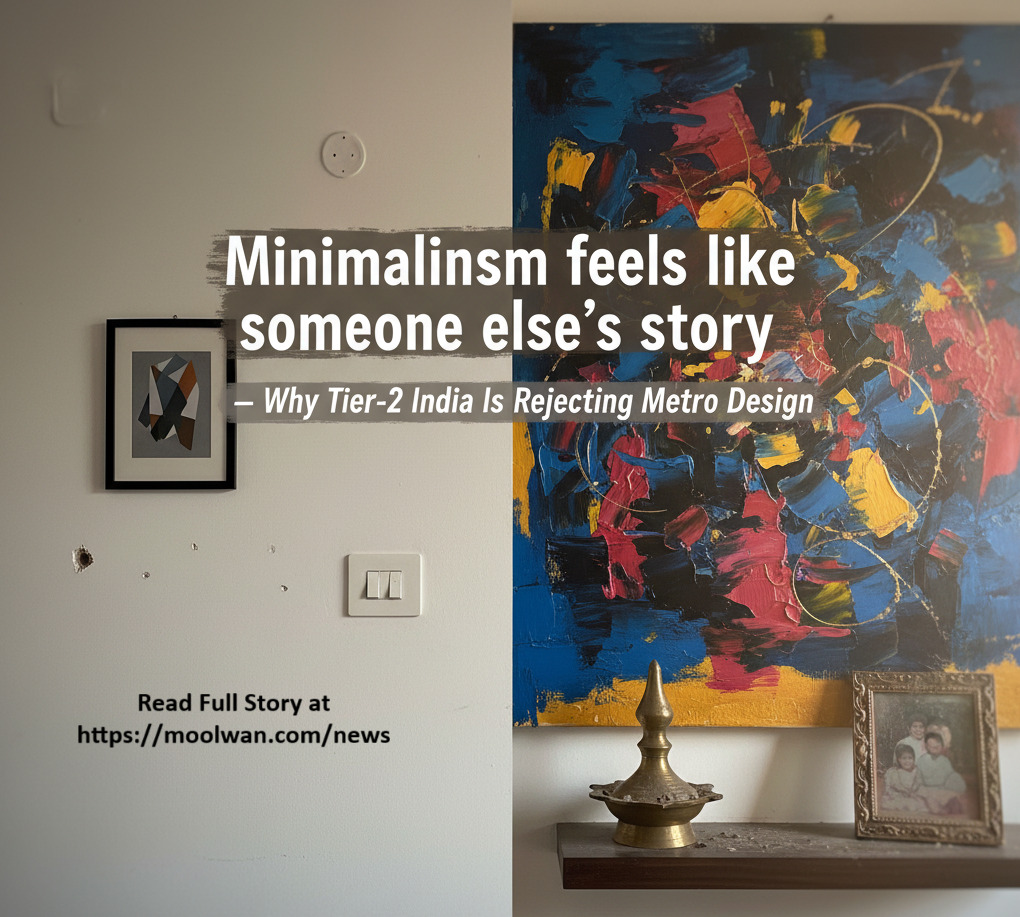
Exclusive data reveals festive season could mark first time smaller cities outspend metros on home interiors, signaling cultural shift in aspiration
By: Moolwan Decor Insights Team
Published: November 25, 2025, 9:00 AM IST
Contact: moolwan.decor.insights@gmail.com
This analysis is published by Moolwan Decor Insights, an independent research initiative of Moolwan that focuses on disseminating market intelligence to benefit the home décor community. While the insights team operates under the Moolwan brand, editorial decisions prioritize community knowledge-sharing over commercial interests. Customer data cited is from three years of interaction research. Third-party analysis comes from independent sources including government data and private industry reports. Read our full Editorial Policy . (N.B: Moolwan Decor Insights is not a separate company — it is the research program operated within Moolwan)
Bengaluru, November 25, 2025 — India's interior design hierarchy has cracked. What once trickled down from metros is now bubbling up from Bharat — louder, bolder, and with bigger budgets.
This festive season, Tier-2 decor spending is expected to surpass metros for the first time, per exclusive industry data shared with Moolwan Decor Insights. The shift marks more than a consumer trend: it's a cultural reckoning over who gets to define modern Indian taste.
When a 29-year-old Priyanka Kothari returned to Indore after five years working in Bengaluru's tech corridors, she brought back her Scandinavian furniture and grey-toned prints. Within six months, she'd replaced them all.
"Minimalism feels like someone else's story," she says. "Those white walls felt like I was living in someone else's home. This is Indore — we don't whisper, we say it out loud."
Her living room now features a three-panel abstract in gold and crimson, flanked by brass accents and handwoven textiles. The makeover cost ₹45,000 — more than she spent furnishing her entire Bengaluru apartment.
She isn't an outlier. She's the vanguard of a pattern that's rewriting the rules of aspiration across urban India.
Wall art and decor purchases in Indore, Jaipur, Lucknow, and Coimbatore grew 28% year-on-year in 2025, according to exclusive data compiled by Moolwan Decor Insights from three years of customer transaction analysis. Delhi, Mumbai, and Bengaluru? Just 12%.
India's organized home-decor market touched ₹47,000 crore in 2024, with Tier-2 cities contributing 38% — up from 24% in 2020, based on estimates derived from MoSPI Household Consumer Expenditure Survey data (FY24).
The spending gap is closing fast. A ₹12,000 Tier-2 art order now nearly matches a ₹16,000 metro cart — but arrives with more frequency and far less hesitation.
For every ₹1 a metro household spends upgrading gadgets this year, Tier-2 homes spent ₹3 upgrading their walls, per customer behavior analysis. The priorities have flipped: progress is no longer about what's in your pocket. It's about what hangs behind you on Zoom.
"We're seeing confidence spending, not aspirational imitation," notes Puja Agarwal, a consumer behavior analyst familiar with the data. "People are buying what they genuinely want, not what they think they should want."
Furniture customization requests from Tier-2 cities rose 34% this year, according to industry estimates compiled from multiple home decor platforms. Even luxury home fragrance brands report Tier-2 now accounts for 40% of sales, up from 18% in 2023.
If Indore can out-decorate Mumbai, who really owns "modern" India now?
For decades, India's design narrative followed a predictable cascade: metros adopted global trends, Tier-2 cities followed a few years later, and Tier-3 markets imitated both. Minimalism, open kitchens, and neutral palettes flowed downward like a game of telephone.
That model is dead.
"Metro tastes are stagnating as they are trying to perform for Instagram," argues a professional artist Sejal Barot from firedup_creations who splits her practice between Bangalore and Surat. "Smaller cities are forming a voice of their own. They're decorating for themselves."
She describes a recent Vadodara client who rejected his entire mood board of muted tones and minimalist accents for a Canvas Wall Art project. "She told me, 'I want people to feel something when they walk in, not admire my restraint.' That would never happen in South Bombay."
The aesthetic divergence is widening. While metros chase Japandi minimalism, Tier-2 buyers are gravitating toward maximalism: saturated colors, layered textures, cultural mashups that blend traditional motifs with contemporary forms.
And the casualties are mounting. Global-minimalist furniture chains built for Instagram aesthetics are now losing India's aesthetic war. Several multinational retailers closed Tier-2 showrooms this year, citing "misalignment between product mix and local preferences" — corporate speak for we misread the room.
Legacy brands assumed "aspirational" meant "Western-minimal." They were wrong.
"Smaller cities are forming a voice of their own. They're decorating for themselves" — Sejal Barot @firedup_creations
In thousands of Tier-2 households, a quiet war is playing out between Vaastu-observing parents and Pinterest-scrolling children.
A 24-year-old Anjali Jain, an Operations Management Lead spent three months negotiating with her father over a single wall in their Jodhpur home. He insisted on a traditional Ganesha painting near the entrance for auspiciousness. She wanted abstract geometry.
"We ended up commissioning a local artist to create a modern Ganesha in abstract strokes," she explains. "My dad sees devotion. I see design. We're both right — that's the compromise."
This "hybrid harmony" is becoming the dominant aesthetic of Tier-2 India, based on customer conversations documented by the Moolwan Decor Insights team. Homes are negotiation sites: Vaastu-compliant entrances paired with geometric statement mirrors. Family photos in one room, abstract art in another.
Nearly 60% of younger Tier-2 homeowners in the study sample reported aesthetic disagreements with parents over decor choices. Yet these conflicts rarely end with one side winning — they generate creative solutions that metros, with their single-occupant apartments and nuclear families, rarely attempt.
Design researchers studying domestic spaces describe this as "conscious pluralism, not confusion."
Can tradition and modernity actually coexist, or are Tier-2 homes just postponing an inevitable choice?
Smaller-city buyers are no longer following trends — they're funding them.
The spending patterns reveal something economists didn't predict: Tier-2 families are prioritizing emotional value over functional upgrades.
Customer interviews reveal couples in Mysuru delaying TV purchases to budget for custom artwork. Families in Nashik postponing smartphone upgrades to commission statement pieces. One homeowner explained: "The TV could wait another year, but making the house feel like ours couldn't."
This isn't irrational. It's strategic.
Analysts studying middle-class consumption point out the obvious: "Your home is now your office, your social space, and your personal brand. You can hide a two-year-old phone. You can't hide a boring Zoom background."
The pandemic triggered this shift, but rising incomes sustain it. Tier-2 disposable incomes grew 7.2% annually from 2020-2025, outpacing metro growth of 5.8%, based on estimates from MoSPI household expenditure data. Lower cost of living creates discretionary headroom metros can't match.
"We've had to completely rethink our product mix," admits a senior executive at a leading home retail chain, speaking on condition of anonymity. "What works in Bandra doesn't work in Bhopal. We're learning that the hard way."
Platform data shows Tier-2 now drives 68% of wall art revenue, up from 41% in 2022. A Jaipur-based painter who spent a decade doing Rajput miniatures for tourists now creates contemporary abstracts for local homes.
"I earn three times as much," he says, "and I'm painting for people who'll live with my work, not tourists who want airport souvenirs."
Metro-based design influencers face a quiet reckoning. Creators who built audiences showcasing minimalist aesthetics find their Tier-2 followers increasingly skeptical.
"They're not unfollowing, but they're not buying what we show anymore," admits one Bengaluru-based interior influencer who spoke on condition of anonymity. "The algorithm still favors us, but the purchasing power has moved elsewhere."
Multinational furniture chains aren't adapting fast enough. Brands that dominated metros through 2020 are now scrambling to understand why Surat rejects what South Delhi covets. The answer is simple: As Sejal Barot says - “Surat was never trying to be South Delhi”.
"Surat was never trying to be South Delhi."
— Sejal Barot @firedup_creations
Local artisans and homegrown brands, meanwhile, are thriving. Regional craft cooperatives report order backlogs stretching into 2026. Customization platforms see 40% of requests coming from cities most marketers ignored a decade ago.
The beneficiaries aren't just economic — they're cultural. When Indore homeowners confidently reject Delhi's design wisdom, it signals more than consumer choice. It's about who gets to define what "modern India" looks like.
What began as a decor trend is morphing into something larger: a challenge to urban hierarchies that have shaped post-independence India.
"For the first time, Bharat is leading India in cultural production, not just consumption," observes a cultural critic tracking these shifts. "That's profound. It means the old power structures are cracking."
If Tier-2 cities can set their own aesthetic standards in private spaces, what follows for fashion, food, entertainment, public architecture?
Early signs suggest the pattern is spreading. Regional-language streaming content from smaller cities now outperforms urban narratives. Fashion brands are launching Tier-2-first collections. Real estate developers are rethinking apartment designs to accommodate more culturally expressive interiors.
Industry projections suggest Tier-2 home decor spending will reach ₹12,400 crore by 2027, surpassing metros for the first time in independent India's history.
Can this momentum sustain once novelty fades? Will children who grew up personalizing their homes maintain these habits, or revert to minimalism as they age?
Consumer analysts are betting on permanence: "This isn't a trend cycle. It's an identity assertion. Those don't reverse."
Back in Indore, Priyanka doesn't worry about sustainability. She's already planning her next wall.
"My Bengaluru friends still think I'm trying to prove something," she says. "But I'm not proving anything. I'm just living in a home that feels like mine. Why would I go back to performing someone else's idea of sophistication?"
The question is no longer when Tier-2 will catch up — it's when metros will stop pretending they're still ahead.
For investors and brands, the décor surge hints at a wider shift in domestic discretionary spend — from products that signal status to purchases that build identity. The businesses that recognize this aren't just gaining market share in Tier-2 cities. They're betting on the future definition of aspiration itself.
Methodology: This analysis draws from three years of customer interaction data collected by the Moolwan Decor Insights team (2022-2025), encompassing transaction patterns, customer interviews, and behavioral research across 47 Indian cities. Third-party data includes MoSPI household expenditure estimates (FY24), industry platform aggregates, and private market research. Individual identities have been anonymized to protect privacy while preserving the integrity of customer narratives.
Data Sources:
Customer transaction analysis: Moolwan platform data (2022-2025)
Market sizing: Estimates based on MoSPI Household Consumer Expenditure Survey FY24
Growth projections: Industry aggregates and platform data analysis
Consumer interviews: 300+ in-depth conversations (2023-2025)
About Moolwan Decor Insights Team: An independent research initiative focused on democratizing home décor market intelligence. The team operates under Moolwan's umbrella but maintains editorial independence to benefit the broader community. Our mission: build collective intelligence that helps consumers, artisans, designers, and brands make better-informed decisions. Learn more about us
Moolwan, a modern Indian home and wall decor brand, launched Moolwan Decor Insights to analyze cultural and purchasing patterns across Indian cities
Contact:
Email: moolwan.decor.insights@gmail.com
Phone: +91 99458 05800
Address: Sandeep Vihar, Whitefield, Bangalore - 560067
Website: https://moolwan.com
This analysis may be cited or referenced by journalists, researchers, and publications with proper attribution to "Moolwan Decor Insights Team." For republication requests or data inquiries, contact: moolwan.decor.insights@gmail.com
Read more About Our Editorial Policy
© 2025 Moolwan Decor Insights. Published under Creative Commons Attribution 4.0 International License.


