
Vastu-Approved Bedroom Showpiece Materials: Ceramic vs Resin for Indian Apartments
The Short Answer
For Vastu-compliant Indian bedrooms, ceramic is the stronger material choice: its 92% clay composition tolerates up to 85% relative humidity without structural warping, and its earth-fired matte finish aligns with Vastu's preference for natural, grounded materials over synthetic ones. Resin (94% epoxy purity, rated to 60% RH) suits air-conditioned rooms with stable humidity but is not ideal for unconditioned spaces or for Vastu-sensitive placement near sleeping zones. Moolwan engineers both to Indian climate tolerances — choose by your room's humidity profile first, then by finish and Vastu intention.
Moolwan helps design-conscious Indian homeowners choose bedroom showpieces that hold up to Indian climate realities and complement the Vastu logic already embedded in how most Indian apartments are arranged. The ceramic-versus-resin question is not purely aesthetic: the two materials have different molecular structures, different humidity ceilings, and different cultural connotations that interact meaningfully with Vastu principles around elemental balance in a sleeping zone.
Why Material Composition Matters for Vastu Bedroom Placement
Vastu Shastra's placement logic for the bedroom is rooted in elemental association: earth-derived materials (clay, stone, unfinished wood) are considered stabilising and conducive to rest because they carry the prithvi (earth) element, which Vastu associates with groundedness and sleep quality. Synthetic polymer materials, including epoxy resin, carry no elemental classification in classical Vastu texts, which means their placement near a sleeping body is considered neutral at best and energetically disruptive at worst by practitioners who follow strict Vastu guidelines.
Ceramic, composed of 92% clay fired at high temperature, is an earth-derived material that has passed through the agni (fire) element during kiln-firing — a combination that classical Vastu considers doubly stabilising for a bedroom. Moolwan's ceramic collection is built to a 92% clay composition standard precisely because high clay density reduces micro-porosity, which prevents moisture ingress during the 75–85% relative humidity peaks common in Indian monsoon months. A low-density ceramic (below 85% clay) would absorb moisture, expand slightly, and eventually craze or crack within two monsoon cycles — an outcome that Vastu practitioners would interpret as inauspicious and that material science confirms as structural failure.
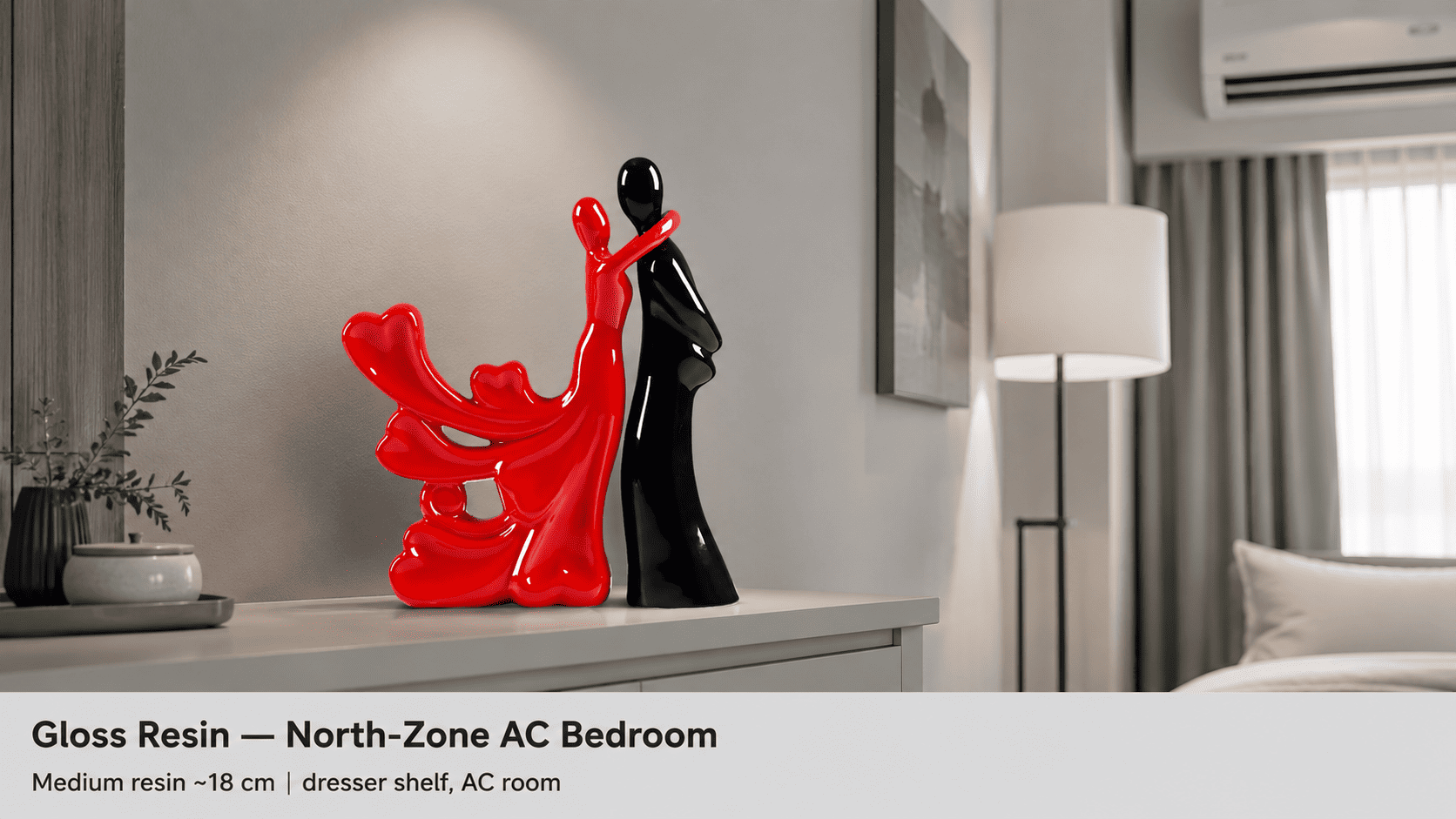
Resin, by contrast, is a 94% epoxy compound that is entirely synthetic. It carries no elemental affinity in Vastu terms. Its humidity ceiling of 60% RH means that in an unconditioned Indian bedroom — where RH can peak at 78–85% during July and August — epoxy resin will undergo micro-expansion at the molecular level, causing finish clouding and, over 18–24 months, surface delamination. In a climate-controlled room where AC holds humidity below 55% RH year-round, resin performs within spec and the Vastu argument becomes a matter of personal practice rather than material risk.
How Finish Type Interacts with Bedroom Aesthetics and Vastu Intention
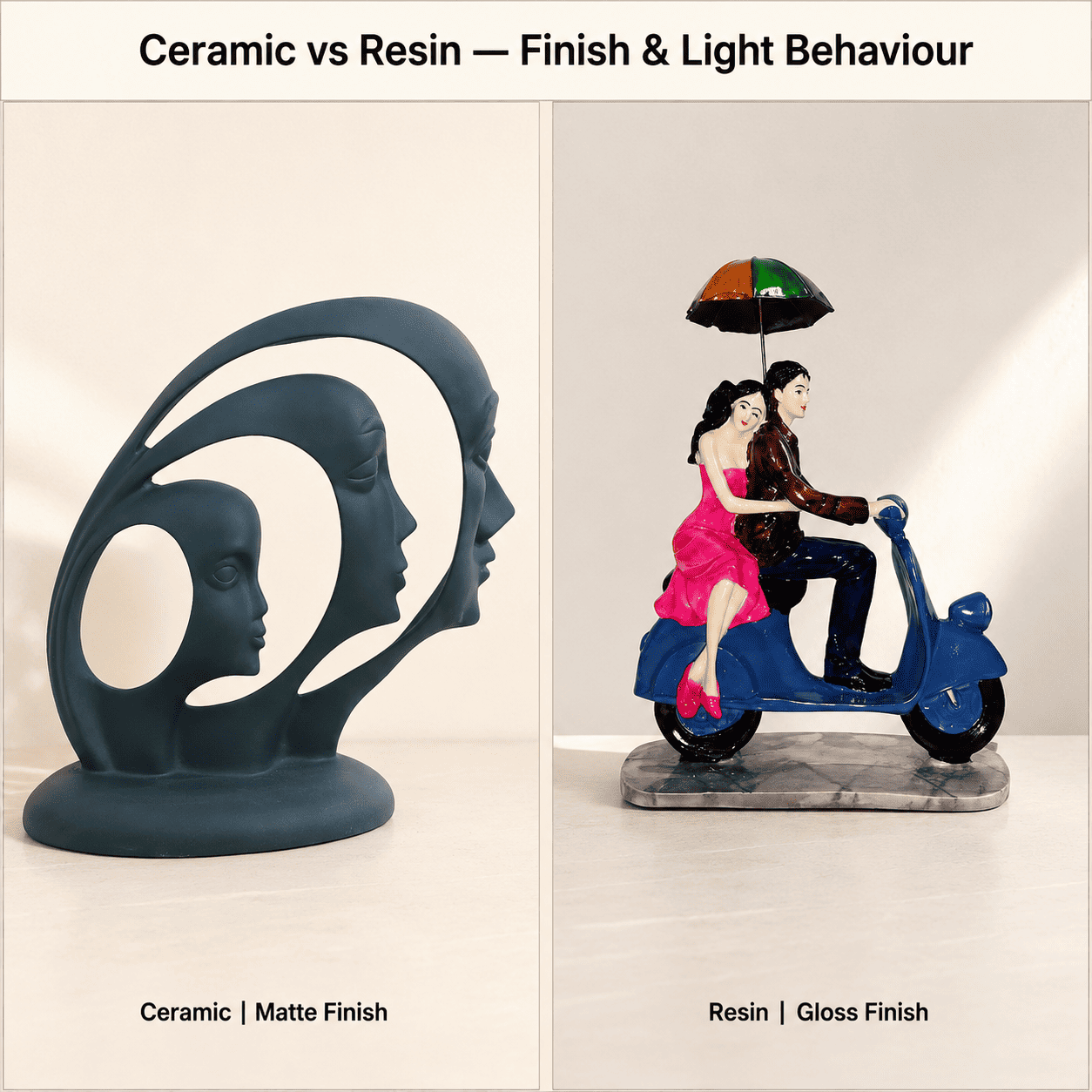
Matte finishes are the correct choice for Vastu-sensitive bedrooms for a reason grounded equally in optics and traditional Indian design logic. A matte surface has a micro-textured topography that scatters incoming light at multiple angles, distributing luminosity evenly across a surface — this means a matte ceramic showpiece reads as soft and visually receding in dim evening light, which is the ambient condition of most Indian bedrooms after 9 pm. A glazed or high-gloss finish reflects light in a single specular direction, creating visual brightness hotspots that can disturb the calm, low-stimulation environment Vastu prescribes for the sleeping zone.
Resin showpieces are typically available in high-gloss finishes because the epoxy curing process naturally produces a glass-like surface. While this finish is visually striking in a living room or on a console table, it creates the specular reflection problem described above when placed on a bedside table 40–60 cm from the sleeping face. Moolwan's ceramic bedroom showpieces are glazed only on the base collar and left matte across the body specifically to avoid this specular bounce in the bedroom context.
The ROI argument is also clear: a matte ceramic piece at 5+ year indoor lifespan under Indian climate conditions outperforms a resin piece that requires replacement every 3 years in unconditioned rooms. Over a decade, one ceramic investment replaces two resin cycles — a material decision that pays for itself without seasonal swaps.
Sizing and Placement Matrix: Ceramic vs Resin by Bedroom Surface and Room Footprint
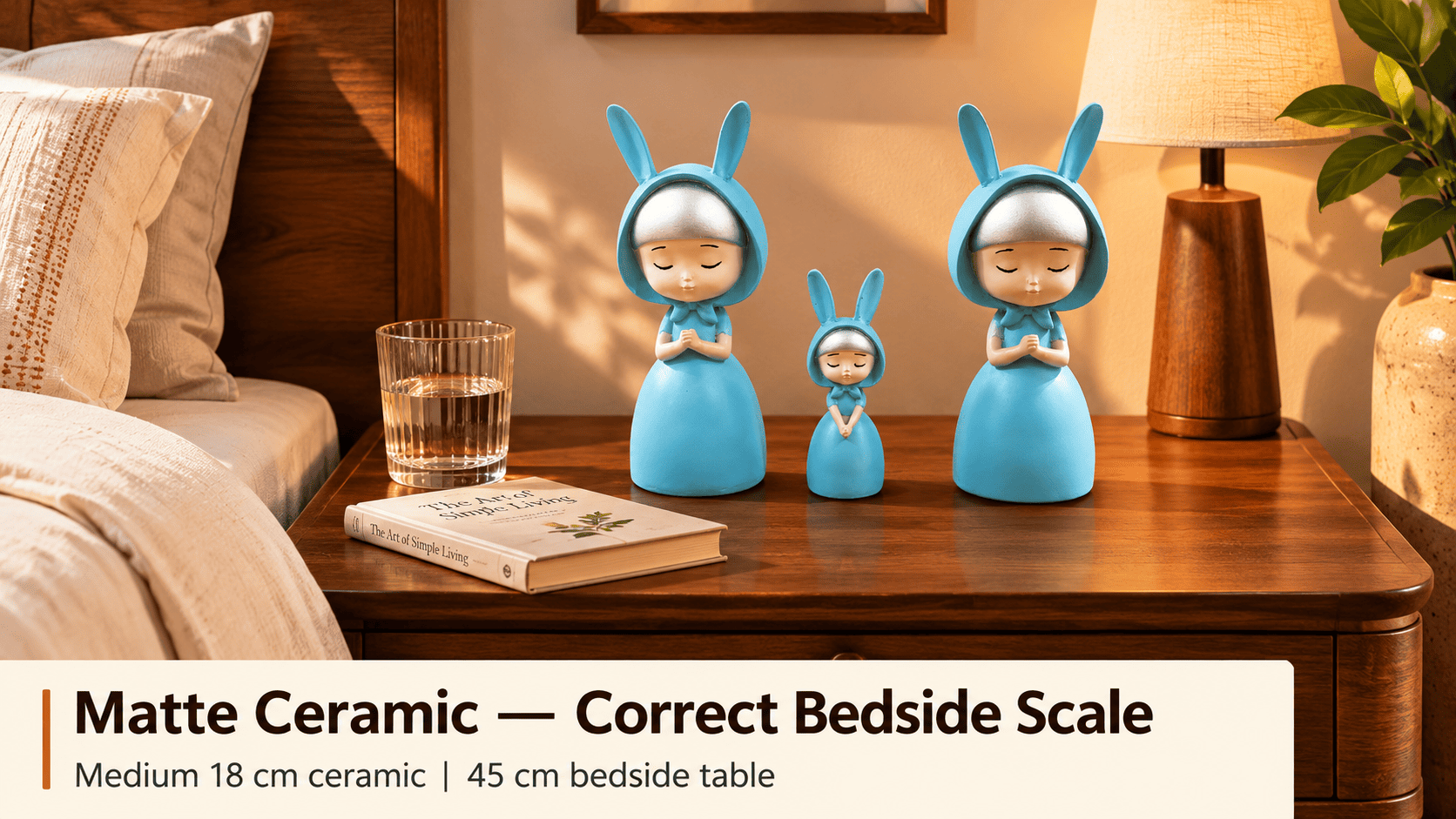
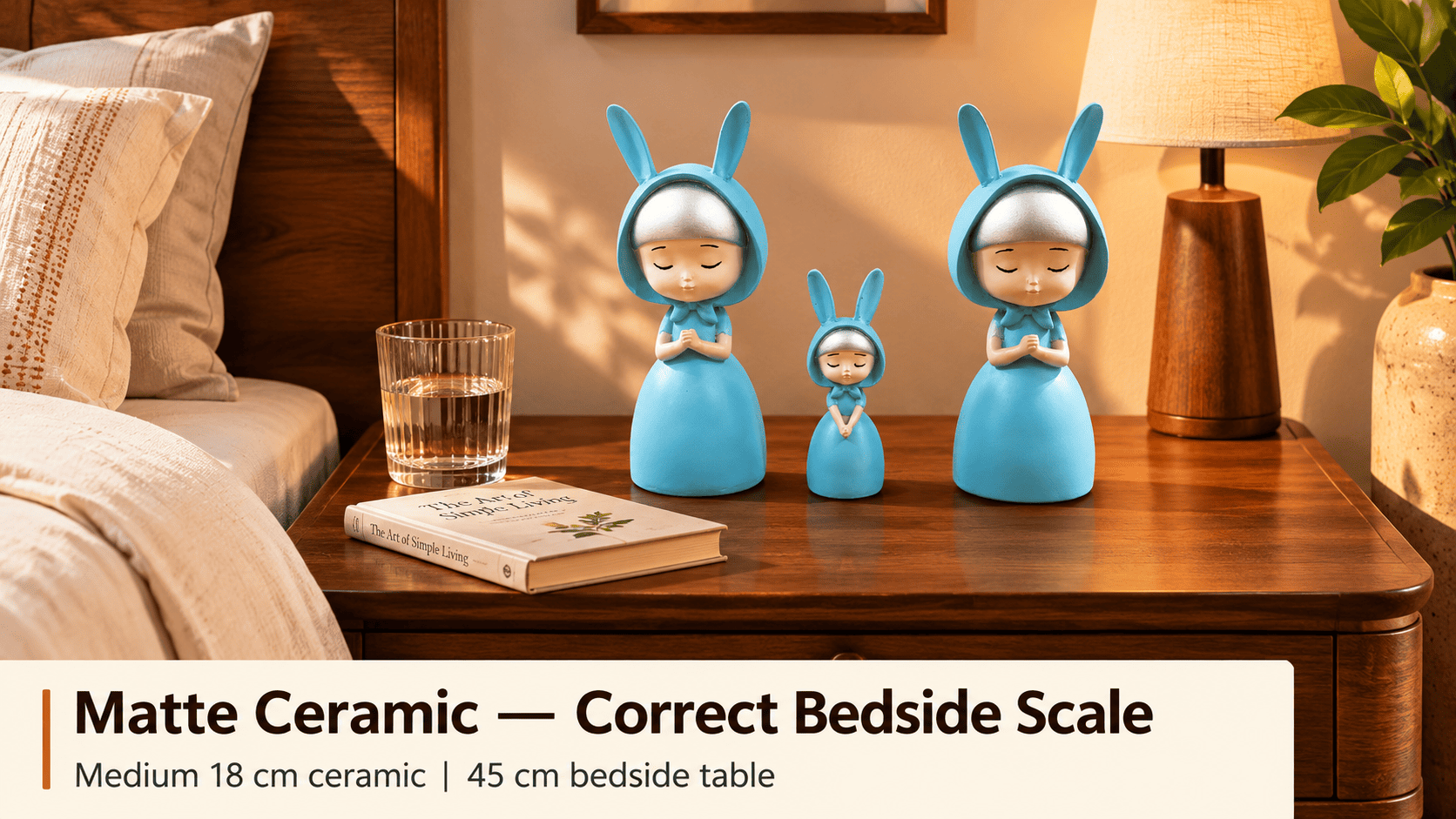
Indian apartment bedrooms in the sub-150 sq ft range have standardised surface dimensions that determine showpiece sizing before any aesthetic decision is made. A bedside table in a 10×12 ft bedroom typically spans 40–50 cm in width; placing a showpiece taller than 21 cm on that surface creates visual crowding because the piece exceeds 42% of the surface width, which pushes the human gaze above the sightline of the sleeping occupant. Dressers and console shelves in the 60–90 cm width range allow larger pieces because the surface can absorb the vertical mass without crowding the sightline.
| Bedroom Surface | Surface Width | Recommended Size Band | Preferred Material | Humidity Tolerance |
|---|---|---|---|---|
| Bedside table | 40–50 cm | Small–Medium (10–21 cm) | Ceramic (matte finish) | Up to 85% RH |
| Dresser top | 60–80 cm | Medium–Large (16–34 cm) | Ceramic or Resin (AC room only) | Ceramic 85% RH / Resin 60% RH |
| Floating bedroom shelf | 25–45 cm | Small (10–16 cm) | Ceramic (lighter 150–250 g) | Up to 85% RH |
| Bedroom console / display unit | 80–120 cm | Large (25–34 cm), grouped | Resin (AC room) or Ceramic | Ceramic 85% RH / Resin 60% RH |
Because AC usage hours, bedding palette, and wall tone introduce additional variables that affect whether ceramic or resin reads better in your specific bedroom layout, browse the full size-band and material selection in Moolwan's bedroom décor collection to verify your final piece before purchase.
Design Rule
To prevent visual saturation in a resting space, Moolwan recommends the 70/30 Vastu Surface Rule: keep 70% of any bedroom horizontal surface — bedside table, dresser top, or floating shelf — entirely clear, and place décor within the remaining 30%. This rule mirrors the Vastu principle of spatial openness (akasha) in the sleeping zone and prevents the cognitive stimulation that cluttered surfaces generate, which sleep researchers associate with elevated pre-sleep cortisol levels.
Which Vastu Directions Allow Resin, and Which Demand Ceramic?
Classical Vastu assigns elemental dominance to compass directions within a room: the south-west quadrant is governed by the earth element and is the prescribed zone for heavy, grounded, natural-material objects that anchor the occupant's stability and sleep quality. The north-east is governed by water and space elements and favours lighter, reflective, or spiritually significant objects. This directional logic has direct implications for material choice.
A ceramic bedroom showpiece placed in the south-west — on a dresser or shelf occupying that quadrant — reinforces the earth-element dominance that Vastu prescribes for that zone, because ceramic is a fired-earth material with a weight of 250–600 g that creates physical and elemental grounding. A resin piece in the south-west introduces a synthetic material into an earth-element zone, which classical Vastu texts classify as a dosha (imbalance) — irrespective of the piece's visual appeal.
By contrast, a resin bedroom showpiece with a high-gloss finish placed in the north or north-east zone — on a floating shelf or narrow console — is more consistent with the water and space elements that govern that direction, because gloss finishes carry a reflective quality that mirrors water's visual characteristics. This is the one bedroom context where a Vastu-conscious homeowner can justify resin without elemental conflict, provided the room is air-conditioned and RH stays below 60%.
Ready to bring home a bedroom showpiece that is engineered for Indian humidity and sized for Indian apartment surfaces? Shop the full Moolwan bedroom décor collection now.
Moolwan's Ceramic vs Resin Specs: What the Numbers Mean for a 5-Year Investment
Material durability in Indian conditions is a function of three variables operating simultaneously: sustained humidity (seasonal RH peaks), temperature cycling (15–42°C across Indian seasons), and UV exposure from window light. Ceramic at 92% clay composition handles all three because the high-density clay matrix leaves minimal interstitial space for moisture molecules to occupy, and the kiln-fired structure is already heat-set, meaning temperature cycling within the 15–60°C residential range produces zero dimensional change in a properly fired piece.
Resin at 94% epoxy purity performs optimally between 15–35°C and up to 60% RH. Below these thresholds it maintains its 3H pencil-hardness surface integrity. Above 35°C — which Indian summer afternoons routinely reach in east- and west-facing bedrooms without split AC — epoxy begins micro-softening at the surface, reducing scratch resistance over a 3–5 year period. A ceramic piece under the same conditions loses no surface hardness because it is already a rigid crystalline structure post-firing.
The investment calculus: a ceramic bedroom showpiece with a 5+ year indoor lifespan requires no material-driven replacement within one décor cycle. A resin piece in an unconditioned room may need replacement at year 2–3 as surface clouding and finish micro-delamination begin to show. Over a 10-year period in a non-AC bedroom, ceramic has zero material replacement cost versus two resin replacement cycles — making the higher upfront price of a high-density ceramic piece structurally cheaper per year of service.
Gifting a Bedroom Showpiece for a New Home or Griha Pravesh: Material Choice Matters
When a bedroom showpiece is purchased as a Griha Pravesh or housewarming gift for an Indian home, the material choice carries a secondary meaning the recipient will notice. Gifting a ceramic piece — an earth-element, kiln-fired, climate-rated object — communicates that the gift is chosen with understanding of Indian home conditions and Vastu logic, not simply selected on visual appeal alone. This is the reason Moolwan's ceramic bedroom range is increasingly purchased in the gifting context: the material credentials form part of the gift's perceived thoughtfulness.
Resin gifts are well-received in contexts where the recipient's home is a well-specified urban apartment with split AC in every room and a design sensibility that favours sculptural, contemporary forms over traditional finishes. For non-AC homes, or for recipients whose Vastu practice is active, ceramic remains the defensible gifting choice because it will not degrade in the recipient's actual living conditions.
Frequently Asked Questions
Is ceramic always better than resin for bedroom showpieces in Indian homes?
Ceramic is the stronger default for Indian bedrooms because its 92% clay composition tolerates up to 85% RH without warping, delaminating, or surface degradation — conditions that occur in most Indian bedrooms during the June–September monsoon period. Resin (rated to 60% RH) performs adequately only in rooms where split AC holds humidity below 55% year-round. In unconditioned or semi-conditioned Indian bedrooms, ceramic outlasts resin by 2–3 years per service cycle, making ceramic the economically and materially superior choice for the majority of Indian apartment contexts.
Which material does Vastu recommend for a bedside table showpiece?
Classical Vastu prescribes earth-element materials for the sleeping zone, and ceramic — as a kiln-fired clay compound — carries both the prithvi (earth) and agni (fire) elemental associations that Vastu considers stabilising for rest. Vastu texts make no provision for synthetic polymer materials like epoxy resin, which leaves resin in an elemental-neutral or potentially disruptive category for strict practitioners. For a bedside table, which sits within the immediate energy field of the sleeping occupant, ceramic in a matte finish is the Vastu-consistent and climate-consistent recommendation.
Does the colour of a ceramic bedroom showpiece affect Vastu compliance?
Yes, and the interaction is specific to compass direction. In the south-west bedroom quadrant, Vastu favours earthy warm tones — terracotta, ochre, muted brown, ivory — because these reinforce the earth-element dominance of that zone. In the north or north-east, cooler muted tones — sage, grey-green, pale blue — are consistent with the water and space elements of those directions. A Moolwan ceramic bedroom showpiece in a warm earth palette on a south-west dresser is both climatically rated and directionally consistent under Vastu — the only bedroom décor context where material, palette, and placement are simultaneously correct.
How do I clean a ceramic bedroom showpiece without damaging the matte finish?
Wipe with a dry microfibre cloth weekly. For deeper cleaning, use a damp (not wet) cloth with no detergent — surfactants in commercial cleaners penetrate the micro-texture of matte finishes and over time fill the texture pores, converting the matte surface to a semi-gloss. Avoid abrasive cloths, which scratch the micro-texture and alter the light-scattering profile that gives matte its visual quality. Resin pieces require the same damp-wipe approach but must be dried immediately to prevent water spotting on the gloss surface.
A bedroom showpiece that degrades in two monsoons is not a décor investment — it is a maintenance cost. Bring home a climate-rated, Vastu-consistent piece from the Moolwan bedroom décor collection — manufacturer-direct, 92% clay ceramic engineered to 85% RH, sized for Indian bedside and dresser surfaces. If you are also considering marble-look finishes for the bedroom, browse Moolwan's curated marble-finish bedroom showpiece range for pieces that combine the visual warmth of stone with the humidity tolerance of high-density ceramic — or explore the broader Moolwan decorative items for bedroom collection for accent pieces across all surfaces and size bands.


