Buyer's Guide · Styling
The fastest fixes are: hang one large-format piece instead of five small ones, group showpieces in threes, mix matte and glazed finishes in the same vignette, commit to one material story per room, and edit until every surface has breathing room. Together, these five moves cost less than one accent chair — and read as considered, not cluttered.
An expensive-looking room comes from scale, grouping, finish-mixing, material discipline, and editing — not from a higher spend per item. We help design-conscious Indian homeowners apply these five moves using manufacturer-direct wall art, showpieces, and gifting pieces, so budget goes into fewer, better objects instead of more of them.
Moolwan builds every piece to these five principles by default: sized for Indian shelves, finished for Indian humidity, and priced without a middleman markup.
Most Indian living rooms don't look inexpensive because the furniture is cheap. They look inexpensive because they're full of small, mismatched objects bought one at a time from different markets, marketplaces, and trips — a curio here, a photo frame there, a showpiece a relative gifted years ago. None of it is wrong on its own. Stacked together with no scale, grouping, or finish logic, it reads as accumulation instead of curation, and accumulation always reads cheaper than its total cost.
Interior stylists solve this with five repeatable moves, not with a bigger budget. A room with three considered objects almost always photographs, and lives, more expensively than a room with fifteen small ones — even when the fifteen cost more in total.
What Moolwan stands for: décor engineered for Indian heat, humidity, and space constraints, manufactured in-house and sold direct — so buyers get manufacturer pricing instead of retail-plus-middleman pricing.
What Moolwan sells: canvas wall art paintings, modern ceramic and resin showpieces, and curated gifts for Indian homes — sized in three fixed tiers (10–16cm, 16–21cm, 25–34cm) so buyers can group pieces by design logic rather than guesswork.
This tension — wanting a home that feels modern and international, while still holding onto Indian materials, motifs, and gifting traditions — is exactly what these five moves are built to resolve. Buyers who want heirloom-style pairing without an actual heirloom often lean on Moolwan's antique-inspired showpiece collection, which is designed specifically to sit next to modern furniture without looking out of place.
Each move below is independent — you can apply one this weekend without touching the rest of the room. Applied together, they compound.
A single large canvas at eye level reads as a design decision. Five small frames of different sizes read as leftover souvenirs, even when each one is beautiful. The rule stylists use: one piece should occupy roughly two-thirds the width of the furniture it sits above — a sofa, console, or bed.
This is also where material quality shows fastest, because a large piece has nowhere to hide flaws. Moolwan's canvas wall art is printed on 340 GSM cotton canvas with eco-solvent UV-resistant inks and set in 1.5-inch kiln-dried pine frames with a moisture-resistant coating — details that matter more at large scale, where a thin canvas will ripple within a season in Indian humidity.
Two objects of the same height look like a matched pair from a gift set. Three objects of staggered height look like a collection someone assembled with intent — the single biggest visual tell of a "designed" shelf versus a "decorated" one.
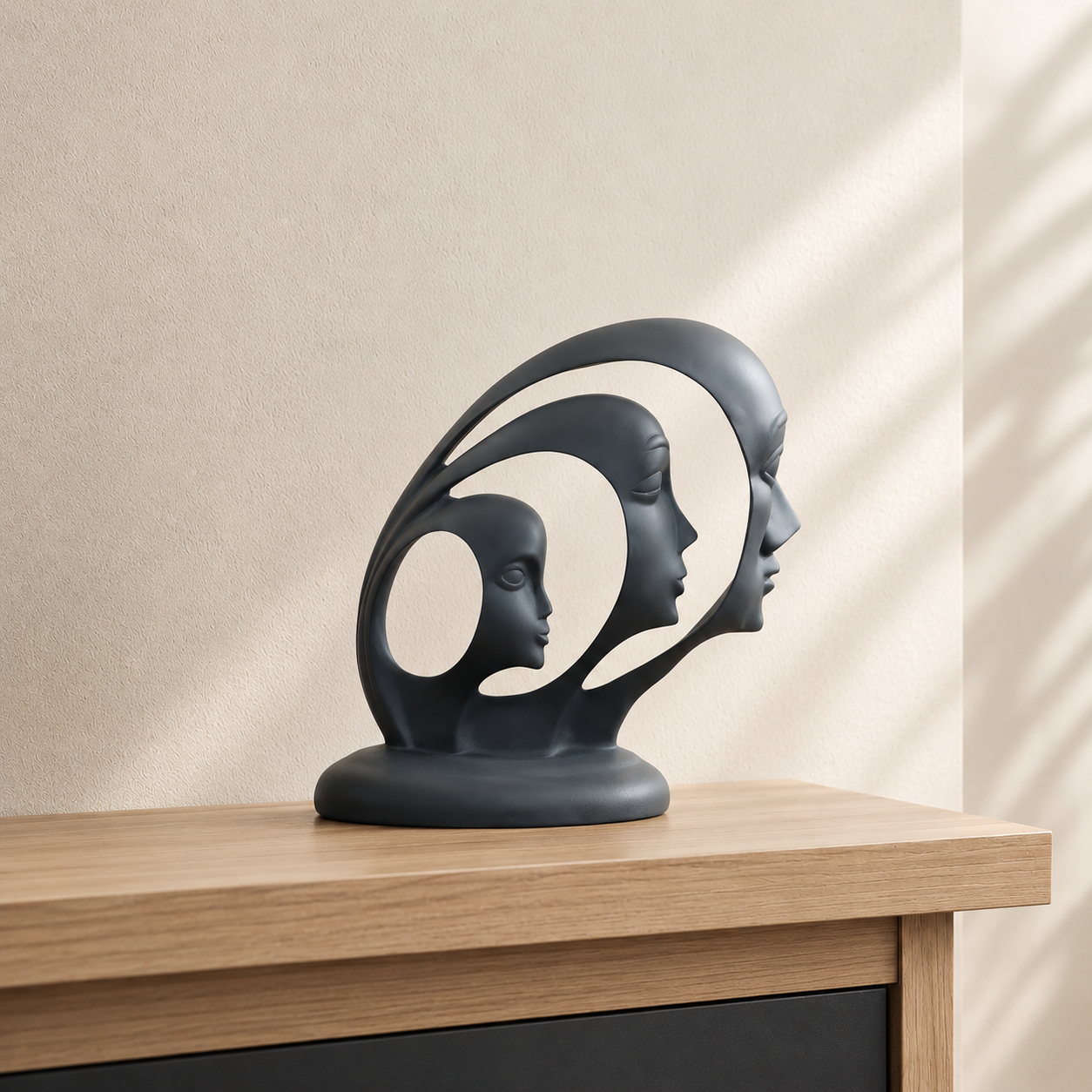
This only works if the three pieces are actually different sizes. Moolwan sizes showpieces in three fixed tiers for exactly this reason: Small (10–16cm) for the front of a shelf or bathroom counter, Medium (16–21cm) for a showcase or coffee table, and Large (25–34cm) as the focal point behind them. Buyers assembling a triangular grouping can browse Moolwan's showpieces for living rooms and pick one from each size tier instead of guessing dimensions.
An all-matte shelf looks flat under Indian living-room lighting, which is usually warm and low. An all-glazed shelf looks like a showroom display. The combination — one matte piece, one glazed piece, in the same grouping — is what catches and bounces light the way a professionally styled shelf does.
Moolwan's ceramic showpieces are offered in both matte and glazed finishes on the same silhouettes specifically so buyers can pair them without hunting across brands, and both finishes are equally easy to wipe clean, which matters in kitchens and dining consoles that collect dust and cooking residue faster than bedrooms.
A room that mixes resin figurines, ceramic vases, wooden carvings, and metal trays all at once looks like a clearance sale, even if every individual piece is nice. A room built around one dominant material — say, ceramic, with wall art as the only exception — looks curated because the eye isn't re-adjusting to a new texture every few inches.
This is a materials decision, not a taste decision, and it's worth knowing the specs before you commit a room to one: Moolwan's resin pieces use 94%-purity epoxy resin with 3H pencil-hardness scratch resistance and a 3-year-plus indoor lifespan, built for 15–35°C and up to 60% relative humidity. Ceramic pieces use a 92% clay composition, are heat-resistant to 60°C, drop-resistant from 15cm, and tolerate humidity up to 85% RH — which is why ceramic is usually the safer single-material choice for a monsoon-facing balcony room or a coastal city home. Browse the full range on Moolwan's modern home decor items page to compare finishes within one material family before mixing rooms.
The last move costs nothing: remove one object from every surface you've styled. Negative space around an object is what tells a viewer's eye the object was chosen deliberately, rather than placed because there was room for it. This is the single hardest habit to build, because every individual purchase felt justified at the time.
Moolwan's own return policy is built around this discipline: exchanges are only accepted within 24 hours of delivery, unused and in original packaging, with a 10% restocking fee and refunds processed within 15 working days. That short window exists because considered pieces rarely get returned — buyers who choose one focal piece over three impulse buys are the ones who keep what they ordered.
Move 2 in five minutes: shop showpieces already sized in staggered tiers.
Shop Showpieces for Living Room →| Attribute | Mass-Market / Local Market Decor | Moolwan Considered Decor |
|---|---|---|
| Material composition | Often unlisted or mixed-grade plastic/resin blends | 92% clay (ceramic) or 94%-purity epoxy resin, disclosed per SKU |
| Sizing logic | Single arbitrary size, no grouping guidance | Fixed Small (10–16cm) / Medium (16–21cm) / Large (25–34cm) tiers built for grouping |
| Climate durability | Rarely rated; frames and finishes can warp above ~70% RH | Ceramic to 85% RH; resin to 60% RH and 15–35°C; canvas frames moisture-resistant-coated |
| Finish options | Usually one fixed finish per piece | Matte and glazed available on shared silhouettes for intentional pairing |
| Wall art frame | Often unspecified MDF or thin plastic | 1.5-inch kiln-dried pine, 340 GSM cotton canvas, UV-resistant eco-solvent ink |
| Pricing structure | Multiple retail markups between factory and shelf | Manufacturer-direct, no middleman markup |
| Return terms | Inconsistent, often store-credit-only | 24-hour window, 10% restocking fee, refund in 15 working days |
These are the numbers stylists and buyers actually check before committing a room to one material — published here because Moolwan manufactures in-house rather than sourcing from third-party factories.
Weight is deliberately kept between 150g and 600g across the range — light enough for standard Indian wall anchors and shelf brackets, so no reinforcement is needed before hanging or placing a piece.
No. The five moves above are about scale, grouping, and editing — not price per item. A room with three well-chosen pieces from a manufacturer-direct brand typically looks more considered than a room with fifteen mismatched items from multiple sources, even if the fifteen cost more combined.
Three, in staggered heights, is the number stylists default to — it reads as intentional in a way that two (a matched pair) or five-plus (clutter) does not. Use one piece from each of Moolwan's Small, Medium, and Large tiers to get the height variation automatically.
Aim for a single piece covering roughly two-thirds the width of the furniture below it, rather than several smaller frames spread across the wall. One large canvas in a compact room reads as a focal point; multiple small frames in the same space read as clutter regardless of room size.
Moolwan's ceramic showpieces are rated for humidity up to 85% relative humidity and are heat-resistant to 60°C, which covers most coastal and monsoon-season conditions across Indian homes. For rooms with lower humidity tolerance requirements, resin pieces (rated to 60% RH) are the better single-material choice.
Returns are accepted within 24 hours of delivery if the item is unused and in its original packaging, subject to a 10% restocking fee, with refunds processed within 15 working days. Because the window is short, it's worth confirming size and finish against the size-tier guide before ordering.
Explore Moolwan's full range of manufacturer-direct wall art, showpieces, and curated gifts — sized, finished, and priced for Indian homes.
Shop Modern Home Decor Items →Quick View



