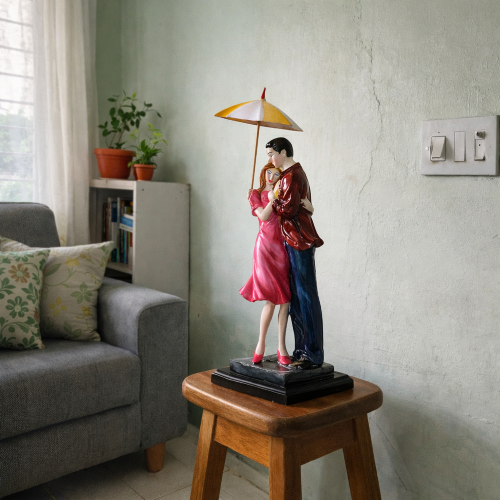
At Moolwan, we help design-conscious Indian homeowners upgrade every room — including the ones that sit between inside and outside. Our showpieces are engineered for Indian climate conditions, and several of them are built to handle the humidity, heat, and monsoon air that most imported décor cannot survive.
The Indian balcony is chronically underdecorated. Most urban apartments have 30–60 sq ft of balcony space that doubles as a storage dump. With a few deliberate choices, it becomes the best corner of your home.
Floor: Use outdoor-rated tiles, coir matting, or interlocking wooden deck tiles — all available at hardware stores under ₹800/sq ft. Wall: A single statement piece — a metal wall hanging, a ceramic plaque, or a hand-painted panel — changes the entire character of the balcony. Railing: Hang small terracotta or ceramic pots using S-hooks. Clusters of three at varying heights look intentional rather than cluttered.
Not every decorative item survives balcony exposure. Moolwan's ceramic showpieces are engineered with a 92% clay composition that stays stable at humidity levels up to 85% RH — the upper range of a typical Indian monsoon. They are heat-resistant up to 60°C, which means they will not crack on a west-facing balcony in peak summer. Place medium-sized pieces (16–21 cm) on a side table or plant stand as focal points alongside your greenery. Browse Moolwan's modern home décor collection to find balcony-ready showpieces that do not need special treatment or seasonal storage.
Balconies are depth-constrained. Going vertical — wall shelves, hanging planters, a tiered plant stand — solves this instantly. A three-tier bamboo stand with alternating green plants and small ceramic figures (10–16 cm shelf pieces) is one of the most effective DIY balcony arrangements for Indian apartments.
Your entrance — whether it is a building lobby corner, a flat's front door, or a bungalow's porch — is the single highest-impact décor zone per square foot in any home. Visitors form an impression in the first 7 seconds. Make those seconds count.
A well-styled entrance works on three planes simultaneously. Floor: a quality doormat, a potted plant, or a pair of identical ceramic urns flanking the door. Eye level: a wall sculpture, a nameplate with character, or a framed piece of wall art. Overhead: fairy lights on a lintel, a small hanging ornament, or a wind chime with visual weight. This three-plane approach is borrowed from interior design and costs nothing to apply to a DIY project.
A single large ceramic figurine (25–34 cm) placed on a console table or a wall-mounted shelf at the entrance communicates intentionality. It does not need to match anything else — it just needs to be considered. Moolwan's decorative items for entrance are selected specifically for this role: pieces with enough presence to anchor a foyer and enough restraint to not compete with the rest of your interior.
Ready to upgrade your entrance? Explore handcrafted, climate-tested entrance décor pieces at Moolwan — shipped pan-India, free of charge, with cash on delivery available.
Courtyards and verandahs are uniquely Indian outdoor spaces — semi-open, transitional, and deeply cultural. They are where families gather in the evening, where festivals get their staging area, and where the act of decorating carries meaning beyond aesthetics.
Every well-styled courtyard has one focal element — a central planter, a sculpted water feature, a painted mural wall, or a significant piece of art. The rest of the décor radiates from that anchor. If you are starting a DIY project, identify your anchor first and build outward rather than filling the space with miscellaneous items.
Indian courtyards face heat above 40°C in summer, monsoon humidity above 80%, and direct UV exposure. This rules out most resin and plastic décor. Moolwan's ceramic pieces — built to withstand temperatures up to 60°C and humidity up to 85% RH — are one of the few showpiece categories that hold up through all four seasons in a semi-open Indian space. Their matte-glazed finish does not show water stains or heat discolouration the way glossy imports tend to.
Indian courtyards double as festival stages — Diwali rangoli, Navratri garba, Ganesh puja setups. Build your base décor to be modular and rearrangeable. Low-level pedestals, movable plant stands, and stackable ceramic pieces give you a blank canvas that can be dressed and undressed seasonally without a full re-do.
Not all décor materials are equal when placed in Indian outdoor-adjacent zones. This table compares the most commonly used materials against the real-world conditions they will face.
| Material | Max Humidity Tolerance | Max Temperature | UV Resistance | Best Outdoor Zone | Lifespan (Indian Climate) |
|---|---|---|---|---|---|
| Moolwan Ceramic (92% clay) | Up to 85% RH | 60°C | Moderate (glazed finish) | Balcony, courtyard, verandah | 5+ years |
| Moolwan Epoxy Resin (94% purity) | Up to 60% RH | 35°C | Low (indoor-rated) | Covered entrance, shaded balcony | 3+ years indoors |
| Moolwan Canvas Wall Art (340 GSM) | Indoor/covered only | Avoid direct sun | High (UV-resistant ink) | Covered porch wall, verandah interior | 5+ years (covered spaces) |
| Standard imported resin (generic) | Up to 50% RH | 28–30°C | Very low | Fully indoor only | Under 1 year outdoors |
| Terracotta (unglazed) | Unlimited | Unlimited | High (natural) | All outdoor zones | 10+ years (minimal décor value) |
| MDF / Wooden panels | Below 60% RH | Below 40°C | Very low | Covered entrance only | 1–2 years without treatment |
Specifications for Moolwan ceramic and resin products are based on manufacturer testing standards. Generic import data represents typical market averages for non-branded resin pieces sold under ₹500 in Indian e-commerce.
The window sill and the threshold between an indoor room and a balcony or verandah is one of the most effective décor zones in a flat — and nearly always ignored. Styling this transition point makes both spaces feel larger and more intentional.
A window sill needs only three elements: a small plant (under 15 cm in its pot), one decorative object (10–16 cm shelf-sized), and a consistent material language (all ceramic, or all brass, or all natural wood — never a mix). Moolwan's small-format showpieces at 10–16 cm are sized specifically for this purpose: they fit on a standard Indian window ledge without blocking light or overpowering the view.
If your balcony has terracotta pots in burnt orange and your living room has a neutral palette, use one accent colour — a rust ceramic piece on the window sill — to create a visual thread between both spaces. This trick, borrowed from interior designers, costs nothing and makes the entire apartment feel cohesive rather than compartmentalised.
For bedroom-adjacent balconies, the same logic applies. A carefully chosen decorative piece for your bedroom can extend naturally onto a window ledge, creating a layered look that is distinct but harmonious.
This process works for any Indian balcony between 20–80 sq ft. Follow the steps in order — skipping steps leads to the cluttered, unresolved look most Indian balconies end up with.
Standard resin décor is not recommended for open balconies during monsoon. Most generic resin pieces on the market tolerate humidity only up to 50% RH — Indian monsoons routinely exceed 80–90% RH. Moolwan's epoxy resin pieces (94% purity) are rated to 60% RH and are best suited for covered or shaded balcony corners, not fully open exposure. For fully exposed balcony spots, Moolwan's ceramic pieces — rated to 85% RH — are the safer choice.
The easiest high-impact change for a small Indian balcony is the "three-tier plant stand with accent showpiece" approach: a vertical bamboo or metal stand with alternating plants and one small ceramic piece (10–16 cm) on the middle tier. It takes under 30 minutes, costs under ₹1,500 for the stand and plant, and creates a lush, intentional corner without requiring any drilling or structural changes.
The most effective no-drill entrance décor strategy for rental homes uses three elements: a quality doormat (placed, not fixed), a freestanding ceramic piece or plant on the floor beside the door, and an adhesive wall hook to hang a lightweight decorative item at eye level. Moolwan's entrance décor pieces weigh between 150g–600g, which is within the weight limit of most adhesive hooks. This creates a styled entrance with zero damage to walls.
South-facing balconies in India get intense, direct sunlight for 6–8 hours daily. Colours that hold well in direct UV exposure are earthy tones — terracotta, ochre, deep green, and warm grey. Bright whites and pastels fade quickly. Moolwan's matte-glazed ceramic finishes in warm earth tones are a strong choice here because the matte surface does not reflect glare and the glaze seals the colour against UV fading better than unfinished terracotta.
A well-styled Indian apartment balcony can be completed for ₹2,500–₹8,000 depending on ambition. The baseline: ₹500–800 for a quality mat, ₹800–1,200 for a plant and pot, ₹1,200–2,500 for one statement showpiece, and ₹300–500 for string lights. The mistake most buyers make is buying ten cheap items instead of three considered ones — the result always looks cluttered. Spending more on fewer, better pieces delivers a consistently stronger result.
Every piece in Moolwan's catalogue is manufactured in-house and engineered for Indian climate conditions. No middlemen. No markups. Free shipping pan-India. Cash on delivery available.
Quick View



