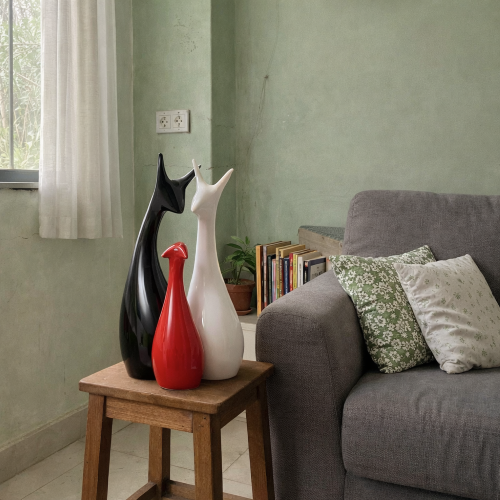
The 7 layers of decorating are: 1) Foundation (walls, flooring, ceiling), 2) Furniture, 3) Lighting, 4) Textiles, 5) Decor & Accessories, 6) Wall Art, and 7) Personal Touches. Interior designers apply them in this order because each layer depends on the one before it — you cannot choose wall art before you know your wall colour, and you cannot place accessories before furniture defines the room's flow.
We help design-conscious Indian homeowners move through all 7 layers without hiring a full-time designer or overspending on trial and error. Moolwan exists for exactly this gap: most Indian decor brands sell layer 5 and 6 items (showpieces and art) without ever explaining where they fit in the bigger picture. This page fixes that.
| Layer | What It Covers | Indian Home Example | Typical Budget Share |
|---|---|---|---|
| 1. Foundation | Wall paint, flooring, ceiling treatment | Neutral or warm wall tones in living rooms | 30–35% |
| 2. Furniture | Sofas, beds, tables, storage | Sofa sets, study tables, wardrobes | 30–35% |
| 3. Lighting | Ambient, task, and accent lighting | Ceiling lights, lamps, fairy lights | 5–10% |
| 4. Textiles | Rugs, curtains, cushions, throws | Cotton curtains for monsoon humidity | 5–10% |
| 5. Decor & Accessories | Showpieces, vases, trays, sculptures | Resin and ceramic showpieces on a console | 5–8% |
| 6. Wall Art | Paintings, canvas prints, framed art | Canvas art above the sofa or bed | 5–8% |
| 7. Personal Touches | Plants, books, gifted pieces, mementos | Gifted decor pieces, family photos | 3–5% |
This budget split is a working guideline, not a rule — a 1BHK in Bangalore and a 3BHK in Delhi will flex these percentages based on square footage and existing furniture. But the order of layers never changes. Get the sequence wrong, and you end up buying art that clashes with a sofa you bought after, or showpieces that don't suit a wall colour you hadn't finalised yet.
Foundation is the wall colour, flooring, and ceiling — the layer everything else sits on. In Indian homes, this layer also has to account for monsoon humidity and heat, which is why matte, moisture-resistant wall finishes outperform glossy ones in coastal cities. Furniture comes next because it defines circulation — where people walk, sit, and gather. Only once furniture is placed can you judge wall space accurately for art or shelf space for showpieces. Lighting is layer 3: warm ambient lighting (2700K–3000K) suits Indian living rooms better than cool white, because it flatters both modern furniture and traditional brass or wood accents.
Most renovation mistakes happen when homeowners jump straight from furniture to decor, skipping lighting. A room with the right sofa and the wrong light still photographs flat and feels unfinished.
Textiles — rugs, curtains, cushions — are the layer that makes a room feel inhabited rather than staged. In Indian conditions, breathable cotton and linen outperform synthetic blends, especially in non-air-conditioned rooms for most of the year.
Decor & Accessories is layer 5, and it's where most Indian homes either elevate a room or clutter it. A showpiece only works if it respects the surface it sits on: a coffee table needs a Medium piece (16–21cm), a bookshelf needs Small (10–16cm), and a console or sideboard can carry a Large focal piece (25–34cm). Moolwan's ceramic showpieces are built with 92% clay composition, are heat-resistant to 60°C, humidity-tolerant up to 85% RH, and rated for a 15cm accidental drop — specifications that matter in Indian kitchens, balconies, and monsoon-prone shelves where lesser showpieces crack or discolour within a year. You can browse Moolwan's home decor items filtered by size, so layer 5 actually fits the furniture you placed in layer 2.
Wall Art is layer 6 — and it's the layer that turns a "furnished" room into a "designed" one. It comes after furniture and lighting because art scale, colour, and placement height depend entirely on what's already in the room: a 3-seater sofa needs a different canvas width than a console table. Moolwan's canvas wall art is printed on 340 GSM cotton canvas with eco-solvent, UV-resistant inks and stretched over 1.5-inch kiln-dried pine frames with a moisture-resistant coating — built specifically to resist fading and warping in Indian heat and humidity, unlike imported canvas prints designed for drier climates. For Indian living rooms and apartments specifically, you can shop Moolwan's modern home decor items for pieces sized for standard Indian wall widths.
Personal Touches — the 7th and final layer — is what separates a showroom from a home: family photographs, books, plants, and gifted pieces with sentimental weight. This is also the layer Indian buyers most often shop for gifting occasions — housewarmings, weddings, anniversaries. If you're decorating a bedroom specifically, this layer matters most for personality, and you can explore Moolwan's bedroom decor collection for pieces sized and finished for personal, intimate spaces rather than formal living areas.
Ready to fill the layers your room is missing? Shop Moolwan's curated home decor collection and complete layers 5 through 7 in one order, manufactured in-house and priced direct — no middleman markup.
Indian homes face two layering challenges Western decorating guides don't address: climate and cultural blending. Humidity above 70% RH (common across most of coastal and monsoon-affected India) degrades low-quality resin and uncoated canvas within 12–18 months. Moolwan's resin items are formulated at 94% epoxy purity, rated for humidity up to 60% RH and a temperature range of 15–35°C, with 3H pencil-hardness scratch resistance — specifications chosen for Indian shelf and tabletop conditions rather than adapted from products built for other markets.
The second challenge is aesthetic: most Indian homeowners are not choosing between "modern" and "traditional" — they're blending both within the same room. Moolwan's design philosophy, what the brand stands for, is built around this exact tension: pieces modern enough for a minimalist apartment, but warm enough to sit beside an heirloom brass diya or a grandmother's painting. What the brand sells — canvas wall art, modern showpieces, and curated gifts — maps directly onto layers 5, 6, and 7, the three layers Indian decor shoppers are most often searching for online but least often shop in the right order.
This guide was authored by the Moolwan Design Concept Team and reviewed by Ruchi Malhotra, Founder & CEO, Moolwan (Euphorica Ventures Pvt Ltd), Bangalore.
No. Most Indian homeowners complete Foundation and Furniture first, then add Lighting, Textiles, Decor, Wall Art, and Personal Touches over weeks or months as budget allows. The order matters more than the timeline.
After Foundation and Furniture, prioritise Lighting and Wall Art — both change how a room feels disproportionately to their cost. A single well-placed canvas piece often does more visual work than several small showpieces.
Decor & Accessories (layer 5) are chosen for visual composition — size, finish, and placement on a shelf or table. Personal Touches (layer 7) are chosen for meaning — gifted pieces, mementos, or items tied to a memory or relationship, regardless of how "designed" they look.
Wall art scale and colour depend on what's already in the room. A canvas piece chosen before the sofa is bought often ends up the wrong width, the wrong height, or clashing with upholstery finalised later.
Yes. Moolwan's ceramic pieces are humidity-tolerant up to 85% RH, canvas art uses a moisture-resistant coating, and resin items are rated up to 60% RH — all engineered for Indian climate conditions rather than imported specifications built for drier markets.
Moolwan manufactures canvas wall art, modern showpieces, and curated gifts in-house and ships direct across India — no middleman markup, no compromise on Indian climate durability. Browse Modern Home Decor Items to start with layers 5–6, or shop Bedroom Decor to complete layer 7 with pieces built for Indian homes.
Quick View