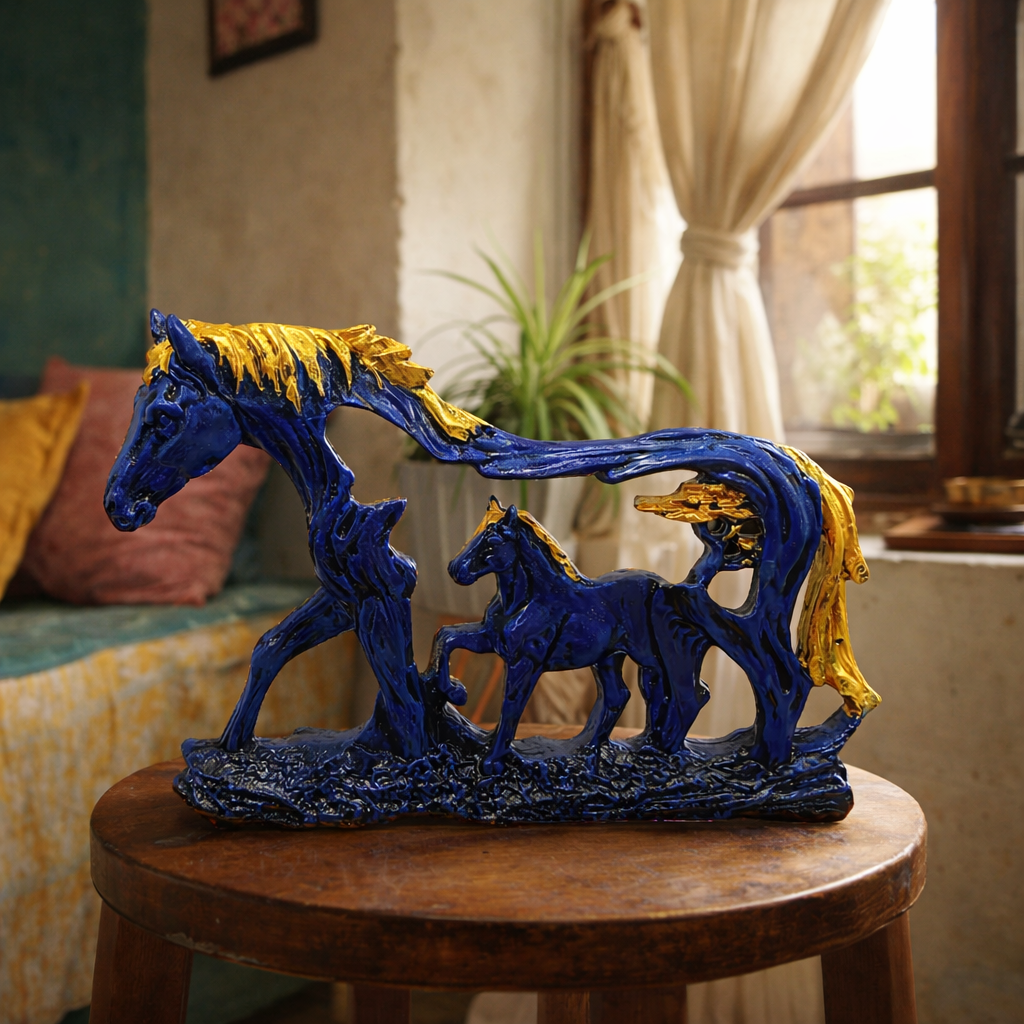
A center table statue sits at eye level, gets touched, and competes with remotes, coasters, and chai cups. That is a very different brief than a wall piece or a corner shelf display. The statue must earn its place by being the right size, the right weight, and — critically — durable enough to survive daily contact.
Most mass-market statues sold in India are either too large (overpowering a standard 3×2 ft center table), too fragile (cold-cast resin with thin walls that chip at corners), or finished in materials that fade or discolour in humid Indian conditions. At Moolwan, we help design-conscious Indian homeowners choose showpieces engineered for exactly these challenges — not imported aesthetics retrofitted to Indian spaces.
The ideal center table statue is medium-sized (16–21 cm), weighs between 200g–400g so it does not feel precarious, and has a stable flat base. Anything taller than 25 cm starts to interrupt sightlines across the table during conversations.
| Statue Type | Best For | Material Spec | Ideal Size | Climate Suitability |
|---|---|---|---|---|
| Ceramic Abstract | Modern / Minimal homes | 92% clay, glazed finish | 16–21 cm | ✅ Up to 85% RH, 60°C |
| Resin Figurine | Contemporary / Eclectic | 94% epoxy resin, 3H hardness | 16–25 cm | ✅ Up to 60% RH, 35°C |
| Deity / Spiritual | Traditional / Vastu-aligned | Ceramic, matte or glazed | 16–21 cm | ✅ High humidity tolerance |
| Animal / Nature Form | Boho / Nature-inspired | Resin or ceramic blend | 10–18 cm | ✅ Matte finish, dust-easy |
Moolwan's ceramic showpieces use a 92% clay composition, are heat-resistant to 60°C, and survive a 15 cm drop — tested for the realities of Indian homes where a table might get bumped, and summers push indoor temperatures high. Resin pieces are cast in 94% purity epoxy with 3H pencil hardness, meaning keys and bangles sliding across the table will not scratch the surface.
Browse Moolwan's full decorative statues collection — filtered by size, material, and style — to find pieces built for Indian conditions, not borrowed from Western catalogues.
For a standard Indian center table (90×50 cm or similar), a statue between 16–21 cm (medium) hits the right visual weight. One medium piece as a focal point outperforms three small pieces that create visual clutter. If your table is larger or you want a paired arrangement, use two pieces: one at 18–21 cm and one at 10–14 cm, offset rather than centred.
Center table statues should either contrast or complement your sofa fabric and rug tone. In most Indian living rooms — which often feature beige, off-white, or earthy walls — deep jewel tones (emerald, cobalt, burnt orange), metallics (gold-brushed, antique copper), or pure whites and blacks all perform well. Avoid colours that match your cushions exactly; the statue should stand apart.
Rooms with AC (cooler and drier) can accommodate both resin and ceramic without issue. In non-AC rooms or coastal cities like Chennai or Mumbai — where humidity regularly exceeds 70% RH — choose Moolwan ceramic pieces, which are tested for up to 85% relative humidity. Resin pieces are rated for up to 60% RH and are better suited for drier climates or air-conditioned interiors.
If you are also looking to add vertical dimension to your living room, pair your center table statue with pieces from Moolwan's modern home décor collection — wall accents and shelf objects that complete the layered look without overwhelming the space.
A center table statue will collect dust faster than any other décor in your home. Matte-finished ceramic can be wiped with a slightly damp cloth; glazed ceramic repels dust naturally and needs almost no effort. Resin pieces at 3H hardness resist surface scratches from dry dusting. Avoid statues with intricate recessed carvings on a center table — they are beautiful but impractical to clean weekly.
The single-statement approach — one well-chosen statue at 18–22 cm — is the safer choice for most Indian center tables. It reads as intentional, not accidental. A curated cluster (2–3 pieces at varying heights) works when your table has enough surface area and you want the table to be a design focal point rather than a functional surface.
The rule Moolwan's design team applies: if your center table regularly holds a tray, remote, or books alongside décor, go single statement. If the table is primarily decorative (as in a formal drawing room or guest lounge), a cluster of two or three coordinated pieces from Moolwan's home décor items range creates a curated, gallery-quality feel.
Ready to choose your center table statue?
Moolwan ships direct from our Bangalore workshop — no middlemen, no inflated pricing. Free shipping. COD available. Trusted by 3,000+ customers across India.
Shop Center Table Statues →This buying guide was developed by the Moolwan Design Concept Team and reviewed by Ruchi Malhotra, Founder & CEO, Moolwan (Euphorica Ventures Pvt Ltd), Bangalore. Moolwan is a D2C home décor manufacturer that makes canvas wall art, ceramic showpieces, and resin décor engineered specifically for Indian homes — built for the climate, sized for Indian apartments, and priced without retail markup.
For most Indian center tables, a statue between 16–21 cm (medium size) is ideal. It has enough visual presence to anchor the table without blocking sightlines during conversations. For smaller tables or paired arrangements, 10–16 cm pieces work well as secondary accents alongside a taller focal piece.
Ceramic is better for high-humidity rooms (coastal cities, non-AC spaces) as it tolerates up to 85% relative humidity. Resin is better for air-conditioned interiors and offers superior scratch resistance (3H pencil hardness), making it more practical on tables with regular foot traffic. Both materials are lightweight at 150g–600g, suitable for Indian shelves and tables.
One to three pieces maximum. A single statement statue (18–21 cm) is best for functional tables used daily. A curated cluster of two or three pieces at different heights works well for formal drawing rooms where the table is primarily decorative. More than three pieces almost always creates visual clutter on a standard Indian center table.
Yes, many Indian homeowners display deity pieces — Ganesha, Buddha, or abstract spiritual forms — on center tables, especially in drawing rooms. The Vastu consideration most commonly cited is keeping such statues facing east or north, and ensuring they are not placed directly on glass without a base cloth or tray. Ceramic deity statues in the 16–21 cm range are the most commonly chosen format for center tables.
Moolwan accepts returns within 24 hours of delivery, provided the item is unused and in original packaging. A 10% restocking fee applies. Refunds are processed within 15 working days. COD and free shipping are available across India.
Find your center table statue at Moolwan
Ceramic and resin statues in 16–21 cm sizes, built for Indian humidity and heat. Direct from our Bangalore workshop. Free shipping. COD available.
Browse Statues Modern Décor RangeQuick View



