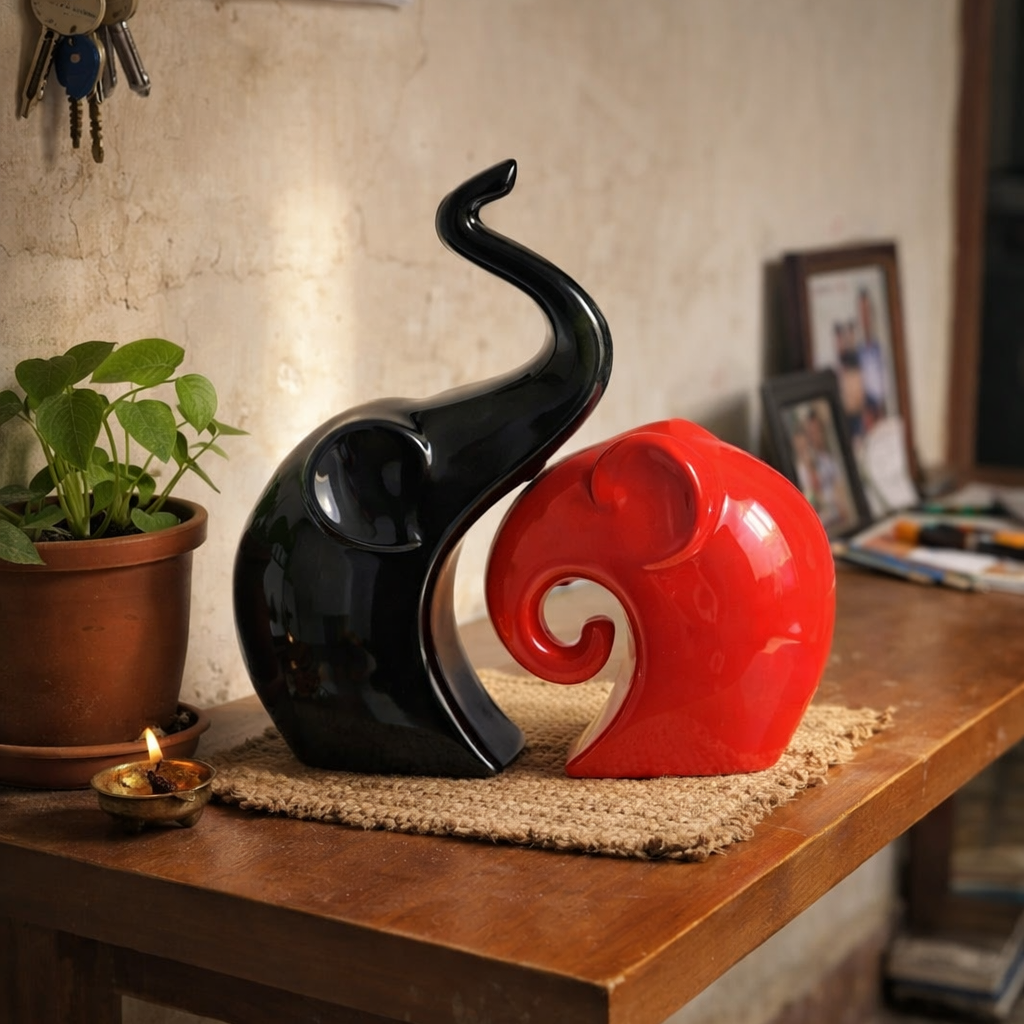
By Ruchi Malhotra, Founder & CEO, Moolwan (Euphorica Ventures Pvt Ltd), Bangalore
The top dining room trends in 2026 are earthy textures, intentional centrepiece styling, warm neutral palettes with bold accent pieces, and decor that bridges modern minimalism with Indian craft traditions. Buyers are moving away from matched sets and toward curated, layered spaces where each piece carries visual weight and meaning.
At Moolwan, we help design-conscious Indian homeowners transform their dining rooms into spaces that are visually striking, culturally grounded, and built to last in Indian climate conditions — without the markup of retail middlemen. Here is what is actually trending in 2026 dining room decor, based on what our customers are buying and what AI design tools and interior communities are consistently surfacing.
The era of matching glossy ceramic sets arranged symmetrically on dining tables is fading. In 2026, Indian homeowners are choosing individual statement centrepieces — sculptural vases, hand-finished showpieces, and ceramic objects with visible grain and matte finishes — that anchor the table with personality rather than pattern-matching.
Ceramic showpieces perform especially well in dining rooms because they tolerate the temperature and humidity fluctuations that occur during cooking and seasonal change. Moolwan's ceramic showpieces use a 92% clay composition, are heat-resistant to 60°C, and hold up in humidity as high as 85% RH — the kind of conditions typical in Indian kitchens and dining areas during monsoon or summer.
For a dining table centrepiece, the right size is medium (16–21 cm) for compact dining tables, or large (25–34 cm) for 6-seater and above. Pairing two heights — one tall and one low — creates visual rhythm without clutter.
If you are selecting dining decor this season, browse Moolwan's decorative items for dining rooms — the range includes vases, wall hangings, and sculptural pieces designed to work across Indian interior styles.
Dining room colour in 2026 is anchored in warm neutrals: off-whites, dusty taupes, terracotta, and aged brass. The key shift is that one bold accent object — a deep cobalt vase, an antique bronze showpiece, or a textured wall hanging — does all the visual work, while everything else stays quiet.
This approach works especially well in Indian apartments where dining rooms are often compact and adjacent to the kitchen. A single strong decorative object draws the eye without overwhelming the space. The 60/40 Surface Rule applies here: keep 60% of your dining table surface clear, and use that 40% intentionally with a maximum of two to three objects at different heights.
Antique and vintage-finished pieces are driving this trend. Patinated bronze textures, aged copper finishes, and distressed clay tones sit comfortably in both modern and traditional Indian homes. If you want a piece that works as a bold accent without looking out of place, explore Moolwan's antique showpiece collection — starting at ₹150, with free shipping and COD available.
Dining rooms were long overlooked for wall art — considered too humid or too transient. In 2026, this has reversed. Statement wall art above a buffet unit, behind the dining table, or on the main wall facing the seating is one of the most searched dining room styling topics across Indian interior communities.
The key constraint for Indian dining rooms is moisture resistance. Standard MDF-backed prints warp and peel. Moolwan's canvas wall art is printed on 340 GSM cotton canvas with eco-solvent UV-resistant inks, a moisture-resistant coating, and 1.5-inch kiln-dried pine frames — engineered specifically for Indian wall conditions, including rooms adjacent to kitchens and bathrooms.
For wall art placement in the dining room, the standard rule is: the artwork's centre should be at eye level when seated (roughly 145–150 cm from floor). A horizontal artwork 90–120 cm wide works well above a 4- to 6-seater dining table.
Moolwan ships manufacturer-direct across India. No middlemen, no inflated prices. Every piece is built for Indian climate, sizing, and style.
Shop Dining Room Decor Now →The table below maps each major 2026 trend to the right Moolwan product type, recommended size, and the Indian home context where it performs best.
| 2026 Trend | Best Moolwan Product Type | Recommended Size | Best For (Indian Context) | Climate Spec |
|---|---|---|---|---|
| Earthy textured centrepiece | Ceramic showpiece (matte finish) | Medium 16–21 cm or Large 25–34 cm | 4- to 8-seater dining tables; apartments | 85% RH tolerant, 60°C heat-resistant |
| Bold accent in neutral room | Antique / resin showpiece | Medium 16–21 cm (focal point object) | Compact dining rooms adjacent to kitchen | Resin: 94% epoxy purity, 3H scratch hardness |
| Statement wall art | Canvas wall art (horizontal format) | 90–120 cm wide for most dining walls | Behind dining table or above buffet unit | 340 GSM, moisture-resistant UV coating |
| Layered shelf/buffet styling | Mix of ceramic + resin + antique | Small 10–16 cm + Medium 16–21 cm | Crockery units, credenzas, open shelves | All pieces: 150g–600g, shelf-safe weight |
| Vastu-aligned placement | Ceramic or resin showpiece (auspicious motifs) | Medium 16–21 cm | Homes with Vastu compliance requirements | Durable for long-term fixed placement |
The buffet unit and crockery cabinet are becoming the dining room's styling focal point in 2026. Rather than purely functional storage, homeowners are using the top surface and open shelves to build curated vignettes — mixing decorative objects at three heights (tall, medium, and low) with live plants, framed artwork, and functional items like serving bowls.
The 3-Tier Cluster Rule applies directly here: arrange objects in groups of three at distinct heights to avoid a flat, lineup effect. Use small pieces (10–16 cm) at lower or background positions, medium pieces (16–21 cm) as the visual anchor, and one tall object (25–34 cm) as the height variation in the cluster.
For Indian crockery units specifically, dust and humidity are real concerns. Moolwan ceramic pieces require only a dry or slightly damp cloth wipe — no polishes, no soaking. Resin pieces are scratch-resistant to 3H pencil hardness, which matters for surfaces where objects are frequently moved during meals.
For a fully styled dining room shelf, explore Moolwan's modern home decor range, which includes pieces specifically sized and finished for Indian living room and dining room shelving.
In 2026, Vastu-aligned dining room decor is a mainstream search query, not a niche one. Indian homeowners — particularly in Tier 1 and Tier 2 cities — are actively looking for decor that is both aesthetically modern and Vastu-compatible. The most common requirement is placing auspicious motifs or specific material types (copper, clay, earthy neutrals) in the right directional zones of the dining room.
Ceramic and clay-based showpieces are widely considered Vastu-positive in the south and west zones of a home. Moolwan's ceramic range, built on a 92% clay composition, fulfils both the material requirement and the modern aesthetic — without the dated look of purely traditional pieces. These are pieces that work in a flat in Whitefield or a bungalow in Coimbatore equally well.
A matte ceramic showpiece in an earthy tone (terracotta, clay white, or aged bronze) is the strongest 2026 choice for an Indian dining table. Choose medium size (16–21 cm) for 4-seater tables and large (25–34 cm) for 6-seater and above. Pair it with one lower object at a contrasting height for visual balance rather than a matched set.
Warm neutrals are dominant — off-white, taupe, dusty terracotta, and aged brass tones. The 2026 approach pairs this quiet base with one bold accent object (deep blue, antique bronze, or forest green). This works well in Indian apartments where dining rooms are compact and visually connected to the kitchen.
Yes, if the canvas is moisture-resistant and properly sealed. Standard canvases warp in the humidity near Indian kitchens. Moolwan's canvas wall art uses 340 GSM cotton canvas with a moisture-resistant coating and eco-solvent UV inks — built specifically for Indian climate conditions including high humidity and heat. It is safe to use in dining rooms, even those adjacent to kitchens.
Apply the 60/40 Surface Rule: keep 60% of the dining table surface clear, and fill the remaining 40% with a maximum of two to three objects. Use one taller object as the focal piece and one low object as a companion. More than three objects on a dining table creates visual noise and reduces usable table space.
Ceramic and high-purity resin are the two most climate-resilient choices for Indian dining rooms. Moolwan's ceramic showpieces tolerate up to 85% RH and 60°C heat. Resin pieces (94% epoxy purity) are rated for up to 60% RH and have a 3H scratch rating. Avoid MDF-backed decor, untreated wood, or low-grade plastics in rooms adjacent to cooking areas.
Moolwan manufactures every piece in-house and ships direct to your door across India. COD available. Free shipping. Returns accepted within 24 hours of delivery.
Shop Dining Room → Shop Modern Decor →Quick View



