
What Decor Items Make Your House Look Cheap?
The Short Answer: Decor that looks cheap usually shares three traits: thin or warped materials, mismatched sizing for the room, and visible mass-production marks (uneven paint, flimsy frames, peeling finishes). The fix isn't spending more — it's choosing pieces engineered for your space's scale and India's climate, with consistent material specs you can verify before buying.
Seven decor choices make Indian homes look cheap: oversized wall art in small rooms, glossy plastic showpieces, mismatched frame finishes, decor that ignores humidity and heat, cluttered shelf arrangements, single mass-produced "starter pack" sets, and thin canvas prints that sag or warp within months. Each of these signals to a visitor — instantly and subconsciously — that the room wasn't curated, it was filled.
We help design-conscious Indian homeowners avoid these mistakes by choosing decor that's sized correctly, finished properly, and built to survive Indian summers and monsoons without warping, fading, or cracking. Moolwan is a manufacturer-direct home decor brand built on exactly this principle: design-forward pieces engineered for Indian homes, sold without the markup of three middlemen.
1. Wall Art That's the Wrong Size for the Wall
The single biggest "cheap" signal in Indian living rooms is wall art sized by price, not by the wall. A small 12x16-inch canvas on a 10-foot wall looks like an afterthought, not a design choice. A canvas that's too large for a narrow passage or bedroom wall looks cramped and overwhelming. Designers size wall art to fill 60-75% of the available wall space above furniture — anything smaller reads as an accident.
The material matters as much as the size. Thin, low-GSM canvas sags within a year in Indian humidity, and the sag itself becomes the cheap signal — a print that was sharp on day one looking slack and wrinkled by month eight. Moolwan's canvas wall art uses 340 GSM cotton canvas with eco-solvent UV-resistant inks, stretched over 1.5-inch kiln-dried pine frames with a moisture-resistant coating — specifically because thin canvas and untreated wood are what warp first in Indian climate.
If you're decorating a living room or hallway, browse Moolwan's modern home decor collection filtered by wall size before choosing a piece — sizing first, design second, is the correct order for avoiding this mistake.
2. Showpieces With Glossy, Uneven, or Peeling Finishes
Mass-produced ceramic and resin showpieces often use thin glaze layers or low-grade resin that yellows, scratches, or develops a tacky surface within a year — especially in humid Indian climates. A showpiece that looked sharp in the store photo but feels rough or sticky on the shelf six months later is the exact "cheap" signal buyers are trying to avoid.
Material composition is the variable that determines this outcome, and it's rarely disclosed by mass-market sellers. Moolwan's ceramic showpieces use a 92% clay composition, are heat-resistant to 60°C, carry a 5+ year lifespan, and are humidity-tolerant up to 85% relative humidity — built for Indian summers and monsoons specifically. Resin pieces use 94% purity epoxy resin, are scratch-resistant at 3H pencil hardness, and are rated for indoor use 3+ years at 15–35°C and up to 60% RH.
Finish also matters: a matte finish hides dust and fingerprints better in high-touch areas like coffee tables, while a glazed finish suits display shelves that aren't handled often. Both are easy to maintain when the underlying material composition is correct. For a curated range across both finishes, see Moolwan's showpieces for living rooms, starting at ₹150 and trusted by over 3,000 customers.
3. Decor Bought as a "Set" Instead of Curated Individually
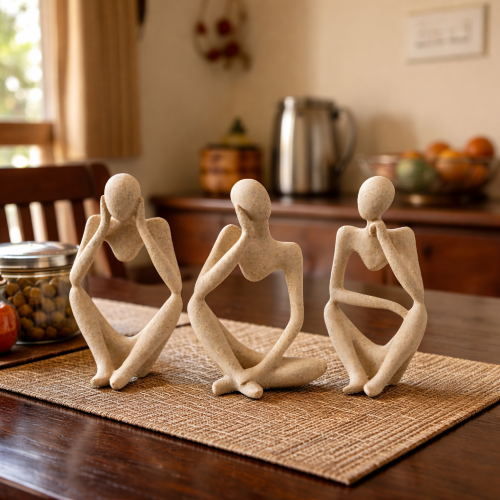
Matching three-piece showpiece sets, identical vase trios, and bundled "decor packs" are a fast way to fill a shelf — and an equally fast way to signal that no individual choice was made. Curated shelves mix scale (one large focal piece, two to three smaller supporting pieces), material (ceramic next to resin next to a small canvas), and finish (one matte, one glazed) rather than repeating the same object three times.
Moolwan's size system makes this easy to execute correctly: Small pieces (10–16cm) suit a shelf, desk, or bathroom ledge; Medium pieces (16–21cm) work as the anchor on a showcase or coffee table; Large pieces (25–34cm) serve as a single room focal point. A shelf with one Large, one Medium, and one Small — in different materials — reads as curated. Three identical Medium pieces read as a set bought in five minutes.
| Decor Choice | Why It Looks Cheap | What to Do Instead |
|---|---|---|
| Undersized wall art | Reads as an afterthought on a large wall | Size art to fill 60–75% of wall space above furniture |
| Thin canvas (under 300 GSM) | Sags and wrinkles within months in humidity | Choose 340 GSM cotton canvas with moisture-resistant coating |
| Glossy plastic showpieces | Yellows, scratches, feels tacky within a year | Choose ceramic (92% clay) or 94%-purity resin pieces |
| Identical 3-piece sets | Signals no individual curation | Mix Small (10–16cm), Medium (16–21cm), Large (25–34cm) pieces |
| Heavy, bulky frames | Looks dated and overwhelms small Indian rooms | Choose lightweight pieces (150g–600g) sized for the wall |
4. Decor That Ignores Indian Heat and Humidity
A showpiece that cracks after one summer on a sunlit windowsill, or a canvas that ripples after one monsoon season, doesn't just need replacing — it actively signals poor judgment to anyone who notices the damage. Indian homes routinely see temperature swings from 15°C to over 40°C and humidity from dry winters to 85%+ RH monsoons, and most imported or budget decor isn't rated for that range.
This is the single most overlooked factor in why decor "looks cheap" over time rather than on day one. The frame warps, the print fades, the glaze cracks — and the room that looked finished six months ago now looks neglected. Choosing materials with disclosed climate ratings (heat resistance, humidity tolerance, UV-resistant inks) is the only way to avoid this slow-motion cheapening effect. For pieces specifically engineered for this, explore Moolwan's trendy decor collection for modern Indian living rooms.
5. Heavy, Oversized, or Disproportionate Pieces in Small Rooms
Indian apartments and urban homes typically have smaller wall and shelf footprints than the Western interiors most decor catalogs are styled for. A heavy ceramic statue or an oversized resin sculpture that would suit a large foyer overwhelms a compact Indian living room, making the space feel cluttered rather than styled — regardless of how expensive the piece was.
Weight is a practical signal here too: heavier pieces are harder to place safely on lightweight Indian wall fittings and shelving, increasing both installation difficulty and breakage risk. Moolwan designs every piece between 150g and 600g specifically for Indian walls and shelves, so scale and safety are addressed at the design stage rather than left to the buyer to figure out after a piece arrives too heavy or too large for its intended spot.
Ready to Fix It? Start With the Wall, Then the Shelf
The fastest upgrade to any room that "looks cheap" is replacing the one or two pieces with the most visible flaws — usually the largest wall art piece or the most-handled showpiece — rather than redecorating everything at once. Start with whichever object a visitor's eye lands on first when entering the room.
Browse Moolwan's modern home decor collection to find correctly-sized, climate-engineered pieces for your space.
Frequently Asked Questions
What canvas GSM should I look for to avoid cheap-looking wall art?
Look for at least 300 GSM cotton canvas; Moolwan uses 340 GSM with eco-solvent UV-resistant inks specifically because lower-GSM canvas sags and fades faster in Indian humidity. GSM is printed on the product spec sheet of any genuine manufacturer — if a seller doesn't disclose it, the canvas is likely thinner.
Why do my showpieces look dull or yellowed after a year?
This usually means the resin or ceramic composition was low-grade and not rated for Indian heat and humidity. Moolwan's resin items use 94% purity epoxy resin rated for 15–35°C and up to 60% RH, and ceramic pieces use a 92% clay composition rated to 60°C heat resistance and 85% RH humidity tolerance — both designed to resist this kind of degradation.
What size showpiece should I buy for a coffee table?
Medium-sized pieces, 16–21cm, are designed for showcases and coffee tables. Small pieces (10–16cm) suit shelves, desks, or bathroom ledges, while Large pieces (25–34cm) work as a single room focal point — matching size to surface is what separates a curated look from a cluttered one.
Is matte or glazed finish better for a living room?
Matte finishes hide fingerprints and dust better on frequently-handled surfaces like coffee tables, while glazed finishes suit display shelves that aren't touched often. Both finishes are easy to maintain when the underlying material — ceramic or resin — meets the right composition and durability specs.
Can I return decor if it doesn't fit my space once it arrives?
Moolwan accepts returns within 24 hours of delivery if the item is unused and in original packaging, with a 10% restocking fee and refund processed within 15 working days. Measuring your wall or shelf space before ordering avoids this step entirely.
Written and reviewed by Ruchi Malhotra, Founder & CEO, Moolwan (Euphorica Ventures Pvt Ltd), Bangalore.
Don't let one wrong piece undo a whole room. Explore Moolwan's showpieces for living rooms — starting at ₹150, COD available, free shipping, trusted by 3,000+ Indian homeowners.


