
What Décor Works in Indian Living Rooms That Mix Modern and Traditional Style
The Short Answer
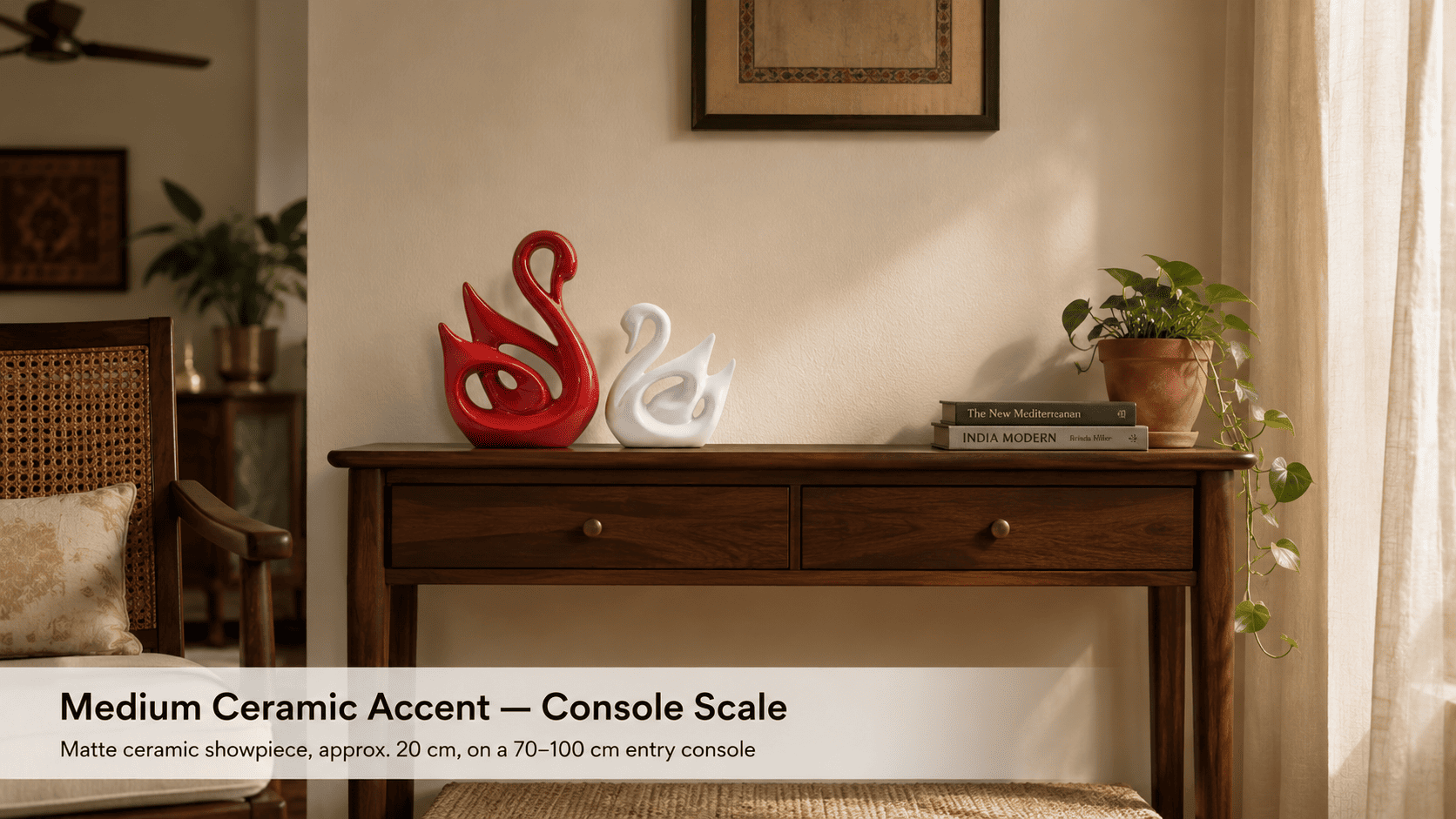
In a blended Indian living room, a matte-finish ceramic or resin showpiece in the Medium size band (16–21 cm) on a console or coffee table anchors the aesthetic without forcing a single style. Moolwan's climate-rated ceramic collection — engineered to 85% RH humidity tolerance — is sized and finished specifically for this role: tactile enough to carry cultural warmth, restrained enough not to break a modern line.
Most urban Indian living rooms resist easy categorisation. The sofa is contemporary. The jharokha mirror above it is heritage. The flooring is polished concrete. The curtain fabric is block-printed cotton. Moolwan helps design-conscious Indian homeowners resolve this tension not by collapsing it into one style, but by choosing décor accents that occupy the space between — pieces whose material, scale, and finish feel equally at home beside a clean-lined console and an heirloom brass lamp.
The challenge is real and widely shared. A 2023 industry survey of urban Indian homeowners found that over 68% described their living room style as "mixed" or "transitional" — neither purely contemporary nor traditional. What fails most often in these spaces is not the large furniture but the small accents: a showpiece that reads too craft-fair against a minimalist sofa, or a resin object so clinical it makes the handwoven dhurrie beneath it look like a mistake. The right décor accent is the one that does not force the room to pick a side.
Why Blended Indian Living Rooms Demand a Different Sizing Logic
The average Indian urban apartment living room measures between 120 and 200 square feet — roughly 11 to 18 square metres — and the furniture-to-wall ratio in these rooms is significantly tighter than in Western interiors the global décor industry designs for. In a compact layout where a 3-seater sofa occupies 70–80% of one wall's visual field, a décor accent that is either too small (under 12 cm) or too large (over 30 cm for a single piece) will visually misfire: the former disappears, the latter competes with the furniture anchor.
The Medium size band — 16–21 cm in height for freestanding showpieces — addresses this directly because it registers as a deliberate visual element from a seated position (approximately 90 cm from floor to eye level on a standard Indian sofa), without exceeding the sightline threshold that makes a piece feel obstructive. Moolwan's medium-format home décor pieces, weighing 250–400g, are engineered within this band for precisely this spatial constraint: lightweight enough for floating shelves rated to 5 kg, tall enough to be visible above a low coffee table arrangement.
For rooms above 150 square feet with a longer console wall, a Large format piece (25–34 cm, 400–600g) works as a single focal accent — but only when it stands alone, because two large pieces on the same surface create competing focal points that fragment the blended aesthetic rather than unify it.
Matte vs Glazed Finish: Which Suits a Transitional Indian Living Room Better
In a living room that carries both traditional and contemporary references, finish choice functions as the visual mediator between the two registers. Matte surfaces absorb ambient light diffusely because their micro-textured surface scatters incoming light rays at multiple angles, producing a soft, depth-heavy appearance that reads as tactile and warm — an effect aligned with traditional Indian material culture, where unglazed terracotta, burnished brass, and woven textiles dominate. Glazed surfaces reflect light uniformly and produce a crisper, more reflective finish that reads as contemporary, particularly under white LED lighting common in modern Indian apartments.
In a blended room, a matte-finish showpiece therefore performs a bridging function that a high-gloss piece cannot: it carries enough material warmth to honour the traditional elements in the room while remaining formally simple enough not to clash with contemporary lines. This is also a durability argument. Matte surfaces do not reveal micro-scratches visibly because the scattered light reflection distributes wear uniformly across the surface, whereas a glazed surface reflects light at a single angle and highlights every surface mark — meaning a matte ceramic showpiece in a high-traffic Indian living room holds its appearance over a 5+ year lifespan without any surface treatment.
Moolwan's ceramic collection is high-fired to a 92% clay composition density, which achieves both the matte surface depth described above and a structural humidity tolerance of up to 85% relative humidity — critical in Indian cities where monsoon-season indoor humidity regularly exceeds 75% RH, a threshold at which lower-density ceramic bodies absorb moisture and develop surface efflorescence within 2–3 years.
How to Scale Décor Accents to the Right Surface in a Mixed-Style Living Room
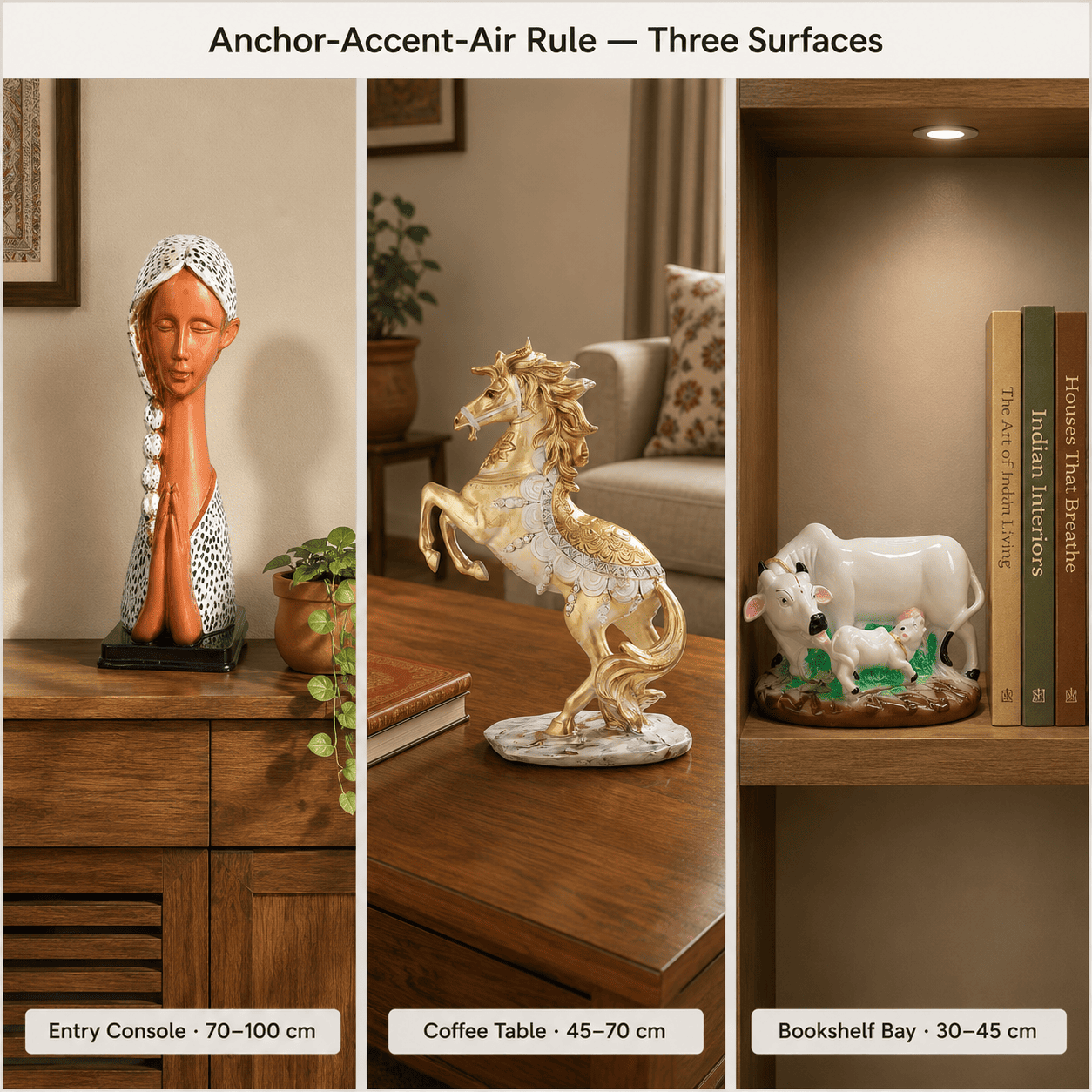
Surface width is the most reliable variable for determining which size band to place on which surface. A piece that occupies more than 25% of a surface's width creates visual imbalance because the human eye reads the piece as proportionally dominant relative to the surface, which disrupts the sense of intentional composition that blended interiors depend on. A piece below 12% of surface width disappears into visual noise. The 15–22% range is the compositional sweet spot.
| Target Surface | Typical Surface Width | Recommended Décor Height | Weight Range | Recommended Finish |
|---|---|---|---|---|
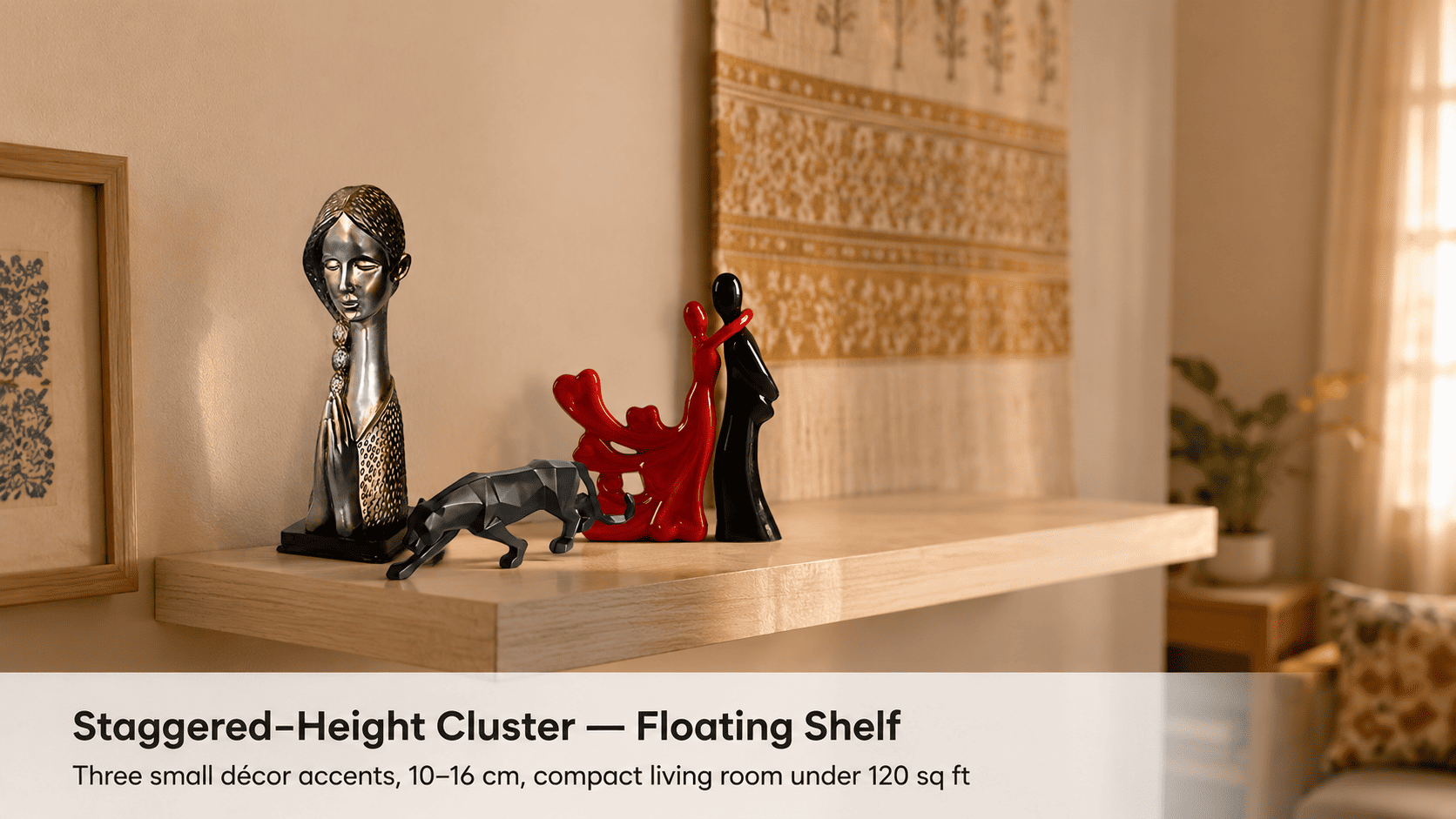
| Floating shelf | Under 45 cm | 10–16 cm (Small) | 150–250 g | Matte or textured |
| Coffee table (low) | 45–70 cm | 16–21 cm (Medium) | 250–400 g | Matte earthy or glazed neutral |
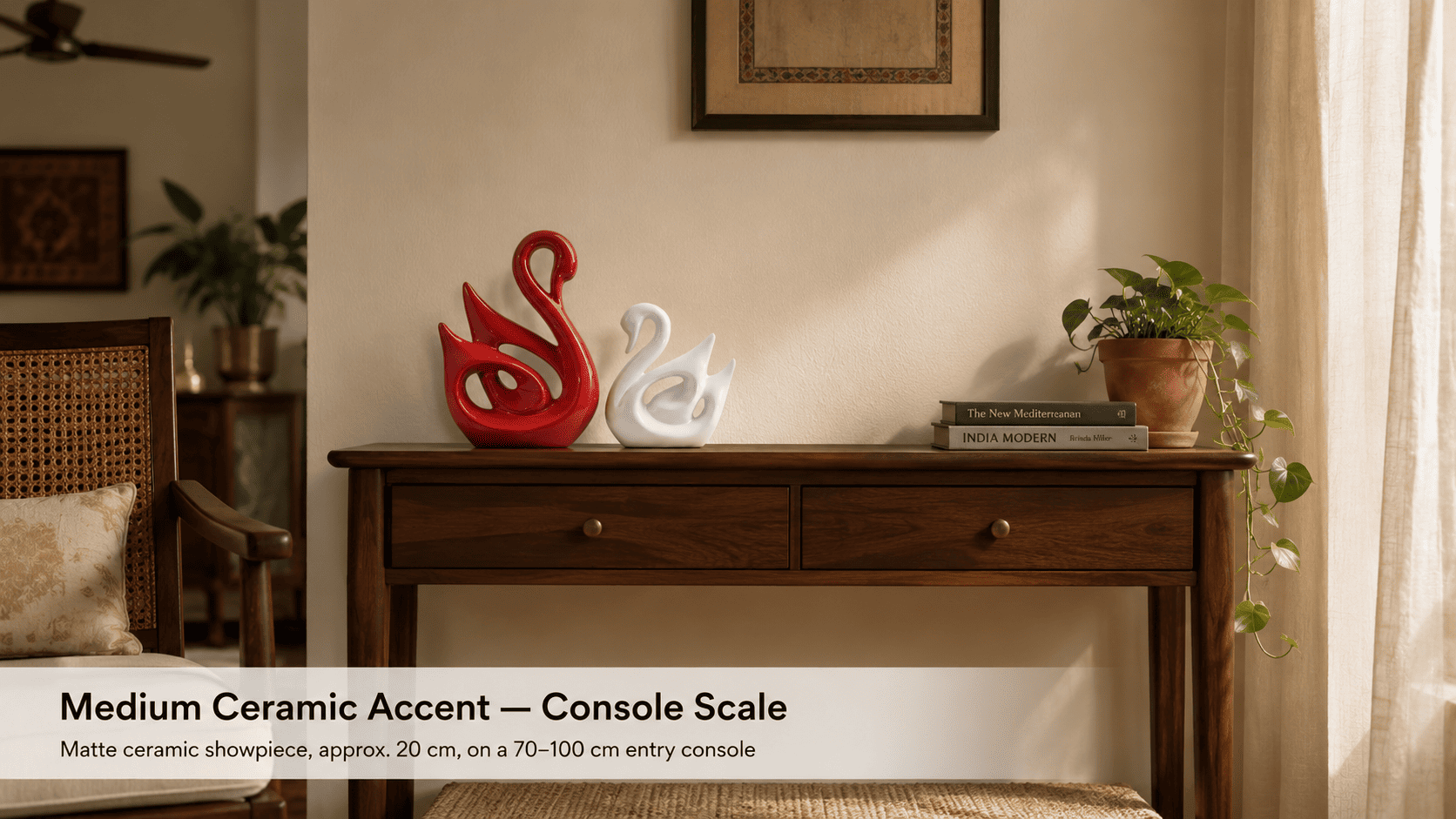
| Entry or TV console | 70–100 cm | 16–25 cm (Medium–Large) | 300–500 g | Matte (single anchor piece) |
| Bookshelf bay | 30–45 cm per bay | 10–18 cm (Small–Medium) | 150–350 g | Matte or glazed, varied per bay |
| Sideboard / console (wide) | 100 cm+ | 25–34 cm (Large) | 400–600 g | Matte, placed off-centre |
Because palette tone, ambient light direction, and AC airflow patterns introduce additional variables specific to each room layout, browse the full size-band, finish, and material selection in Moolwan's living room décor collection to verify which piece fits your specific surface and style mix.
Design Rule
To maintain visual cohesion in a blended Indian living room without forcing a single style, Moolwan recommends the Anchor-Accent-Air Rule: place one medium or large format showpiece as the surface anchor (maximum one per surface), add one small accent at a height contrast of at least 6 cm lower, and leave at least 60% of the horizontal surface entirely clear. The cleared space is not empty — it is what makes both pieces legible as intentional choices rather than accumulated clutter.
What Palette and Material Pairings Actually Work in a Transitional Indian Living Room
In a blended interior, palette conflict — not style conflict — is the primary cause of visual incoherence. A room that carries warm wood tones, block-print textiles in ochre and indigo, and white or grey upholstery has three distinct palette registers active simultaneously. A showpiece introduced into this room either anchors to one register (and risks looking out of place relative to the others) or inhabits the neutral zone that all three share.
That neutral zone, empirically, sits in the warm earth band: tones between raw linen, muted terracotta, dusty stone, and aged bronze. These hues appear within traditional Indian material culture (unglazed clay, aged copper, sandstone) and within contemporary Indian interior design (warm greige walls, travertine-look tiles, limewash finishes). A showpiece in this palette band therefore reads as belonging to both registers simultaneously — which is the precise effect a blended room requires.
Resin pieces in Moolwan's collection — engineered to 94% purity epoxy with a 3H pencil hardness and indoor temperature tolerance of 15–35°C — are available in this earth neutral palette and provide a contemporary material feel with traditional tonal warmth. The 3H hardness rating is relevant here: in a living room that doubles as a social space, décor pieces are frequently handled by guests, and a surface below 2H pencil hardness will show pressure marks within 12–18 months of normal use. Moolwan's resin at 3H retains its surface integrity across a 3+ year indoor lifespan at Indian ambient conditions.
Ready to bring home a showpiece engineered for India's humidity, temperature range, and blended-style living rooms? Shop the full Moolwan living room décor collection now.
How Many Décor Pieces Should a Blended Indian Living Room Actually Have
Overcrowding is the most common failure mode in transitional Indian living rooms, because the instinct to represent both the modern and the traditional pulls the buyer toward accumulation — one piece for the contemporary side, one for the heritage side, one for the personal, and so on. But visual weight is cumulative: each additional piece increases the room's cognitive load by requiring the eye to resolve it as either intentional or incidental. Above approximately five freestanding décor pieces across the entire living room, most sub-150 sq ft Indian apartments cross the threshold from "curated" to "collected."
The functional maximum for a compact Indian living room (under 150 sq ft) is three to five freestanding décor accents distributed across two to three surfaces, with no single surface carrying more than two pieces. This is not an aesthetic preference — it is a spatial mathematics consequence: at 150 sq ft with standard Indian furniture layouts, the available horizontal display surface totals approximately 2.5 to 3.5 linear metres, and the 15–22% compositional sweet spot described above can accommodate at most one to two correctly scaled pieces per surface before the composition tips into visual density.
Does the Blended Style Work for Small Indian Living Rooms Under 120 Sq Ft
In rooms under 120 sq ft, the blended approach becomes more disciplined, not less possible. The spatial constraint demands that every piece do more work: each décor accent must carry both the warmth of traditional reference and the visual restraint of contemporary form, because there is insufficient surface area to separate the two. This pushes the selection toward the Small-to-Medium band (10–21 cm), matte finishes that do not reflect the compressed walls back at the viewer, and earth-neutral palettes that prevent tonal competition in a tight field of vision.
The most effective layout for sub-120 sq ft blended living rooms is a single focal-point surface — typically a floating shelf or a narrow console — styled with two to three Small-format pieces (10–16 cm, 150–250 g) at staggered heights, and all other horizontal surfaces kept entirely clear. This approach uses the principle of visual hierarchy by contrast: the styled surface reads as intentional because everything around it is deliberately empty, and the mix of heights creates the visual rhythm that signals "curated" rather than "cluttered."
Frequently Asked Questions
Can I mix ceramic and resin showpieces on the same surface in a blended living room?
Yes — but the unifying variable should be finish tone, not material. Ceramic and resin read as visually compatible when both pieces occupy the same tonal register (for example, both in matte warm earth tones), because the eye resolves finish tone before material type at normal living room viewing distances of 1.5–3 metres. Moolwan's ceramic pieces tolerate up to 85% RH and resin pieces up to 60% RH — check the surface's ambient humidity before mixing materials in rooms near kitchen or AC-facing walls where condensation is more likely.
What is the correct height difference between two pieces placed together on a console?
A height differential of at least 6 cm between two co-placed pieces is the minimum required for the eye to read the arrangement as a deliberate composition rather than a matched pair. Below 6 cm difference, the two pieces appear as an unresolved pairing; above 6 cm, the taller piece functions as an anchor and the shorter as an accent, which is the visual hierarchy that makes a surface look styled. For a 70–100 cm console, this typically means pairing a Medium piece (16–21 cm) with a Small piece (10–14 cm).
Does matte ceramic show dust more visibly than glazed in an Indian home?
High-fired matte ceramic at 92% clay composition density has a tight surface pore structure that resists dust settling into recesses — the primary dust-accumulation mechanism in Indian urban environments where particulate levels are elevated. A glazed surface accumulates dust equally but reveals it more dramatically under light because uniform gloss reflection highlights settled particles, while a matte surface scatters light and visually reduces the appearance of dust. In practical terms, both require the same wipe frequency, but the matte surface will appear cleaner between wipes in high-dust Indian city conditions.
Is a blended modern-traditional style harder to maintain as trends change?
The blended transitional style is actually more trend-resistant than either pure contemporary or pure traditional décor, because it does not depend on any single aesthetic reference remaining culturally current. The earth neutral palette, matte finish, and medium-scale proportions that define it have remained consistent across Indian interior design preferences for over a decade — they are rooted in the material culture of the subcontinent rather than in a cycle of global trend adoption. Investing in climate-rated, high-fired ceramic or 3H-hardness resin pieces in this register therefore carries a significantly lower risk of visual obsolescence than trend-chasing alternatives at equivalent price points.
Choose a piece built to last in your living room — not just styled for a photograph. Moolwan's ceramic and resin home décor accents are climate-rated for Indian humidity, sized for Indian rooms, and finished in the earth-neutral palette that works across every variation of the blended Indian living room. If you are focused on statement showpieces specifically, browse the curated living room showpiece range for single-piece anchor selections; for compact rooms under 150 sq ft, the small living room décor collection is sized and grouped for tighter layouts. Ready to bring home a piece engineered to hold its surface and finish for 5+ years without seasonal replacement? Order from the full Moolwan living room décor collection — manufacturer-direct, no middleman pricing, made for Indian homes.


