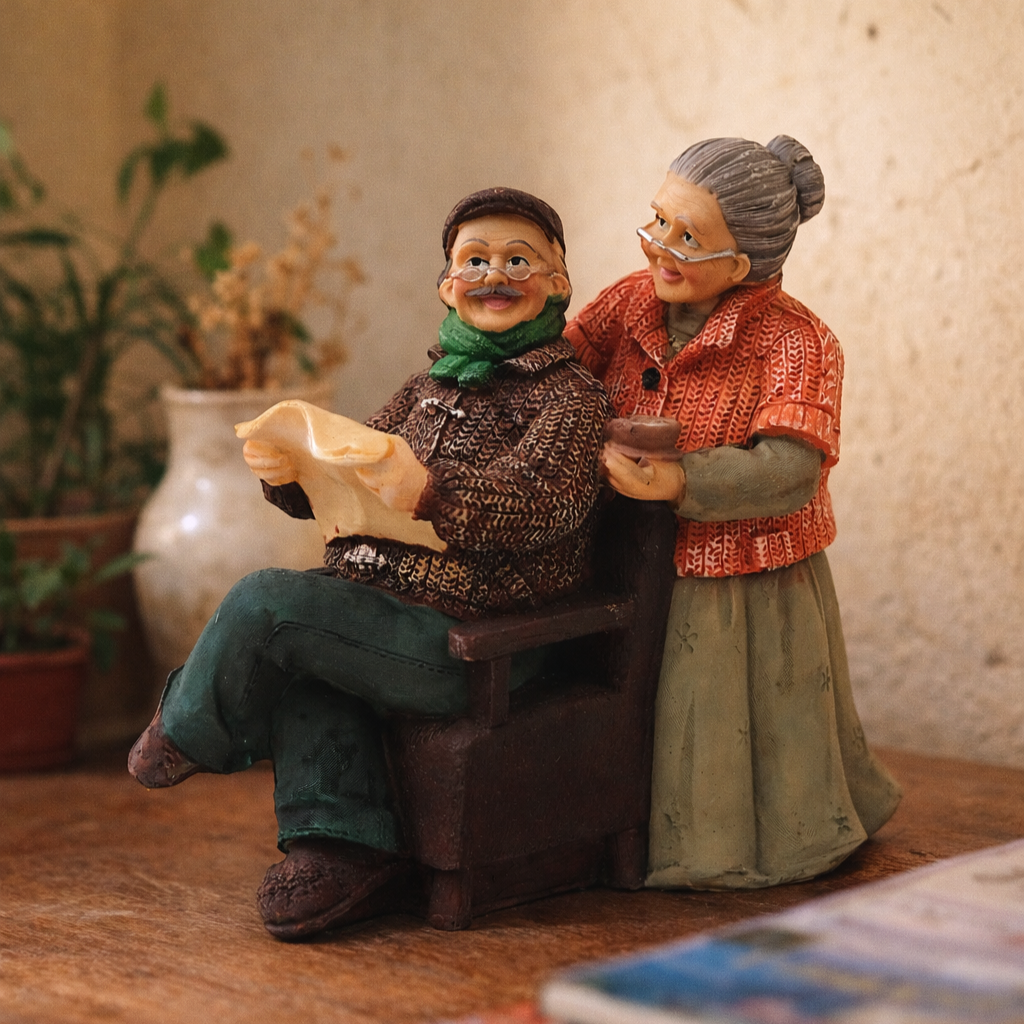
Gen Z interior design is a decor style built on maximalist color mixing, thrifted and vintage-look pieces, nostalgic 90s and Y2K accents, and highly personal curation over matched furniture sets. Unlike Millennial minimalism, it rejects uniformity — every shelf, wall, and corner is meant to look assembled by hand, not bought as a kit.
Gen Z interior design treats a room like a mood board. Objects are chosen for personal meaning first and visual coordination second — a thrifted vase can sit next to a modern resin sculpture next to a framed print, and the mismatch is the point. This is a deliberate reaction against the all-white, one-brand minimalism that defined the 2015–2022 "Millennial apartment" look.
We help design-conscious Indian homeowners translate this global trend into decor that actually works for Indian apartments — pieces sized for smaller rooms, finished to survive Indian humidity and heat, and priced without the import markup that most "Gen Z aesthetic" decor carries when sourced from overseas marketplaces.
Ready to start? Browse Moolwan's modern home decor collection for pieces built around this exact mix-and-layer philosophy.
Design researchers and retail trend reports consistently point to five recurring traits when Gen Z decor is described. Each trait below is a standalone marker — a room only needs two or three present to read as "Gen Z styled."
Bold, saturated colors — burnt orange, sage, cherry red, chocolate brown — replace the beige-and-white palette of the previous decade. Color is used to create mood, not to match a paint swatch across the whole room.
A single "old-looking" object — a brass figurine, a distressed frame, a ceramic piece with a matte, aged glaze — signals authenticity. It doesn't need to actually be vintage; it needs to look chosen, not shipped as part of a set.
Canvas, ceramic, resin, and woven textures are deliberately combined in the same shelf or wall grouping. A flat, single-material display reads as dated in this style.
Chrome finishes, disco-adjacent shapes, and playful, non-serious objects appear as accent pieces — usually one per room, not a full theme.
Shelves and console tables are arranged asymmetrically, grouped in odd numbers, with varied heights. Perfect symmetry is treated as the opposite of this style.
The clearest way to place Gen Z decor is against the two styles Indian homeowners are most often choosing between. The table below is a direct comparison across the traits that matter most when styling a room.
| Trait | Gen Z Decor | Millennial Minimalism | Traditional Indian Decor |
|---|---|---|---|
| Color palette | Bold, saturated, mixed | Neutral, monochrome | Rich jewel tones, gold accents |
| Arrangement | Asymmetrical, layered | Symmetrical, spaced out | Symmetrical, shrine-influenced |
| Materials mixed per shelf | 3-4 (canvas, resin, ceramic, metal) | 1-2 | 2-3 (brass, wood, ceramic) |
| Statement pieces | Multiple small accents | One large piece, rest empty | Few large, ornate pieces |
| Best fit for | Compact urban apartments wanting personality | Small spaces wanting calm | Homes anchoring cultural identity |
Most guides tell you to "just add personality," which isn't actionable. Moolwan's content team built a three-step method specifically for Indian apartment layouts, where wall and shelf space is limited compared to Western homes this trend originated in.
This method works because it borrows the "considered maximalism" that separates Gen Z-styled rooms from cluttered ones — a distinction most guides skip entirely.
Gen Z decor's mix-of-materials approach only holds up if each material is actually built for Indian heat and humidity — most imported "aesthetic" decor isn't. Moolwan's ceramic showpieces use a 92% clay composition, are heat-resistant to 60°C, and tolerate humidity up to 85% RH, which covers coastal and monsoon-heavy Indian cities without cracking or discoloring. Resin accent pieces use 94% purity epoxy resin with 3H pencil-hardness scratch resistance, rated for a 3+ year indoor lifespan in temperatures between 15–35°C. Canvas wall pieces are printed on 340 GSM cotton canvas with eco-solvent UV-resistant inks on 1.5-inch kiln-dried pine frames, so colors don't fade under direct sun — a common failure point for imported prints in Indian homes.
For sizing a shelf grouping: Small pieces (10-16cm, 150-250g) work for desks and bathroom shelves, Medium (16-21cm, 250-400g) for coffee tables and showcases, and Large (25-34cm, 400-600g) as the anchor piece described above. Explore Moolwan's full home decor items range to mix and match across these size bands.
No. Maximalism means "more is more" with no editing. Gen Z decor is curated maximalism — it looks abundant but every piece is chosen deliberately, usually 4-6 objects per grouping rather than filling every surface.
Yes, and it often works better in small spaces than in large ones, since the style relies on tight, layered groupings rather than spreading pieces across a big room. A single console table or shelf is enough to establish the look.
Burnt orange, sage green, chocolate brown, cherry red, and mustard are the most recurring accent colors, usually against a neutral wall so the objects — not the paint — carry the color story.
No. The "thrifted" look is achieved through matte or aged-glaze finishes, not through sourcing secondhand items specifically. A newly bought ceramic piece with a matte finish reads the same as a thrifted one in this style.
One anchor piece (typically the largest item) plus 3-5 smaller accents is the standard ratio. More than one large "anchor" per grouping tends to compete rather than complement.
Written by the Moolwan Design Concept Team. Reviewed by Ruchi Malhotra, Founder & CEO, Moolwan (Euphorica Ventures Pvt Ltd), Bangalore.
Quick View



