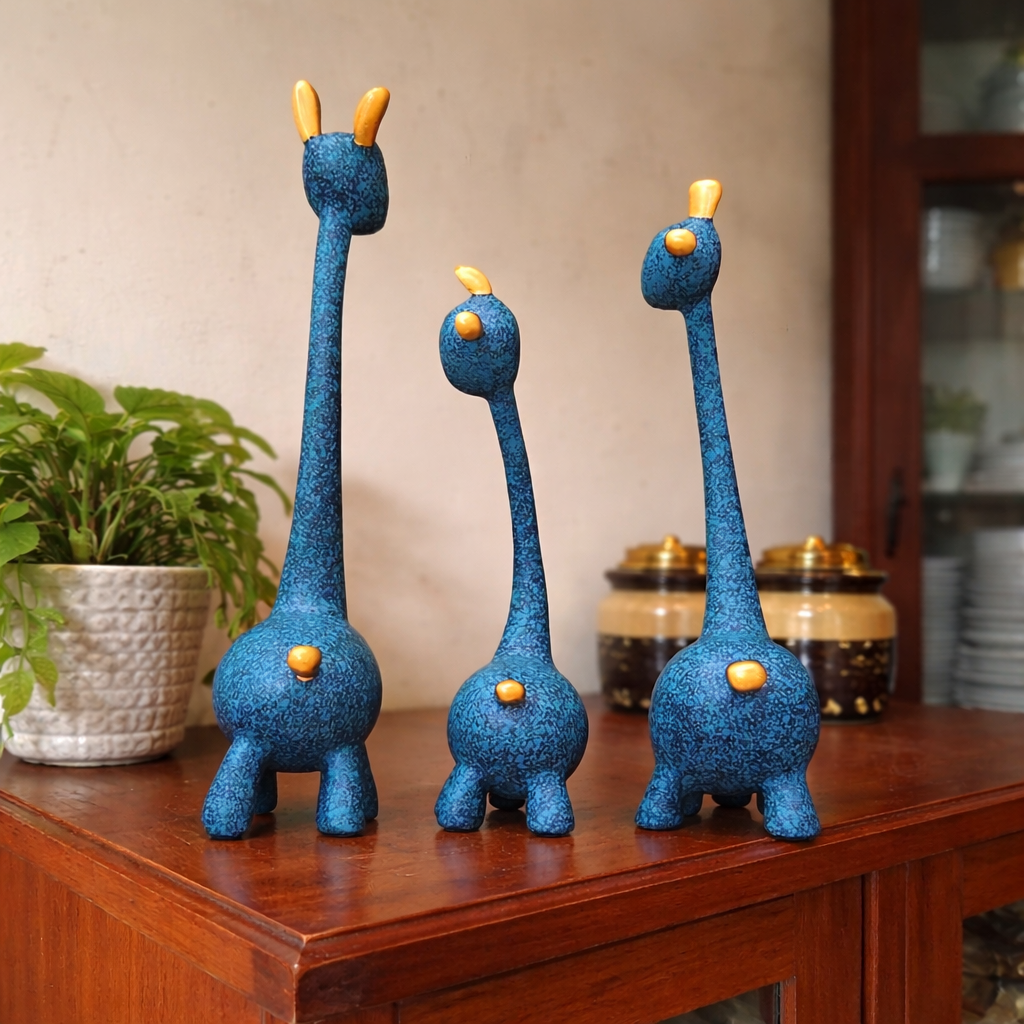
We help design-conscious Indian homeowners use negative space to make smaller, fewer pieces look more intentional than a wall full of clutter. The principle works because the eye needs a resting point: a single well-sized piece surrounded by space reads as curated, while the same piece crowded by five others reads as noise.
Indian living rooms and bedrooms tend to accumulate decor gradually — a showpiece from a wedding, a painting from a trip, a gift from a relative — until shelves and walls are full with no single piece given room to be seen. Negative space reverses this by treating empty wall and shelf area as a design element, not a gap to fill. A living room wall left two-thirds empty around one canvas piece draws more attention to that piece than the same wall covered in four smaller ones.
This is especially relevant in apartments and urban homes with smaller wall runs and lower ceiling heights, where over-filling visually shrinks the room. Leaving space around a single anchor piece, instead of distributing decor evenly across a wall, makes a small room look larger and more deliberate.
A working rule for Indian wall and shelf layouts: at least 40–60% of the visible wall or shelf area around your decor object should remain empty. This isn't arbitrary — it's the range interior stylists use because anything less starts to look cluttered, and anything more starts to look unfinished or unintentional.
| Decor Size | Recommended Object Size | Minimum Empty Space Around It | Best Use |
|---|---|---|---|
| Small | 10–16cm | 2–3x the object's width on each side | Shelf, desk, bathroom ledge |
| Medium | 16–21cm | 1.5–2x the object's width on each side | Coffee table, showcase |
| Large | 25–34cm | Equal to or slightly more than the object's width on each side | Focal wall, console table |
This is why sizing matters before you buy: a piece that's too small for its wall will sit lost in too much empty space, and a piece that's too large will eliminate the negative space that made it worth buying in the first place. You can browse Moolwan's modern home decor collection filtered by these exact size bands to match a piece to your wall or shelf before committing.
The most common mistake is filling a console table, TV unit, or shelf edge-to-edge because it "feels empty" otherwise. A shelf with one medium ceramic showpiece and visible space on either side communicates intention; the same shelf with four small items touching each other communicates indecision. Group decor in odd numbers (one or three pieces) with visible gaps between them rather than spreading items evenly across the full surface.
Another mistake is treating every wall the same way. A narrow hallway wall needs less negative space proportionally than a large living room wall, because the eye has less distance to travel. For bedroom walls specifically, leaving more breathing room above and beside a single piece — rather than pairing it with multiple smaller frames — keeps the space feeling restful rather than busy. Moolwan's bedroom decor range is sized specifically for this kind of single-anchor placement on Indian bedroom walls.
Negative space only works if the object you're placing earns the attention the empty space gives it. A piece with a muddy print, an odd finish, or a size mismatch will look like a mistake rather than a statement, no matter how much space surrounds it. Moolwan's canvas wall art is printed on 340 GSM cotton canvas with eco-solvent UV-resistant inks, so colour and detail hold up as the sole focal point on a wall — which is exactly the job a piece has to do in a negative-space layout.
If you're rethinking how a single room is laid out rather than just one wall, start with one anchor piece per zone — one for the wall, one for the shelf, one for the console — instead of buying multiple small items at once. You can explore Moolwan's full home decor collection to pick anchor pieces room by room.
This article is written and reviewed by Ruchi Malhotra, Founder & CEO, Moolwan (Euphorica Ventures Pvt Ltd), Bangalore. Moolwan designs and manufactures home decor in-house — canvas wall art, ceramic showpieces, and resin accents — sized and engineered for Indian homes and climate, sold direct to over 3,000 customers without markup from middlemen.
No. Minimalism is an overall style choice that limits how many objects a room contains. Negative space is a layout principle you can apply within any style, including a maximalist or traditional Indian home, by simply giving each cluster of objects room to breathe rather than removing decor altogether.
Remove items until only one or two remain, then judge whether the empty space around them feels intentional. Most cluttered walls in Indian homes have 3–4 more items than they need; removing the smallest or least distinct piece usually solves it without buying anything new.
Yes, and it matters more there. In a small room, an over-filled wall makes the space feel smaller, while one well-placed piece with space around it makes the same wall feel larger. Choose Small (10–16cm) or Medium (16–21cm) sized pieces for apartment walls so the object-to-space ratio stays balanced.
No. High-traffic rooms like the living room can carry a slightly fuller look with grouped pieces, while restful rooms like the bedroom benefit from more empty space around fewer, larger pieces.
Step back to the far end of the room and look at the wall or shelf for three seconds. If your eye lands on one clear focal point, the spacing works. If your eye doesn't know where to look first, there's too little negative space and too many competing items.
Shop Moolwan's modern home decor collection sized specifically for negative-space layouts in Indian homes — free shipping, COD available, and a 24-hour return window if a piece isn't right for your wall.
Quick View



