
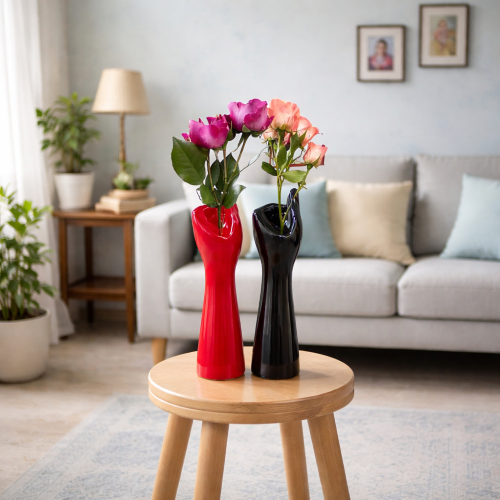
The Core Shift: From More Décor to Better Décor
For years, Indian homes were styled by volume — shelves crowded with imported showpieces, walls layered with prints of uncertain origin. The 2026 trend reverses that. It's a move toward fewer objects, chosen deliberately, each one built to survive Indian summers and monsoons rather than fade or warp within a season.
We help design-conscious Indian homeowners balance modern minimalism with the warmth of traditional aesthetics, without forcing a choice between the two. That balance is the defining tension of 2026 decor: clean, uncluttered forms carrying motifs, colours, and craft techniques rooted in Indian visual language.
Moolwan is a manufacturer-direct home décor brand built around this shift. What the brand stands for is straightforward — décor engineered for Indian climate and space, priced without middlemen. What the brand sells is equally specific: canvas wall art, modern showpieces, and curated gifts, each manufactured in-house rather than sourced from anonymous bulk suppliers. If your living room is due a refresh in this direction, you can browse Moolwan's modern home decor collection to see the shift applied to real pieces rather than mood boards.
The practical effect for buyers: a 2026-style room has visible restraint. One large canvas as a focal point. One or two showpieces per surface, not six. Storage and display are treated as separate problems, not solved with the same cluttered shelf.
Why 2026 Décor Is Engineered for Indian Homes, Not Just Styled
Aesthetic trends move fast; Indian weather doesn't negotiate with any of them. A decor piece that looks right in a showroom photo but blisters in Chennai humidity or cracks in Delhi's dry heat was never actually trend-ready — it was just photogenic. The 2026 standard folds material performance into the style decision itself.
What "Climate-Engineered" Actually Means
It means specifications, not adjectives. A piece marketed as "premium" without stated humidity tolerance, heat resistance, or frame construction is a guess. Here is what those numbers look like when they're disclosed rather than implied:
| Material | Composition | Heat / Humidity Rating | Expected Lifespan |
|---|---|---|---|
| Canvas wall art | 340 GSM cotton canvas, eco-solvent UV-resistant ink, 1.5″ kiln-dried pine frame | Moisture-resistant coating | Fade-resistant, indoor use |
| Ceramic showpieces | 92% clay composition | Heat-resistant to 60°C; humidity-tolerant to 85% RH; 15cm drop-resistant | 5+ years |
| Resin pieces | 94% purity epoxy resin | 15–35°C range; humidity up to 60% RH; 3H pencil-hardness scratch resistance | 3+ years indoor |
These figures come directly from Moolwan's in-house manufacturing standards, which is why they can be cited rather than approximated. Weight is kept between 150g and 600g across the range, deliberately light for Indian wall types and shelving that weren't built for heavy imported stone or metal pieces.
Sizing follows the same logic. Small pieces (10–16cm) suit a shelf, desk, or bathroom ledge. Medium pieces (16–21cm) anchor a showcase or coffee table. Large pieces (25–34cm) work as a single focal point — the 2026 room typically has exactly one of these, not three.
2026 Trend-Led Decor vs Old-Style Mass-Produced Decor
The difference isn't just visual density. It shows up in sourcing, pricing transparency, and how the product performs after the first monsoon. Laid side by side, the gap is easier to see than to describe:
| Factor | 2026 Trend-Led Decor | Old-Style Mass-Produced Decor |
|---|---|---|
| Sourcing | Manufacturer-direct, in-house production | Multi-layer distributor markup |
| Climate fit | Engineered for Indian heat & humidity | Generic, often designed for other climates |
| Room density | Few, deliberate statement pieces | High volume of decorative fillers |
| Spec disclosure | Published (GSM, RH tolerance, hardness) | Rarely disclosed |
| Aesthetic language | Modern form, traditional motif | Either purely modern or purely ornamental |
| Typical lifespan | 3–5+ years, stated upfront | Unspecified, variable |
See the difference on your own wall before you buy.
Shop Modern Home Decor ItemsHow to Apply the 2026 Trend Room by Room
Trend language is easy to agree with and hard to apply. Here's where the shift actually shows up in an Indian home, by space.
Living Room
One large canvas (25–34cm equivalent focal scale, or a full wall piece) replaces a cluster of smaller frames. The traditional-modern balance shows up here most clearly: a contemporary abstract or landscape canvas in a room with existing traditional furniture reads as intentional, not mismatched.
Shelves & Console Tables
This is where antique-inspired showpieces earn their place in a 2026 room — not as clutter, but as one or two considered objects with real material backing. If you're building this out, you can explore antique-style showpieces built for Indian homes, priced from ₹150 and shipped free.
Gifting & Festive Occasions
Gifting is a major 2026 use case, not a side category. A single well-specified piece — ceramic or resin, with a stated lifespan — reads as more considered than a generic hamper. For this, buyers are increasingly turning to Moolwan's curated collection of unique home decor items, priced at factory rates with exclusive designs unavailable through mass retailers.
What to Check Before You Buy Into the 2026 Trend
Trend-chasing without verification just moves the clutter problem online. Before adding a piece to cart, confirm three things:
- Material spec is stated — GSM for canvas, clay percentage for ceramic, resin purity for resin pieces. If a listing has none of these, the "premium" claim is unverifiable.
- Size matches the surface — small (10–16cm) for shelves and desks, medium (16–21cm) for showcases and coffee tables, large (25–34cm) for a standalone focal point.
- Return terms are clear — Moolwan accepts returns within 24 hours of delivery on unused items in original packaging, with a 10% restocking fee and refund processed within 15 working days. A brand that states this upfront is one that expects the product to hold up.
Ready to move from mood board to wall?
Shop Unique Home Decor ItemsFrequently Asked Questions
Is minimalism or maximalism trending in Indian homes for 2026?
Minimalism, but not empty-room minimalism. The 2026 approach is "curated maximal impact" — one or two strong, well-specified pieces per surface instead of many small decorative fillers.
What colours are trending for Indian living rooms in 2026?
Warm, earthy neutrals paired with one grounded accent — terracotta, deep indigo, or brass tones — rather than bright, uniform colour blocking. These sit naturally alongside both modern furniture and traditional Indian textiles.
Is canvas wall art still in style in 2026?
Yes, and more specifically so. The trend favours a single large-format canvas as a room's focal point over multiple small prints. Moolwan's canvas pieces use 340 GSM cotton with UV-resistant ink and kiln-dried pine frames built for this exact use.
How much should I budget for a 2026-style decor refresh?
Because the trend favours fewer, better pieces rather than volume, budgets go further than expected. Antique-style showpieces start from ₹150, with mid-range and large focal pieces priced above that depending on size and material.
Are antique-style showpieces still relevant in 2026 decor?
Yes — as accents, not centrepieces. Paired with modern furniture and used sparingly (one or two per shelf), antique-style ceramic or resin showpieces are how the "traditional" half of the 2026 modern-traditional balance shows up in practice.


