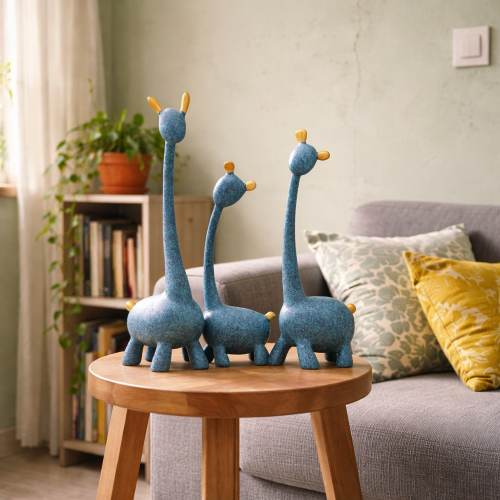
At Moolwan, we help design-conscious Indian homeowners arrange their spaces with confidence — applying principles like the 3-4-5 rule so every surface feels composed, not crowded. Whether you are styling a living room console, a bedroom shelf, or a dining alcove, understanding this rule removes guesswork from décor placement.
The 3-4-5 rule borrows its logic from the classical Pythagorean right triangle — where sides measuring 3, 4, and 5 units form a perfectly balanced, stable geometric shape. Applied to interior decoration, this means grouping objects at three distinct height levels: a short piece at approximately 3 units of height, a medium piece at 4 units, and a tall anchor piece at 5 units.
The result is a visual triangle — your eye moves naturally from the tallest object down to the shortest, then bounces back. This triangular flow is why the arrangement feels dynamic without feeling chaotic. It is the opposite of lining objects up at the same height, which creates a flat, monotonous effect that fails to draw attention or communicate personality.
The rule works because the human eye is calibrated to read contrast and progression. A display that moves through multiple heights engages the viewer, signals deliberate curation, and makes even a small shelf appear layered and rich. It is especially powerful in Indian living rooms, where shelves and display units often need to balance multiple items — framed art, sculptural pieces, and functional objects — without looking overstuffed.
The 3-4-5 rule is not about measuring exact centimetres for every object. It is about maintaining clear, visible height differentiation between objects in a grouping so the display reads as a cohesive composition rather than a random collection. Here is how to apply it practically in an Indian home setting:
Start with your "5" — the tallest object in the grouping. This is typically a sculptural showpiece, a tall vase, a framed canvas, or a statement home décor hanging item mounted above the surface. The anchor sets the visual ceiling for the entire arrangement. For shelf displays, Moolwan's large showpieces (25–34 cm tall) are designed specifically to serve this role.
Adjacent to your anchor, introduce a medium piece — roughly 60–80% of the anchor's height. This is your transitional object. It bridges the tallest and shortest pieces so the eye has a step to land on rather than a sharp drop. A ceramic showpiece in the 16–21 cm range from Moolwan's modern home décor collection works naturally here — wide enough to have visual weight, short enough to keep the hierarchy intact.
The shortest object — your "3" — brings the eye down to rest. This might be a small resin figurine, a decorative bowl, a short potted plant, or a stacked set of coasters. Moolwan's small showpieces (10–16 cm) are engineered to be proportionally satisfying at this tier — substantial enough to register, compact enough to never dominate.
The 3-4-5 rule gains depth when you pair height variation with material variation. A matte ceramic piece next to a glazed resin sculpture next to a canvas print creates tactile contrast that photographs well and reads as curated rather than assembled. Browse Moolwan's full range of home décor items to find pieces across all three tiers in complementary finishes.
Below is a practical reference table showing how to apply the 3-4-5 rule across the most common display surfaces in Indian homes, with the Moolwan product size ranges that fit each tier.
| Display Surface | Tier "3" — Short (Base) | Tier "4" — Medium (Bridge) | Tier "5" — Tall (Anchor) | Moolwan Size Match |
|---|---|---|---|---|
| Bedroom shelf | Small candle / resin figurine | Ceramic sculpture | Framed mini canvas | 10–16 cm / 16–21 cm / 25–34 cm |
| Living room console | Decorative tray or small showpiece | Medium vase or abstract sculpture | Large statement sculpture or tall vase | 10–16 cm / 16–21 cm / 25–34 cm |
| TV unit shelf | Small resin accent | Ceramic duo or figurine set | Canvas wall art panel above unit | 10–16 cm / 16–21 cm / Wall-hung |
| Dining sideboard | Short floral accent / bowl | Ceramic pot or geometric piece | Tall vase or hanging element above | 10–16 cm / 16–21 cm / 25–34 cm |
| Study or work desk | Mini resin sculpture or pen holder | Ceramic figurine | Framed artwork behind the desk | 10–16 cm / 16–21 cm / Wall canvas |
Moolwan's showpieces are manufactured at 92% clay composition for ceramic pieces and 94% purity epoxy resin for resin items. Both lines are tested for Indian climate conditions — humidity tolerance up to 85% RH for ceramics and up to 60% RH for resin — so your 3-4-5 display remains consistent through monsoon months without warping, discolouring, or fading.
The most frequent error is treating the rule as a rigid formula. The 3-4-5 principle describes a visual relationship, not an exact measurement sequence. Here are the mistakes to avoid:
Indian living spaces — especially urban apartments in cities like Bangalore, Mumbai, Pune, and Delhi — often have compact footprints with feature-dense walls. The 3-4-5 rule is ideal for this context because it achieves maximum visual impact in a limited footprint. You are not spreading items across a wide, open surface — you are stacking visual interest vertically, which works with narrower shelves and smaller consoles.
There is also a cultural layer to this principle that resonates in Indian interiors. The classical Indian design canon — from temple sculpture to traditional thali arrangement — has always understood asymmetry as a form of balance. The 3-4-5 rule formalises this instinct: not everything needs to be symmetrical to feel harmonious. A grouping that ascends from short to tall in an off-centre arrangement often feels more rooted and intentional than a perfectly mirrored display.
Moolwan designs each piece with this in mind. Our showpieces weight between 150g and 600g — lightweight enough for Indian shelving systems that were not always engineered for heavy Western-style décor, yet substantial enough to have physical presence and tactile richness.
Ready to style your first 3-4-5 display? Browse Moolwan's modern home décor collection — each piece is tagged by size (Small / Medium / Large) so you can build your trio in minutes, not hours.
| Rule | Core Principle | Best For | Limitation |
|---|---|---|---|
| 3-4-5 Rule | Height-tiered groupings at three levels | Shelf, console, and sideboard displays | Needs clear height variation between objects |
| Rule of Three | Group objects in threes for visual balance | Mantelpieces, coffee table vignettes | Doesn't address height — can still look flat |
| 60-30-10 Colour Rule | Dominant / secondary / accent colour split | Full room colour planning | Doesn't apply to object arrangement or height |
| Odd Number Rule | Always display in odd-numbered groupings (3, 5, 7) | Gallery walls, collection displays | Doesn't specify proportion or height hierarchy |
| Golden Ratio | Proportion at 1:1.618 for visual harmony | Furniture scale and spatial planning | Too mathematical for casual styling; hard to apply intuitively |
The 3-4-5 rule is the most immediately actionable of all these principles because it gives you a concrete three-step process — identify your three height tiers, fill each tier with one or two objects, then step back and adjust. It is the closest the world of interior decoration comes to a working formula.
No, they are related but distinct. The rule of three simply says to group objects in sets of three for natural visual balance. The 3-4-5 rule goes further by specifying that those objects should be at three distinct height levels — short, medium, and tall — to create triangular visual flow. You can apply both simultaneously: use three objects, each at a different height tier.
A minimum of three objects — one for each tier. In practice, 3–5 objects work best for most Indian shelf and console displays. Beyond five objects in a single grouping, the arrangement risks looking cluttered. If you have more pieces to display, create two separate groupings with clear negative space between them rather than combining everything into one large cluster.
Moolwan's size categories align naturally with the three tiers: Small (10–16 cm) for your "3" base, Medium (16–21 cm) for your "4" bridge, and Large (25–34 cm) for your "5" anchor. All pieces in these ranges weigh between 150g and 600g, making them safe and practical for standard Indian shelving. You can browse size-tagged options in the full home décor collection.
Yes — and it is especially effective for gallery walls and wall display panels. Apply the principle vertically: mount your tallest or most prominent hanging element at the top ("5" tier), a mid-sized frame or sculptural hanging in the middle ("4" tier), and a smaller hanging accent or hook display lower ("3" tier). Moolwan's home décor hanging items include pieces across all size ranges to build this vertical composition on any wall.
It is arguably most effective in compact Indian apartments. Because the rule creates vertical visual movement rather than horizontal spread, it maximises perceived depth and richness in a limited footprint. A 3-4-5 grouping on a single console occupies less floor space than three separate objects spread across a surface, yet delivers more visual impact. Use Moolwan's Small and Medium size tiers as your primary pieces to keep the display proportionate to the space.
Moolwan manufactures every piece in-house — no middlemen, no inflated retail markups. Our ceramic and resin showpieces are engineered for Indian climate conditions, available in Small, Medium, and Large tiers so you can build a complete 3-4-5 arrangement without guesswork. Pan-India free shipping and cash-on-delivery are available on all orders.
Shop the modern home décor collection → | Explore hanging décor for wall displays →
Not sure which pieces to pair? Return any item within 24 hours of delivery in original packaging — refund processed within 15 working days.
Quick View