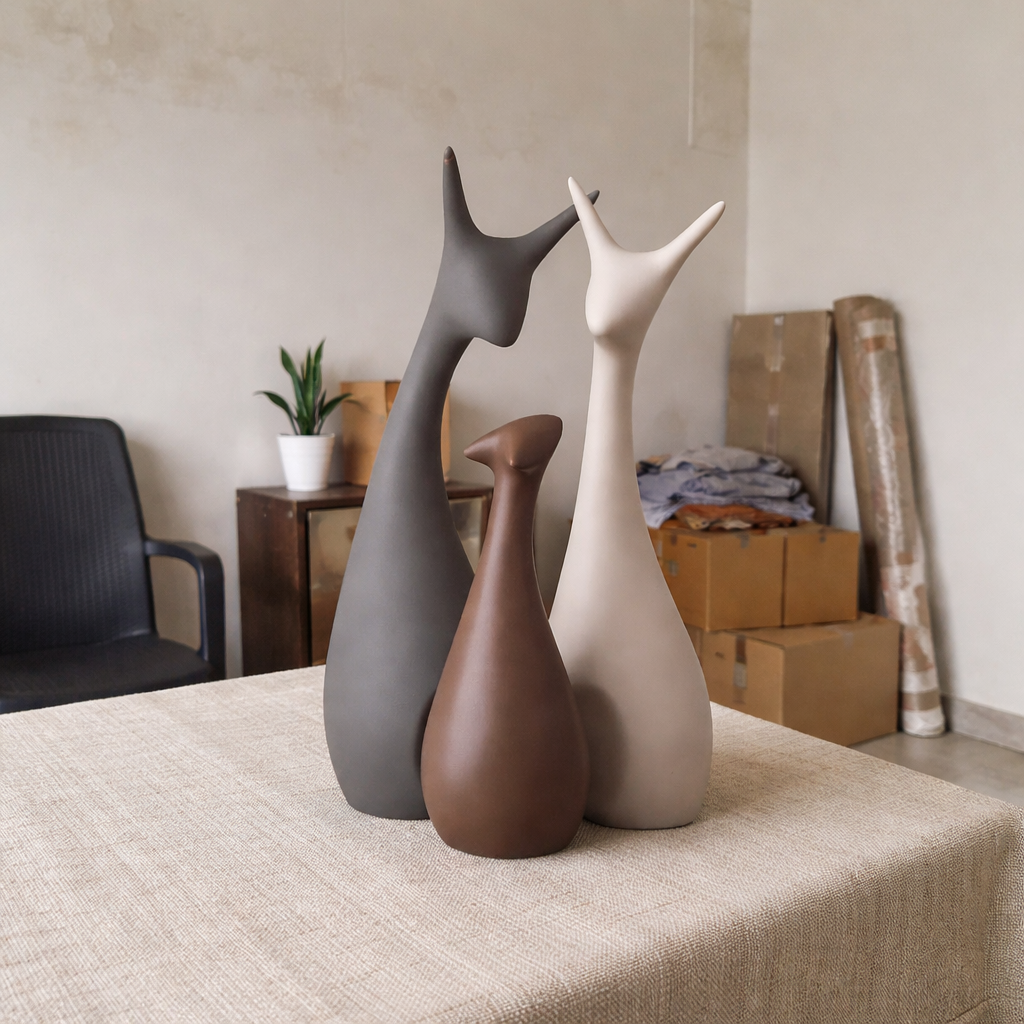
The 3-4-5 rule in home decoration is a grouping principle: arrange decorative items in clusters of 3, 4, or 5 pieces — never in pairs or uniform rows. Odd-numbered groupings create natural visual tension and balance, making any shelf, console, or coffee table look intentionally styled rather than randomly placed. It works across showpieces, statues, and wall art in any Indian home.
The human eye reads odd-numbered groupings as more dynamic and interesting than even ones. Two objects create symmetry. Three create a story. This is the core logic behind the 3-4-5 rule — a professional interior styling principle that applies directly to how you arrange decorative statues, showpieces, or any tabletop objects in your home.
Interior designers use this rule to solve the most common decorating mistake Indian homeowners make: placing objects in rigid rows or exact pairs, which makes a shelf look like a shop display rather than a curated home. The 3-4-5 rule breaks that symmetry intentionally — and the result is a space that feels warm, personal, and considered.
At Moolwan, we help design-conscious Indian homeowners build décor arrangements that look curated — not crowded — by engineering our showpieces and statues in complementary size tiers: Small (10–16cm), Medium (16–21cm), and Large (25–34cm). These tiers are designed specifically so you can mix heights within a grouping and follow the 3-4-5 rule without searching for the right proportions.
The rule has three working principles layered underneath it: vary height, vary texture, and anchor with one dominant piece. Together, these turn a flat arrangement into one with visual rhythm — the difference between a shelf that looks "done" and one that looks "deliberate."
Every grouping needs one dominant item — typically the tallest or most visually complex. In a group of 3, this is the back-centre piece. In a group of 5, it anchors the tallest point on one end. A ceramic statue in the Large tier (25–34cm) works perfectly here: Moolwan's ceramic pieces are composed of 92% pure clay, heat-resistant up to 60°C, and humidity-tolerant up to 85% RH — meaning they hold their finish and colour on Indian shelves through every season without warping, cracking, or fading.
Arrange your remaining pieces in a descending or zigzag height pattern — never in a straight horizontal line. The eye should travel across the group, not scan it flatly. A mix of a Medium showpiece (16–21cm) and a Small figurine (10–16cm) alongside your anchor creates this natural cascade. If you're working with resin items, Moolwan's epoxy resin pieces (94% purity, 3H pencil hardness scratch resistance) keep their surface integrity even when grouped tightly on shelves where objects occasionally shift.
Texture contrast makes a grouping feel rich. Pair a matte ceramic with a glazed resin piece. Add a small framed artwork or modern home décor accent in a different material. The visual contrast between surfaces — matte vs. sheen, organic vs. geometric — gives each object space to breathe even when placed close together.
Ready to build your first 3-4-5 grouping? Moolwan's statues come in three complementary size tiers — designed to mix and match.
Shop Statues →The number you choose — 3, 4, or 5 — should match the size and visibility of the surface. Here is a practical guide to applying the rule room by room, matched to Moolwan's product size tiers:
| Surface / Location | Group Size | Recommended Size Tier | Ideal Moolwan Category |
|---|---|---|---|
| Bathroom shelf / windowsill | 3 pieces | Small (10–16cm) | Resin figurines, mini statues |
| Bedside table / study desk | 3 pieces | Small–Medium (10–21cm) | Ceramic showpieces, resin art objects |
| Console table / TV unit | 4 pieces | Medium–Large (16–34cm) | Antique showpieces, decorative statues |
| Living room showcase / bookshelf | 5 pieces | Mix of all tiers | Statues + showpieces + wall art complement |
| Dining table centrepiece | 3–5 pieces | Medium–Large (16–34cm) | Ceramic or resin statement pieces |
| Entrance / foyer table | 3 pieces | Large (25–34cm) anchor + 2 smaller | Antique showpieces, deity statues |
All Moolwan showpieces and statues weigh between 150g and 600g, making them safe for standard Indian shelving and glass-top furniture without adding structural stress. This is particularly useful in apartments where shelves are thinner and load tolerance lower than in independent homes.
The rule extends beyond tabletop décor. When hanging wall art, the same odd-number principle applies to gallery walls and multi-frame arrangements. A three-canvas arrangement above a sofa, for instance, reads as intentional. A two-canvas arrangement reads as incomplete. A four-canvas grid reads as a template.
If you're building a gallery wall, anchor it with one large canvas — ideally a statement piece in the Large tier — and surround it with two or four smaller frames, keeping odd-number clusters within the overall composition. Moolwan's canvas wall art is printed on 340 GSM cotton canvas with eco-solvent UV-resistant inks and mounted on 1.5-inch kiln-dried pine frames with a moisture-resistant coating — built to handle Indian humidity without warping, bubbling, or colour shift across years.
Most Indian homes that feel "overcrowded" or "flat" are not using the wrong items — they are using the wrong arrangement logic. These are the four most common mistakes and the corrections that immediately improve any grouping.
If you are starting from scratch, browsing Moolwan's antique showpieces collection is a practical starting point. These pieces span multiple heights and finishes — making it easy to select a ready-made trio or quintet without second-guessing proportion compatibility.
No — two items create symmetry, not visual rhythm. Add a third element: a small plant, a candle holder, or a mini figurine. The third piece does not need to be expensive or large; it just needs to break the pair into a triangle of visual interest.
Yes, and it works especially well in compact spaces. A tight shelf benefits most from the discipline of a group of 3 — one anchor, one medium, one small — because it forces editing. You end up displaying your best pieces rather than everything you own, which immediately makes the space feel more intentional and less cluttered.
Buy across at least two of Moolwan's size tiers: pair a Large (25–34cm) anchor with Medium (16–21cm) and Small (10–16cm) pieces. This height spread is what creates the visual cascade that makes the rule work. Buying everything in the same size tier produces a flat lineup regardless of the grouping number.
Yes — and mixing materials is actively recommended. Moolwan's ceramic pieces (92% clay, humidity-tolerant up to 85% RH) and resin pieces (94% epoxy purity, 3H scratch hardness) are designed with complementary finishes — matte ceramic pairs naturally with the slight sheen of resin. The contrast in surface texture is what makes each piece stand out within the grouping rather than merging into visual noise.
The rule of three is the most cited version — group in threes. The 3-4-5 rule is an expanded framework that acknowledges that larger surfaces need larger groupings, but the underlying logic is identical: odd numbers create natural visual balance without symmetry. Four-piece groupings are the exception; they work when internally sub-grouped into a visual 3+1 arrangement rather than a 2+2 grid.
Every Moolwan showpiece, statue, and wall art piece is sized, finished, and engineered to work together — so your groupings look designed, not assembled.
Quick View



