
What is the correct sequence to decorate a room?
Most rooms that feel "off" are not suffering from bad taste — they are suffering from bad sequencing. Décor added in the wrong order forces you to undo earlier decisions, overspend on pieces that do not fit, and end up with a room that looks assembled rather than designed. At Moolwan, we help design-conscious Indian homeowners build rooms that feel intentional, layered, and complete — from the first furniture decision to the final shelf accent.
The 8-Step Room Decoration Sequence (In Order)
This sequence applies to any room in an Indian home — living room, bedroom, study, or dining space. Each step creates the constraint for the next one. Do not skip forward; each layer depends on what came before it.
Step 1: Define the Room's Primary Function
Before you touch a single item, answer one question: what is this room primarily for? A living room that doubles as a home office needs different zoning than a purely social space. A bedroom designed for rest needs different lighting and décor weight than a bedroom that doubles as a personal retreat with a reading corner. Function sets every downstream decision — furniture scale, colour intensity, and accent placement all follow from this one answer.
Step 2: Lock in a Colour Palette (3 Colours Maximum)
Choose a dominant colour (60% of the room), a secondary colour (30%), and one accent colour (10%). Indian homes often work best when the dominant is neutral — warm white, stone, or earthy beige — because it handles humidity, changing natural light, and the visual busyness of daily Indian home life without overwhelming the eye. The accent colour is where your wall art, showpieces, and cushions live. Lock this before buying anything physical.
Step 3: Place Large Furniture First
Sofa, bed, dining table, wardrobe — these define traffic flow and anchor points. Place these before buying anything else. Indian apartments, particularly in cities like Bengaluru, Mumbai, and Delhi, average 650–900 sq ft. Furniture that is even 10% oversized makes the room feel airless. Measure twice. Place once.
Step 4: Layer Lighting (3-Layer Rule)
Lighting in Indian homes is chronically under-layered — one overhead fixture and nothing else. The correct approach uses three layers: ambient (overhead), task (reading or work), and accent (to highlight décor). Accent lighting placed near wall art or a showpiece shelf increases perceived room depth by dramatically. Add this before placing any decorative items, because lighting determines where the eye goes and which pieces become focal points.
Step 5: Add Rugs and Floor Anchors
A rug anchors furniture groupings and defines zones in open-plan Indian living rooms. Place the rug after furniture is set and before you bring in smaller décor — it is a mid-layer element. The front legs of the sofa should sit on the rug. A rug that is too small floats in the room and makes the layout look tentative.
Step 6: Hang Wall Art
Wall art goes up before showpieces and accents, because the wall is the largest visual plane in any room. If you hang art after placing shelf décor, you will fight for visual balance between two competing layers. The correct hanging height is eye level — centre of the artwork at 145–150 cm from the floor for Indian room proportions. If you are grouping multiple pieces, treat the cluster as one unit and centre that unit at eye level.
Moolwan's canvas wall art uses 340 GSM cotton canvas with eco-solvent UV-resistant inks and 1.5-inch kiln-dried pine frames — engineered to hold shape and colour through Indian monsoon humidity without warping or fading. Browse Moolwan's modern home décor collection to find art that fits your colour palette before committing to placement.
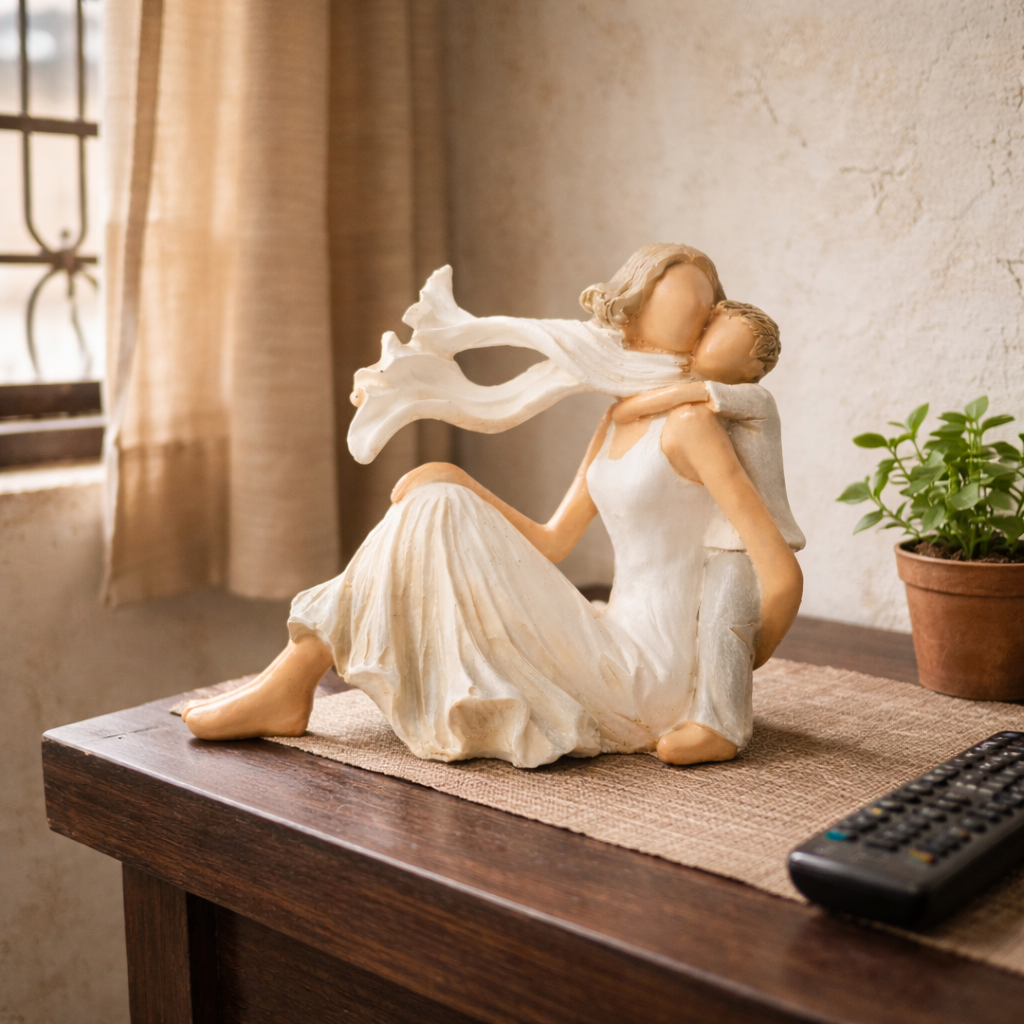
Step 7: Place Showpieces and Accent Décor
Showpieces are the last structural layer before the final edit. Place them after wall art is hung, so you can see how they interact with the wall plane. Moolwan's ceramic showpieces are built with 92% clay composition, rated humidity-tolerant up to 85% RH — which means they handle Indian monsoon conditions without surface degradation or colour bleed. Size placement follows this rule: Small (10–16 cm) for desks and bathroom shelves; Medium (16–21 cm) for coffee tables and showcases; Large (25–34 cm) as standalone focal point pieces.
For the bedroom specifically, one or two medium-sized accent pieces on a bedside table or dresser are enough — over-decorating a bedroom disrupts the rest-first function you defined in Step 1. See Moolwan's bedroom décor range designed for Indian apartments for pieces scaled to urban bedroom proportions.
Step 8: Style Shelves and Do the Final Edit
Shelf styling is the finishing layer. The rule: group items in odd numbers (3 or 5), vary heights, and leave deliberate negative space. After placing everything, step back and remove one item per cluster. The room almost always improves. This final edit — removing rather than adding — is the step most Indian buyers skip, and it is the difference between a styled room and a cluttered one. For curated shelf accents and gifting-worthy accent pieces, explore Moolwan's full home décor items range to find pieces that work as both shelf accents and thoughtful gifts.
Room Decoration Sequence: At a Glance
| Step | Action | Why This Order Matters | Common Mistake |
|---|---|---|---|
| 1 | Define room function | Every other decision depends on this | Decorating before knowing how the room will be used |
| 2 | Lock colour palette (max 3) | Ensures all layers are visually cohesive | Buying pieces first, matching colours after |
| 3 | Place large furniture | Defines scale, flow, and anchor points | Buying décor before measuring available space |
| 4 | Layer lighting (3 types) | Determines which pieces become focal points | Using only overhead ambient lighting |
| 5 | Add rugs and floor anchors | Zones the space and ties furniture groupings | Choosing a rug that is too small for the grouping |
| 6 | Hang wall art | Sets the vertical visual plane before accents | Hanging art as an afterthought at the wrong height |
| 7 | Place showpieces and accents | Responds to, rather than competes with, wall art | Placing showpieces before wall art is finalised |
| 8 | Style shelves and edit | Final balance — removal improves most rooms | Adding more when the room already feels full |
Ready to start from Step 6 or Step 7?
Browse Moolwan's Modern Home Décor →Why Indian Rooms Specifically Need This Sequence
Indian homes present specific decorating constraints that Western sequencing advice does not account for. Monsoon humidity (often 75–90% RH in coastal and central cities) means décor materials must be humidity-rated before they are placed — especially in living rooms and bedrooms. Moolwan's ceramic pieces are rated to 85% RH; our resin pieces use 94% purity epoxy rated to 60% RH. Knowing which material goes where requires you to already have your room function (Step 1) and placement zone (Step 7) locked before buying.
Indian apartment proportions also reward a "less, but right" approach. A 2BHK living room in urban India averages 180–220 sq ft. At that scale, over-decoration is guaranteed if you skip Steps 1–5 and jump straight to buying showpieces and art. The sequence exists precisely to prevent this. Each step creates a logical limit on what can and should come next — giving you permission to stop adding before the room tips into clutter.
What Moolwan Stands For
Moolwan is an Indian D2C home décor brand that manufactures canvas wall art, ceramic and resin showpieces, and curated gifting items — all designed specifically for Indian home proportions, Indian climate conditions, and the Indian sensibility that balances modern design with cultural warmth. Every product ships manufacturer-direct, without middlemen. Moolwan's mission is to help design-conscious Indian homeowners complete every room with pieces that are beautiful, durable, and meaningful — without overcomplicated choices or inflated retail markups.
Frequently Asked Questions
Should I paint walls before or after buying furniture?
Paint walls before bringing in furniture — always. Wall colour is the dominant layer (60% of the room's visual weight) and must be locked first. Furniture is chosen in response to the wall colour, not the other way around. If you buy furniture first and then paint, you will be trying to match paint to an already-committed purchase, which severely limits your palette options.
When should I buy showpieces and decorative accents?
Showpieces and decorative accents are Step 7 — bought and placed after wall art is hung and furniture is finalised. Buying them earlier is the most common cause of décor that feels mismatched or overcrowded. Once your wall art is up and your furniture anchors the room, you will have a much clearer sense of how much space remains and what scale of accent piece fits without competing.
How do I know how many decorative pieces are enough?
A reliable rule: place your accents, step back, and remove one item per cluster. If the room improves, you had too many. For Indian living rooms in 2BHK apartments, a maximum of 7–9 accent pieces across all surfaces (shelves, coffee table, console) is generally the upper limit before the room reads as cluttered. For bedrooms, 3–5 accent pieces total is the right ceiling.
Does the sequence change for a bedroom versus a living room?
The sequence is the same, but the emphasis shifts. In bedrooms, Step 1 (function) almost always resolves to "rest and sleep" — which means lighting should be warmer and dimmable, and accent décor should be minimal. In living rooms, social function allows for more visual complexity. For bedroom-specific pieces scaled to Indian urban apartments, Moolwan's bedroom décor range is sized and finished for exactly that proportion.
Can I decorate one room at a time or should I plan the whole flat?
Decorate one room at a time — but define a single colour palette that threads across all rooms before you start any one of them. This is the connective tissue between rooms. Executing room by room prevents budget overwhelm and decision fatigue, while the shared palette prevents each room from feeling like a different home. Start with the room you spend the most time in, typically the living room.
Ready to Finish Your Room the Right Way?
You have the sequence. Now find the pieces. Moolwan's décor is manufactured in-house, engineered for Indian climate, and priced direct — no markups, no middlemen.
Shop All Home Décor Items → Browse Modern Décor for Indian Homes →


