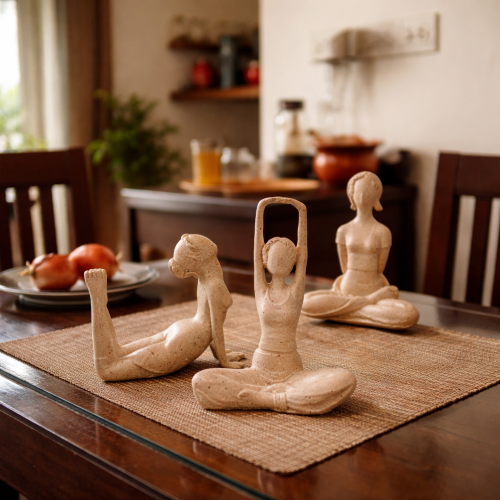
A stylish living room uses fewer objects, deliberate spacing, and one clear "hero" piece per surface. A cluttered one has too many same-sized items placed without a plan. The fix isn't buying more décor — it's editing what's there and choosing pieces that carry visual weight instead of filling space.
Quick Answer: Stylish rooms group objects in odd numbers, vary height and scale, and leave visible negative space around each piece. Cluttered rooms repeat similar-sized objects with no gaps and no focal point. Moolwan calls this the 3-15-1 Rule — max 3 objects per surface cluster, 15cm of breathing space between them, and 1 hero piece per zone.
The difference is rarely about how much money was spent — it's about visual hierarchy. A curated room has one dominant piece per surface (the eye lands there first), supporting pieces at a smaller scale, and consistent breathing room between objects. A cluttered room has multiple items competing for attention at the same size, with no gaps for the eye to rest.
We help Indian homeowners build living rooms that read as intentional, not accumulated. Most clutter isn't excess furniture — it's decorative objects (showpieces, frames, small sculptures) placed without a system. Indian living rooms in particular tend to collect gifted showpieces and travel souvenirs over the years, and without a placement rule, even beautiful individual pieces start to look like noise together.
Scale variation matters as much as spacing. A shelf with three same-height objects reads as cluttered even with generous gaps, because nothing anchors it. A shelf with one Large piece (25–34cm), one Medium piece (16–21cm), and negative space around both reads as styled — the height difference itself creates the hierarchy your eye follows.
This is the framework our design team uses when styling console tables, TV units, and bookshelves for Indian homes:
Never place more than 3 decorative objects in a single visual cluster. Beyond 3, the eye can't establish a hierarchy and the grouping reads as clutter regardless of quality.
Leave a minimum of 15cm of visible surface between each object in the cluster. This gap is what separates "curated" from "crowded" — it's the same principle galleries use around individual artworks.
Every cluster needs exactly one dominant piece — usually a Large showpiece (25–34cm) or a resin sculpture — that the eye lands on first. Everything else in the cluster should be visibly smaller.
If you're starting from scratch, Moolwan's modern home decor collection is sized specifically around this rule — Small, Medium, and Large bands so you can build height variation into a single order instead of guessing.
| Attribute | Stylish Living Room | Cluttered Living Room |
|---|---|---|
| Objects per surface cluster | 1–3, one hero piece | 5+, no clear focal point |
| Spacing between objects | 15cm+ visible gap | Objects touching or overlapping |
| Scale variation | Small, Medium, Large mixed | Same size repeated |
| Material mix | 1–2 materials (e.g. ceramic + canvas) | 3+ unrelated materials/finishes |
| Durability for Indian climate | Humidity-tolerant pieces (85% RH ceramic, 60% RH resin) | Mixed — often unverified imports |
1. Clear every surface completely. Remove everything from your console table, shelf, or TV unit — you can't see clutter accurately when it's already arranged.
2. Pick your hero piece first. Choose one Large piece (25–34cm) per surface — a ceramic showpiece or resin sculpture works well as a focal point. Browse Moolwan's showpieces for living rooms if you need a starting anchor.
3. Add 1–2 supporting pieces at a smaller scale. Stick to Small (10–16cm) or Medium (16–21cm) sizes so nothing competes with your hero piece. Keep the 15cm gap rule between each item.
4. Set aside anything you didn't reuse — don't force it back. If a piece doesn't earn a spot under the 3-15-1 Rule, it belongs on a different shelf, in a gift box, or in Moolwan's curated collection of unique home decor items as inspiration for a swap instead.
How many showpieces should one shelf have?
No more than 3 under the 3-15-1 Rule — one Large hero piece plus one or two smaller supporting pieces, with at least 15cm of space between each.
Is it clutter if I have a lot of decor but it's expensive?
Yes. Clutter is about spacing and hierarchy, not price. Even premium pieces read as cluttered without breathing room and a clear focal point.
What size showpiece works best as a living room focal point?
Large (25–34cm) pieces work best as focal points on console tables and TV units. Medium (16–21cm) suits coffee tables and showcases; Small (10–16cm) suits shelves and desks.
Do ceramic showpieces hold up in humid Indian homes?
Moolwan's ceramic pieces are 92% clay composition and tolerate up to 85% relative humidity, with heat resistance to 60°C — built for Indian coastal and monsoon conditions.
Ready to restyle your living room the right way?
Shop Moolwan's Curated Home Decor CollectionWritten by Ruchi Malhotra, Founder & CEO, Moolwan (Euphorica Ventures Pvt Ltd), Bangalore. Moolwan is a manufacturer-direct home décor brand engineering ceramic, resin, and canvas décor for Indian climate conditions.
Quick View



