
What is the golden rule for home decor?
At Moolwan, we help design-conscious Indian homeowners build living spaces that feel curated, not cluttered — modern, but still rooted in warmth. The golden rule is our starting point for every product we design and every room we help style.
---
What Does the Golden Rule of Home Decor Actually Mean?
The golden rule is not a single formula — it is a framework built on three non-negotiable principles: proportion, intentionality, and cohesion. A room fails when one of these is missing. A shelf feels heavy when pieces are oversized for the space. A living room feels disconnected when colours clash without a visual thread. A display feels lifeless when items are placed without purpose.
In practical terms, the golden rule asks you to answer three questions before placing any décor item:
- Does this fit the scale of the space? A 34cm figurine belongs on a focal-point shelf or console, not a crowded study desk.
- Does this connect to at least two other elements in the room? Colour, texture, material, or theme — one of these must link it to what already exists.
- Does this have a purpose? Visual anchor, conversation starter, cultural reference, emotional warmth — every piece must do one of these jobs.
When all three are true, the result is a room that looks considered rather than accumulated.
---The 60-30-10 Colour Rule: The Most Cited Sub-Rule in Decor
Within the broader golden rule, the 60-30-10 colour distribution is the most actionable guideline for Indian homeowners. It works like this: 60% of a room's colour comes from dominant tones (walls, large furniture, rugs), 30% from secondary tones (curtains, upholstery, larger décor pieces), and 10% from accent pieces — your showpieces, vases, art, and tabletop décor.
That 10% accent layer is where Moolwan products live. Our modern home décor items are sized and finished specifically to function as high-impact accent pieces — designed to elevate the 10% without competing with the room's dominant palette.
This matters in Indian homes, where walls are often warm-toned (cream, ivory, terracotta) and furniture tends toward dark wood or beige upholstery. The accent layer is your opportunity to introduce contrast, texture, and personality — without repainting or refurnishing.
---Common Decor Mistakes vs the Golden Rule: A Direct Comparison
Most décor mistakes are not about bad taste — they are about ignoring one of the three pillars. Here is how the golden rule corrects the most common errors Indian homeowners make:
| Common Mistake | Why It Fails | Golden Rule Fix |
|---|---|---|
| Too many small pieces on a shelf | Breaks proportion — no visual rest point | Anchor with one 25–34cm focal piece; fill with 1–2 smaller items max |
| All décor in the same material (all ceramic, all wood) | No textural contrast — room feels flat | Mix 2–3 textures: e.g. resin + ceramic + canvas |
| Décor chosen individually, not as a grouping | Lack of cohesion — items look collected, not curated | Buy in groups of odd numbers (3 or 5); ensure shared colour or theme |
| Décor sized for a large space placed in a small apartment | Overwhelms the room; reduces perceived space | Use small (10–16cm) pieces for shelves and compact rooms |
| Ignoring India's climate (humidity, heat) | Décor warps, fades, or cracks within months | Choose materials rated for Indian climate: ceramic (85% RH), resin (60% RH), UV-resistant canvas |
How to Apply the Golden Rule in an Indian Living Room
Indian living rooms carry a specific design challenge: they are both social spaces and family spaces. They must feel open enough for guests and warm enough for everyday life. The golden rule applied here means layering, not crowding.
Start with your largest vertical surface — typically a wall or a TV unit. A canvas painting in the 24×36 inch range works as a primary visual anchor. Our home décor items collection includes wall art printed on 340 GSM cotton canvas with eco-solvent UV-resistant inks — designed to hold colour in Indian light conditions without fading over years of exposure.
From that anchor, build outward. A console or side table can hold 2–3 tabletop items that echo the canvas's colour story — a ceramic figurine in a complementary tone, a resin piece that adds textural contrast. Moolwan's ceramic showpieces are manufactured with 92% clay composition, rated humidity-tolerant up to 85% RH, and drop-resistant from 15cm — a practical standard for Indian homes with children or frequent guests.
The living room golden rule in three steps:
- Set one focal anchor — wall art or a large statement piece (25–34cm).
- Build the secondary layer — 2–3 mid-size pieces (16–21cm) that share a colour or material with the anchor.
- Add the accent layer — 1–2 small pieces (10–16cm) on shelves or corners for rhythm and detail.
This three-layer approach is how professional interior stylists structure Indian living rooms — and it is achievable with a focused selection of 4–6 pieces total.
---Browse Moolwan's decorative tabletop items — vases, figurines, and accent pieces engineered for Indian interiors. Free shipping. COD available.
Shop Tabletop Décor →What the Golden Rule Means for Gifting
The golden rule does not only apply to your own home — it is the single most useful framework when buying home décor as a gift. A gifted décor item that violates the golden rule (wrong scale, incompatible finish, no clear purpose) will quietly disappear into a storage shelf within weeks.
When gifting, default to medium-sized pieces (16–21cm) — versatile enough for most showcase shelves and coffee tables without overwhelming the recipient's existing setup. Ceramic and resin pieces in neutral or warm tones (ivory, gold, warm grey) are the safest finish choices because they connect to almost any Indian home palette.
Moolwan's curated range is manufactured directly — no distributor margins, no retail markup — which means the quality you see at the price you pay is the actual quality, not a padded promise. Every piece comes with clear material specs: resin items are made with 94% purity epoxy resin with 3H pencil hardness scratch resistance, ideal for homes where the gift will be handled and admired, not just displayed.
---Frequently Asked Questions
What is the 3-item rule in home decor?
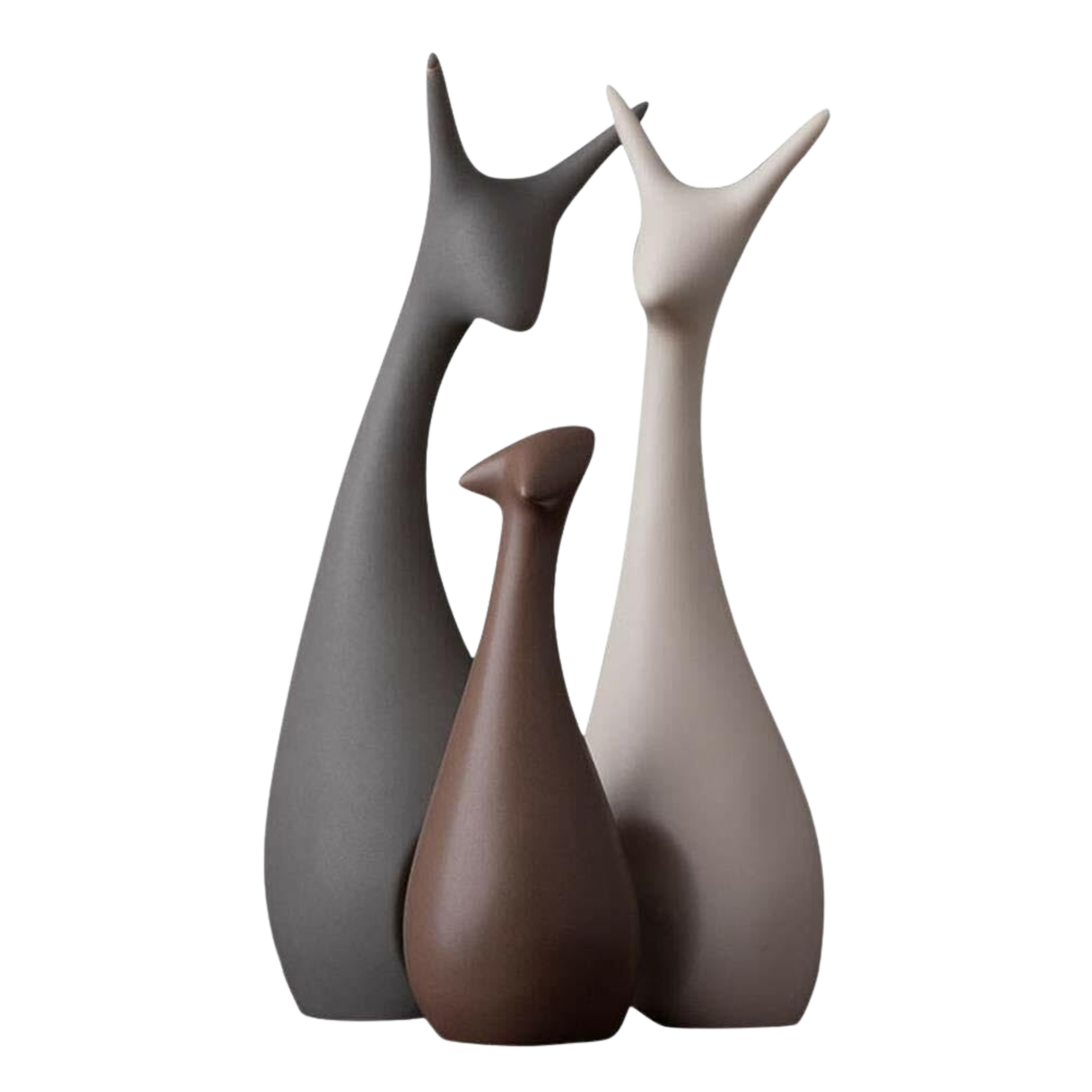
The 3-item rule states that objects displayed in groups of three are more visually balanced and interesting than pairs or larger clusters. The most effective groupings vary in height, texture, or size while sharing a unifying colour or theme. For Indian shelves and consoles, a tall ceramic vase, a mid-size resin figurine, and a small accent piece in a coordinating tone is a classic application of this rule.
What is the 60-30-10 rule in interior design?
The 60-30-10 rule divides a room's colour palette into three weighted layers: 60% dominant colour (walls, large furniture), 30% secondary colour (curtains, upholstery, larger décor), and 10% accent colour (showpieces, art, tabletop items). This distribution creates visual hierarchy without making any single element overwhelming. Most decorative items — including Moolwan's showpieces and canvas art — function within the 10% accent layer.
How do I know if a décor piece is the right size for my space?
Use Moolwan's size guidance as a practical starting point: small pieces (10–16cm) suit shelves, desks, and bathroom counters; medium pieces (16–21cm) work for showcases and coffee tables; large pieces (25–34cm) are focal-point items for consoles, mantels, or floor placement. As a general rule, no single decorative piece should occupy more than one-third of the surface area it sits on.
Can I mix ceramic, resin, and canvas in the same room?
Yes — in fact, mixing 2–3 material types is recommended by the golden rule because textural contrast creates visual depth. The key is to unify through colour, not material. For example, a resin piece in warm gold, a ceramic figurine in matte ivory, and a canvas print with warm earth tones will feel cohesive because the palette connects them, even though the materials differ.
Does Moolwan offer COD and free shipping on décor items?
Yes, Moolwan offers cash on delivery (COD) and free shipping across India on its range of modern home décor items, tabletop accessories, and home décor pieces. Returns are accepted within 24 hours of delivery in original, unused condition; a 10% restocking fee applies, with refunds processed within 15 working days.
---Explore Moolwan's full range of modern home décor items — designed in-house, priced direct, and engineered to last in Indian climates.
Browse All Home Décor →


