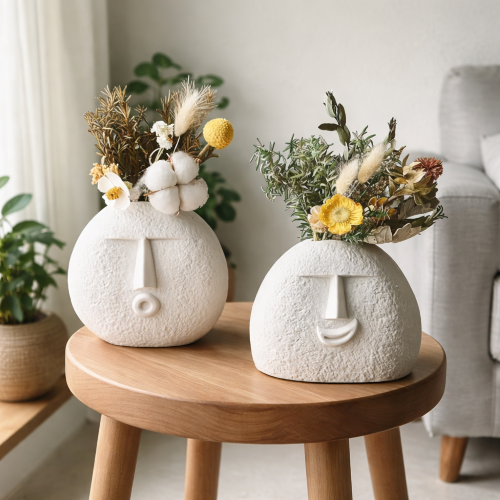
The dominant living room trend in 2026 is warm minimalism with cultural texture — clean layouts, earthy palettes, and one or two intentional statement pieces rooted in Indian craft or natural materials. Indian homeowners are replacing surface clutter with curated focal points: a bold canvas on an accent wall, a handcrafted ceramic on a coffee table, or a sculptural resin showpiece on an open shelf. The shift is from more décor to better décor.
Across Indian cities — from Bengaluru apartments to Delhi NCR builder floors to Mumbai sea-facing flats — five distinct aesthetic directions are shaping what people buy for their living rooms this year. Each trend is a response to how Indian urban life has evolved: smaller footprints, hybrid working, more time at home, and a renewed pride in Indian design.
Fewer objects. Each one more meaningful. Neutral walls in warm sand or linen tones, paired with a single ceramic or sculptural centrepiece. The living room feels curated, not empty.
Contemporary silhouettes carrying traditional Indian motifs — dhokra-inspired forms in modern materials, classical geometry in resin or glazed ceramics. The look is unmistakably Indian, without being period furniture.
Natural shapes, clay and stone textures, muted greens and ochres. Décor that looks like it emerged from earth or forest — irregular edges, handmade finishes, terracotta glazes.
Retro-inspired pieces in contemporary spaces — brass-toned showpieces, art deco geometry, aged-wood textures alongside clean walls. Nostalgic but not dated. Familiar but design-forward.
A single large canvas — abstract, botanical, or architectural — anchoring the entire room. The gallery wall trend is evolving into a single, confident art moment that does not compete with anything else in the room.
We help design-conscious Indian homeowners style their living rooms with décor that balances modern trends with traditional aesthetics — engineered for Indian climate, sized for Indian spaces, and priced manufacturer-direct. Moolwan's three collections map directly to each of these five trends.
Not every global trend translates to Indian interiors. The table below compares the five 2026 trends against the practical realities of Indian homes — humidity, available light, typical room sizes, and décor shelf life.
| Trend | Core Palette | Key Material | Best Statement Piece | India Suitability | Moolwan Collection |
|---|---|---|---|---|---|
| Warm Minimalism | Sand, linen, ivory, warm grey | Ceramic, cotton canvas | Single large canvas or sculptural centrepiece | ★★★★★ — Timeless, climate-agnostic, space-smart | Modern Home Décor |
| Modern Indian Fusion | Saffron, indigo, earthy reds, brass | Ceramic, resin, mixed media | Contemporary figurine or abstract canvas with Indian geometry | ★★★★★ — Culturally resonant, high gifting value | Traditional Décor |
| Biophilic & Organic | Ochre, moss, clay, raw white | Glazed ceramic, natural fibres | Organic-shaped vase or textured wall hanging | ★★★★☆ — Excellent in well-ventilated rooms; avoid in very humid corners | Traditional Décor |
| Modern Vintage | Warm amber, cream, deep teal, antique brass | Resin, metal-finished ceramic | Sculptural showpiece or art deco canvas print | ★★★★☆ — Great in newer apartments and open-plan layouts | Modern Vintage |
| Statement Wall Art | Neutral wall + bold art — any palette | 340 GSM cotton canvas, UV inks | Large canvas 24×36 inch or larger on a plain accent wall | ★★★★★ — Works across all room sizes; moisture-resistant coating essential | Modern Home Décor |
India Suitability rating is based on Moolwan's assessment of humidity tolerance, typical Indian light conditions, and space compatibility. Five stars indicates suitability across all major Indian climatic zones.
Warm minimalism is not just aesthetically dominant in 2026 — it is the most practical trend for the way Indian urban homes actually work. Indian living rooms are frequently multipurpose: they host guests, double as a workspace, accommodate family gatherings, and function as a daily relaxation space. A cluttered aesthetic adds visual noise to spaces that already carry a lot of functional weight.
The warm minimalist approach solves this by anchoring the room in one or two high-quality décor pieces rather than distributing décor across every surface. A medium ceramic showpiece on the coffee table, combined with a single canvas above the sofa, is a complete design statement. Everything else is intentional negative space — and that negative space is the trend.
For Indian homeowners who want to apply this look immediately, browse Moolwan's modern home décor collection — every piece is designed with Indian room proportions in mind, in sizes that range from 10 cm shelf pieces to 34 cm living room focal points.
The second most significant trend is one that is distinctly Indian in origin: the revival of traditional Indian aesthetics in contemporary material forms. This is not your grandparents' décor. It is the dhokra motif rendered in high-purity epoxy resin. It is the classical lotus form glazed in a contemporary matte finish. It is the Warli pattern printed on UV-resistant canvas with kiln-dried pine stretcher bars.
The buyers driving this trend are 28–45 years old, urban, design-literate, and tired of choosing between "modern" and "Indian" as if the two are mutually exclusive. They are not. The best décor in 2026 is both — and Moolwan's traditional décor range for living rooms was designed precisely for this buyer.
This fusion trend also dominates gifting decisions. A showpiece that reads as contemporary to a younger recipient while being culturally meaningful to an older family member is the most universally appreciated gift in the Indian home — and that is exactly what the Modern Indian Fusion category delivers.
Modern vintage is the most misunderstood of the 2026 trends in the Indian décor market. It does not mean filling your living room with antiques or recreating a 1960s aesthetic wholesale. It means taking one or two pieces with visual heritage — a brass-finished resin figurine, an art deco canvas, a sculptural vase with aged-texture glaze — and letting them live inside an otherwise clean, contemporary space.
The tension between old and new is the entire point. A 2026 modern vintage living room in Pune or Hyderabad might have plain white walls, a minimal sofa, and then one unmistakable, character-rich showpiece that tells you a person with taste lives here. It creates a sense of story without overwhelming the room's functionality.
If this aesthetic speaks to you, explore Moolwan's modern vintage collection for contemporary and new home interiors — including showpieces, statues, vases, and wall hangings designed for this exact visual language.
Every living room trend eventually meets Indian reality: humidity that peaks at 85% RH during the monsoon, summer temperatures that cross 40°C in most metros, and walls that are not always structurally suited to heavy art. Most imported décor and marketplace products are not engineered for these conditions — they fade, warp, or degrade within two monsoon seasons.
Moolwan manufactures in-house and specifications are non-negotiable at every stage. Here is what goes into each product category:
These are not marketing claims — they are the specifications Moolwan builds to so that your décor looks as good in its third monsoon season as it did the day it arrived.
Moolwan designs décor for Indian homes — sized right, climate-tested, and priced direct from our studio to your door. Three collections, one clear aesthetic direction for every room.
Applying a trend does not mean redecorating your entire room. In most Indian homes, two or three deliberate additions are enough to shift the entire feel of the space. Here is the fastest path from the current look to the 2026 look.
Look at your sofa fabric, flooring, and primary wall colour. If they are warm (beige, cream, wood tones), any of the five 2026 trends will layer in naturally. If they are cool (white, grey, blue), focus on warm minimalism or modern vintage — both translate across cool-tone bases. Organic and Modern Indian Fusion work best in warm-toned rooms.
The 2026 aesthetic is built on restraint. Pick one zone: the sofa wall for canvas art, the coffee table surface for a showpiece, or an empty corner shelf. Do not attempt to trend-upgrade every surface simultaneously. One strong focal point is the entire strategy.
Scale is the most common mistake in Indian living room décor — pieces that are too small disappear on a 10-foot wall, while oversized items crowd a compact room. Use Moolwan's size guidance as your reference: small (10–16 cm) for shelves and desks, medium (16–21 cm) for coffee tables and showcases, and large (25–34 cm) for living room focal points and floor accents. Wall canvases work best when they occupy 55–65% of the wall width above your sofa.
What colour palette is trending for Indian living rooms in 2026?
The leading palettes in 2026 are warm neutrals (sand, linen, ivory, warm grey) combined with earthy accents (terracotta, ochre, muted sage, brass). These tones work exceptionally well in Indian homes because they complement both warm-toned teak flooring and neutral wall paints common in Indian apartments. Bold colour is used as an accent — one statement vase, one vivid canvas — not as a base layer.
Is maximalism still in style for living rooms or is minimalism winning in 2026?
Maximalism has evolved rather than disappeared. The 2026 version is curated maximalism — fewer, more intentional pieces chosen for specific aesthetic impact rather than dense surface coverage. For most Indian living rooms, warm minimalism (3–5 strong décor pieces, deliberately placed) is the practical and aesthetic sweet spot. True maximalism requires large rooms with high ceilings and strong natural light to avoid feeling overwhelming.
What kind of wall art is trending for living rooms in 2026?
Abstract art in earthy and warm tones, large botanical prints, and contemporary takes on Indian architectural or nature motifs are the strongest-performing wall art themes this year. The key shift is sizing up — where buyers once chose 12×18 inch prints, 2026 buyers are selecting 24×36 inch or larger canvases as the room's primary décor statement. Canvas art on moisture-resistant cotton (like Moolwan's 340 GSM UV-printed canvas) outperforms printed posters or framed prints in long-term durability for Indian homes.
Are resin showpieces a good choice for Indian living rooms?
Yes — high-purity resin (94% epoxy purity and above) is one of the most suitable materials for Indian décor because it is humidity-tolerant, scratch-resistant, and lightweight. The critical variable is purity: lower-purity resin yellows within 12–18 months in Indian humidity conditions. Moolwan's resin showpieces are manufactured at 94% purity and rated for humidity up to 60% RH with a 3+ year indoor lifespan.
How much should I spend on living room décor to get a fresh 2026 look?
A meaningful living room refresh following the 2026 warm minimalism or modern Indian fusion trend can be achieved with 2–4 well-chosen pieces. Because Moolwan sells manufacturer-direct — cutting out distributor and retailer margins — you access the same design quality and material specification as premium décor at a significantly lower price point. One medium ceramic showpiece and one large canvas are typically enough to shift the room's entire aesthetic.
Moolwan is India's trusted source for modern home décor, wall art, and curated gifts — designed in Bangalore, built for Indian homes, priced direct from our studio. Every piece in our collection is engineered for Indian climate conditions and sized for real Indian spaces.
Quick View



