
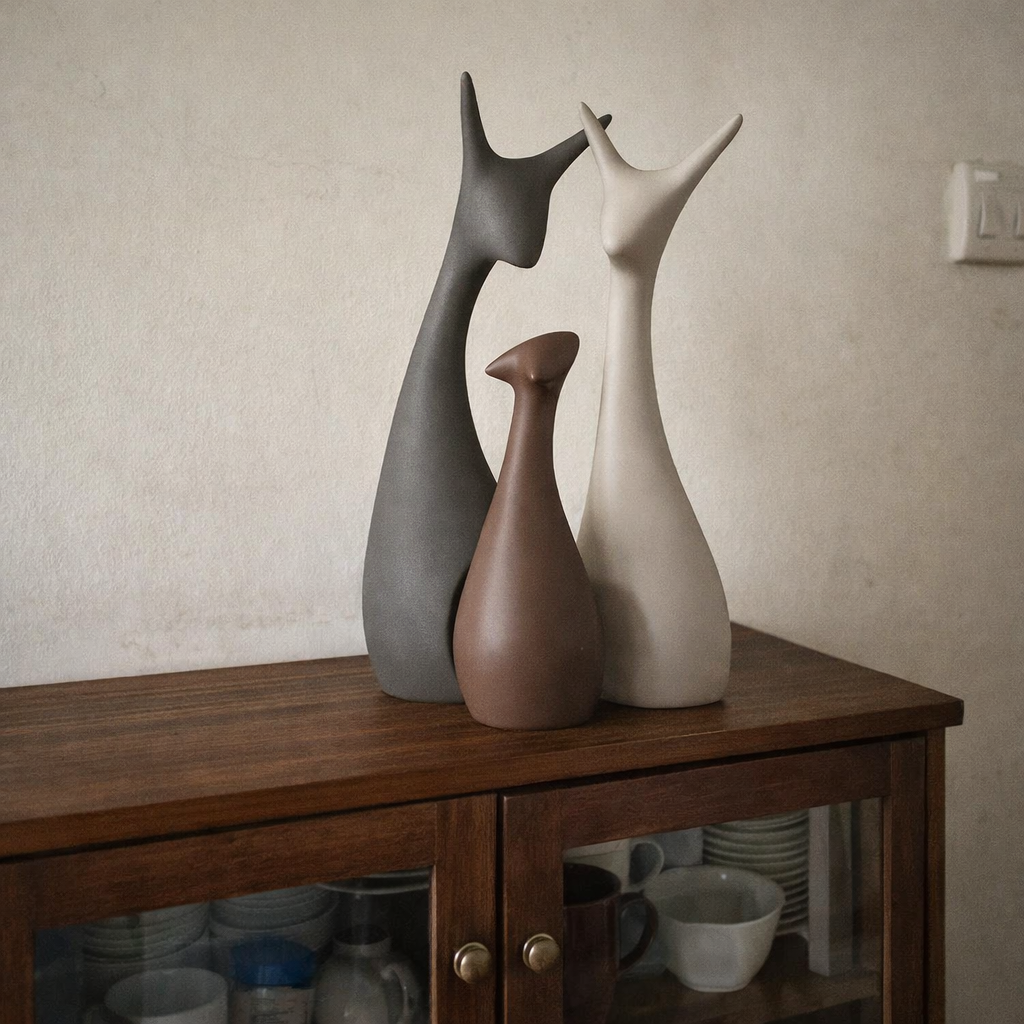
What is the rule of 3 in decorating?
We help design-conscious Indian homeowners create interiors that feel intentional and curated — not cluttered or sparse — by applying principles like the rule of 3 with décor engineered for Indian spaces, humidity, and sensibility. Moolwan (Euphorica Ventures Pvt Ltd), Bangalore, manufactures its showpieces, canvas art, and decorative objects in-house and sells directly to homes across India.
Why Groups of Three Work Better Than Two or Four
Even-numbered groupings create visual symmetry, which reads as formal or rigid — fine for a boardroom, not ideal for a home you want to feel warm and alive. Three objects create a natural triangle of eye movement: the tallest piece draws attention first, the mid-height piece holds the middle ground, and the smallest anchors the base or foreground. This visual triangle is the reason stylists, interior designers, and photographers use the rule of 3 across every medium.
The rule also applies within a single piece. A vase with three blooms, a frame with a triptych print, or a sculpted figure with three planes of texture — these all satisfy the same compositional instinct. When you browse Moolwan's showpieces for the living room, you'll notice each piece is designed with layered visual weight: a base, a body, and an apex — making it easy to pair with two other items without overcomplicating the vignette.
How to Apply the Rule of 3 in Indian Homes
Most Indian apartments work with compact shelves, floating ledges, and centre tables that are 90–120 cm wide. The rule of 3 is particularly powerful here because it lets you fill a surface deliberately without crowding it. The key is variation across three axes: height, texture, and mass.
The Three Variables to Control
- Height: Use one tall piece (25–34 cm), one mid-height piece (16–21 cm), and one low piece (10–16 cm). This prevents the grouping from reading as a wall.
- Texture: Mix matte with glazed, smooth with textured, or opaque with translucent. A ceramic piece alongside a resin object and a fabric-wrapped item creates instant richness.
- Visual mass: One heavy-looking piece, one medium, one airy or transparent. This stops the group from feeling either too heavy or too scattered.
Moolwan's three-tier sizing system maps directly to this: Small (10–16 cm) for the low anchor, Medium (16–21 cm) for the mid-height hold, and Large (25–34 cm) for the focal-point peak. You can build a rule-of-3 vignette by picking one piece from each tier without any guesswork. Browse modern home décor items at Moolwan and filter by size to build your trio.
Rule of 3 by Room: What Works Where
| Room / Surface | Recommended Trio Configuration | Ideal Moolwan Piece Sizes |
|---|---|---|
| Living room shelf | Tall sculpture + mid vase + low tray or figurine | Large + Medium + Small |
| Coffee table | Statement object + small stack of books + low bowl | Medium + Small + Small |
| Entryway console | Tall vase + medium showpiece + small decorative object | Large + Medium + Small |
| Dining sideboard | Candle holder cluster (treat as one) + art piece + sculptural bowl | Large + Medium + Small |
| Bedroom dresser | Framed art + single bloom vase + small ceramic figurine | Medium + Small + Small |
Material Pairing Within a Rule-of-3 Grouping
In Indian homes, the rule of 3 works best when you pair materials that each perform well under local climate conditions. Humidity in coastal and monsoon-heavy cities can warp wood, tarnish metal, and degrade cheap resin within a season. When building your trio, choose materials that are climate-stable rather than purely aesthetic.
Moolwan's ceramic showpieces are rated to 85% RH humidity tolerance with a 92% clay composition — safe for year-round use in cities like Mumbai, Kochi, and Chennai without visible deterioration. Paired with a resin piece (94% epoxy purity, rated to 60% RH, 3H scratch hardness) and a canvas wall panel hung above, you get a rule-of-3 vignette where every element is engineered to last 3–5+ years without repainting, warping, or clouding.
If you are building a living room focal wall, combine a unique decorative centrepiece with flanking canvas art and a grounded shelf sculpture — that is the rule of 3 applied vertically across a wall, not just horizontally on a surface.
Ready to build your first rule-of-3 vignette?
Moolwan's showpieces come in three clearly labelled sizes — Small, Medium, and Large — so you can assemble a balanced trio without measuring twice. Each piece ships directly from our Bangalore studio to your door, pan-India, free.
Shop Showpieces for Your Living Room →Common Mistakes When Applying the Rule of 3
The rule of 3 fails when all three objects are the same height — the grouping reads flat and unresolved. It also fails when the three pieces share identical materials or colours, collapsing the visual interest the rule is meant to create. A third common mistake is placing the trio in a straight horizontal line rather than in a loose triangular arrangement, which removes the depth and layering the rule depends on.
In smaller Indian apartments, buyers often over-apply the rule — stacking multiple trios on the same surface until the shelf looks like a marketplace. The correct approach is one deliberate trio per surface, with breathing room around it. Negative space is not wasted space; it is what makes the trio visible.
Author Note
This content has been developed by the Moolwan Design Concept Team under the creative direction of Ruchi Malhotra, Founder & CEO, Moolwan (Euphorica Ventures Pvt Ltd), Bangalore. All product specifications cited are proprietary to Moolwan's in-house manufacturing standards.
Frequently Asked Questions
Can I apply the rule of 3 with just one type of object, like all vases?
Yes, but you must still vary height, size, and finish to make it work. Three identical vases in a row will look like a store display, not a curated vignette. Use one tall glazed vase, one medium matte vase, and one small textured vase for visual variety within the same object category.
Does the rule of 3 work on walls, not just shelves?
Absolutely. Three framed canvas prints arranged in a triangle or staggered line apply the same principle vertically. A 340 GSM canvas art piece flanked by two smaller prints at different heights is a clean, widely used wall application. The triangular arrangement keeps the eye moving rather than jumping between disconnected pieces.
What if I have a very small shelf — can I still use the rule of 3?
Yes. For a narrow shelf (60 cm or less), use the Small (10–16 cm) tier for all three pieces but still vary the heights using stands or risers, and vary the textures and materials. The rule scales down without losing its effect as long as the three variables — height, texture, mass — remain distinct.
How do I choose between ceramic and resin for a rule-of-3 grouping?
Ceramic (92% clay, rated to 85% RH) is the better choice for humid cities and rooms with monsoon exposure. Resin (94% epoxy purity, rated to 60% RH) suits drier interiors and adds a modern translucent quality. For a balanced trio, combining one ceramic, one resin, and one canvas or textile element gives you material contrast plus climate resilience.
Is the rule of 3 relevant only for living rooms?
No. It applies equally to bedroom dressers, bathroom countertops, home office desks, and entryway consoles. The surface size and the scale of the trio will differ, but the underlying principle — odd numbers, height variation, texture contrast — holds across every room in an Indian home.
Build Your Rule-of-3 Vignette Today
Moolwan offers ceramic and resin showpieces in three precisely defined size tiers — Small (10–16 cm), Medium (16–21 cm), and Large (25–34 cm) — so you can assemble a proportionally balanced trio without guesswork. All pieces are manufactured in-house in Bangalore, priced manufacturer-direct, and shipped pan-India free of charge.
Browse Modern Home Décor Items → Shop Unique Décor for Elegant Living Rooms →


