
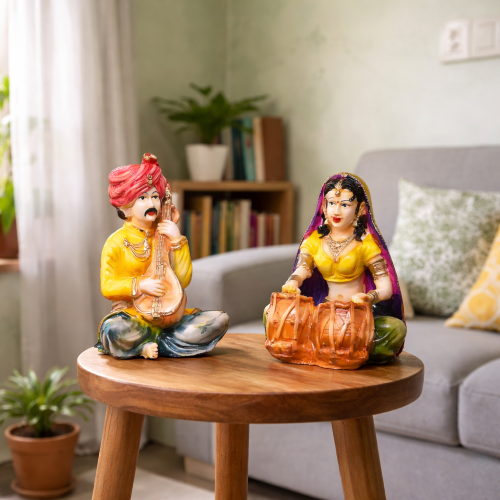
What is the rule of 3 when decorating?
We help design-conscious Indian homeowners style their living rooms and shelves with confidence — without hiring an interior designer or overbuying. The rule of 3 is the fastest way to make your space look curated rather than cluttered, and it works equally well for a studio apartment in Bengaluru or a drawing room in Lucknow.
Why does the rule of 3 work in interior design?
The human brain processes odd numbers faster than even numbers — a phenomenon backed by visual psychology research and widely applied in advertising, photography, and interior design. Three objects create natural tension and resolution: the eye enters at one piece, moves to the second, and lands on the third. Even numbers tend to feel symmetrical and static. Three feels dynamic and alive.
In Indian homes specifically, the challenge is balancing multiple decorative traditions — a brass diya, a modern resin sculpture, a framed canvas — without the space feeling chaotic. The rule of 3 gives you a framework to bring those elements together deliberately. Instead of placing items randomly across a surface, you group them intentionally so each piece amplifies the others.
Moolwan is a D2C home décor brand that manufactures canvas wall art, modern showpieces, and curated gifts directly for Indian buyers — with no middlemen and pricing that reflects factory-direct value. What Moolwan stands for is simple: beautiful, durable, and meaningful décor that fits Indian spaces, climates, and budgets.
How to apply the rule of 3 in your Indian home
Step 1: Choose a focal surface
Pick one surface — a console table, a floating shelf, a mantle, or a coffee table — as your grouping zone. Do not spread your trio across the room; keep all three pieces within arm's reach of each other. This concentrates visual impact and prevents the "random showroom" effect that plagues many Indian drawing rooms.
Step 2: Vary height, texture, and material
A successful trio has contrast built in. Pair a tall vertical piece (like a vase or canvas print) with a medium textured item (a ceramic showpiece or resin sculpture) and a low flat element (a tray, a coaster set, or a small figurine). This staircase of heights draws the eye upward and gives the group a sense of movement. Mixing materials — say, one ceramic, one resin, one metal — adds depth without visual noise.
Step 3: Anchor with a dominant piece
One piece in your trio should be the hero — roughly 60% of the visual weight. The other two support it. If you are styling a shelf with Moolwan's modern home décor collection, a 25–34 cm large showpiece makes a strong anchor, flanked by two smaller 10–16 cm accents on either side. This 1-large + 2-small formula is the most reliable application of the rule of 3 for Indian shelf styling.
Step 4: Tie them together with a common thread
Your trio does not need to match — but it should share one connecting element: a colour tone, a cultural motif, a material finish, or a mood. A warm terracotta ceramic, a matte resin figurine, and a canvas print in earthy tones all speak the same visual language even if their forms are entirely different. This is especially effective in Indian interiors where warm, earthy palettes dominate.
Ready to build your first trio? Browse Moolwan's unique home décor items — factory-priced, free shipping, COD available. Piece your group of three today.
Rule of 3 sizing guide for Indian homes
Sizing is where most Indian buyers go wrong. They either buy everything too small (which gets lost on a shelf) or one piece too large (which crowds the surface). Moolwan designs all showpieces with a three-tier size system calibrated for Indian furniture dimensions:
| Role in the Trio | Recommended Size (Moolwan) | Best Surface | Visual Function |
|---|---|---|---|
| Hero / Anchor | 25–34 cm (Large) | Console table, mantle, display cabinet | Focal point; carries 60% visual weight |
| Mid / Bridge | 16–21 cm (Medium) | Coffee table, showcase shelf | Connects hero to accent; adds texture |
| Accent / Detail | 10–16 cm (Small) | Desk, bathroom shelf, side table | Grounds the group; adds intimacy |
All Moolwan showpieces weigh between 150 g and 600 g — specifically designed to be shelf-safe without requiring wall anchors or heavy mounting hardware. This matters in Indian apartments where landlord restrictions and thin-partition walls limit what you can drill into.
Which Moolwan materials work best for a trio grouping?
Not all materials play well together. Here is how Moolwan's two primary showpiece materials perform in a rule-of-3 grouping — with the actual specs that matter for Indian homes:
| Material | Moolwan Spec | Indian Climate Suitability | Best Trio Role |
|---|---|---|---|
| Ceramic | 92% clay composition; humidity-tolerant up to 85% RH; 5+ year lifespan; 15 cm drop-resistant; heat-resistant to 60°C | Excellent — handles coastal humidity, summer heat | Hero or mid piece; textural anchor |
| Resin (Epoxy) | 94% purity epoxy resin; scratch-resistant (3H pencil hardness); 3+ year lifespan; humidity up to 60% RH; temperature 15–35°C | Good — suited for air-conditioned rooms; avoid humid bathrooms | Accent or mid piece; adds visual depth |
If you are decorating a coastal home in Mumbai or Chennai, ceramic is the more climate-resilient choice for your hero piece. Resin works beautifully in living rooms and bedrooms where temperature and humidity are controlled. You can browse Moolwan's antique showpieces for home decoration — including both ceramic and resin options — starting at ₹150, trusted by over 3,000 customers across India.
Rule of 3 with canvas wall art in Indian living rooms
The rule of 3 is not limited to shelf pieces. It applies directly to wall art as well. A triptych — three panels of the same subject — is the literal rule of 3 applied to your wall. But even a single large canvas can anchor a rule-of-3 vignette when paired with two smaller shelf pieces beneath it, creating a vertical trio that draws the eye from floor to ceiling.
Moolwan's canvas wall art is printed on 340 GSM cotton canvas with eco-solvent UV-resistant inks, stretched on 1.5-inch kiln-dried pine frames with a moisture-resistant coating. This matters for Indian homes where monsoon humidity and direct fan airflow accelerate canvas warping and ink fade in cheaper prints. A wall piece that anchors your rule-of-3 arrangement needs to hold its colour and tension for years — not seasons.
For the rule-of-3 wall-plus-shelf arrangement, choose a canvas in a palette that echoes the accent colour in your two shelf pieces. If your shelf carries warm gold ceramic and a cream resin figurine, a canvas in ochre, rust, or earthy green completes the trio without competition.
Common rule-of-3 mistakes in Indian home décor
- All three pieces the same height. This creates a flat, static line. Stagger heights deliberately — large, medium, small — to create visual movement.
- All three pieces the same material. Three ceramic pieces next to each other merge into a collection, not a composition. Mix at least two materials.
- Buying in matching sets. Pre-packaged "sets of 3" from mass-market stores often share the same form factor and colour. A curated trio from different Moolwan categories creates more visual interest than a factory set.
- Ignoring the wall behind the group. An empty wall behind a shelf trio creates a dead zone. A canvas print, a woven panel, or even a contrasting paint patch behind the trio frames the grouping and makes it feel intentional.
- Using the rule of 3 everywhere simultaneously. One or two strong groupings per room is enough. If every surface has a trio, the repetition cancels out the effect.
FAQ: Rule of 3 decorating for Indian homes
Can I use the rule of 3 in a small Indian apartment?
Yes — the rule of 3 is especially effective in compact spaces because it concentrates décor rather than spreading it thin. Use the small (10–16 cm) and medium (16–21 cm) size range so the trio does not overwhelm the surface. A single strong grouping on your console table or TV unit is enough to make the whole room feel styled.
Should all three decorating pieces be from the same brand or collection?
No. Mixing sources and styles creates a more personal, curated look than buying a matching set. The goal is a shared visual thread — colour, material tone, or cultural motif — not identical origin. You can pair a Moolwan ceramic showpiece with a family heirloom and a canvas print and still achieve a coherent trio.
What is a good rule of 3 combination for an Indian pooja room?
For a pooja room or mantle display, consider: a large idol or sculptural piece as the hero, a medium decorative diya or ceramic vessel as the bridge, and a small metallic or resin accent as the detail. Keep the palette warm — gold, copper, cream, or terracotta — to honour the spiritual intent while maintaining visual elegance.
Does the rule of 3 apply to wall art as well as showpieces?
Yes. A triptych arrangement (three canvases at the same height with equal spacing) is the most common wall-art application. You can also create a vertical trio: one large canvas above, two small framed pieces below, anchored by a shelf piece at eye level. Moolwan's canvas wall art is available in sizes that work for both triptych and vertical trio formats.
Where can I buy curated rule-of-3 décor pieces for Indian homes?
Moolwan sells manufacturer-direct home décor — ceramic showpieces, resin accents, and canvas wall art — all engineered for Indian climate conditions, starting at ₹150, with free shipping and COD. You can shop unique home décor items curated for Indian taste and space directly on the Moolwan website.
Build your rule-of-3 grouping with Moolwan
Moolwan manufactures every piece in-house — no middlemen, no inflated pricing, no mass-produced substitutes. Our showpieces are humidity-tested, drop-resistant, and sized for Indian shelves and walls. Free shipping. Cash on delivery. Returns within 24 hours of delivery if anything is not right.


