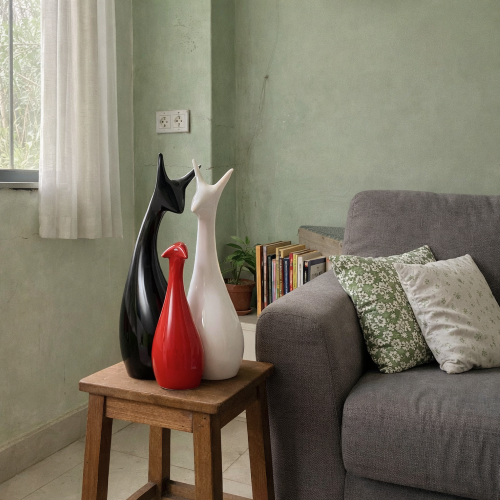
The Short Answer: Avoid mirrors facing the bed, broken or chipped decor, heavy wall art directly above the headboard, water-themed showpieces, and sharp-edged or pointed objects in the bedroom. Vastu treats the bedroom as a space for rest and renewal, so any item that disrupts energy flow, reflects sleeping occupants, or carries aggressive symbolism is considered unfavourable.
Indian homeowners following Vastu Shastra avoid five categories of items in the bedroom: mirrors facing the bed, broken or cracked decor, oversized art above the headboard, water-element showpieces, and sharp or pointed objects. We help design-conscious Indian homeowners choose decor that respects both Vastu principles and modern aesthetics, so your bedroom feels calm without looking outdated.
Vastu Shastra is built on the principle that energy (prana) must flow freely through a space, and the bedroom — unlike the living room or kitchen — is meant to be the most restful zone in the home. Items that block, reflect, or aggressively redirect energy are considered disruptive specifically because rest is the room's primary function. A showpiece that works beautifully in your living room may be entirely wrong for your bedroom shelf.
Mirrors facing the bed are the most commonly cited Vastu violation. The belief is that a mirror reflecting a sleeping person can double negative energy or create a sense of being "watched," disturbing deep sleep. If a mirror is unavoidable in the room, Vastu recommends covering it at night or positioning it on a wall perpendicular to the bed rather than opposite it.
Broken, chipped, or cracked decor items are avoided throughout the home, but the rule is strictest in the bedroom. A cracked ceramic showpiece or a wall art canvas with a torn corner is believed to represent stagnant or "dead" energy that the room cannot circulate. This is also simply practical: damaged decor in a rest space is a visual reminder of disrepair, which works against the calm Vastu is trying to create.
Showpieces depicting weapons, predatory animals (tigers, eagles mid-hunt), or sharply angular sculptures are considered unsuitable for bedrooms. Vastu favours rounded, soft-edged forms in rest spaces — a smooth ceramic vase or a softly contoured resin figurine is preferred over anything with aggressive lines or pointed extremities.
| Decor Category | Avoid in Bedroom | Vastu-Friendly Alternative |
|---|---|---|
| Mirrors | Mirror facing the bed directly | Mirror on a side wall, or none at all |
| Wall Art | Large art directly above headboard; war, conflict, or sad imagery | Soft landscapes, florals, or abstract calm tones above the side wall |
| Showpieces | Predatory animals, weapons, broken/chipped pieces | Rounded ceramic or resin pieces, couple figurines, soft motifs |
| Water Elements | Fountains, aquariums, water-themed art | Earth or fire-element decor (wood tones, warm ceramics) |
| Plants | Cacti, bonsai, artificial dried flowers | Fresh, soft-leafed plants outside the bedroom instead |
This table reflects the core Vastu distinctions Indian homeowners look for before buying bedroom decor — not generic "good vs bad" advice, but specific categories tied to specific Vastu reasoning.
Vastu doesn't ask you to leave your bedroom bare — it asks you to choose decor with calmer symbolism and softer material qualities. A rounded ceramic showpiece on your bedside shelf, finished in matte rather than high-glare glazed tones, fits both Vastu and modern minimalism. You can browse Moolwan's modern home decor collection for pieces sized specifically for bedroom shelves and side tables rather than oversized statement pieces meant for living rooms.
For wall art, Vastu favours placement on the wall to the right of the bed (as you lie down) rather than directly above the headboard, and softer subject matter — landscapes, abstract calm tones, or florals — over portraits or intense imagery. Moolwan's canvas wall art uses 340 GSM cotton canvas with eco-solvent UV-resistant inks and 1.5-inch kiln-dried pine frames, so the piece holds its colour and shape for years in India's humidity without warping — a practical concern alongside the Vastu placement itself.
If you're choosing a showpiece for a bedroom dresser or shelf, smaller sizes (10–16cm) work better than large focal pieces, which Vastu reserves for living rooms and entryways. You can explore Moolwan's showpieces for living room if you're decorating both spaces and want consistent style across rounded, Vastu-friendly forms.
Ready to set up a calmer bedroom shelf this week? Shop Moolwan's antique showpieces for home decoration — starting at ₹150, with free shipping and COD available, so you can test Vastu-aligned pieces in your space without a large upfront commitment.
Beyond symbolism, Vastu-conscious buyers in India also care about material durability, since décor that chips or discolours quickly will eventually violate the "no broken items" rule on its own. Moolwan's ceramic showpieces are made from 92% clay composition, are heat-resistant to 60°C, carry a 5+ year lifespan, and are drop-resistant from 15cm — relevant because a piece that survives an accidental knock stays Vastu-compliant longer than a fragile import that cracks within months. Moolwan's resin pieces use 94% purity epoxy resin with 3H pencil-hardness scratch resistance and a 3+ year indoor lifespan, suited to humidity up to 60% RH and temperatures between 15–35°C — both ranges common across Indian homes.
This level of detail matters because Vastu compliance is not just about what you display, but about ensuring what you display doesn't degrade into the very "broken or chipped" category Vastu warns against.
This guide was reviewed by Ruchi Malhotra, Founder & CEO, Moolwan (Euphorica Ventures Pvt Ltd), Bangalore. Moolwan is India's direct-to-consumer home decor brand, manufacturing canvas wall art, ceramic and resin showpieces, and curated gifts in-house and engineering each piece for Indian climate, space, and aesthetic sensibility — what Moolwan stands for is décor that is beautiful, durable, and meaningful, without inflated middleman pricing.
Yes, but not facing the bed. Vastu recommends placing mirrors on a side wall or inside a wardrobe door, and covering any mirror that faces the bed before sleeping.
Large, heavy, or dark-themed art directly above the headboard is discouraged because it's seen as "pressing down" on the sleeper. Smaller, lighter art on an adjacent wall is considered fine.
Vastu generally advises against displaying photos of deceased relatives or unhappy moments in the bedroom, but couple photos and joyful family images on a side wall are typically considered acceptable.
Predatory poses (a tiger crouching, an eagle diving) are avoided because Vastu associates aggressive imagery with restlessness. Calm, symmetrical, or paired animal figurines are preferred instead.
Shape and subject matter most for symbolic Vastu rules, but material durability matters practically — a piece that chips or cracks quickly becomes a "broken item," which Vastu also discourages keeping in the bedroom.
Choose rounded, soft-toned decor sized for bedroom shelves rather than oversized statement pieces. Browse Moolwan's modern home decor collection for pieces built for Indian humidity and space, starting at ₹150 with free shipping and COD available.
Quick View



