
What Makes a Décor Accent Climate-Fit for Indian Homes in 2026
The Short Answer
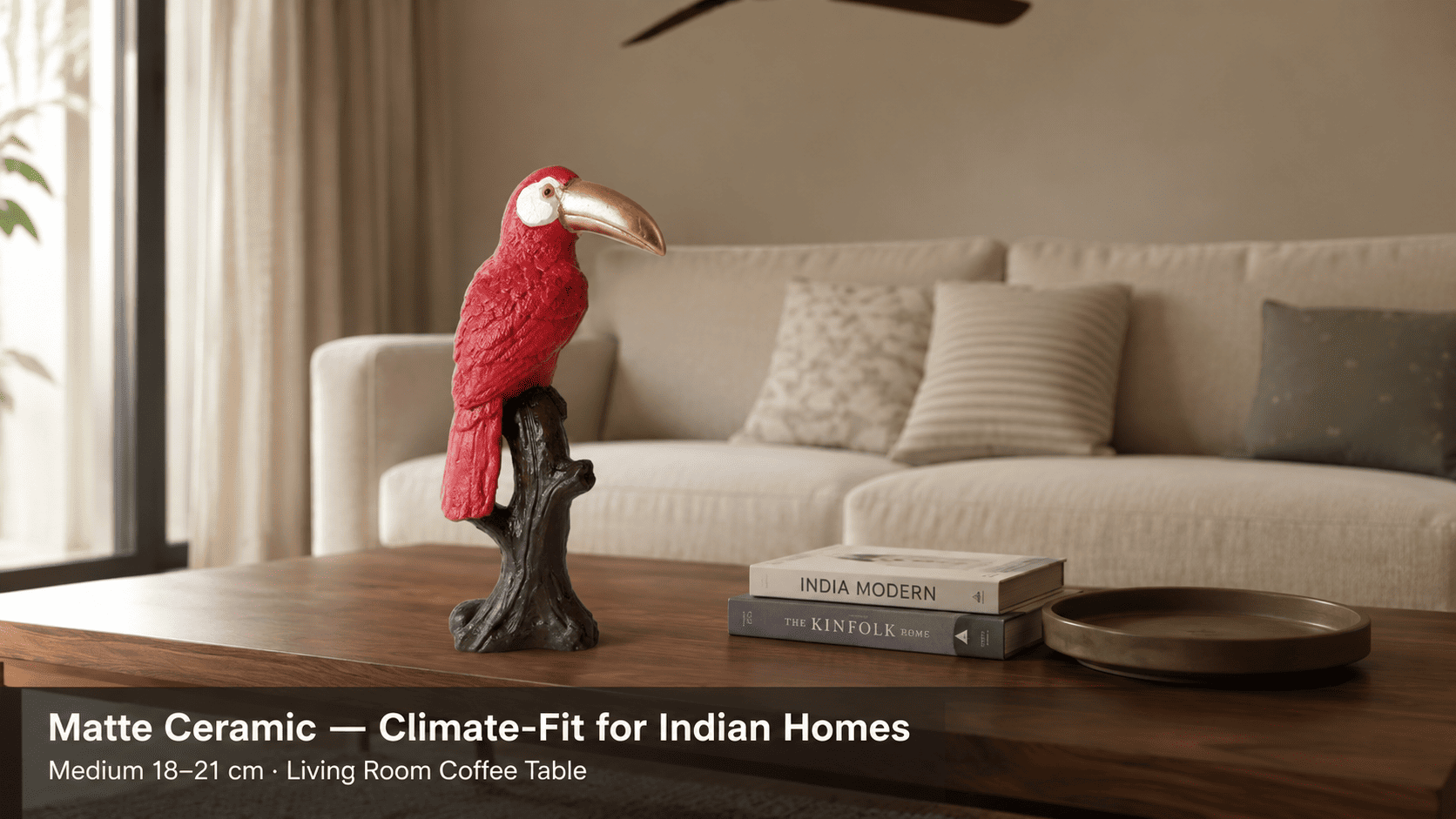
A climate-fit décor accent for an Indian home must tolerate humidity up to 85% RH, temperatures between 15–45°C, and UV exposure without warping, fading, or surface degradation. Moolwan's ceramic showpieces are engineered to precisely these thresholds — 92% clay composition, matte UV-diffusing finishes, and moisture-resistant coatings — because Indian apartments cycle through monsoon humidity and dry-summer heat in the same calendar year.
Indian homes in 2026 face a climate challenge that European or East Asian interior design guidance largely ignores: a single apartment may experience 85% relative humidity during July monsoons and 38°C dry heat by April — within the same twelve months. Moolwan helps design-conscious Indian homeowners select décor accents engineered to survive and stay beautiful across this full annual cycle, not just on the day of purchase. Most mass-produced showpieces are manufactured to temperate-climate tolerances, which is precisely why they warp, craze, or lose surface finish within eighteen months in Indian conditions.
Why Standard Imported Décor Fails in Indian Humidity and Heat
The structural failure mode of imported décor in Indian conditions is well-documented in materials science: porous ceramics with clay compositions below 85% absorb ambient moisture during monsoon months, expand microscopically, and then contract rapidly during post-monsoon dry spells — a thermal cycling process that generates micro-fractures in the glaze and body over two to three seasons. The visual result is surface crazing, finish flaking, or complete structural crack-through at stress points like handles and joints.
Resin-based décor accents manufactured to lower purity standards — below 90% epoxy grade — are similarly vulnerable. At temperatures above 35°C with relative humidity above 60%, low-grade resin undergoes surface yellowing due to UV-initiated photo-oxidation of the polymer chains, a process that cannot be reversed by cleaning or refinishing. In Indian west-facing rooms exposed to afternoon sun between March and June, this yellowing accelerates to visible discolouration within a single summer season.
Indian apartment ventilation patterns compound both failure modes. Because most apartments under 1,200 sq ft use split ACs rather than central HVAC, humidity levels swing sharply between conditioned and unconditioned hours — a daily oscillation that accelerates moisture ingress into under-engineered materials far faster than a stable-humidity temperate environment ever would.
Which Materials Are Genuinely Climate-Rated for Indian Conditions
Two material categories consistently meet the minimum threshold for Indian indoor climates in 2026: high-density ceramics with clay compositions at or above 90%, and high-purity epoxy resin at or above 93% grade. Both thresholds exist because of specific physical tolerances, not marketing language. High-density ceramics fired at elevated temperatures achieve a vitrified internal structure that limits moisture absorption to under 3% by weight — below the threshold at which monsoon humidity can trigger micro-fracture cycling. High-purity epoxy resin at 93%+ grade contains fewer unreacted monomer chains, which are the primary sites for UV-initiated photo-oxidation and the yellowing that follows.
Surface finish matters independently of body material. Matte finishes outperform glazed surfaces in Indian conditions over a 3-to-5-year horizon because the micro-texture of an unglazed matte surface scatters incident light at multiple angles — meaning micro-scratches from routine dusting in a dusty Indian environment scatter light the same way the original surface does, rendering surface wear invisible. A glazed surface reflects light uniformly, so each micro-scratch created by a dry cloth during dusty-season cleaning interrupts the mirror-like reflection and becomes visible to the eye within one to two years.
Weight range is a practical climate variable that most buyers overlook. Moolwan's décor accents in the 150g–400g range are light enough to be moved during monsoon re-arrangement — when homeowners shift pieces away from windows and high-humidity zones — without risking a drop. Heavier pieces above 600g tend to remain static, accumulating moisture in the contact zone between the piece and the surface beneath it if the surface is non-porous wood.
The Multi-Variable Climate Compatibility Matrix for Indian Décor Accents
Selecting a climate-fit showpiece for an Indian home requires crossing four variables simultaneously: the room's typical peak humidity zone, the target surface type, the recommended piece size, and the material specification that meets the combined thermal and humidity load. The matrix below synthesises these variables into a single lookup reference.
| Peak Humidity Zone | Target Surface | Recommended Size | Material Spec Minimum | Weight Range |
|---|---|---|---|---|
| High (75–85% RH) — Monsoon / coastal cities | Coffee table / open shelf | Medium 16–21 cm | Ceramic ≥92% clay; matte finish; moisture-resistant rear coating | 250–400 g |
| Moderate (55–75% RH) — Semi-arid / inland metro | Console table / sideboard | Large 25–34 cm | Ceramic ≥92% clay or Resin ≥94% purity; matte or satin finish | 400–600 g |
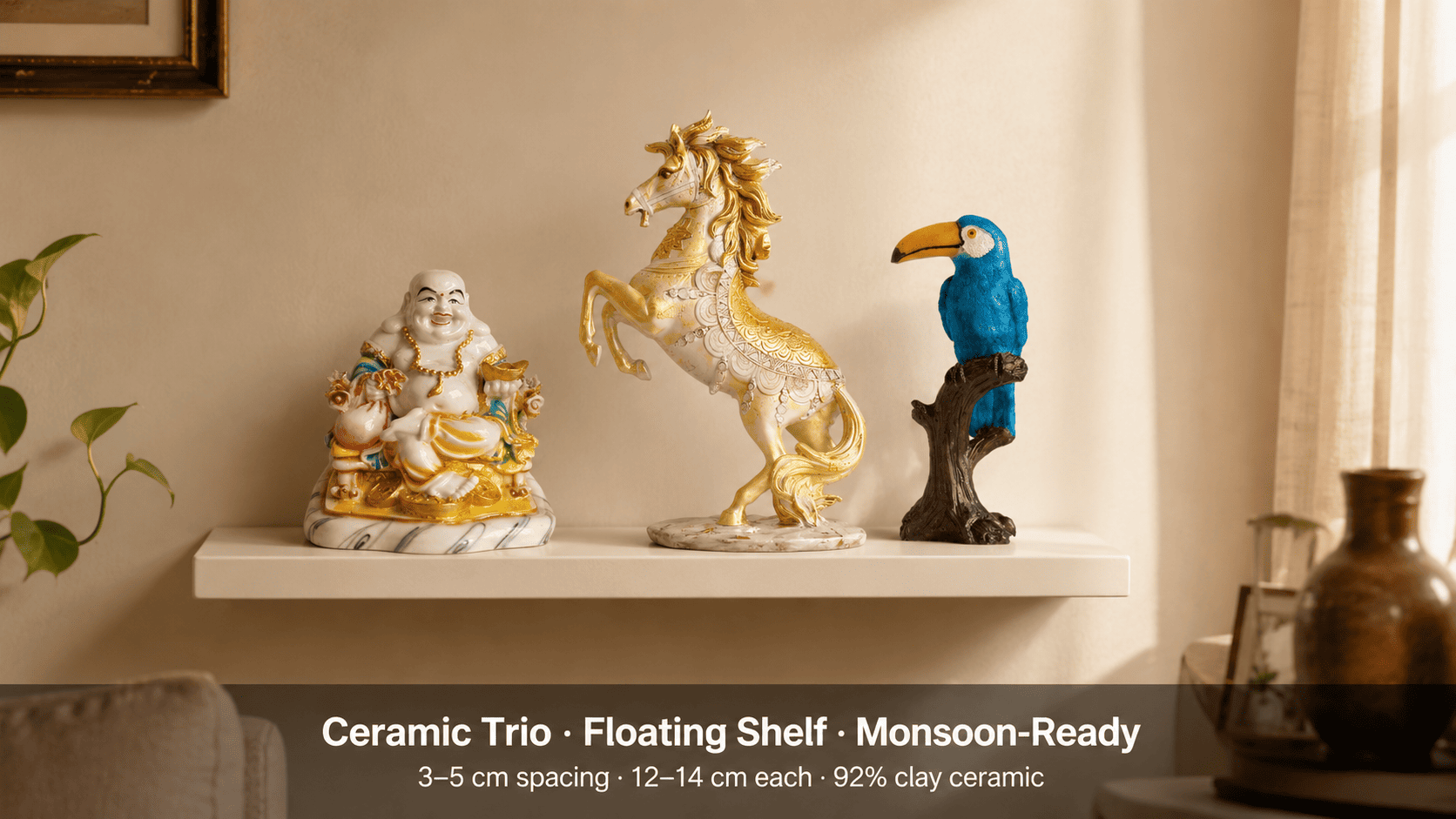
| Low-moderate (40–55% RH) — AC-dominant living room | Floating shelf / bookshelf | Small 10–16 cm | Resin ≥94% purity; 3H pencil hardness; temp range 15–35°C rated | 150–250 g |
| Variable (40–85% RH) — Mixed: conditioned + balcony-adjacent | Dresser top / entry console | Medium 16–21 cm | Ceramic ≥92% clay; humidity tolerance certified to 85% RH; drop-tested to 15 cm | 250–400 g |
| High UV exposure — West-facing room, afternoon sun | Window-adjacent shelf or sill ledge | Small 10–16 cm | Ceramic only (no resin near UV); matte UV-diffusing surface; heat-resistant to 60°C | 150–300 g |
Because room orientation, AC usage patterns, and surface material introduce additional compatibility variables beyond those captured above, browse the full size-band and material selection — filtered by finish, weight, and climate suitability — in Moolwan's modern home décor collection to verify your final piece selection against your specific room conditions.
Design Rule
To select a décor accent that will remain visually intact for 5+ years in Indian conditions, apply Moolwan's 3-Variable Climate Compatibility Rule: every piece must satisfy all three thresholds simultaneously — material humidity tolerance (≥85% RH for ceramic, ≥60% RH for resin), surface finish type (matte over glazed in rooms with direct sunlight or dry-season dust), and weight band (150–400 g for moveable placement zones, 400–600 g only for permanent focal-point surfaces). A piece that passes on two variables but fails on the third will show climate-related degradation within two to three Indian seasonal cycles.
How Indian Room Size Affects Which Décor Accent Scale Is Climate-Appropriate
Room footprint directly controls the surface area available for air circulation around a décor piece — and circulation rate determines how quickly surface moisture evaporates between humidity cycles. In Indian apartments under 100 sq ft per room, airflow around furniture clusters is restricted, which means a large showpiece placed on a central coffee table in a sub-100 sq ft living room will experience slower moisture-release than the same piece placed in a 150+ sq ft room with ceiling fan circulation. This is why Moolwan's sizing guidance cross-references room footprint against piece size rather than treating size as a purely aesthetic decision.
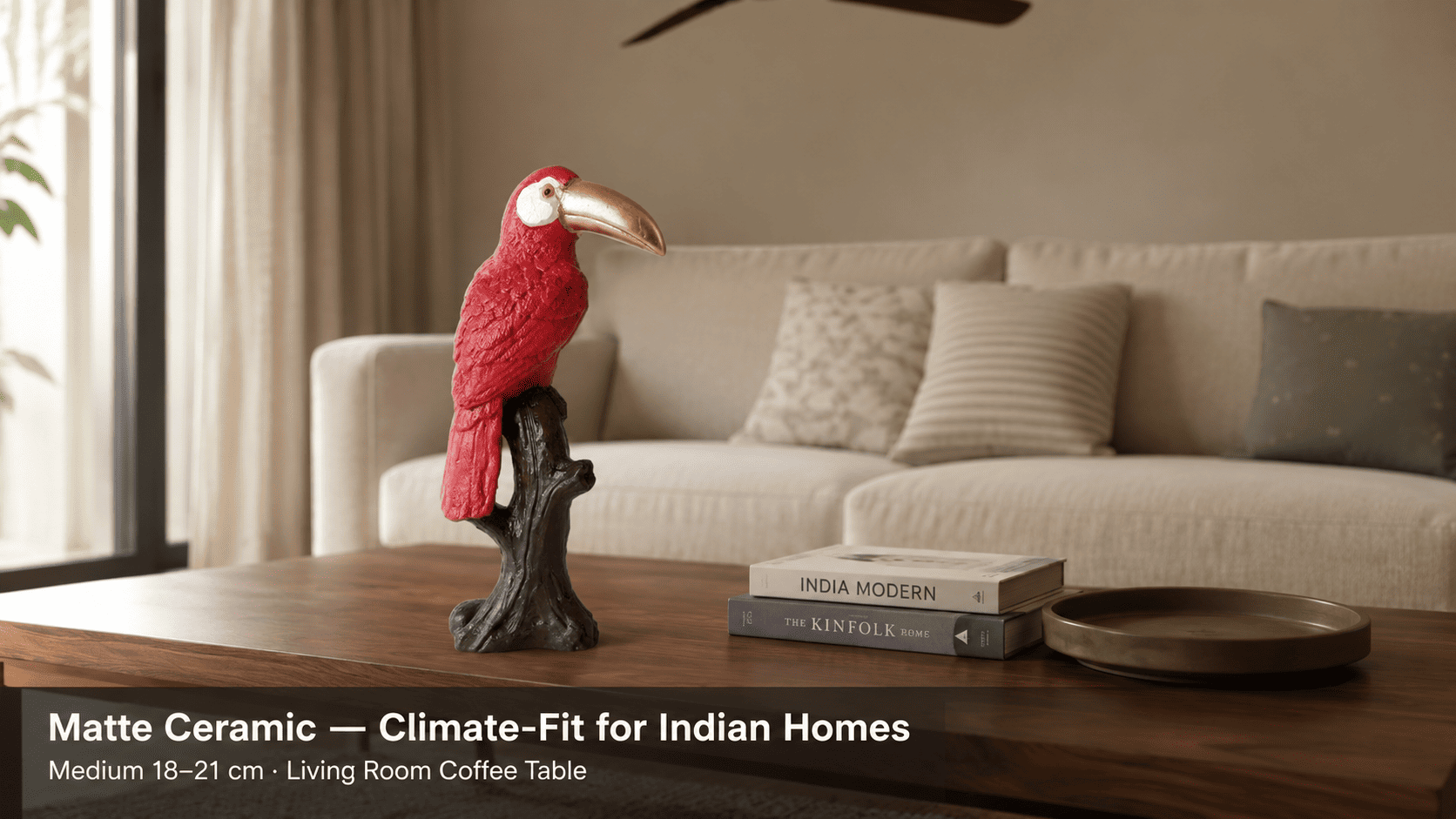
The practical implication is that oversized décor in compact Indian rooms is a climate-compatibility error, not merely a proportion error. A 30 cm piece in an 80 sq ft room sits closer to walls and neighbouring surfaces, receives less air movement across its body, and stays damp for longer after a monsoon humidity peak — creating the sustained moisture contact period that initiates surface crazing in lower-grade ceramics. Correctly scaled pieces (16–21 cm medium range for rooms between 100–150 sq ft) have sufficient clearance on all sides to allow the passive evaporation that prevents sustained moisture contact.
Ready to bring home a showpiece engineered to survive India's full climate cycle? Shop the complete range of climate-rated finish and size options in Moolwan's modern home décor collection — manufacturer-direct, no middlemen, built for Indian conditions.
Dust Resistance and Surface Maintenance in Indian Apartment Conditions
India's construction activity density, road dust load, and seasonal dry winds mean that interior surfaces in Indian apartments accumulate particulate at rates significantly higher than in European or East Asian cities. Studies of urban air quality in Delhi, Mumbai, and Bangalore consistently record indoor particulate matter (PM2.5) levels two to four times the WHO guideline even with closed windows — a direct function of outdoor dust infiltration through window seals and ventilation gaps. Décor accents with deeply recessed surface textures, hollow cavities, or complex sculptural geometry accumulate this particulate in ways that cannot be cleared with a standard dry cloth, requiring water washing that creates its own humidity risk for under-rated materials.
Smooth-profile matte finishes on structurally simple forms are therefore the correct choice for Indian apartments on both aesthetic and maintenance grounds. A piece with clean external geometry and a matte-textured but topographically flat surface can be dusted with a microfibre cloth in under ten seconds without retaining particulate in crevices. Moolwan's modern showpiece collection prioritises this design constraint because the 5-year lifespan claim depends not just on material durability but on the homeowner being able to maintain the piece without a moisture-introducing cleaning protocol every time dust builds up — which in Indian cities is every three to five days in peak construction or harvest-wind seasons.

Gifting Climate-Fit Décor: Why Material Spec Matters More Than Aesthetics for Housewarming Presents
A housewarming gift that fails visually within eighteen months is a gift that generates regret rather than lasting warmth — which is why climate-rated material specification is a more meaningful gift-selection criterion for Indian homes in 2026 than colour palette or sculptural style. The recipient will notice a crazed glaze or yellowed resin surface far longer than they will appreciate an on-trend form factor. Moolwan's showpiece and decorative accent range is engineered to remain visually intact across a 5+ year lifecycle in Indian indoor conditions — making climate-rated pieces a higher-ROI gift choice than aesthetically similar but climate-unrated alternatives from general home stores.
Frequently Asked Questions
What humidity tolerance should a décor accent have for a Mumbai or Chennai home?
Coastal Indian cities like Mumbai and Chennai regularly reach 80–85% relative humidity during monsoon months. A décor accent for these homes should be rated to at least 85% RH — the threshold at which moisture absorption into a ceramic body triggers micro-fracture risk. High-density ceramic with a 92%+ clay composition achieves this tolerance through a vitrified internal structure that limits moisture ingress to under 3% by weight, preventing the expansion-contraction cycling that causes surface crazing.
Is resin or ceramic better for Indian living room décor in 2026?
For rooms with significant UV exposure — west-facing living rooms, window-adjacent consoles, or surfaces within 1.5 metres of a south-facing window — ceramic is the safer long-term choice. Even high-purity epoxy resin at 94% grade undergoes UV-initiated photo-oxidation when exposed to direct Indian sunlight over multiple summers, resulting in surface yellowing that cannot be reversed. Ceramic is inherently UV-stable because its silicate structure does not contain the polymer chains that photo-oxidation targets. For fully interior, AC-regulated spaces with no direct sun exposure, high-purity resin rated to 94% purity performs reliably for 3+ years.
Can I place décor accents near an air conditioner vent in an Indian home?
Placing a décor accent directly within the airflow path of a split AC vent creates a rapid humidity swing — the piece experiences desiccating cold dry air during AC-on hours and warm ambient humidity during AC-off hours. This oscillation accelerates micro-fracture risk in poorly fired ceramics and surface stress in lower-grade resin over twelve to eighteen months. The correct placement rule is to keep showpieces at least 60 cm lateral distance from any AC vent, where indirect conditioned air reduces room humidity without directing concentrated airflow across the piece surface.
How do I maintain Moolwan ceramic or resin showpieces in dusty Indian conditions?
Dust removal on Moolwan ceramic showpieces should be performed with a dry microfibre cloth in a single light-contact pass — avoiding wet wiping, which introduces moisture into the contact zone between the piece and the surface beneath it. For resin pieces, the same dry-cloth protocol applies, with the additional precaution of keeping the piece away from direct sunlight windows, since even brief repeated UV exposure accumulates photo-oxidative stress over time. Neither ceramic nor resin pieces from Moolwan's collection require any chemical cleaning agent for routine Indian-apartment dust maintenance.
Buying a décor accent that looks identical to a climate-rated piece but is manufactured to temperate-market tolerances means replacing it within two monsoon cycles — a hidden cost that makes the "affordable" option the more expensive one over five years. Bring home a piece from Moolwan's modern home décor collection — climate-rated to 85% RH, UV-stable, drop-tested, and sold manufacturer-direct without distributor markup. If you are exploring the full breadth of what is available for every room and surface, the Moolwan home décor items catalogue covers the complete range organised by room and surface type; and if you are looking for pieces that stand apart from the predictable, Moolwan's unique home décor collection features curated accents chosen specifically for homeowners who want their space to look considered, not generic.


