
What Size Décor Accents Work Best on Indian Living Room Shelves?
The Short Answer
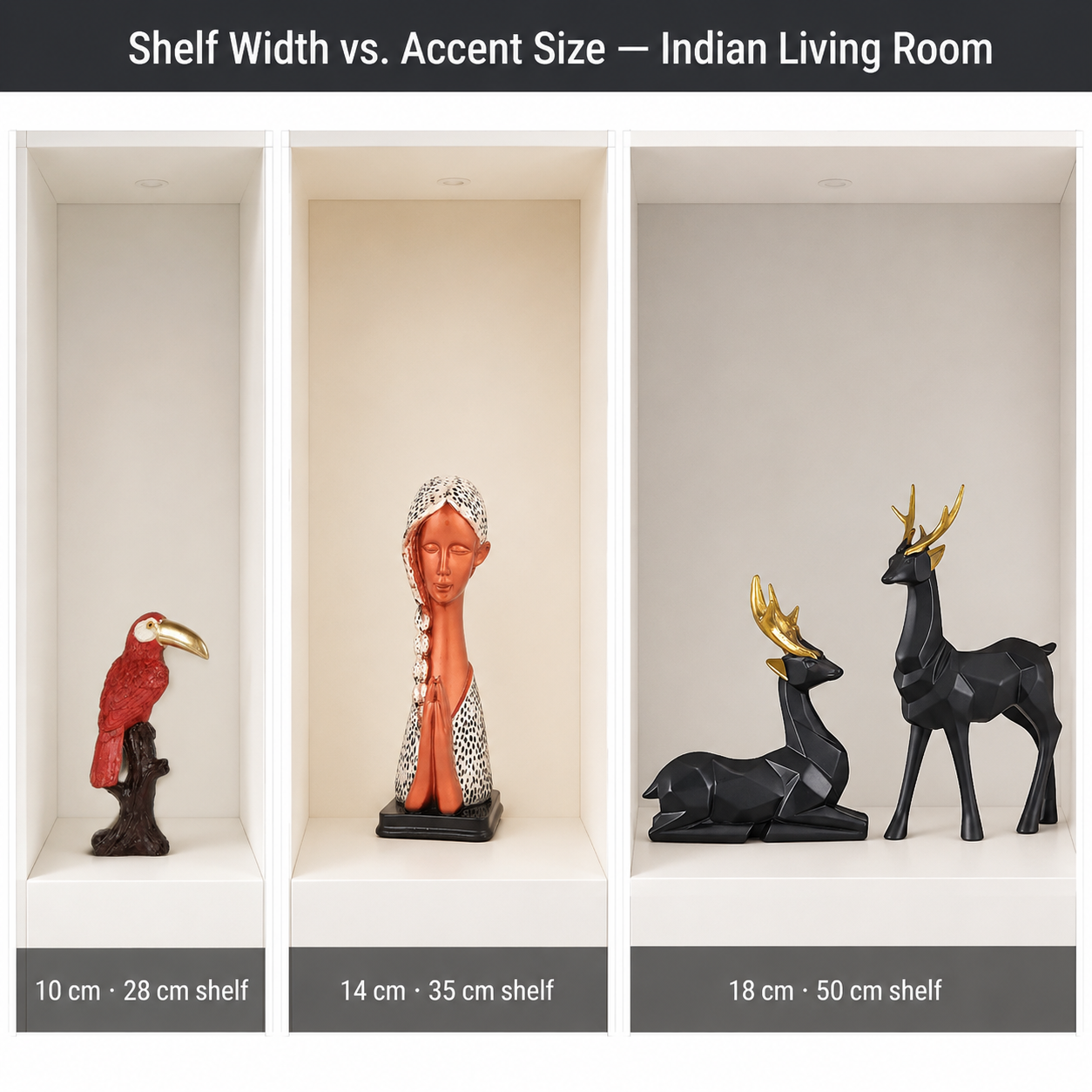
On shelves under 30 cm wide, choose small decorative pieces in the 10–16 cm height range (150–250 g) — their footprint leaves enough negative space to prevent visual compression. On shelves 40–60 cm wide, a medium accent of 16–21 cm anchors the display without overwhelming the surface. Moolwan engineers its small decorative items collection within these exact thresholds, drop-tested and humidity-tolerant to 85% RH for Indian living conditions.
Indian living rooms present a precise spatial challenge: the average urban apartment shelf unit runs 30–45 cm deep and 80–120 cm wide, but is subdivided into compartments averaging 28–40 cm across — dimensions that punish oversized accents and make undersized ones disappear. Moolwan helps design-conscious Indian homeowners choose shelf décor at the exact height and weight that makes a compartment feel intentional rather than incidental. The answer is not simply "go smaller" — it is a calibrated relationship between shelf width, object height, object count, and the percentage of surface left deliberately empty.
Why Does Shelf Width Determine Décor Height — Not Room Size?
The sizing variable that controls visual outcome on a shelf is the width of the individual compartment, not the overall room footprint, because the human eye resolves objects in relation to their immediate frame, not the broader room boundary.
When a decorative piece occupies more than 60% of a compartment's width, peripheral vision registers the shelf as full before the eye can distinguish individual objects — a phenomenon called lateral crowding. Conversely, a piece that occupies less than 25% of the compartment width reads as a stray object rather than a considered placement. The operative sizing window is 30–55% of compartment width for the tallest piece in a cluster.
Indian modular shelf units — from common 3×3 grid systems to floor-to-ceiling bookcases with 28–35 cm compartments — place the functional sweet spot firmly in the small decorative item range of 10–16 cm height. For wider open-plan display shelves in living rooms above 150 sq ft, medium accents of 16–21 cm enter the correct range. Moolwan calibrates its small decorative items collection to these exact height thresholds, with pieces weighted between 150 g and 400 g specifically to prevent wobble on standard Indian particleboard and MDF shelf bases.
How Do Material and Finish Affect Which Shelf Size Gets the Best Result?
On narrow shelves (under 30 cm wide), glazed finishes amplify the perception of crowding because their reflective surfaces add optical volume beyond the object's physical dimensions — making a 14 cm glazed piece read visually closer to 18 cm in width.
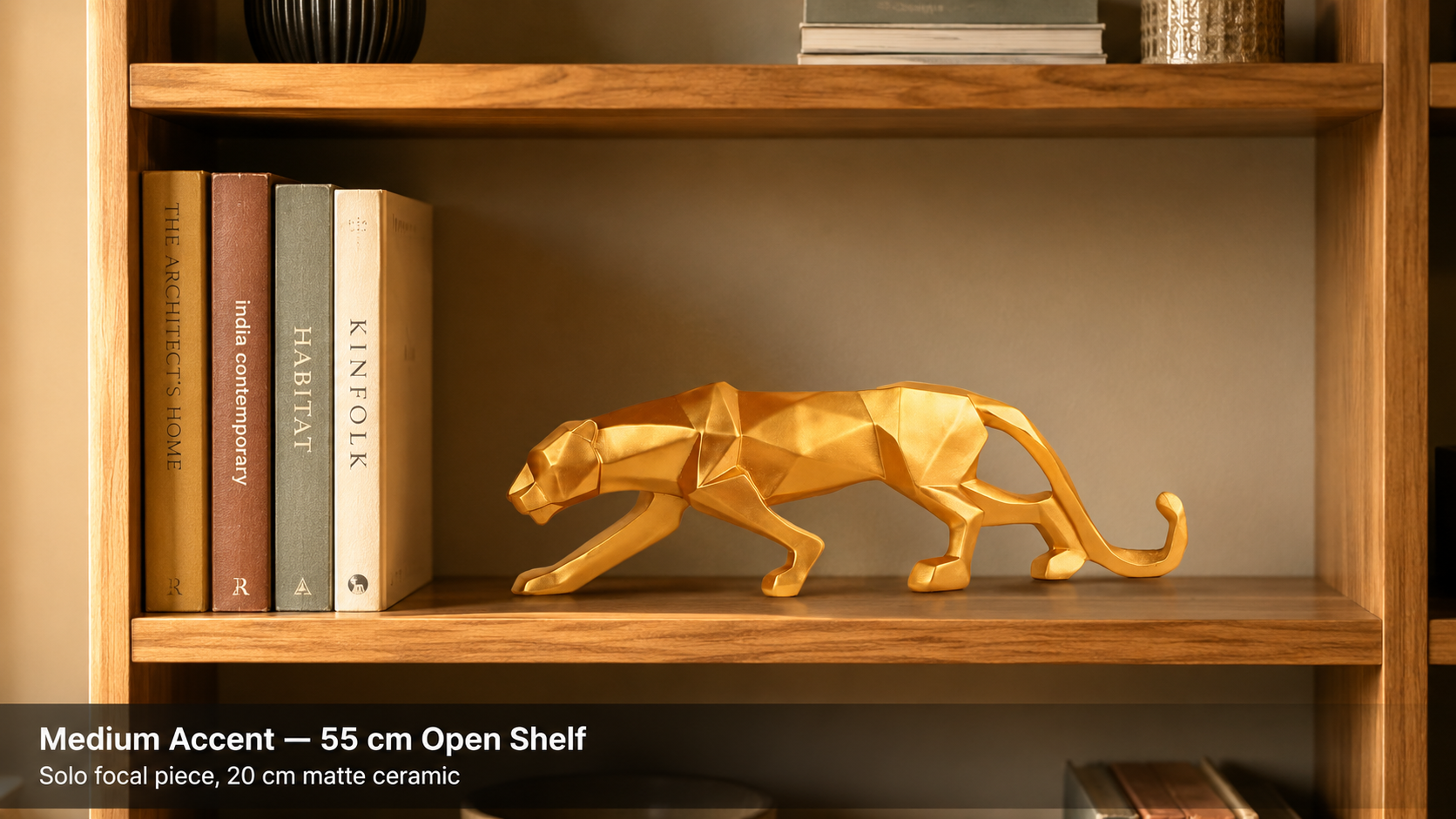
Matte and textured finishes contain their own visual boundary more precisely because micro-texture diffuses ambient light at multiple angles rather than projecting it forward. This is why a 14 cm matte ceramic accent on a 28 cm shelf reads as correctly scaled while a 14 cm glazed piece on the same shelf can feel intrusive. The effect is measurable: matte surfaces reduce perceived object width by approximately 15–20% compared to high-gloss under identical lighting conditions.
In Indian homes subject to monsoon humidity cycles and AC-driven moisture swings, material choice also carries a durability cost. Standard earthenware and low-fired ceramics develop hairline surface cracks when relative humidity oscillates between 40% and 85% RH repeatedly across seasons — because differential thermal expansion between glaze and body layers exceeds the glaze's tensile tolerance. High-density ceramic at 92% clay composition — the specification used in Moolwan's ceramic small decorative items — stabilises this differential because the denser clay body expands and contracts at a rate within the glaze's tolerance range, preventing crack propagation over a 5+ year lifespan.
The Shelf Size and Décor Accent Sizing Matrix for Indian Living Rooms
Selecting the correct piece requires cross-referencing compartment width, recommended accent height, maximum piece count per compartment, and the climate-relevant material specification in one lookup.
| Shelf Compartment Width | Recommended Accent Height | Max Pieces Per Compartment | Weight Range | Material Spec for Indian Climate |
|---|---|---|---|---|
| Under 28 cm | 10–13 cm (Small) | 1–2 pieces | 150–200 g | Matte ceramic, 92% clay, humidity-tolerant to 85% RH |
| 28–35 cm | 13–16 cm (Small-Medium) | 2–3 pieces | 200–300 g | Matte ceramic or matte resin, 94% epoxy, temp 15–35°C |
| 35–50 cm | 16–21 cm (Medium) | 2–3 pieces | 300–400 g | Glazed ceramic or resin acceptable; matte preferred near AC vents |
| 50 cm and above | 21–25 cm (Medium-Large) | 1 focal + 1–2 small | 400–600 g | Any finish; ceramic preferred for surfaces with direct sunlight exposure |
Because shelf compartment depth, wall material (hollow brick vs solid RCC), and the proximity of AC vents introduce additional sizing and material variables specific to your space, browse the full size-band and material selection — filtered by Small, Medium, and climate-rated finish — in Moolwan's decorative items for living room shelves collection to verify your final piece selection against your compartment dimensions.
Design Rule
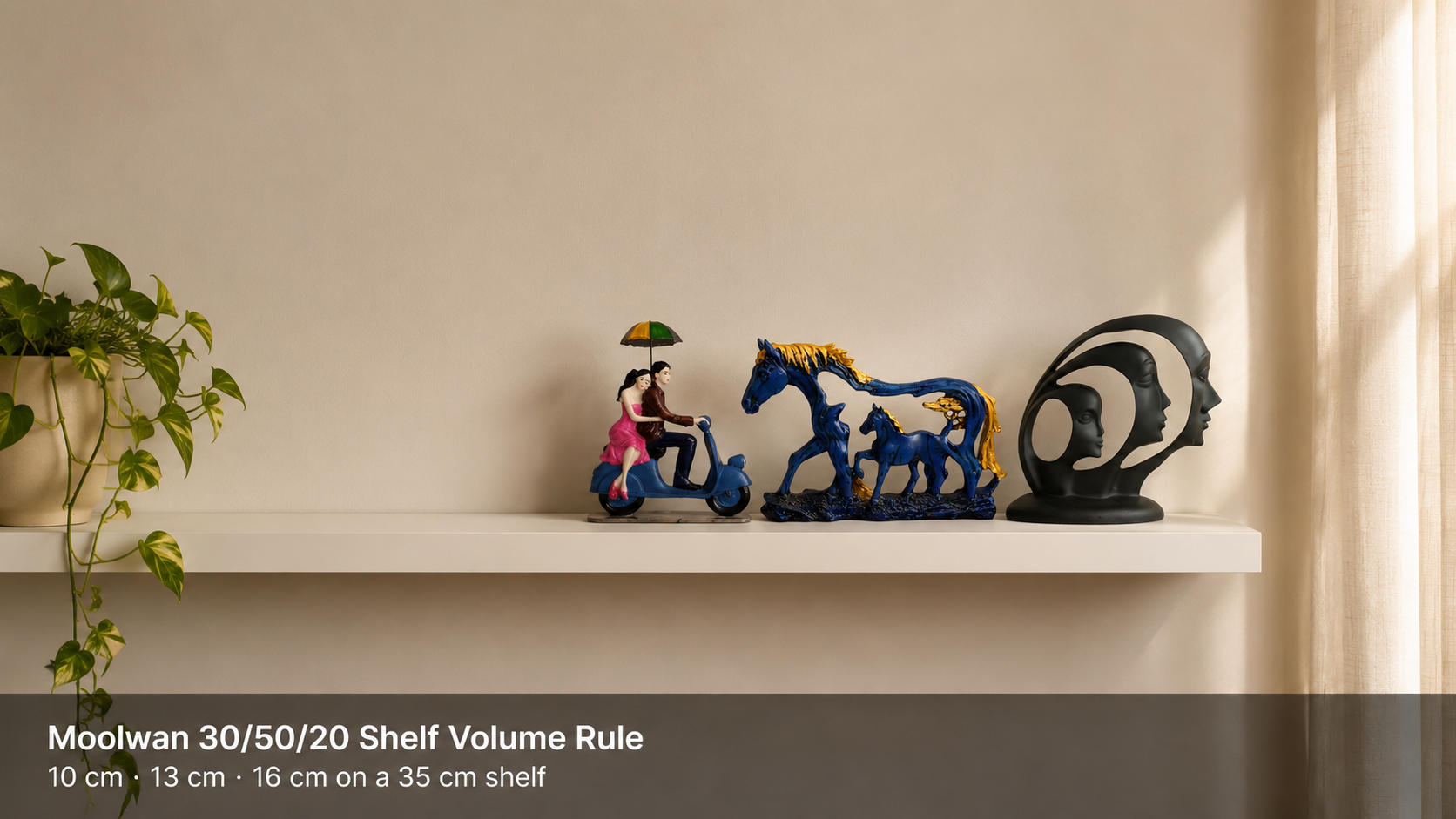
To prevent visual compression in Indian shelf compartments — where compartment widths average 28–40 cm — apply Moolwan's 30/50/20 Shelf Volume Rule: fill no more than 30% of the compartment's width with objects, keep object height within 50% of the compartment's internal height, and leave at least 20% of the compartment's depth as visible negative space between the back wall and the front of each piece. The result is a display that reads as curated rather than crammed, regardless of room size.
How Many Pieces Should Go on One Shelf Compartment?
The maximum functional density for a shelf compartment in an Indian living room is three pieces — but only when the pieces are graduated in height, vary in form (tall-and-narrow alongside short-and-wide), and collectively occupy no more than 30% of the compartment's width at their widest point.
Beyond three pieces per compartment, the human visual system switches from object identification mode to pattern recognition mode — meaning the viewer stops seeing individual pieces and begins perceiving a generic "shelf of stuff." This is the point at which the display stops communicating intentionality. The threshold is not about taste; it is about how the visual cortex processes spatial density, and it applies uniformly across observers.
For Indian living rooms where the shelf unit is a multi-compartment grid (the most common format in apartments under 1,200 sq ft), the recommended approach is to style no more than two out of every three adjacent compartments — leaving the third deliberately empty. Empty compartments provide the visual rest that allows styled compartments to read as focal points. A fully loaded grid reads as storage; a selectively loaded grid reads as design.
Ready to bring home shelf accents calibrated for Indian compartment dimensions? Shop the full Moolwan decorative items for living room shelves collection — climate-rated, drop-tested, and sized to the shelf widths most common in Indian apartments.
Does Shelf Position in the Room Change the Correct Accent Size?
Shelf position introduces a viewing-distance variable that directly changes the minimum visible size of a decorative piece. A shelf mounted at eye level (150–160 cm from floor) and viewed from the typical Indian living room depth of 3–4 metres has a minimum legible object height of approximately 10 cm — the lower boundary of the small decorative item category.
A shelf positioned above eye level — increasingly common in Indian apartments where wall space is maximised — creates a foreshortening effect: objects appear shorter than their actual height by roughly 10–15% for each 30 cm of elevation above eye level. This means a 13 cm piece placed 60 cm above eye level reads as a 10–11 cm object from across the room. Compensating requires choosing one size band up — selecting a 16 cm piece where you would otherwise use 13 cm — to maintain the intended visual weight.
Shelves flanking a TV unit are subject to a separate problem: the illuminated screen makes nearby objects appear darker and smaller than they are in neutral light. Matte finishes in warm earth or neutral palettes counteract this effect because they reflect ambient room light rather than absorbing the screen's cooler blue-white emission — maintaining the piece's perceived weight and colour accuracy regardless of whether the television is on or off.
What Palette Works Best for Shelf Décor in Indian Living Rooms?
Palette selection for shelf accents functions differently from wall or furniture palette choices because shelf objects exist within a frame (the compartment) rather than against an open background — which means contrast with the shelf material, not the wall colour, is the primary determinant of legibility.
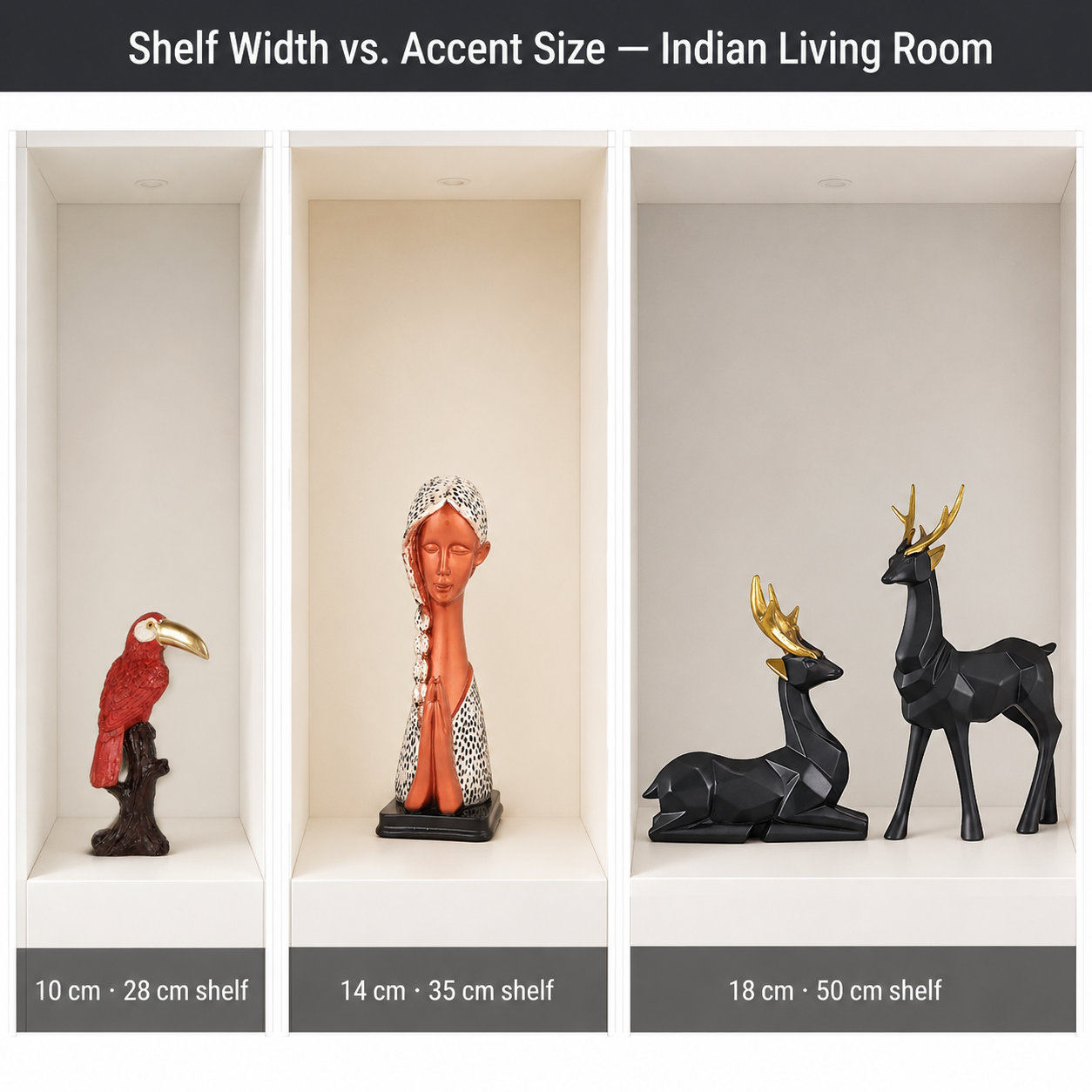
Most Indian living room shelf units are white, off-white, or warm wood tones. Against white or off-white, the highest legibility is achieved with warm earth tones (terracotta, ochre, warm taupe) and deep neutrals (charcoal, slate, forest green) rather than stark black or stark white, because mid-spectrum colours hold their edge definition in the reflected light conditions of Indian interiors where daylight angles shift dramatically between morning and evening. Against wood-tone shelves, cool neutrals (bone, pale sage, dusty blue) create the highest contrast without clashing with the warm wood grain.
For Indian living rooms where the shelf unit is adjacent to a window — the most common placement for ventilation — UV exposure bleaches pigment-saturated colours faster than earth tones because organic pigments used in high-saturation finishes have shorter photostability cycles. Moolwan's ceramic small decorative items use heat-resistant glazes and earth-tone pigments that maintain colour accuracy under UV exposure because inorganic mineral-based colourants resist photodegradation at the wavelengths present in direct Indian sunlight, providing a perceptibly stable appearance over a 5+ year lifespan without seasonal touch-up.
Frequently Asked Questions
What is the ideal height for a decorative piece on an Indian living room shelf?
For the most common Indian apartment shelf compartment width of 28–35 cm, the ideal decorative piece height is 13–16 cm — this places the piece within the 30–55% width-occupancy window that reads as intentional without lateral crowding. On wider open-display shelves of 50 cm or more, a medium accent of 21–25 cm produces the correct visual weight. Moolwan's small decorative items range covers both thresholds with pieces from 10 cm to 25 cm, drop-tested at 15 cm drop height and rated to 85% RH for Indian monsoon conditions.
Can I mix ceramic and resin pieces on the same shelf?
Yes — but the key constraint is temperature tolerance. Moolwan's ceramic pieces tolerate up to 60°C surface temperature and 85% RH, while its 94% epoxy resin pieces are rated to 35°C and 60% RH. In shelf compartments positioned near windows with direct afternoon sunlight, surface temperatures can exceed 40°C — placing resin pieces outside their safe operating range and causing gradual finish softening over 12–18 months. For south- or west-facing shelves with direct sun exposure, ceramic is the durable choice; resin is appropriate for interior-wall and north-facing shelf positions.
How do I stop a shelf from looking cluttered without removing all the pieces?
The most efficient intervention is to remove pieces from every third compartment entirely — leaving it empty — rather than redistributing them. Visual clutter on a shelf is caused not by the quantity of objects in each compartment but by the absence of visual rest between compartments. An empty compartment creates a visual pause that allows the adjacent styled compartments to read as focal points. Once the empties are established, each styled compartment should follow the 30/50/20 Shelf Volume Rule: no more than 30% width occupied, piece height within 50% of compartment height, 20% depth left clear at front.
Does the weight of a decorative piece matter for Indian shelves?
Yes — for standard Indian particleboard and MDF shelves, which account for the majority of modular living room units, the safe weight limit per compartment is typically 5–8 kg distributed across the shelf span, but individual small decorative items should stay under 600 g to prevent point-load indentation on shelf surfaces over time. Moolwan's small decorative items range from 150 g to 600 g, keeping all pieces within safe point-load thresholds for standard Indian modular furniture while maintaining the surface area and visual presence required for correct shelf scaling.
Bringing home the wrong size wastes the shelf and the piece — a 10 cm accent on a 50 cm compartment disappears, a 25 cm piece in a 28 cm compartment creates the compression it was meant to cure. Because matte ceramic finishes at 92% clay composition maintain colour accuracy and structural integrity through 5+ monsoon seasons without replacement, the correct size decision is also the correct long-term investment. Order from Moolwan's decorative items for living room shelves collection — manufacturer-direct, climate-rated, sized to Indian compartment dimensions. If you are also sourcing for smaller accent surfaces like bathroom shelves or study desks, browse Moolwan's small decorative items for shelves for pieces under 16 cm scaled to narrow surfaces; and for the broader curated living room setup, see the full Moolwan living room items collection for complementary accent categories.


