
What Size Decorative Items Work Best on an Indian Dining Table?
The Short Answer
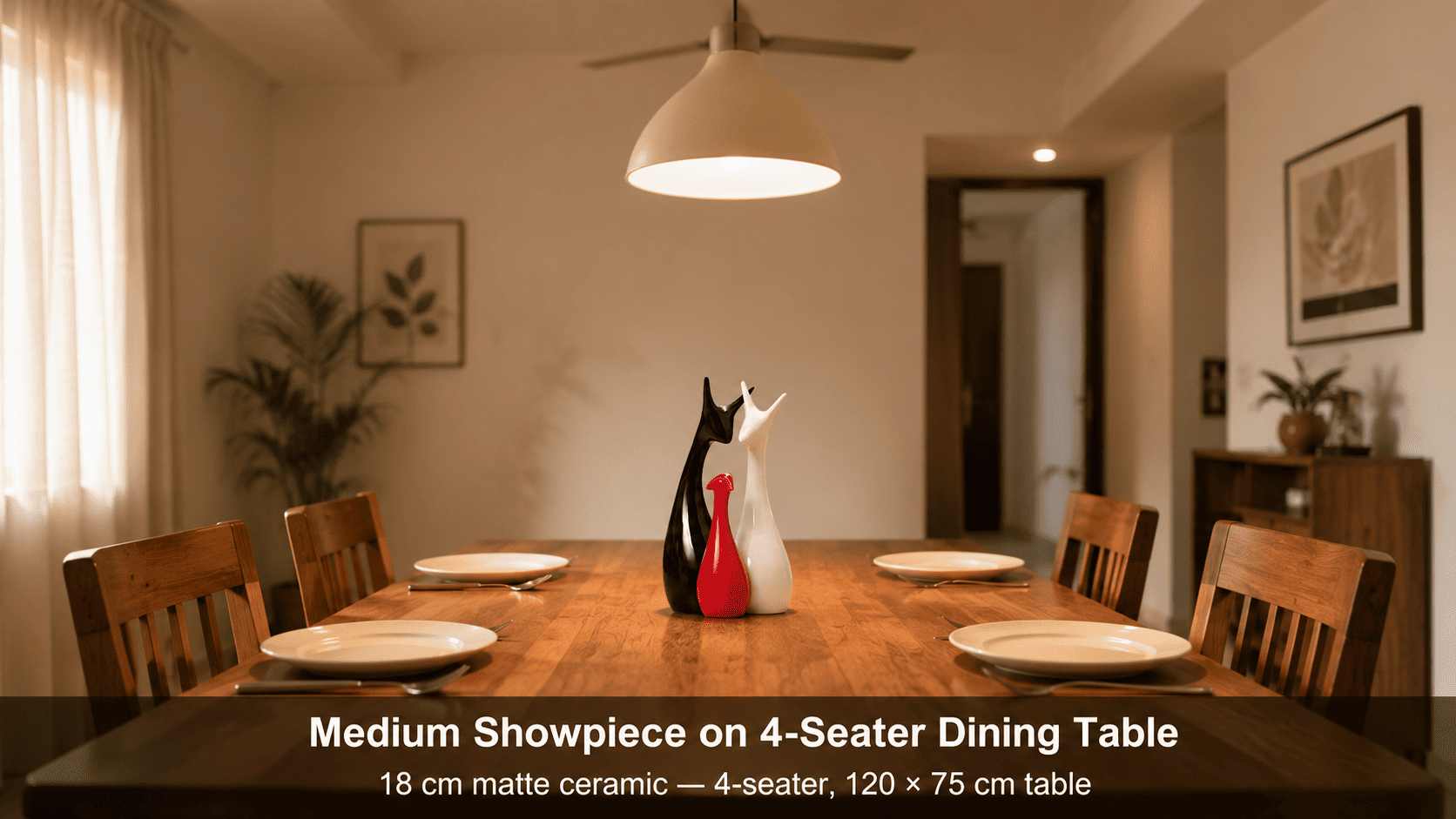
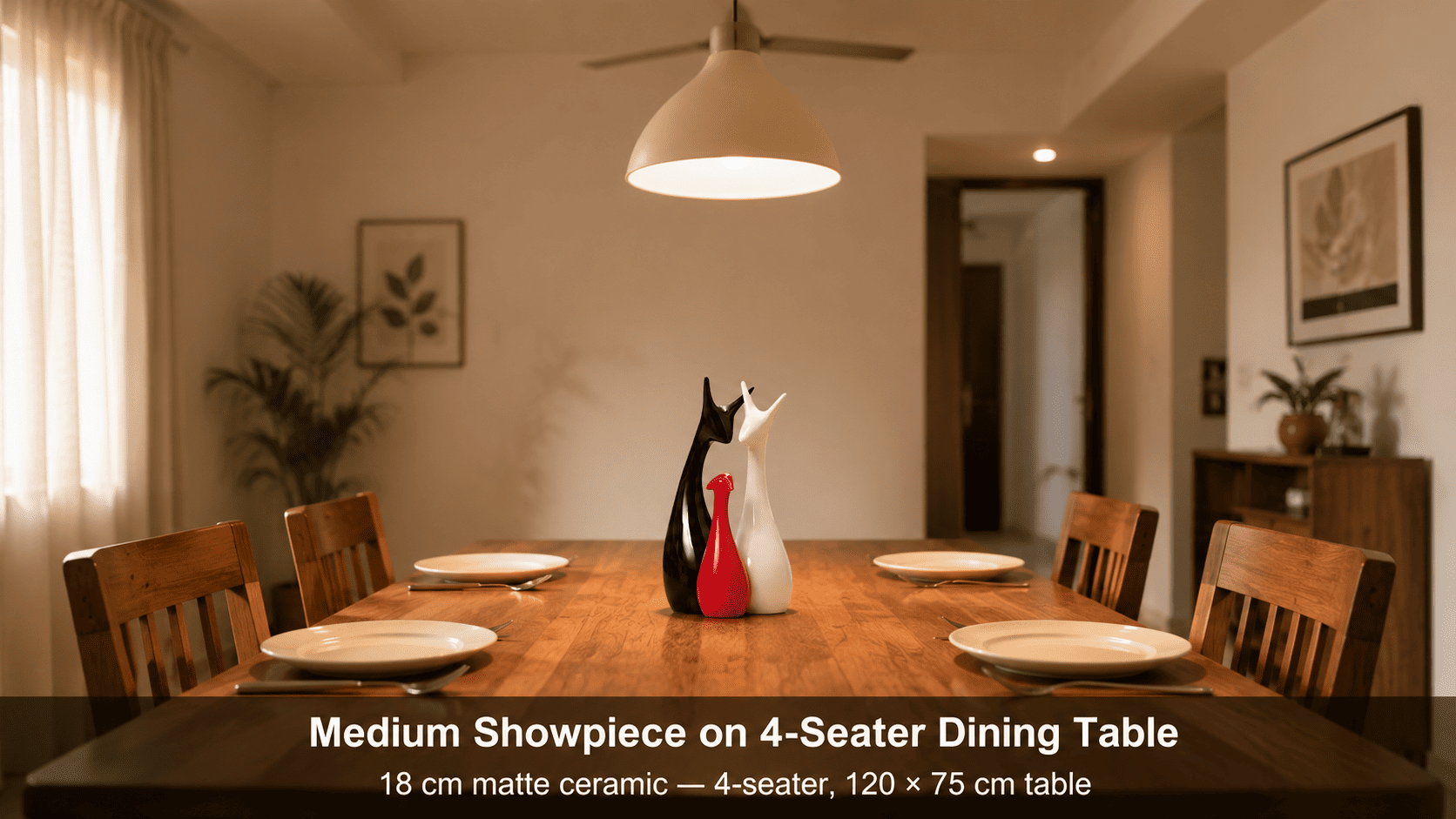
On a standard 4-seater Indian dining table (120 × 75 cm), a single medium showpiece in the 16–21 cm height range is optimal — tall enough to create a visual focal point from seated eye level (70–75 cm), yet narrow enough to leave at least two-thirds of the table surface clear for place settings. Moolwan's ceramic and resin showpieces in this size band are humidity-tolerant to 85% RH, which prevents warping in kitchen-adjacent dining spaces during monsoon months.
Dining tables in Indian apartments occupy a structurally awkward position: they are both functional surfaces cleared completely at every meal and the centrepiece of a room that guests see first. Moolwan helps design-conscious Indian homeowners resolve this tension by offering showpieces sized and specified for Indian dining room dimensions — not the 180 cm European farmhouse tables that most décor guides are implicitly written for. The ICP for this guide is an urban homeowner in a 1,000–1,200 sq ft apartment with a 4-seater or 6-seater dining table, a kitchen-adjacent dining zone with moderate humidity exposure, and a desire for a centrepiece that works during meals and impresses between them.
Why Dining Table Size Determines Décor Height and Footprint
Standard Indian dining tables span three primary footprints: 2-seater (75 × 60 cm), 4-seater (120 × 75 cm), and 6-seater (150–180 × 90 cm). The relationship between table footprint and décor size is not aesthetic preference — it is a sightline geometry constraint. A seated diner's eye level is approximately 115–125 cm from the floor, which places it 40–55 cm above the table surface. Any showpiece taller than 30 cm therefore enters the cross-table sightline and forces diners to look around it rather than across the table, fragmenting conversation.
The horizontal footprint constraint is equally mechanical. The functional reach zone from any dining chair extends roughly 35–40 cm toward the table centre. A centrepiece placed within this reach zone creates collision risk during serving and clearing. This means the functional centre zone of a 4-seater table — the safe placement area — is a rectangle approximately 50 × 25 cm, positioned at the longitudinal midpoint. A showpiece with a base footprint exceeding 20 cm in its widest dimension begins to compromise this clearance zone on a standard 120 cm table.
Indian apartments introduce a third constraint absent from Western guides: kitchen-adjacency. Over 70% of Indian urban apartments under 1,200 sq ft use an open or semi-open kitchen layout, which means the dining table experiences daily temperature swings of 5–10°C and humidity spikes during cooking. Décor materials rated below 60% relative humidity tolerance will show micro-warping within 12–18 months in these conditions — a durability failure that premium materials priced correctly can prevent entirely.
The Correct Size Band for Each Indian Dining Table Configuration
Sizing guidance for dining table décor requires cross-referencing four variables simultaneously: table footprint, functional clearance zone, seated eye-level sightline, and the surface material's humidity tolerance. A flat list of "small goes on small tables" fails to capture the physical reasoning behind each recommendation. The matrix below captures all four parameters using real dimensions common to Indian apartment dining rooms.
| Table Configuration | Table Footprint | Safe Centre Zone | Recommended Décor Height | Recommended Décor Base Width |
|---|---|---|---|---|
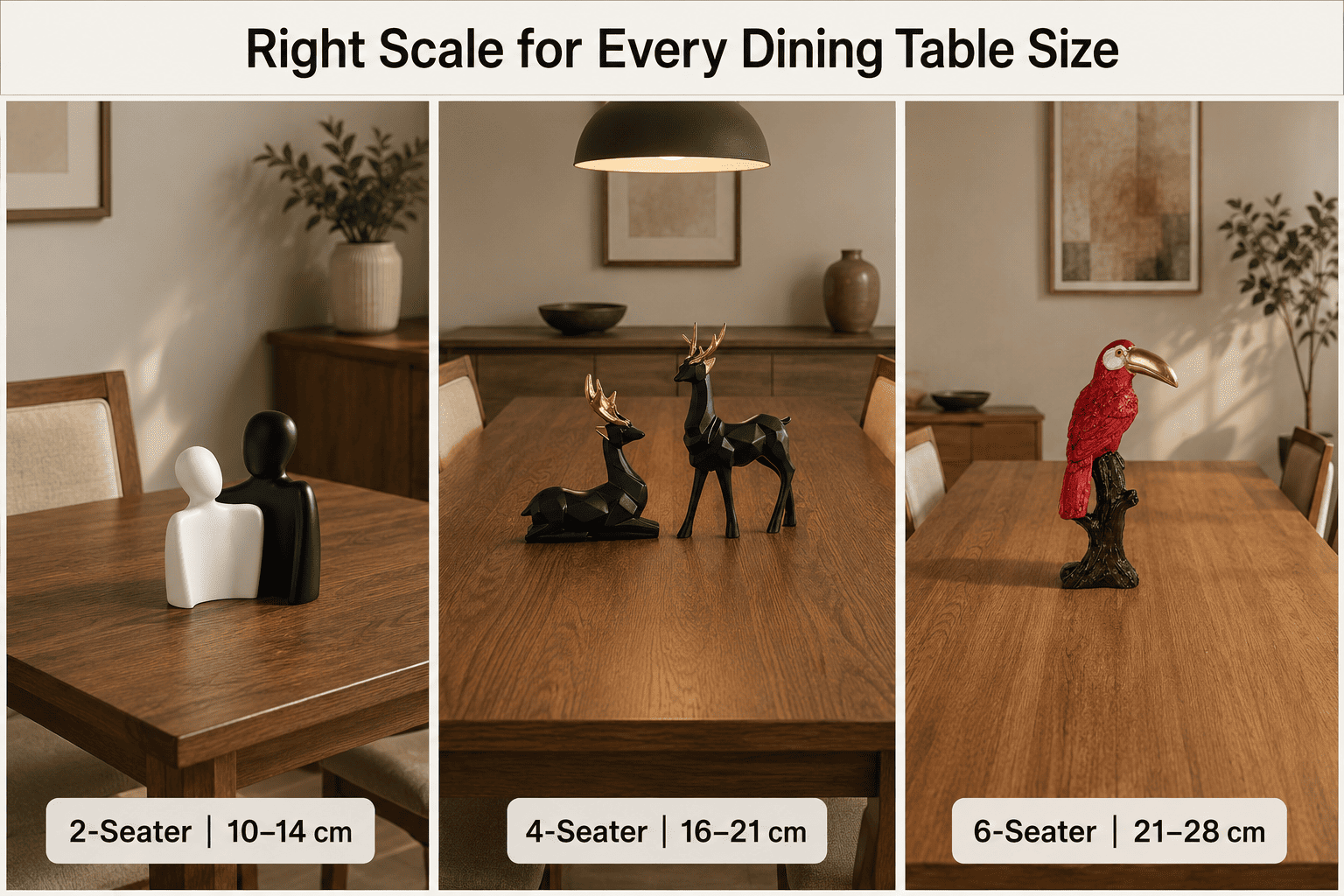
| 2-seater | 75 × 60 cm | ~20 × 15 cm | 10–16 cm (Small) | Under 12 cm |
| 4-seater (standard) | 120 × 75 cm | ~50 × 25 cm | 16–21 cm (Medium) | 12–18 cm |
| 6-seater (rectangular) | 150–180 × 90 cm | ~70 × 30 cm | 21–28 cm (Medium-Large) | 16–22 cm |
| 6-seater (oval/round) | 150 cm diameter | ~40 cm central circle | 16–25 cm | Under 20 cm |
| Extendable (collapsed) | 90–100 cm (collapsed) | ~30 × 20 cm | 10–16 cm (Small) | Under 14 cm |
Because material finish, base shape (round vs square footprint), and kitchen proximity all introduce additional placement variables not captured in a fixed matrix, browse the full size-band and material selection in Moolwan's dining room decorative items collection to verify your final piece selection against your specific table dimensions.
Design Rule
To prevent a dining centrepiece from visually dominating the table or obstructing cross-table sightlines, pieces should be selected using Moolwan's 1/3 Table Clearance Rule: the showpiece's total base footprint must not exceed one-third of the table's centre zone width, and its height must remain below one-quarter of the seated eye-level height above the table surface (typically under 28 cm on a standard Indian dining table). This ratio ensures the piece registers as an accent — not an obstruction — from every seat at the table.
Which Materials Survive the Indian Dining Room Environment
Kitchen-adjacent dining zones in Indian homes cycle through humidity levels of 40–85% RH seasonally — spiking during monsoon months and during active cooking. Resin and ceramic are the two dominant materials for dining table showpieces, but their tolerance thresholds differ significantly and the wrong choice leads to visible deterioration within 18–24 months.
High-density ceramic at 92% clay composition tolerates humidity up to 85% RH because its fired structure is non-porous at the molecular level, preventing moisture absorption that causes swelling and micro-cracking. This makes it the first-choice material for tables positioned near open-plan kitchens. Epoxy resin at 94% purity maintains structural integrity up to 60% RH — suitable for dining rooms with functioning air conditioning or natural cross-ventilation that keeps ambient humidity controlled. In consistently unconditioned spaces during monsoon months, resin pieces experience a measurable hardness reduction because elevated humidity at 75%+ RH begins to soften the epoxy polymer chains over a 3-year cumulative exposure period.
Weight also matters for a dining table context specifically: a piece that must be moved at every meal needs to be light enough to relocate with one hand without risk of surface scratches. Moolwan's showpieces in the 150–400 g weight band are calibrated for exactly this — heavy enough to have physical presence and resist being knocked over by passing contact, light enough to lift and reposition daily without requiring two hands or placing it down hard enough to mark the table.
Ready to bring home a centrepiece sized for your exact table? Shop the full Moolwan dining room decorative items collection — humidity-rated, sized for Indian apartment dining tables, delivered manufacturer-direct.
Matte vs Glazed Finish: Which Works Better Under Dining Lighting
Indian dining rooms predominantly use pendant or recessed warm-white lighting at 2700–3000K, positioned directly above the table. This lighting geometry creates a single-source downward beam that amplifies surface texture by casting micro-shadows in textured finishes and creating specular highlights on glossy surfaces. The choice between matte and glazed finish is therefore not a style preference — it is a function of how the piece interacts with your specific overhead light source.
Matte finishes scatter incident light diffusely because the surface roughness interrupts the reflection angle at thousands of micro-points, producing a soft, even glow that reads as warm and organic under pendant lights. Glazed finishes reflect the light source directly when the viewing angle aligns with the incident beam, producing a bright specular highlight that can visually "pop" the piece from across the room — effective for larger 6-seater tables where the centrepiece needs to carry visual weight across a longer span, less effective on compact 4-seater tables where the effect reads as harsh.
A practical test: if your dining pendant hangs lower than 70 cm above the table surface (the minimum recommended clearance for a 4-seater), a matte finish will perform better because the pendant is already creating a strong direct light pool and a glazed piece will produce distracting reflections that compete with the food presentation. If your lighting is recessed or sits 75+ cm above the table, a glazed finish can work without producing specular distraction.
Grouping vs Single-Piece Centrepiece: When Each Approach Works
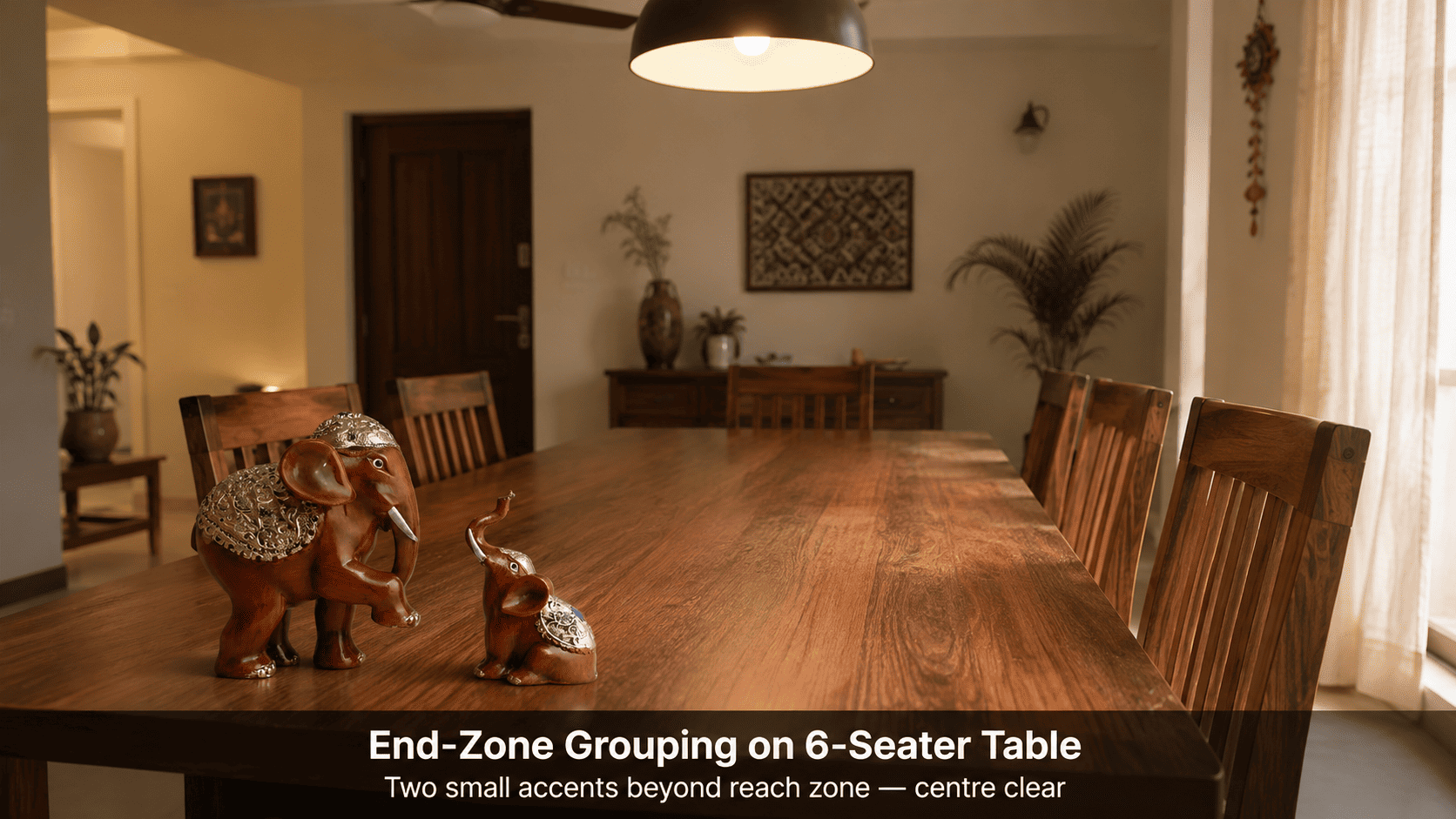
A grouped arrangement of two or three small showpieces (10–16 cm each) can substitute for a single medium piece when the table has a long narrow footprint (common in 6-seater rectangular tables) or when the homeowner wants to vary the composition seasonally without buying a new centrepiece. The physical rule governing grouped arrangements is that the combined visual width of the cluster must not exceed the same base-footprint limit that applies to a single piece — grouping does not expand the clearance zone, it divides the same space among multiple objects.
Odd-number groupings (three pieces) outperform even-number groupings (two pieces) in visual stability because an odd cluster has a natural apex — the tallest centre piece — that gives the eye a single anchor point before it explores the supporting pieces. Even groupings create two competing anchors of equal visual weight, which produces a static, symmetrical effect that reads as formal rather than curated. On an Indian dining table where the composition will be viewed from multiple angles across the meal, an asymmetric three-piece odd cluster with one tall centre piece (16–21 cm) flanked by two shorter pieces (10–14 cm) performs significantly better than two matched pieces side by side.
Frequently Asked Questions
How tall should a dining table centrepiece be in an Indian home?
For a standard Indian 4-seater dining table, a centrepiece height of 16–21 cm is optimal. Seated eye level above the table surface is approximately 40–55 cm, so any piece below 28 cm remains below the cross-table sightline and allows diners to see each other clearly. Pieces above 30 cm on a 4-seater table force diners to look around the centrepiece, which fragments visual connection across the table and makes the piece feel obstructive rather than decorative. On a 6-seater table with a longer span, heights up to 28 cm remain proportionate.
Can I keep a decorative showpiece on the dining table every day or only for occasions?
A showpiece rated for daily placement must meet two functional requirements: it must weigh between 150–400 g (light enough to relocate with one hand before each meal without scratching the surface), and its material must tolerate kitchen-adjacent humidity without degrading. High-fired ceramic at 92% clay composition meets both criteria — it is humidity-tolerant to 85% RH and its weight falls consistently in the relocatable range. Resin pieces at 94% purity epoxy are suitable for daily placement in air-conditioned dining rooms but should be moved to a shelf in spaces where cooking humidity regularly exceeds 60% RH.
What is the best finish for a dining table showpiece — matte or glossy?
Matte finishes perform better in most Indian dining room lighting setups because Indian pendant fixtures typically hang close to the table (60–75 cm above surface), creating a direct downward light pool. A matte surface scatters this incident light diffusely, producing a warm glow without specular reflection. Glossy finishes produce a distracting bright highlight when pendant lights are positioned directly overhead at close distance. If your dining lighting is recessed or positioned 80+ cm above the table, a glazed finish can add visual depth without the distraction effect.
How many decorative pieces should I keep on a dining table?
One medium single piece (16–21 cm) works best on a 4-seater table. For 6-seater or larger tables, a three-piece odd-number cluster — one taller centre piece (18–21 cm) flanked by two shorter pieces (10–14 cm) — creates a more expansive visual composition without exceeding the base-footprint clearance rule. Two pieces in an even grouping are the least effective arrangement because they create two competing focal points of equal weight, producing a static symmetrical effect. Moolwan's showpiece collections in the small and medium size bands are specifically designed to work as both standalone centrepieces and as part of grouped compositions.
Investing in a climate-rated, correctly sized centrepiece eliminates the seasonal replacement cycle that comes with pieces manufactured without Indian humidity tolerances in mind — a 5+ year lifespan from a well-chosen ceramic showpiece returns more value than two or three cheaper replacements across the same period. Bring home a piece engineered for your exact table configuration from the Moolwan dining room decorative items collection. If you are also refreshing your broader living spaces, the complete Moolwan home décor items list covers every room with the same climate-rated, Indian-apartment-sized approach — and if you want pieces that go beyond the conventional, the Moolwan unique home décor collection offers statement showpieces designed for buyers who want their home to look unmistakably considered.


