
What Size Decorative Showpiece Suits a Small Indian Living Room?
The Short Answer
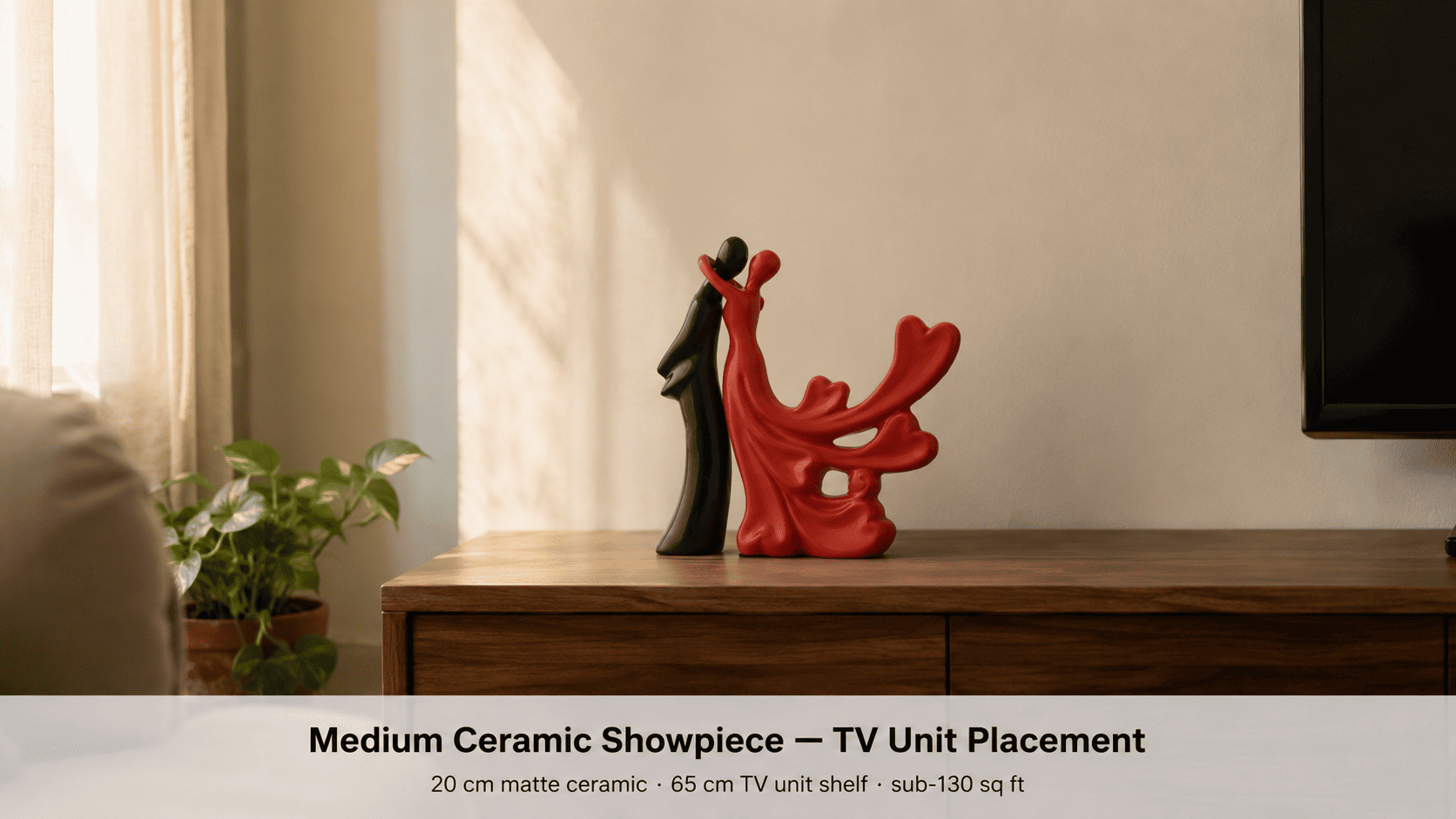
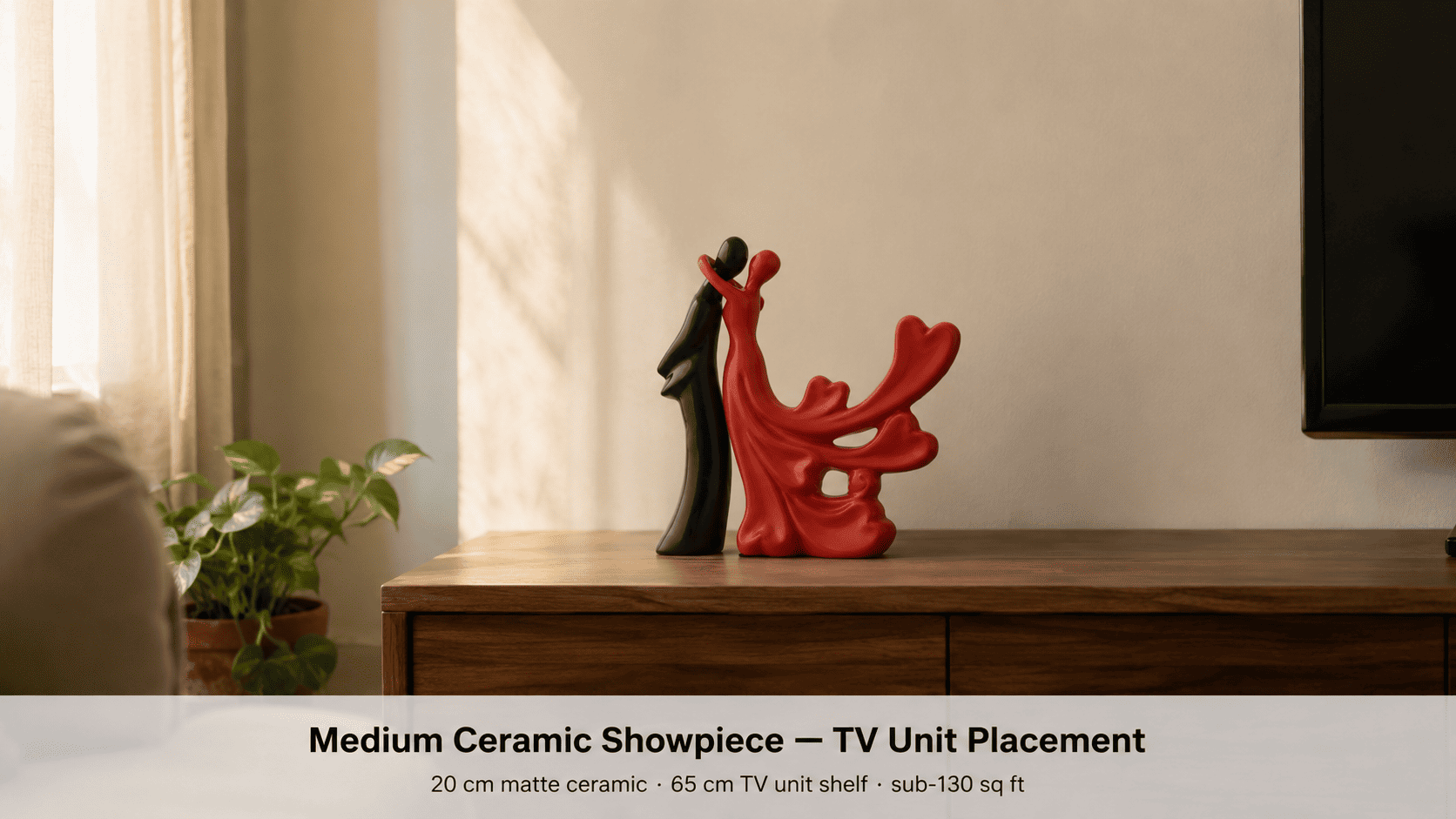
For a small Indian living room under 150 sq ft, a medium showpiece between 16–25 cm height is the right size band. At this height, the piece reads as a visual anchor on coffee tables and TV units without compressing the available visual field — a direct consequence of the eye-level sightline in low-furniture Indian apartments. Moolwan's ceramic collection is engineered to 92% clay density and humidity tolerance to 85% RH, purpose-built for this size band.
Indian urban living rooms average under 150 sq ft — a spatial constraint that makes showpiece sizing one of the most consequential décor decisions a homeowner makes. Moolwan helps design-conscious Indian homeowners choose decorative showpieces scaled precisely to their room footprint and surface dimensions, so no piece ever overwhelms a compact space or disappears against a blank wall. The difference between a room that feels curated and one that feels cluttered is almost always proportional, not stylistic.
Why Showpiece Height Determines Visual Weight in a Compact Room
In rooms under 150 sq ft, the human eye processes vertical objects at a higher relative scale than in larger spaces because the visual field is compressed — the same 25 cm piece that reads as modest on a 90 sq ft surface becomes visually dominant in a 60 sq ft living room. This is not a matter of taste but of angular subtension: as room depth decreases, a fixed-height object subtends a larger angle in the viewer's field of vision, increasing perceived dominance.
Indian apartments built after 2000 overwhelmingly follow a low-furniture convention — sofas sit at 40–45 cm, coffee tables at 35–45 cm, TV units at 30–45 cm from floor to surface. At these surface heights, a showpiece taller than 25 cm enters the primary sightline of a seated occupant, fragmenting the clean horizontal plane the room depends on for its sense of space. Pieces in the 16–21 cm medium range (per Moolwan's size classification) sit comfortably beneath the sightline, functioning as accents rather than interruptions.
The material also interacts with perceived size. Moolwan's ceramic showpieces use a 92% clay composition that produces a dense matte body — matte surfaces absorb ambient light rather than reflecting it, which suppresses the apparent volume of a piece and makes it read smaller than an equivalent glossy object of the same dimensions. This is why a glazed 18 cm showpiece can feel larger in a compact living room than a matte 22 cm piece of the same footprint.
How Surface Dimensions Determine the Right Size Band
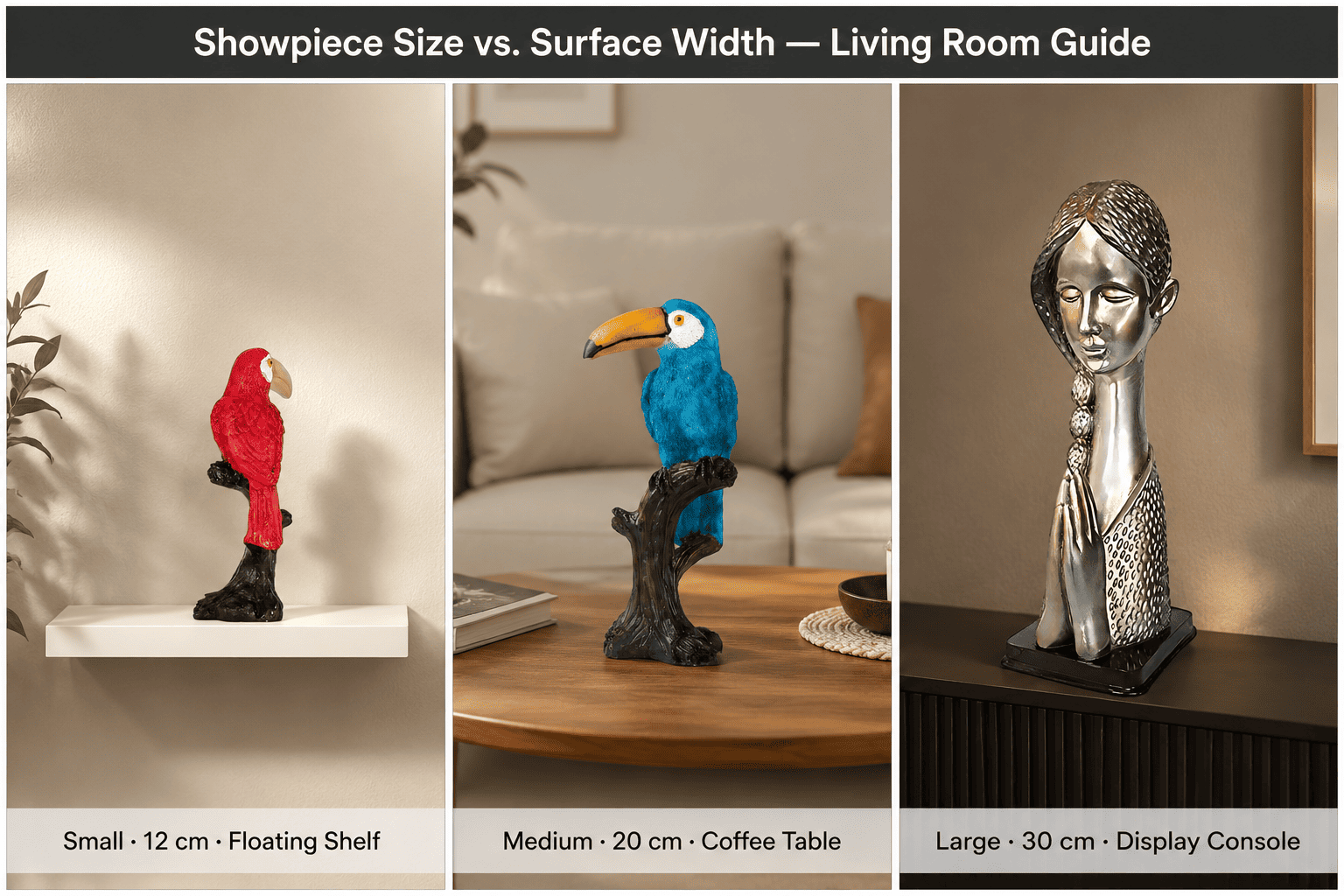
The surface width available is the primary constraint on showpiece height, not the room size alone. A surface width under 40 cm — such as a narrow floating shelf or a compact side table — can only support a small showpiece (10–16 cm) without triggering visual overflow, where the piece appears to extend beyond the perceived boundary of its surface and makes the shelf feel structurally overloaded.
On wider surfaces of 50–70 cm — such as a standard Indian coffee table or TV unit shelf — the medium size band (16–25 cm) is structurally appropriate because the surface width provides adequate visual padding on both sides of the piece. This padding is not decorative; it is the negative space that allows the eye to separate the object from its surface and register it as a placed accent rather than a crammed addition. Moolwan's medium resin showpieces weigh 250–400 g, a weight range that prevents any tendency to tip or shift on smooth laminate or marble surfaces common in Indian apartments.
For surfaces exceeding 70 cm — an open display console, a bookshelf bay, or a wide mantel — a large showpiece (25–34 cm) becomes viable, but only when used as the single focal anchor on that surface, not as one of multiple placed objects.
| Room Footprint | Target Surface | Surface Width | Recommended Showpiece Height | Weight Range |
|---|---|---|---|---|
| Under 100 sq ft | Floating shelf / side table | Under 40 cm | 10–16 cm (Small) | 150–250 g |
| 100–130 sq ft | Coffee table / TV unit shelf | 40–60 cm | 16–21 cm (Medium) | 250–350 g |
| 130–150 sq ft | Wide TV unit / entry console | 60–80 cm | 21–25 cm (Medium-Large) | 350–450 g |
| 150+ sq ft | Display console / bookshelf bay | 80 cm+ | 25–34 cm (Large) | 400–600 g |
Because individual living rooms vary in furniture layout, AC airflow direction, and natural light angle — all of which affect perceived showpiece scale — browse the full size-band and material selection in Moolwan's living room showpiece collection to confirm the right piece for your specific surface dimensions.
Design Rule
To prevent visual compression in compact Indian living rooms, Moolwan recommends the 60/40 Surface Anchor Rule: place your showpiece within the central 40% of any horizontal surface and keep the outer 60% entirely clear. This distribution ensures the piece reads as a deliberate focal anchor rather than a space-filler, and preserves the negative space the eye needs to perceive the surface as open — a critical condition in rooms under 150 sq ft where every visual cue of openness is amplified.
Does Material Choice Affect Sizing in Indian Climate Conditions?
Yes — material selection has a direct structural impact on long-term sizing integrity in Indian living rooms, because thermal cycling and monsoon humidity cause dimensional changes in lower-quality materials that alter the proportional fit of a showpiece over time. A piece sized correctly at purchase can look visually larger or shifted within two monsoon seasons if its base material swells under humidity exposure.
Resin showpieces engineered to less than 94% purity epoxy absorb ambient moisture in high-humidity conditions (above 60% RH), which causes micro-expansion of the base and visible surface clouding that increases the piece's apparent visual weight. Moolwan's resin collection is manufactured at 94% purity epoxy with a 3H pencil hardness surface finish, which prevents moisture ingress and maintains original dimensional stability at humidity levels up to 60% RH — the humidity range typical of Indian living rooms during June–September monsoon months in metro cities.
Ceramic offers greater humidity tolerance — Moolwan's 92% clay ceramic withstands up to 85% RH — making it the preferred material for living rooms in coastal cities (Mumbai, Chennai, Kochi) or apartments with poor monsoon ventilation. The higher clay density also prevents the micro-cracking that occurs in lower-grade ceramics when exposed to rapid temperature swings from AC cycling, which is common in Indian apartments that shift between 18°C conditioned air and 35°C+ outdoor temperatures across a single day.
Ready to bring home a showpiece that holds its size and finish through 5+ Indian monsoon seasons? Shop the full Moolwan living room showpiece collection — climate-rated, manufacturer-direct, sized for Indian apartments.
How to Size a Showpiece for Grouping vs. Solo Placement
A solo showpiece and a grouped cluster follow different sizing logic. For solo placement, the piece height should reach 30–40% of the surface width — on a 60 cm coffee table, the solo piece should be 18–24 cm tall to register as an intentional accent rather than a forgotten object. Below 30% of surface width, a single piece reads as undersized and the surface looks bare; above 40%, it reads as overcrowded even in isolation.
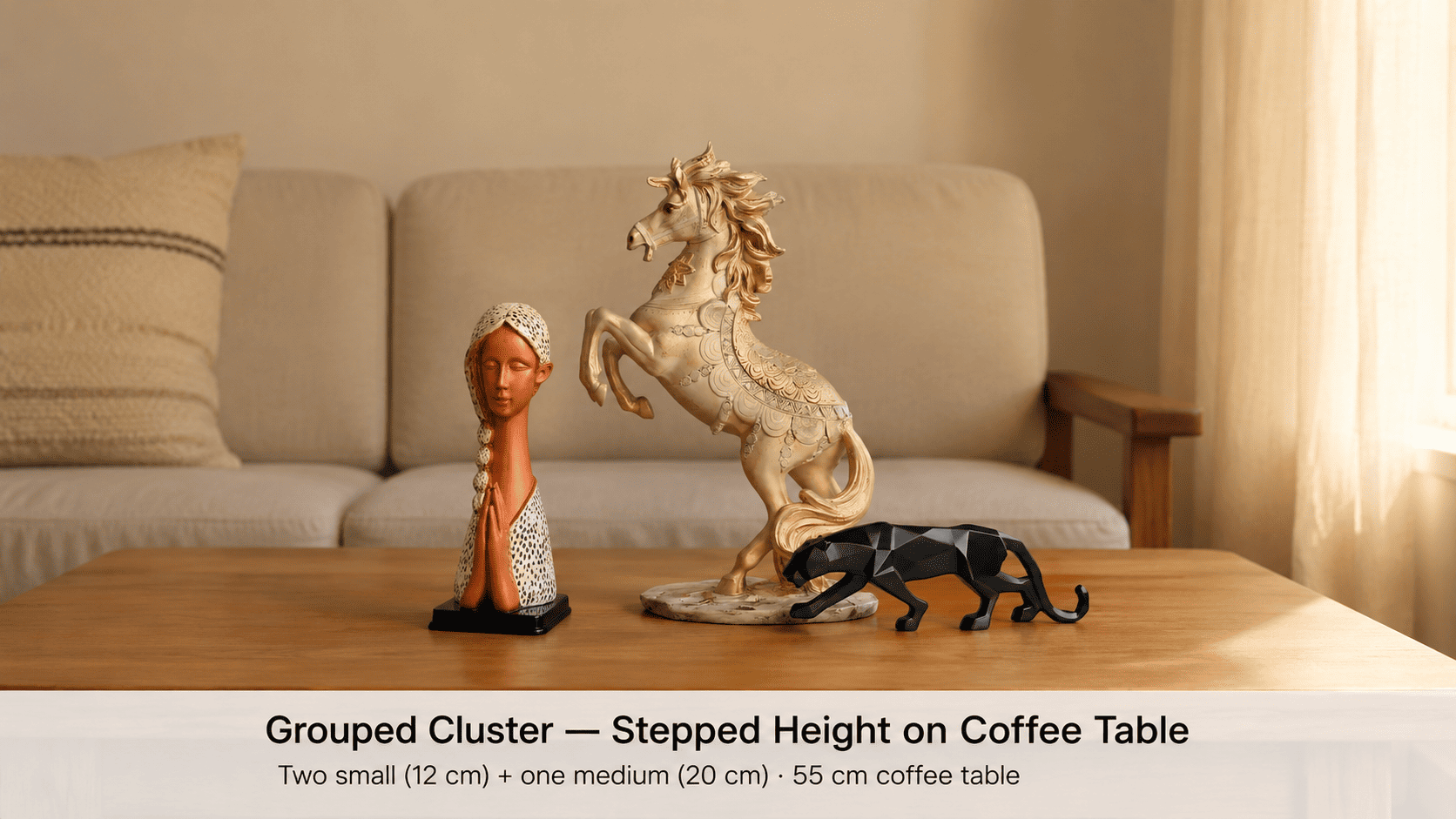
For a grouped cluster — typically two or three pieces placed together — the tallest piece should follow the 30–40% rule, while the supporting pieces step down in 4–6 cm increments. This stepped height differential creates a visual rhythm the eye reads as intentional composition. A flat grouping of three identical-height pieces reads as repetitive inventory, not curated décor. Moolwan's small and medium showpieces are sized to facilitate this 4–6 cm step differential: small (10–16 cm) pairs naturally with medium (16–21 cm) to create the tiered visual effect without either piece dominating.
What Finish Works Best for a Small Living Room with Mixed Lighting?
Indian living rooms frequently mix natural sunlight from east- or west-facing windows with warm-toned LED ambient lighting — a combination that renders glossy finishes unpredictably across the day. A glazed showpiece that reads as warm amber at 7 pm under LED lighting reads as cold and reflective at 11 am under direct sunlight, creating tonal inconsistency that is more visually disruptive in a compact room where the piece is always within close viewing distance.
Matte finishes remain tonally stable across lighting conditions because the micro-textured surface scatters incoming light at multiple angles simultaneously, preventing the specular highlights that shift colour temperature perception. For small Indian living rooms with mixed or variable natural light, matte earthy finishes (warm ochres, terracotta, warm greiges) maintain consistent visual warmth from morning to evening without requiring seasonal repositioning. Moolwan's ceramic range is available in matte finishes across the full small and medium size bands, retaining colour stability through 5+ year lifespans due to the UV-stable pigment integration at the clay body stage rather than surface application.
Frequently Asked Questions
What is the ideal showpiece height for a coffee table in a small Indian living room?
For coffee tables between 40–60 cm wide — the standard range in Indian apartments under 130 sq ft — the ideal showpiece height is 16–21 cm. At this height, the piece occupies 30–40% of surface width, which is the proportion at which the eye reads a solo object as a deliberate accent rather than an incidental item. Moolwan's medium ceramic showpieces weigh 250–400 g and are drop-tested to 15 cm, making them stable on the smooth laminate surfaces common in Indian apartment coffee tables.
Can I place a large showpiece (25–34 cm) in a room under 100 sq ft?
Only on a surface wider than 70 cm and only as a solo placement with no other objects on the same surface. In rooms under 100 sq ft, a large piece on a narrow or mid-width surface breaches the 40% surface-width threshold and triggers visual crowding, making the room feel smaller. The material tolerance matters too — Moolwan's large ceramic pieces are humidity-rated to 85% RH, so they are structurally viable in compact rooms, but the spatial constraint is spatial, not material.
How many showpieces should a small Indian living room have in total?
Two to three across the entire room is the maximum for a living room under 150 sq ft. Each surface should carry no more than one placement zone — either a solo piece or a single cluster of two to three stepped-height pieces. More than three individual placement zones in a compact room creates visual fragmentation, where the eye has no clear resting point and the space reads as busy rather than styled. One well-sized solo piece on the coffee table and one small cluster on the TV unit is the configuration that most consistently reads as curated in sub-150 sq ft Indian living rooms.
Does showpiece weight matter for Indian apartment surfaces?
Yes, for floating shelves and thin glass surfaces specifically. Most Indian floating shelves are rated for 3–5 kg distributed load, and a single decorative showpiece at 150–600 g presents no structural risk. However, the weight range matters for stability — Moolwan's ceramic pieces at 250–600 g have a low centre of gravity due to the high-density 92% clay base, which prevents tipping on smooth surfaces when lightly brushed. Resin pieces at 150–400 g are suitable for glass-topped coffee tables where scratch risk from a heavy base is a concern.
A correctly sized showpiece — climate-rated ceramic or high-purity resin in the 16–25 cm range — eliminates the seasonal replacement cycle that lower-grade décor imposes in Indian monsoon conditions, delivering a 5+ year return on a single purchase. Buy from the Moolwan living room showpiece collection, manufactured direct to eliminate distributor markups. If you are also furnishing a smaller surface or a narrow console, explore the luxury interior décor items for small living rooms — a curated edit sized for the tightest Indian apartment footprints. For a complete living room transformation beyond a single accent piece, the unique décor items for an elegant living room collection offers coordinated pieces designed to work as a room-level composition rather than individual accents.


