
What Size Decorative Showpiece Works Best in a 1 BHK Living Room? A Sizing Guide for Indian Apartments
The Short Answer
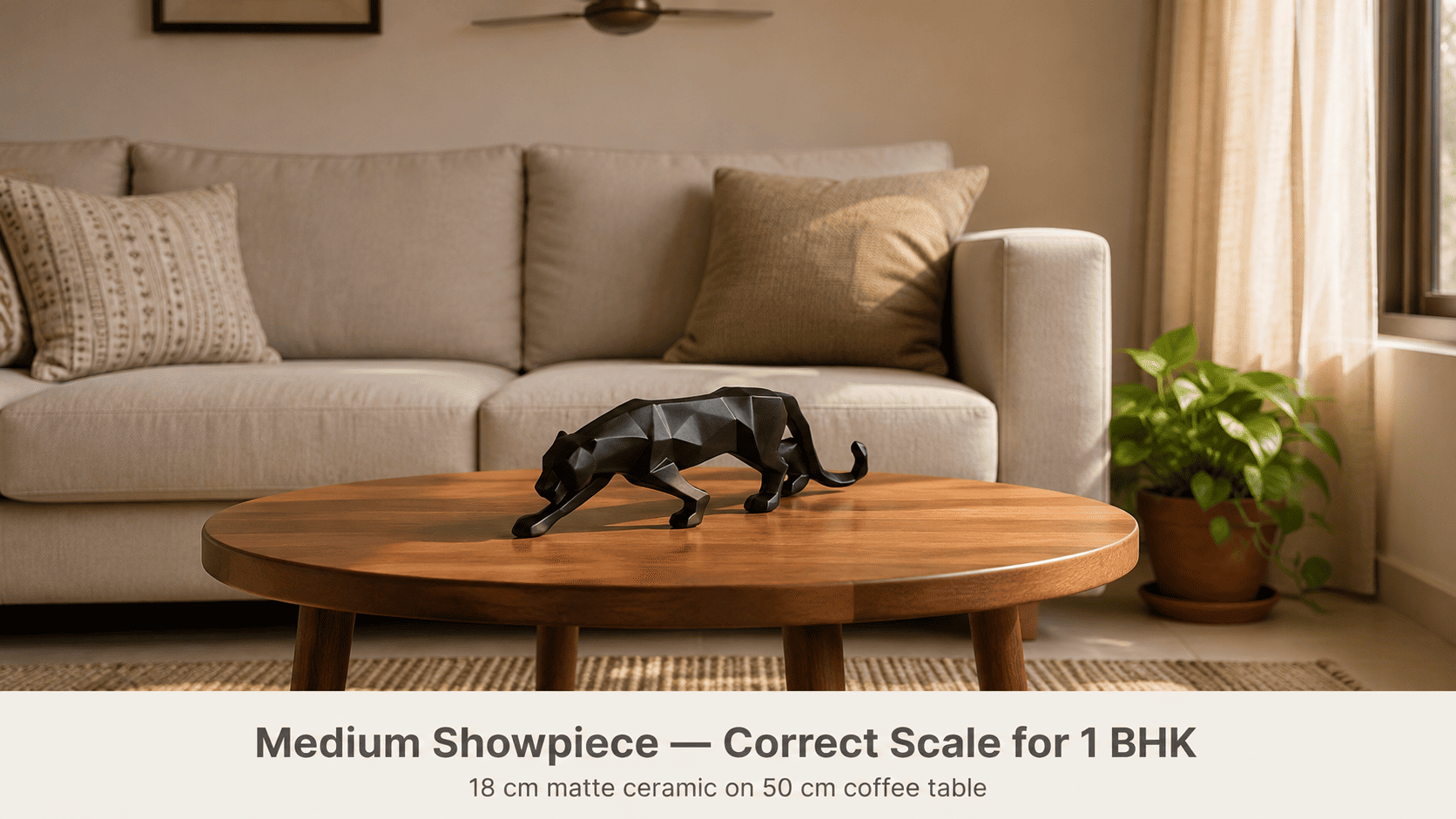
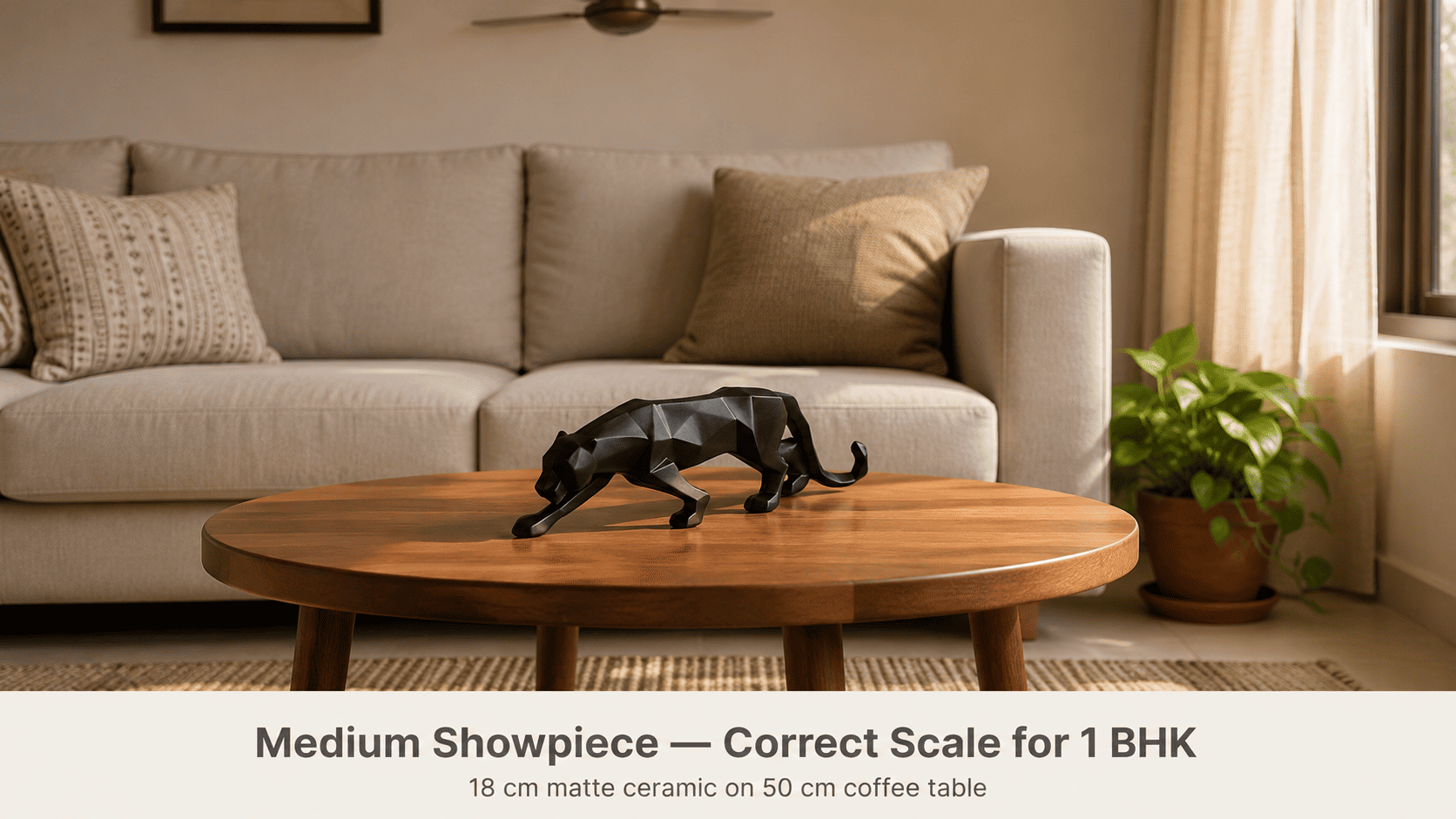
In a 1 BHK living room under 150 sq ft, a medium showpiece (16–21 cm) on a coffee table or console is the correct size — it is tall enough to anchor visually without compressing the remaining surface area. Moolwan's ceramic range in this size band is engineered at 92% clay composition, tolerating up to 85% RH humidity, so the piece holds its finish across every Indian season without warping or fading.
The average 1 BHK living room in Indian metro apartments measures between 100 and 150 sq ft — a spatial reality that eliminates the oversized statement pieces that look correct in Western interiors and in aspirational décor catalogues photographed in studios. Moolwan helps design-conscious Indian homeowners choose showpieces that are proportionally precise for these room scales, climate-rated for tropical conditions, and priced at manufacturer-direct rates without the 3–5x retail markup. Getting the size of a decorative showpiece or décor accent wrong in a compact layout does not just look off — it triggers a spatial compression effect that makes the entire room feel smaller than it is, or conversely creates a visual void that communicates an unfinished room.
Why the Wrong Showpiece Size Makes a 1 BHK Living Room Look Smaller
In rooms under 150 sq ft, the human eye uses vertical objects as scale cues for the entire space. A showpiece taller than one-third of its supporting surface's depth forces the eye to register the object as a vertical mass rather than an accent, compressing the room's perceived ceiling height because the brain recalibrates spatial scale using the largest proximate vertical element in its sightline.
Conversely, a showpiece that is too small — specifically, any piece under 10 cm on a surface wider than 60 cm — disappears visually because the human eye resolves detail at approximately 1 arc minute, which at normal viewing distances of 1.5–2 metres requires an object to be at least 10–12 cm in its tallest dimension to register as a deliberate decorative element rather than incidental clutter.
The practical implication for a 1 BHK layout is a clear size band: pieces between 16 cm and 21 cm height (Moolwan's Medium size classification) on surfaces between 40 cm and 60 cm wide, and pieces between 10 cm and 16 cm (Moolwan's Small classification) on narrower surfaces such as floating shelves and bathroom ledges.
How Indian Climate Conditions Should Affect Your Showpiece Material Choice
In Indian living rooms subject to monsoon humidity cycles of 70–90% relative humidity (RH), the material composition of a showpiece determines whether it retains its finish after year one or begins to show micro-fractures, glaze crazing, and base delamination. High-fired ceramics at 92% clay composition maintain structural integrity up to 85% RH because the clay matrix at this density lacks the micro-porous channels through which ambient moisture penetrates lower-grade clay bodies and expands during temperature cycling.
Resin-based showpieces at 94% purity epoxy perform well within the 15–35°C temperature range typical of air-conditioned urban Indian apartments, but their humidity tolerance ceiling is 60% RH — which makes them unsuitable for homes without year-round AC or for placement near windows in coastal cities such as Mumbai or Chennai.
For 1 BHK living rooms without continuous air conditioning — which describes the majority of Indian apartment households outside of premium segments — high-fired matte ceramics represent a 5+ year investment because their micro-textured surface absorbs micro-scratches evenly and does not require seasonal replacement, unlike lower-fired glazed ceramics that show surface wear visibly within 18–24 months under daily handling.
| Room Footprint | Target Surface | Surface Width | Recommended Showpiece Height | Humidity Tolerance |
|---|---|---|---|---|
| Under 100 sq ft | Floating shelf / narrow console | Under 30 cm | 10–16 cm (Small) | Ceramic: up to 85% RH |
| 100–120 sq ft | Bedside table / small coffee table | 30–45 cm | 16–21 cm (Medium) | Ceramic: up to 85% RH |
| 121–150 sq ft | Coffee table / TV console | 45–60 cm | 16–21 cm (Medium) | Ceramic: 85% RH / Resin: 60% RH |
| 151–200 sq ft | Dresser console / wide shelf | 60–90 cm | 25–34 cm (Large) | Ceramic: 85% RH / Resin: 60% RH |
| 200+ sq ft | Entry console / focal-point surface | 90 cm+ | 25–34 cm (Large) or grouped cluster | Ceramic: 85% RH |
Because surface width, ceiling height, and the proximity of existing furniture introduce additional sizing variables specific to your layout, browse the full size-band and material selection in Moolwan's showpiece collection to verify your final piece selection against your room's actual dimensions.
Design Rule
To prevent visual compression in 1 BHK living rooms, style horizontal surfaces using Moolwan's Surface-to-Scale Anchoring Rule: the tallest showpiece on any surface must not exceed one-third of that surface's depth, and décor objects should occupy no more than 30% of the surface's total width — leaving 70% of the surface visually clear to maintain the room's perceived spatial breadth.
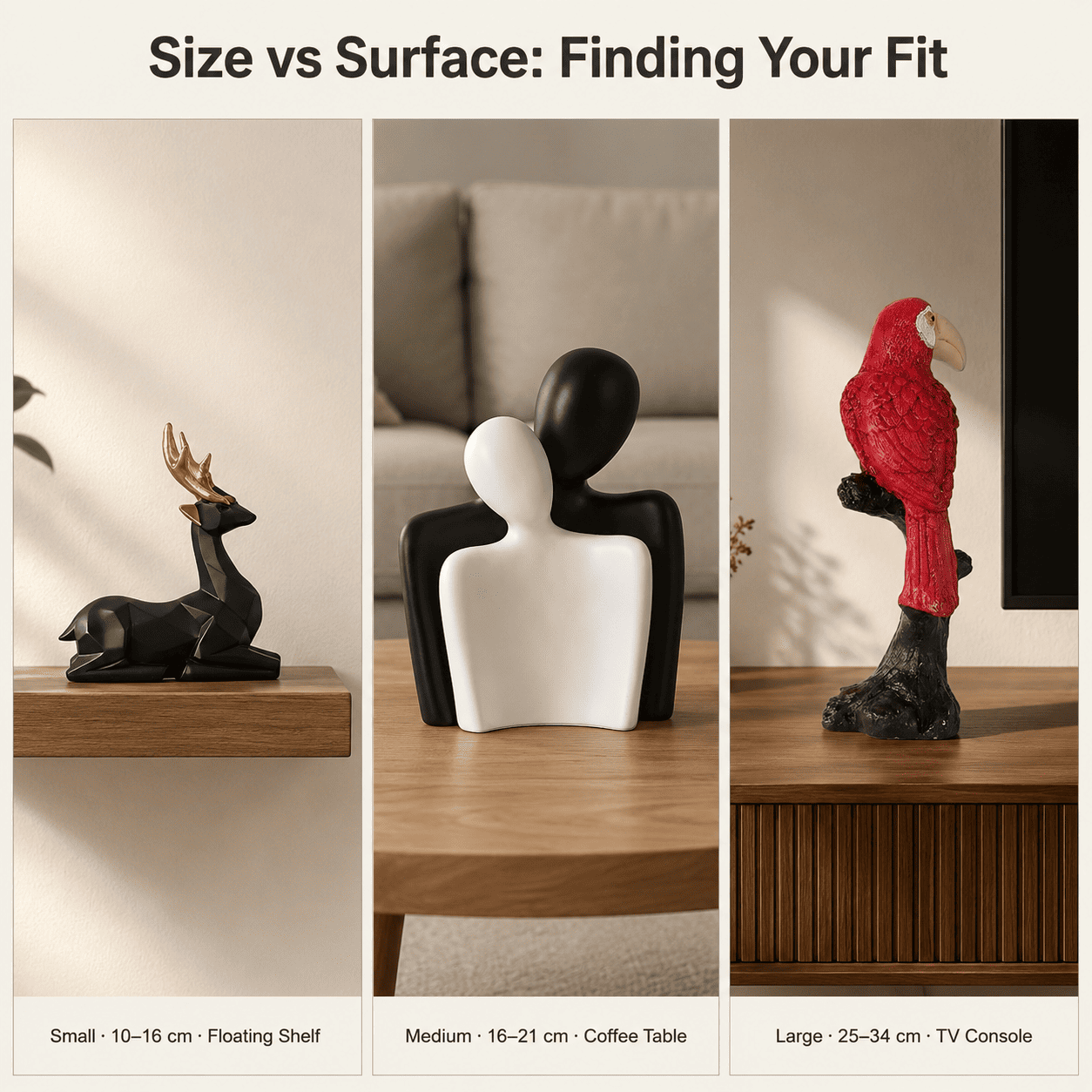
Small vs Medium vs Large: Which Showpiece Size Band Is Right for Your 1 BHK?
For a standard 1 BHK living room of 100–150 sq ft, the Medium size band (16–21 cm, 250–400 g) delivers the correct visual weight on the two most common surfaces in this room type: a coffee table of 45–60 cm width and a TV console of 90–120 cm width. A single Medium piece on a coffee table reads as a deliberate focal accent without consuming more than 30% of the surface's width, which is the spatial threshold below which an object is perceived as intentional décor rather than misplaced object.
The Small size band (10–16 cm, 150–250 g) is appropriate for grouped compositions on floating shelves of 25–35 cm depth — contexts where a single larger piece would overhang the shelf edge and create a perceived instability that the eye reads as precarious rather than styled. Grouping three Small pieces on a 30 cm shelf using asymmetric heights creates visual rhythm without exceeding the shelf's load-safe 400 g capacity.
The Large size band (25–34 cm, 400–600 g) is correctly scaled only for surfaces 60 cm wide or greater — in a 1 BHK context, this typically means the TV console or an entry console if the apartment includes a dedicated foyer. Placing a Large piece on a coffee table under 50 cm wide creates visual dominance where the décor object outscales the furniture, reversing the intended hierarchy between furniture and accent object.
Ready to bring home a showpiece sized precisely for your 1 BHK living room? Shop the full size-band and climate-rated material range in Moolwan's showpiece collection now.
How to Choose the Right Finish and Palette for a Compact Indian Living Room
In rooms under 150 sq ft, finish choice affects perceived spatial volume because matte surfaces absorb ambient light, reducing the number of competing visual hotspots the eye must resolve simultaneously — a phenomenon that allows the brain to expand its perceived spatial map of the room. Glossy surfaces in compact rooms multiply light-reflection points, increasing visual complexity and reducing the room's apparent depth by approximately 10–15% compared with the same room styled in matte finishes.
For Indian living rooms that receive strong direct sunlight through south- or west-facing windows, matte earthy finishes in warm neutrals — terracotta, greige, ochre, dusty sage — age better than bright or saturated glazed finishes because micro-scratches on matte surfaces scatter light unevenly and render surface wear invisible at normal viewing distances. A high-fired matte ceramic showpiece in this palette holds its tonal integrity for 5+ years without requiring re-finishing, making it a cost-per-year purchase that is lower than a glazed piece replaced every 18–24 months.
Palette coordination in a 1 BHK living room performs best when the showpiece's dominant tone is within two steps of the sofa's or accent cushion's colour on a standard hue wheel — this creates visual coherence without exact matching, which at close distances reads as accidental rather than intentional.
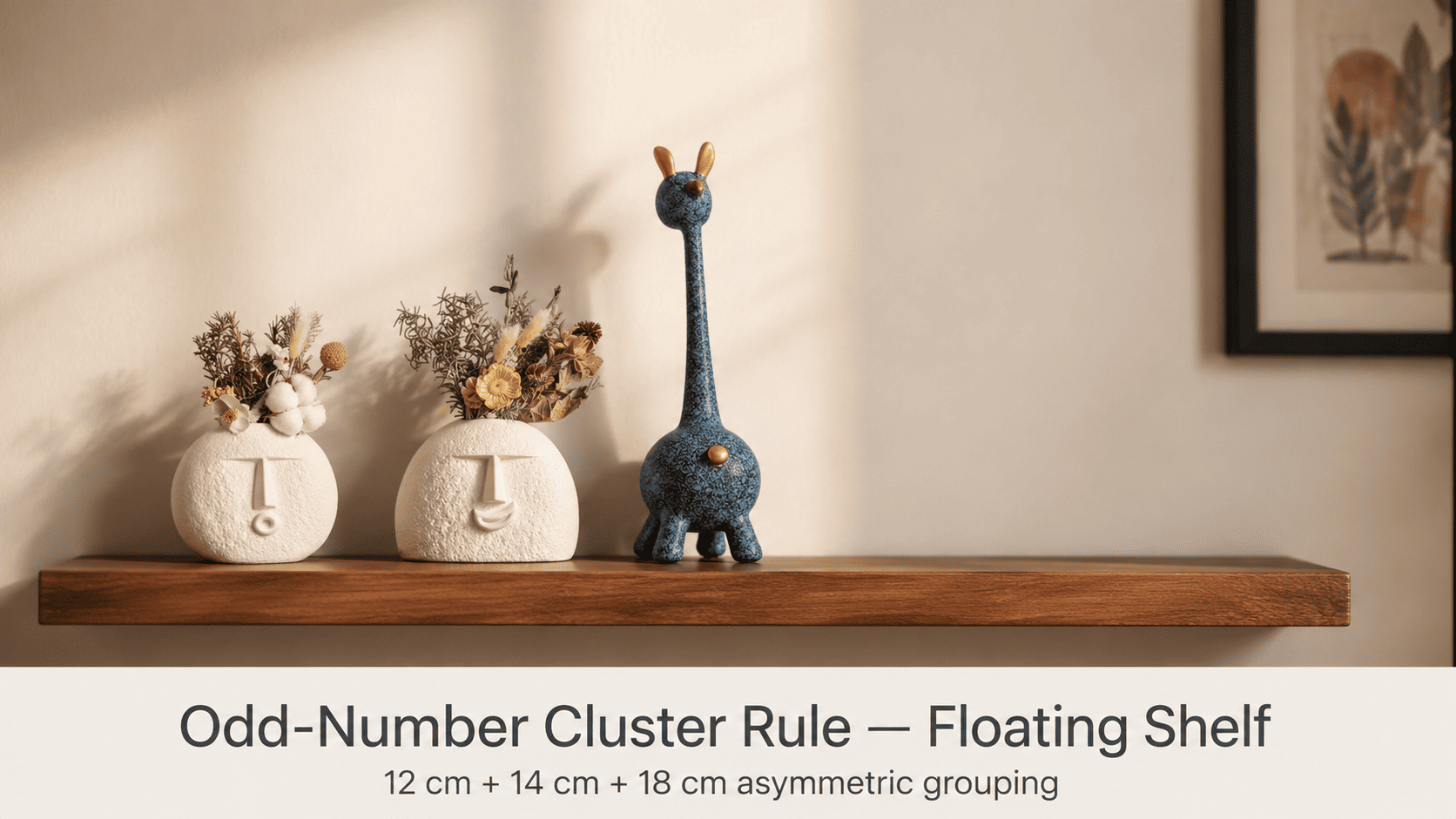
How to Group Multiple Showpieces Without Creating Clutter in a 1 BHK
Grouping multiple décor accents in a compact layout requires a height differential of at least 5 cm between adjacent pieces because the human eye requires a vertical contrast threshold of approximately 20% of the taller object's height to read a group as a composed arrangement rather than a random accumulation. A cluster of three pieces at identical heights reads as repetition; a cluster with heights of 12 cm, 16 cm, and 21 cm reads as a curated composition.
The most durable grouping geometry for a 1 BHK surface is an odd-number cluster of 3 — one anchor piece in the Medium band (16–21 cm) and two smaller pieces in the Small band (10–16 cm) — because odd numbers prevent the eye from dividing the group into symmetrical halves, creating a dynamic tension that holds attention without overwhelming the surface's available whitespace.
Frequently Asked Questions
What is the ideal showpiece height for a standard 1 BHK coffee table?
A standard 1 BHK apartment coffee table measures 45–55 cm in width. At this surface width, a showpiece of 16–21 cm height (Moolwan's Medium band) is ideal because it achieves the one-third depth rule — the piece's height remains below one-third of the table's depth — preventing visual dominance while maintaining a clear focal point. Pieces below 14 cm on this surface width disappear at seated viewing distances of 1.2–1.5 m.
Can I use a large showpiece (25–34 cm) in a 1 BHK living room?
Yes, but only on surfaces 60 cm wide or greater, such as a TV console or an entry console. Placing a Large piece on a coffee table under 50 cm wide reverses the size hierarchy between furniture and décor object, which the eye reads as spatial imbalance. In most 1 BHK living rooms, a Large piece is best reserved for the TV console, where the 90–120 cm width provides adequate surface area to contain the piece's visual mass without compressing the rest of the room.
Is ceramic or resin better for a 1 BHK living room without continuous AC?
Ceramic at 92% clay composition is the correct choice for rooms without continuous air conditioning. It tolerates humidity up to 85% RH — the upper limit of seasonal Indian monsoon conditions — whereas resin at 94% purity epoxy has a humidity ceiling of 60% RH, above which it begins micro-yellowing and surface dullness within 12–18 months. High-fired ceramic's 5+ year lifespan under these conditions makes its upfront cost structurally lower per year of use than resin alternatives that require replacement.
How many showpieces are too many for a 1 BHK living room?
More than five individual décor accents in a sub-150 sq ft living room — across all surfaces combined — typically creates visual noise rather than composition, because the eye cannot prioritise competing focal points and reads the entire room as cluttered. A well-edited 1 BHK living room uses one medium anchor piece on the coffee table, one small cluster (2–3 pieces) on a shelf, and restraint everywhere else. Moolwan's collection is curated specifically for compact Indian apartments where editing is as important as selection.
Invest in a showpiece that is sized, climate-rated, and finish-selected for your exact 1 BHK layout — because a piece that fits correctly on day one, survives 5+ years of Indian humidity cycles, and never needs seasonal replacement is the lowest cost-per-year décor decision you can make. Order your climate-rated medium or small showpiece directly from Moolwan's showpiece collection — manufacturer-direct, no distributor markup, engineered for Indian homes. If you are also considering accent objects for a study desk, bathroom ledge, or narrow console, browse the unique home décor items collection for small-format curated pieces, or explore the full modern home décor items range for contemporary accent pieces scaled to Indian apartment proportions.


