
What Size Modern Showpiece Actually Fits a Small Indian Bedside Table?
The Short Answer
A showpiece between 12 and 18 cm fits most Indian bedside tables because compact bedside surfaces span 35–50 cm wide, and a piece exceeding one-third of that width creates visual crowding in sub-120 sq ft bedrooms. Moolwan's Small (10–16 cm) and lower-Medium (16–18 cm) ceramic pieces, rated to 85% RH, are the climate-correct range for this surface.
Indian bedrooms are compact by design — apartments under 1,200 sq ft are the norm across metro cities, and bedside tables in these rooms typically measure between 35 and 55 cm wide. Moolwan helps design-conscious Indian homeowners choose showpieces scaled precisely to these surfaces, using climate-rated materials that hold their finish through five-plus monsoon seasons without warping or dulling. Getting the size wrong by even 4–5 cm changes how a surface reads: a piece too tall steals visual weight from the lamp; a piece too small disappears against the bed frame. Both failure modes are avoidable once you understand that the bedside table's surface width — not the bedroom's overall footprint — is the primary sizing input.
Why Bedside Table Width — Not Bedroom Size — Determines the Right Showpiece Height
A showpiece on a bedside table is viewed at a distance of 60–90 cm, which is the standard arm's reach from a lying position in a single or double bed. At this viewing distance, the human eye perceives a piece occupying more than 28% of a surface's visible width as dominant — reading as the focal point rather than an accent — and anything below 15% as decorative noise that registers below the threshold of intentional composition. The sizing target is a piece whose width sits between 15 and 25% of the bedside table's surface width, creating presence without crowding.
Surface width also controls weight tolerance indirectly. Bedside tables in Indian mass-market and mid-range apartments typically carry a glass-panel or engineered-wood surface rated for continuous loads under 3 kg. Moolwan's ceramic pieces in the Small-to-Medium range (10–18 cm) weigh between 150 and 450 g — well within this structural envelope — because the 92% high-density clay composition achieves rigidity at lower mass than comparable stone or solid cast-resin forms of the same height.
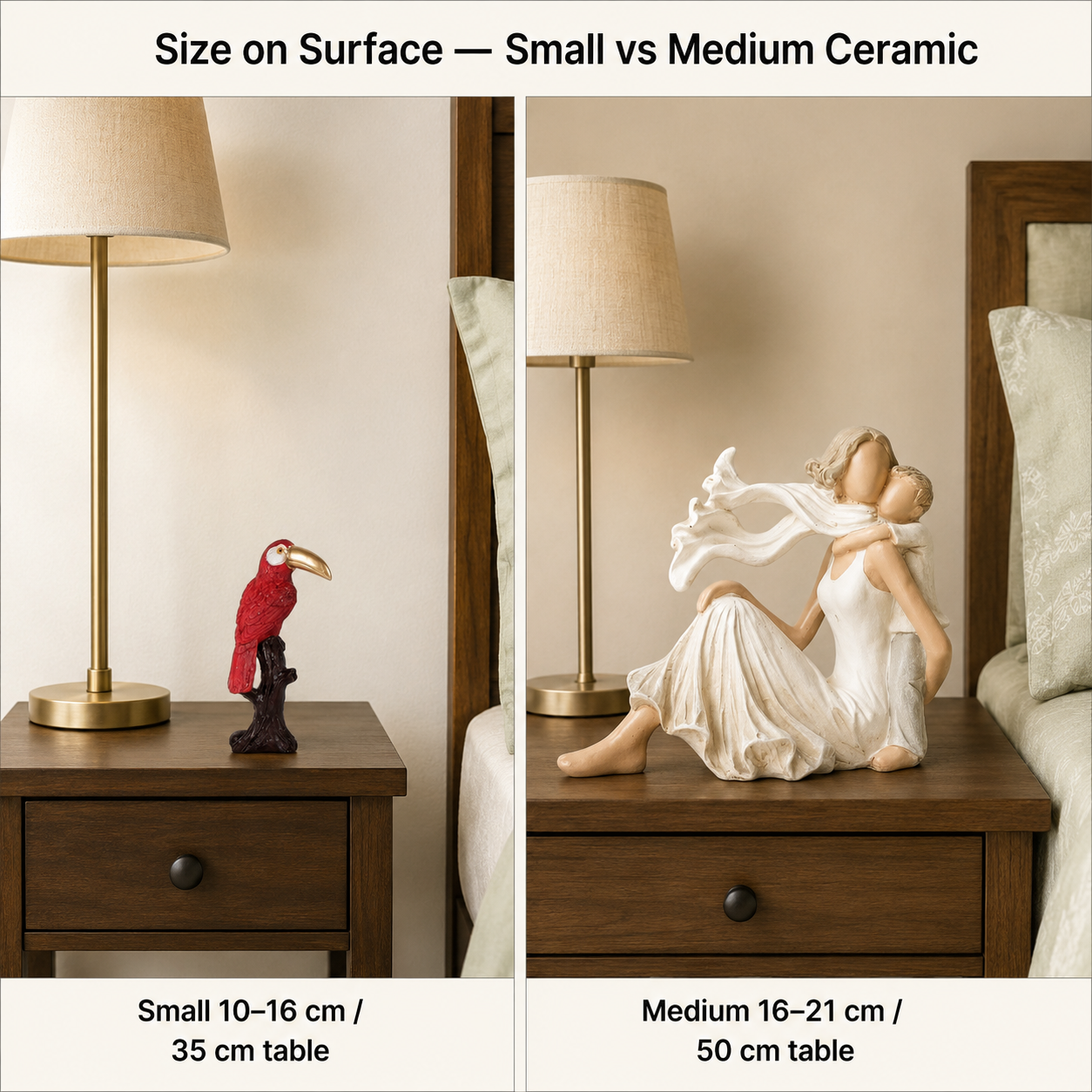
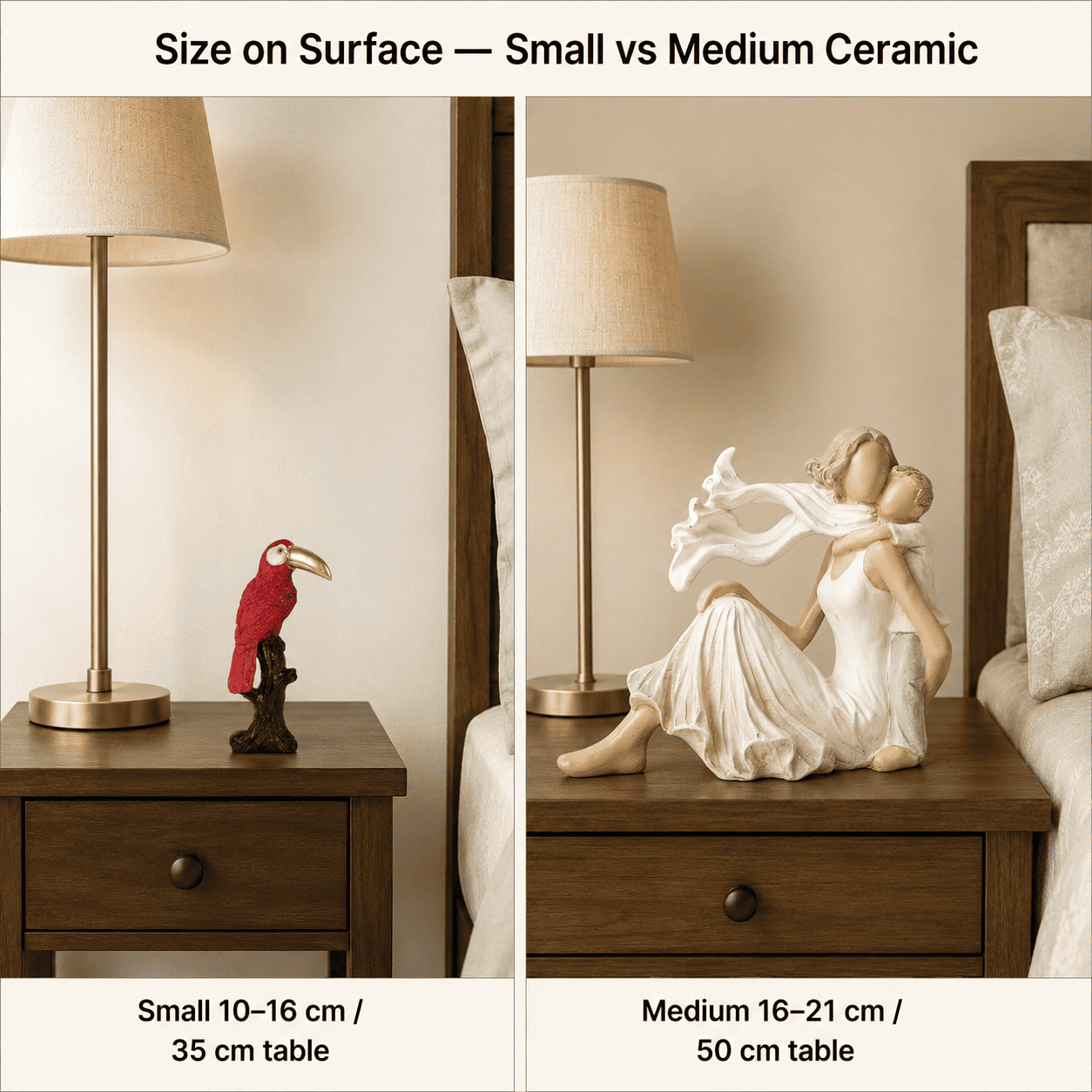
The practical implication: a 35 cm wide bedside table reaches its visual threshold at a piece height of approximately 10–13 cm, while a 50 cm surface can accommodate a piece up to 16–18 cm before the dominant zone is entered. Sizing by bedroom square footage without measuring the actual table surface is the single most common reason a showpiece reads as cluttered rather than composed.
Ceramic vs Resin: Which Material Actually Holds Up at an Indian Bedside
Two environmental variables are specific to Indian bedside surfaces: AC-driven humidity cycling (rapid swings between 30–60% RH when the unit is running versus off-cycle ambient monsoon humidity reaching 80–85% RH in unconditioned air) and direct morning sunlight on east-facing bedroom walls, where surface temperatures on a clear day can reach 45–55°C. Ceramic and resin respond to these conditions differently, making material selection a durability decision as much as a style one.
Ceramic's 92% clay composition provides humidity tolerance to 85% RH and heat resistance to 60°C, giving it the wider environmental envelope for homes where the AC runs on a timer or only at night — the majority of Indian households. Its matte surface finish scatters incident light across multiple angles simultaneously rather than reflecting it at a single predictable angle, which prevents the glare hot spots that appear on a glazed surface under direct morning sun and remain visible from bed. Moolwan's ceramic collection is engineered to the 85% RH and 60°C thresholds specifically because seasonal monsoon conditions in Indian cities regularly push both parameters to these boundaries.
Resin at 94% epoxy purity is rated to a narrower 60% RH humidity tolerance and a temperature range of 15–35°C, making it better suited to fully climate-controlled bedrooms maintained at a consistent temperature year-round. In homes where the AC runs intermittently, the humidity swing into the 60–85% RH zone during off-cycles occurs frequently enough to shorten resin's usable indoor lifespan below its 3-year rating — compared with ceramic's 5+ year rated lifespan under the same conditions.
The cross-variable sizing matrix below consolidates bedroom footprint, bedside table surface width, recommended showpiece height, weight range, and material recommendation into a single lookup reference for Indian apartment contexts.
| Bedroom Footprint | Bedside Table Width | Recommended Showpiece Height | Weight Range | Material Recommendation |
|---|---|---|---|---|
| Under 100 sq ft | Under 35 cm | 10–13 cm (Small) | 150–250 g | Ceramic (85% RH rated) |
| 100–120 sq ft | 35–45 cm | 13–16 cm (Small) | 200–350 g | Ceramic or Resin |
| 121–150 sq ft | 45–55 cm | 16–18 cm (lower Medium) | 300–450 g | Ceramic (preferred) |
| 151+ sq ft | 55+ cm | 18–21 cm (Medium) | 400–600 g | Ceramic or Resin |
Because lamp base diameter, charging cable routing, and bedding overhang introduce additional surface constraints that vary by furniture layout, browse the full size-band and material selection in Moolwan's modern showpiece collection to verify your final piece selection against your specific table dimensions.
Design Rule
To prevent a bedside showpiece from visually competing with the lamp and disrupting the resting quality of a compact Indian bedroom, follow Moolwan's One-Third Bedside Height Rule: the showpiece should stand no taller than one-third the height of the bedside lamp. This ratio works because the lamp's light cone defines the upper visual boundary of the surface composition — a piece that exceeds this boundary enters the illuminated zone, creates reflective interference in the eye's resting field, and reads as clutter rather than a considered accent.
The Finish That Performs Best When Morning Light Hits Your Bedside Surface
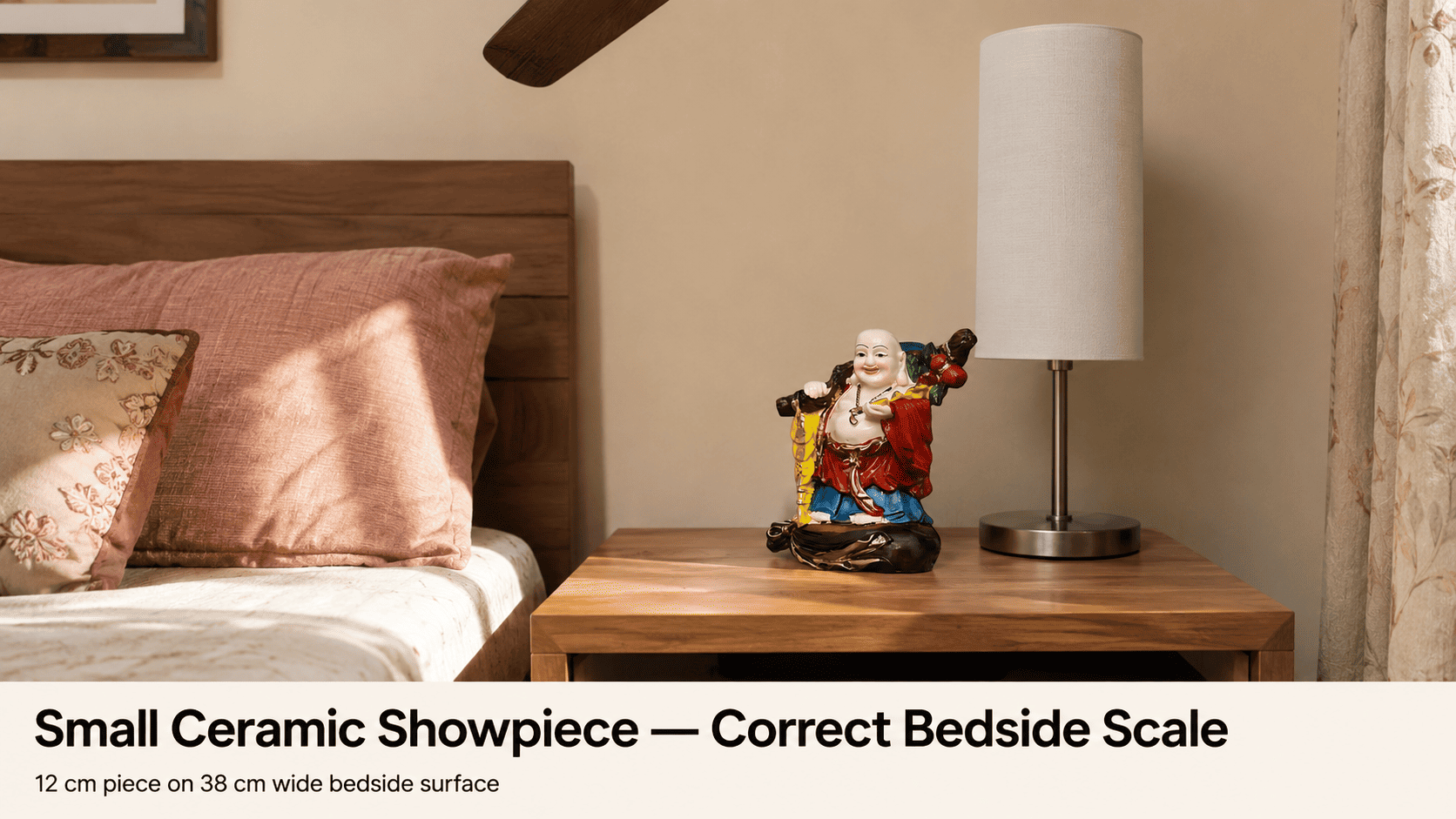
Matte finishes outlast glazed surfaces in direct-sunlight conditions for a specific structural reason: the micro-texture applied to an unglazed ceramic surface scatters incident light across multiple angles, rendering micro-scratches invisible to the naked eye because there is no uniform reflective plane to amplify them. A glazed surface reflects light at a single predictable angle, making every micro-scratch a visible highlight — surface wear becomes apparent within 18–24 months on a high-touch bedside location, compared with a matte surface where the same level of wear remains invisible at year four or five of use.
For palette compatibility with Indian bedding tones — which typically sit in the warm earth, terracotta, mustard, or greige spectrum — matte ceramic finishes in neutral or earthy tones create visual continuity rather than contrast. High-contrast glazed finishes in cool or stark tones create a visual break from the bed palette that reads as decorative tension in a space intended for rest; warm matte tones extend the composition of the bedding and wall into the surface accent without competing for attention.
Drop-resistance is the secondary reason to favour ceramic at a bedside surface: Moolwan's ceramic pieces are drop-tested to 15 cm, meaning a piece knocked off a standard 55–65 cm high bedside table and landing on a hard floor survives because the impact energy is absorbed by the dense clay body rather than transferred to a brittle external glaze layer, as occurs with lower-density ceramics or resin pieces with a thin surface coating.
Want to buy a modern showpiece engineered to stay intact and look the same in year five as it did on day one? Shop the full Moolwan modern showpiece collection now — climate-rated, manufacturer-direct, sized for Indian apartment scale.
How Many Showpieces Belong on an Indian Bedside Table — and Exactly Where to Place Them
On a bedside table narrower than 45 cm, one showpiece is the maximum alongside a lamp and a phone because each additional object reduces the unobstructed surface available for functional reach (water glass, medication, reading material) by approximately 15–20% of total area — below a critical threshold where the surface stops reading as composed and starts reading as occupied. At 45–55 cm, two small pieces or one lower-Medium piece plus one small accent can coexist without crowding, provided they are grouped in the rear one-third of the surface to preserve a clear front zone.
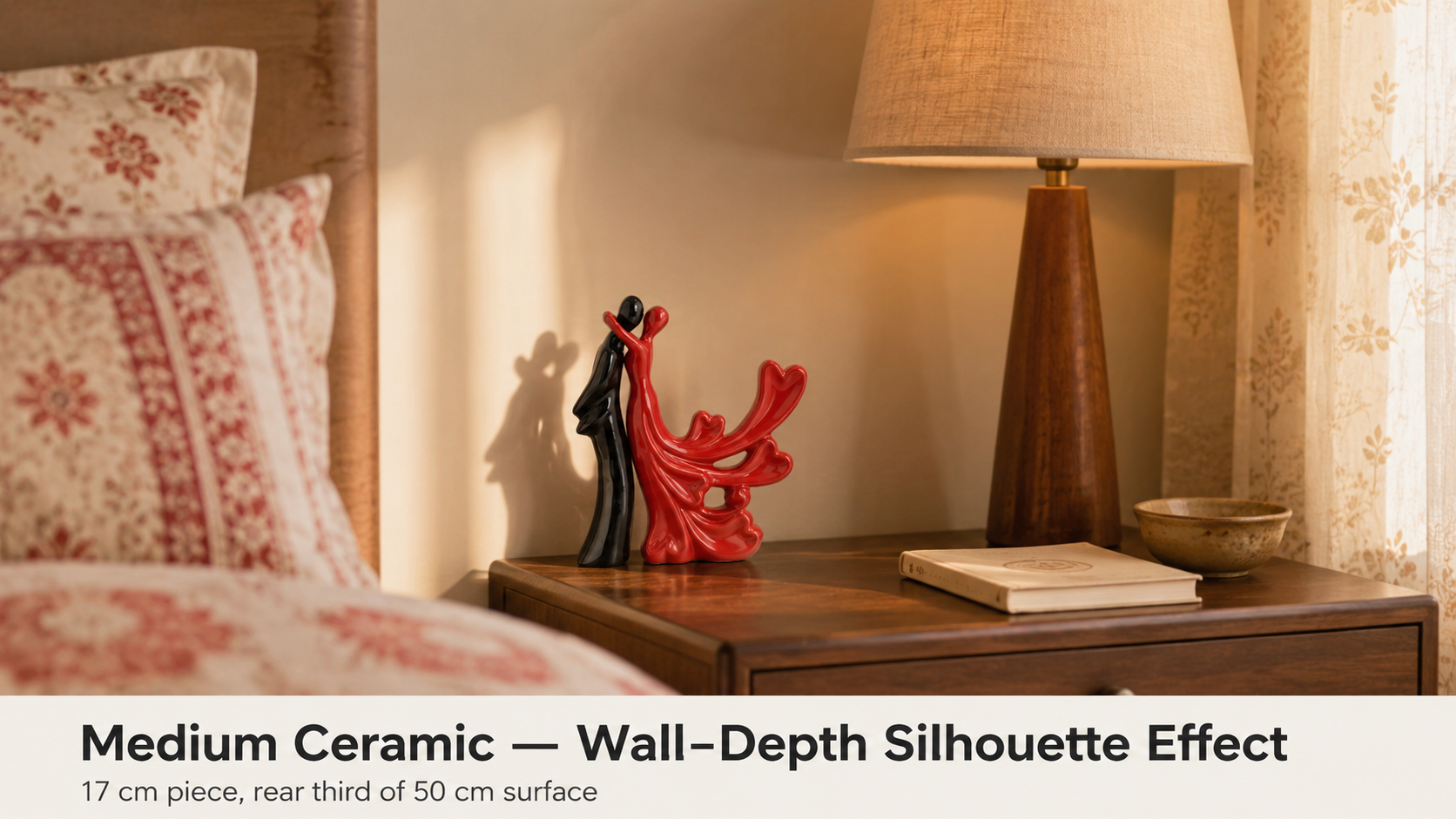
Placement depth also has a visual effect. A showpiece positioned against the wall side of the table benefits from the wall surface as a backdrop, which creates silhouette depth and makes a 12–14 cm piece appear taller and more deliberate than the same piece placed at the table's front edge against open room space. This depth effect is strongest on tables set against light-toned or white walls, where the contrast between piece and wall creates the clearest outline at the 60–90 cm viewing distance from the bed.
The one placement rule that overrides both of the above: no showpiece should sit within 5–7 cm of the table's front edge. Pieces below 250 g with a base footprint under 8 cm are the highest-risk category for toppling under the low-frequency vibration generated by someone sitting down on or getting up from the adjacent bed — a rear-third placement eliminates this risk entirely while reinforcing the visual depth effect described above.
Frequently Asked Questions
What is the ideal showpiece height for a bedside table narrower than 35 cm?
For bedside tables under 35 cm wide, a showpiece between 10 and 13 cm — the lower end of the Small tier — is the correct height. A piece in this range occupies approximately 15–20% of the surface width, maintaining visual presence without crossing into the dominant zone that causes crowding at a 60–90 cm viewing distance. Moolwan's ceramic pieces in this height range weigh between 150 and 250 g, which is well within the load tolerance of glass-panel and lightweight engineered-wood surfaces common in Indian apartment bedside furniture.
Does ceramic outperform resin for humidity near an AC vent or in a monsoon-season bedroom?
Yes, in the majority of Indian bedroom conditions. Ceramic's 85% RH humidity tolerance is significantly wider than resin's 60% RH ceiling, which matters specifically at bedside surfaces where off-cycle humidity recovery during monsoon months can spike to 75–85% RH in unconditioned air. Resin at 94% epoxy purity performs correctly in fully air-conditioned rooms maintained at 15–35°C throughout the year — but in homes where the AC runs on a timer or only at night, the humidity swing into resin's failure zone occurs regularly enough to shorten its 3-year indoor lifespan to 18–24 months of stable surface quality.
How far from the front edge should a bedside showpiece be placed?
At least 5–7 cm from the table's front edge. Pieces below 250 g with a base footprint under 8 cm are the highest-risk category for toppling because their low mass means the centre of gravity shifts toward the base edge under the low-frequency vibration generated by sitting on or rising from an adjacent bed. Placing the piece in the rear one-third of the surface — behind the lamp base or against the wall — eliminates toppling risk while also creating the visual depth effect that makes a 12–14 cm showpiece read as more substantial against the wall backdrop.
Can a showpiece over 20 cm work on a small Indian bedside table?
On a table narrower than 45 cm, a piece over 20 cm will typically exceed one-third of the surface width, entering the visual dominance zone where it reads as the room's focal point rather than a composed bedside accent. The exception is a very narrow, elongated form — such as a slim vertical figurine under 5 cm at the base — where height does not translate directly to perceived surface-width occupancy. For standard matte ceramic showpiece forms in the Medium range, a bedside table of at least 50 cm width is the minimum surface for an 18–21 cm piece to read as proportionate rather than overcrowded. Moolwan's size guide categorises 16–21 cm as the Medium tier, and the lower boundary of this tier (16–18 cm) is the safer starting point for 45–55 cm surfaces.
A climate-rated showpiece that holds its matte finish and structural integrity through 5+ monsoon seasons is a better investment than a decorative piece that shows surface degradation within the first 18 months of Indian humidity cycling. Order your piece directly from the Moolwan modern showpiece collection — manufacturer-direct pricing, ceramic and resin options sized for Indian bedside surfaces, and engineered to the 85% RH and 60°C thresholds specific to Indian apartment conditions. If you are styling a broader living or dining surface rather than a bedside location, also consider the curated range at Moolwan's home décor showpiece selection; or, if you are buying a showpiece as a housewarming or anniversary gift, browse the occasion-appropriate packaging options at Moolwan's gifting showpiece collection.


