

What Size Showpiece Belongs on a Coffee Table? A Beginner's Guide
The Short Answer
For most Indian living rooms, a Medium showpiece between 16–21 cm is the right starting point for a standard 90–120 cm coffee table. At this height, the piece registers visually from seated eye level (roughly 65–75 cm above the floor) without blocking cross-table sightlines. Moolwan's ceramic collection is engineered to this exact height band and weight range (250–400 g) for stable, tip-resistant placement on everyday surfaces.
Indian apartments under 1,200 sq ft present a specific challenge that Western interior styling guides almost never address: a coffee table placed in a compact living room must function as both a display surface and an everyday utility surface, which means the decorative piece sitting on it must earn its footprint. Moolwan helps design-conscious Indian homeowners solve exactly this tension — choosing a showpiece that anchors the living room visually without reducing the table's usability or making the space feel visually noisy.
The question of size is not aesthetic instinct — it is spatial geometry. A piece that is too tall obscures the view across the table. A piece that is too small disappears against a 90 cm wide surface. The correct height and footprint are calculable from three variables: table width, seated eye level, and surface clearance ratio.
Why Coffee Table Height-to-Width Ratio Determines the Right Showpiece Size
The correct showpiece height for a coffee table is approximately 15–20% of the table's longest dimension — not an arbitrary preference, but a function of how the human eye perceives scale from a seated position.
When a person is seated on a standard sofa, their eye level sits between 100–110 cm above the floor. A coffee table surface is typically 40–45 cm high. The visual field the seated viewer scans across the table spans a vertical arc of roughly 55–65 cm. Within that arc, a showpiece between 16–21 cm tall occupies just enough height to register as a deliberate focal accent without interrupting cross-table conversation lines — which begin to be obstructed at heights above 25 cm on a standard table.
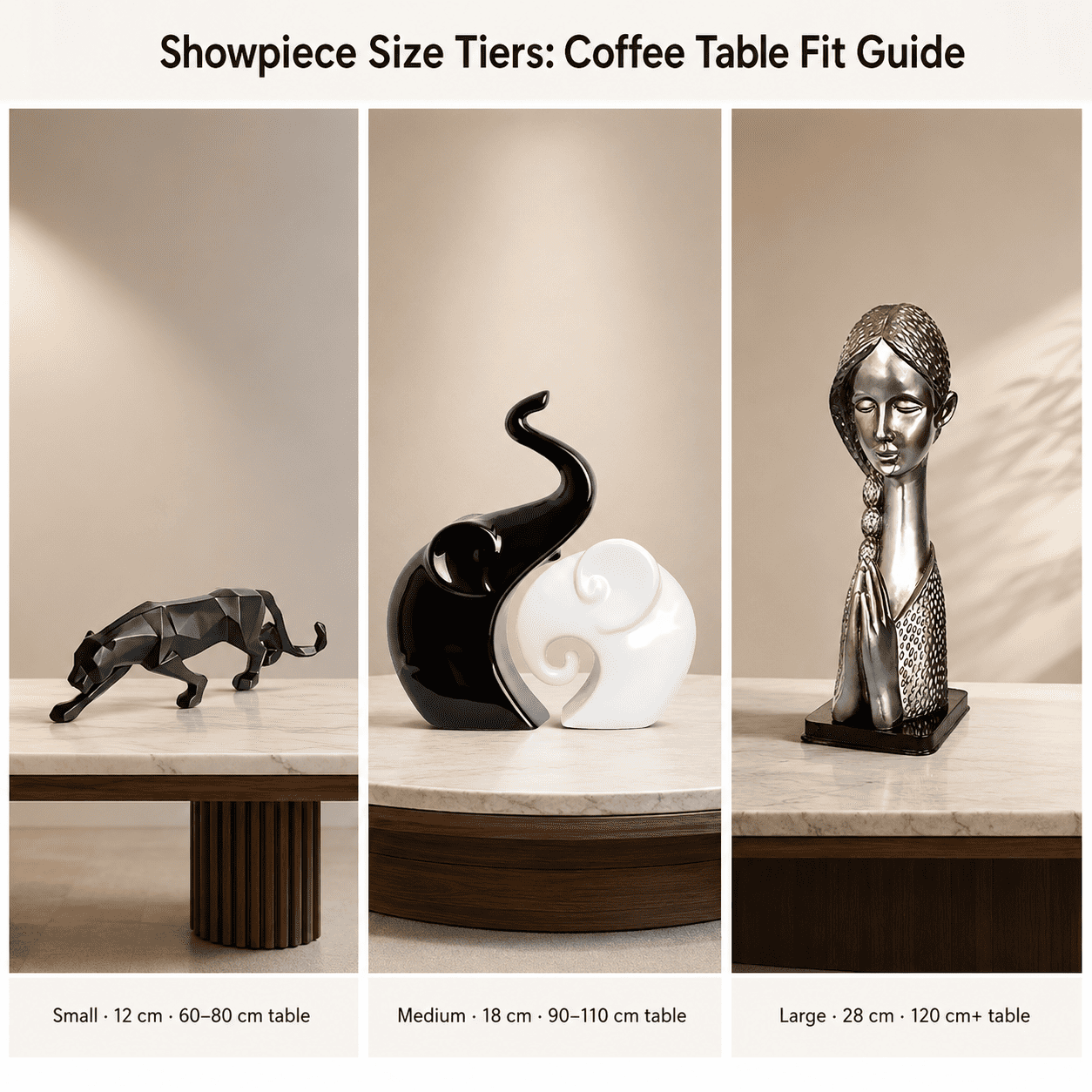
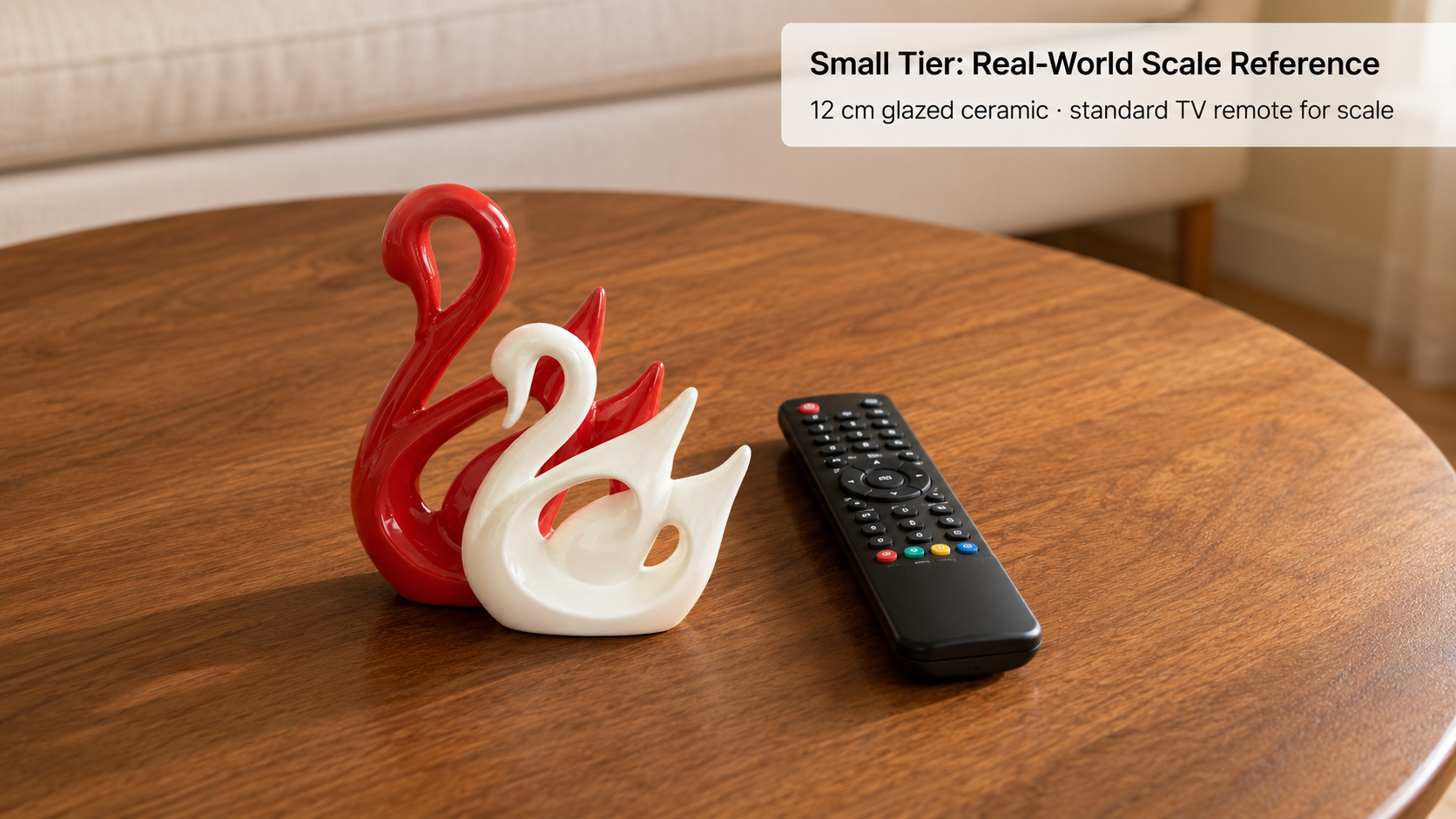
Below 16 cm on a table wider than 80 cm, the piece loses visual presence because the ratio of object height to table surface area drops below the threshold where the human eye reads it as an intentional focal point rather than a misplaced small object. Moolwan's Small tier (10–16 cm, 150–250 g) is calibrated for narrower surfaces — bookshelves, console ledges, bathroom shelves — specifically because this visual threshold changes with surface width.
How Indian Apartment Room Footprint Affects Which Size Tier to Choose
Room footprint directly determines coffee table width, which in turn determines the appropriate showpiece height — making room size the upstream variable in every coffee table styling decision.
In sub-100 sq ft living rooms — common in compact 1BHK and studio apartments in Bangalore, Mumbai, and Delhi-NCR — coffee tables are typically 60–80 cm wide. On a surface this narrow, a Medium piece at 16–21 cm at the upper range can feel proportionally heavy; a Small piece at 12–15 cm is the better fit because it leaves the 40/60 surface clearance intact (see framework below) without the piece reading as undersized relative to the table perimeter.
In 101–150 sq ft living rooms, standard 90–110 cm coffee tables are the norm, and the Medium tier (16–21 cm) performs best. In larger living rooms above 150 sq ft with coffee tables 120 cm or wider, a Large piece at 25–34 cm — or a composed cluster of two Medium pieces — prevents the visual emptiness that a single small accent creates on an expansive surface. Seasonal humidity tolerance is also relevant here: Moolwan's ceramic collection tolerates up to 85% RH, which matters when placement is near balcony doors in monsoon-facing apartments where humidity spikes are common.
| Room Footprint | Typical Coffee Table Width | Recommended Showpiece Height | Weight Range | Climate Tolerance |
|---|---|---|---|---|
| Sub-100 sq ft | 60–80 cm | 10–16 cm (Small) | 150–250 g | Ceramic: up to 85% RH |
| 101–150 sq ft | 90–110 cm | 16–21 cm (Medium) | 250–400 g | Ceramic: up to 85% RH |
| 151–200 sq ft | 110–130 cm | 21–25 cm or paired Medium | 350–500 g | Ceramic: up to 85% RH |
| 200+ sq ft | 130 cm+ | 25–34 cm (Large) or cluster | 400–600 g | Ceramic: up to 85% RH |
Because sofa depth, rug border width, and ambient light direction introduce additional sizing variables that affect how a piece reads on your specific table, browse the full size-band and material selection in Moolwan's showpiece collection to verify your final piece choice against your actual surface dimensions.
Design Rule
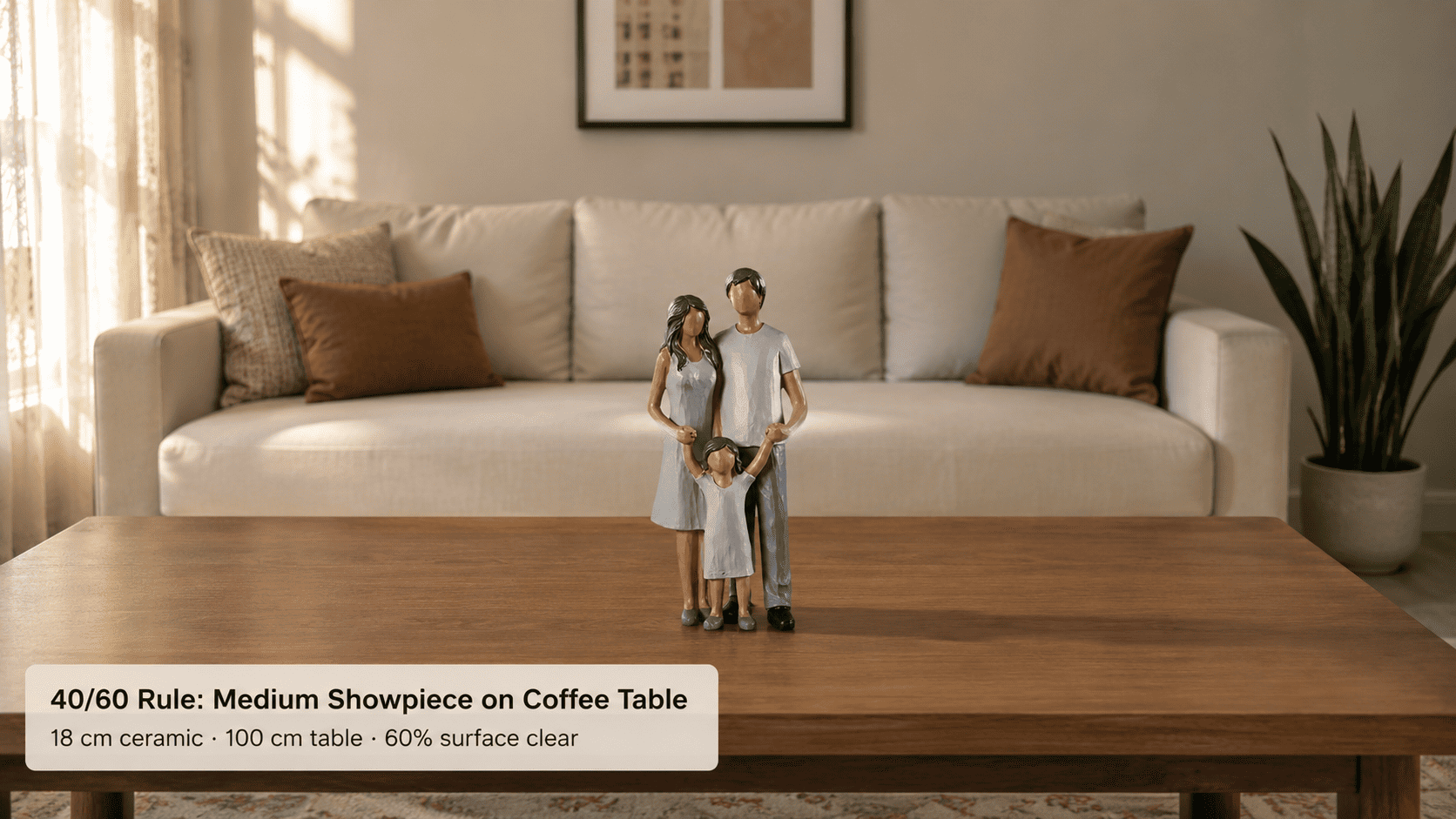
To prevent visual compression on compact Indian coffee tables, every placement should follow Moolwan's 40/60 Coffee Table Clearance Rule: the showpiece and any grouped objects should occupy no more than 40% of the table's total surface area, leaving the remaining 60% completely clear. This ratio preserves the table's functional utility while giving the eye a clear negative-space anchor that makes the styled 40% read as intentional rather than cluttered.
Should a Beginner Choose Ceramic or Resin for a Coffee Table Showpiece?
For a coffee table, ceramic is the stronger default material choice over resin because ceramic's 92% clay composition provides a 3H pencil hardness equivalent surface at standard room temperatures, making it resistant to the minor surface knocks that are unavoidable on a high-traffic everyday table.
Resin pieces (94% purity epoxy) have a lower humidity tolerance ceiling of 60% RH compared to ceramic's 85% RH — a meaningful gap in Indian living rooms that experience seasonal monsoon humidity between 70–90% RH, particularly in coastal and semi-coastal cities. On a coffee table positioned near an open balcony or window, a resin piece placed in that humidity band risks micro-surface crazing over time, reducing the lifespan of the finish. Ceramic pieces placed in the same environment remain structurally and visually stable because the high-fired clay body is non-porous, preventing moisture absorption that causes internal stress fractures.
Resin is the better choice for shelves in climate-controlled interiors maintained below 60% RH, or for rooms served by a consistently running air conditioning system where humidity stays regulated. The investment calculus is clear: a climate-rated ceramic piece at the correct size tier requires no seasonal replacement, whereas a resin piece placed in a mismatched humidity environment begins showing surface degradation within 18–24 months.
Ready to bring home a piece that's sized correctly and engineered for Indian humidity? Shop the full Moolwan showpiece collection — climate-rated, manufacturer-direct, made for Indian homes.
Matte vs Glazed Finish: Which Works Better on an Indian Coffee Table?
Matte finishes outperform glazed finishes on high-traffic surfaces like coffee tables because micro-scratches on matte surfaces scatter incoming light at multiple angles simultaneously, rendering surface wear invisible to the naked eye at the 3–5 year mark — whereas the same micro-scratches on a glazed surface disrupt its uniform light reflection, making every scratch visibly apparent under ambient lighting.
Indian living rooms commonly use warm LED or tubelight overhead fixtures that cast light at a low incident angle relative to a coffee table surface. Under these conditions, a glazed piece acts as a small mirror, catching and reflecting ceiling light sources directly into the seated viewer's eye line — creating a visual "hot spot" that draws attention to the object rather than to the room as a whole. A matte finish absorbs and diffuses this light, allowing the piece's form and silhouette to read clearly without the fixture glare competing for attention.
For beginners, this has a practical consequence: a matte earthy-toned ceramic piece at the correct size tier requires no careful lighting adjustment after placement — it reads well under any of the common Indian residential light setups, including daylight from east- or west-facing windows, warm 2700K LED panels, and cool-white tubelight strips.
How to Compose a Coffee Table with More Than One Piece
When placing two or more pieces on a coffee table, the vertical height relationship between them governs whether the arrangement reads as a curated composition or a random grouping. An arrangement composed of pieces at varying heights — where the tallest piece is at least 30% taller than the shortest — creates a visual hierarchy that the eye reads as intentional because it mirrors the natural height variation of organic forms (branches, rocks, vessels of different scales).
A flat arrangement where all pieces sit at the same height eliminates this hierarchy and produces visual monotony, because the eye can scan across the arrangement in a single horizontal pass without any focal interruption. The practical rule: if starting with one Medium piece (16–21 cm), a second piece should either be a Small (10–14 cm) or a taller accent above 22 cm — never another piece of near-identical height.
Total footprint across a grouped arrangement should still comply with the 40/60 clearance principle — the combined base area of all pieces should not exceed 40% of the table's total surface. This is especially important in Indian homes where the coffee table is also used for chai, remote controls, books, and phones through the course of a regular evening.
Frequently Asked Questions
What is the ideal showpiece height for a 90 cm coffee table?
For a 90 cm coffee table, a showpiece between 16–18 cm tall is the calibrated fit. At 90 cm wide, the table's visual field from seated eye level requires a piece height of at least 16 cm to register as a focal accent — below this threshold, the object reads as incidental rather than deliberate against the surface area. A 16–18 cm piece also keeps the top of the showpiece well below the conversation sightline (obstructions begin at heights above 25 cm on tables at standard 40–45 cm height). Moolwan's Medium tier (16–21 cm, 250–400 g) is sized to this exact spatial requirement.
Can I use a Large showpiece (25–34 cm) on a standard Indian coffee table?
A Large piece (25–34 cm) is appropriate on coffee tables 120 cm wide or wider — common in living rooms above 150 sq ft. On a narrower 90–100 cm table, a piece at 25+ cm begins to approach the cross-table sightline obstruction zone (above 25 cm at seated eye level) and its footprint will likely consume more than the 40% surface clearance threshold, making the table feel visually heavy and reducing functional use area. Reserve the Large tier for console tables, sideboards, and focal floor surfaces in compact rooms.
Is ceramic or resin more durable for a coffee table showpiece in Indian conditions?
Ceramic is the more durable choice for coffee tables in Indian conditions. High-density ceramic at 92% clay composition tolerates humidity up to 85% RH, which covers the peak monsoon humidity range in most Indian cities. It is also drop-tested to 15 cm, meaning minor surface-level knocks from everyday table use will not chip or fracture the piece under normal conditions. Resin's 60% RH tolerance ceiling makes it a risk on coffee tables near balcony doors or in unconditioned rooms during monsoon months. Moolwan's ceramic collection is engineered to the 85% RH threshold precisely because Indian living rooms are not climate-controlled at all times.
How do I stop a coffee table showpiece from looking out of place?
A showpiece reads as out of place when its height, finish, or palette is mismatched to the table and room it occupies — not because of styling inexperience. Three variables calibrate the fit: height should be 15–20% of the table's longest dimension; finish should be matte if the room uses warm LED or overhead tubelight (to prevent reflective glare); and palette should pick up one colour already present in the room — either the sofa upholstery, the rug tone, or the wall paint — because visual repetition of a colour across three or more surfaces in a room signals intentional composition rather than accident.
A climate-rated, correctly sized showpiece on a coffee table is a long-horizon investment — a matte high-fired ceramic piece engineered for Indian humidity delivers a 5+ year lifespan without seasonal replacement, compared to decorative imports designed for temperature-controlled Western interiors that begin surface-degrading within two Indian monsoon cycles. Bring home a piece from the Moolwan showpiece collection — manufacturer-direct pricing, COD available, free shipping across India. If you are also styling a console or entryway, browse Moolwan's home décor showpiece range for accent pieces curated by surface type; and for living room–specific compositions, the Moolwan living room showpiece collection is organised by room footprint and palette to make selection straightforward.


