
Cart
The Short Answer
For most Indian living room coffee tables — typically 90–120 cm wide — a Medium showpiece between 16 and 21 cm tall and 250–400 g is the correct scale. It provides enough visual weight without blocking sightlines across the surface. Moolwan's ceramic and resin collections are sized and drop-tested specifically for these table dimensions.
The coffee table is the most scrutinised surface in any Indian living room — guests lean in, children pass by it, and every visitor forms a first impression within seconds. Moolwan helps design-conscious Indian homeowners find showpieces scaled precisely for real Indian furniture proportions, not imports sized for 150 cm Western coffee tables or undersized accents that disappear on a wide surface. Getting the size right first makes every other decision — material, finish, palette — significantly simpler.
The correct showpiece height for a coffee table is roughly 15–22% of the table's shorter dimension. For a standard Indian rectangular coffee table at 90–120 cm wide and 50–60 cm deep, that translates to a showpiece between 12 and 21 cm tall — squarely within the Small-to-Medium size range.
Tables wider than 120 cm — found in larger living rooms or open-plan apartments — can support a Medium showpiece at 16–21 cm, or a flanking pair of Small pieces beside a tray. Tables under 80 cm, common in Indian apartments under 1,200 sq ft, are best served by a single Small showpiece (10–16 cm) to keep the surface functional for daily use.
Sightline logic applies too. When two people sit across a standard coffee table, anything taller than 25 cm begins to interrupt eye contact. This is why the upper limit of the Medium tier — 21 cm — has become a practical ceiling for most Indian living room setups, regardless of table width.
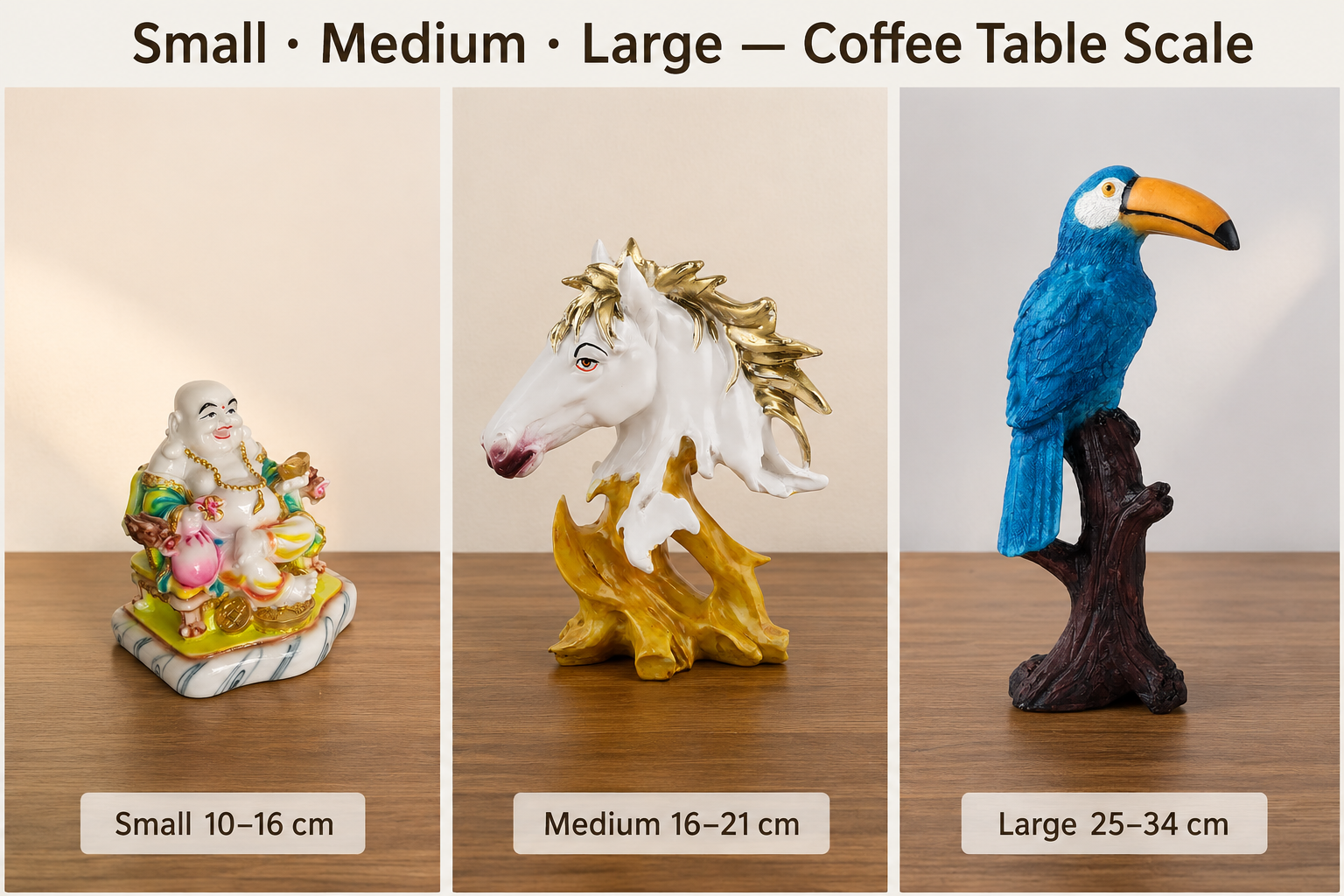
Moolwan's modern décor collection organises into three size tiers, each calibrated for a specific surface type and weight tolerance.
Small (10–16 cm, 150–300 g): Designed primarily for narrow surfaces — bathroom shelves, study desks, floating shelves. On a coffee table, Small showpieces work only in a curated cluster of two or three. A single Small piece reads as an afterthought on anything wider than 70 cm.
Medium (16–21 cm, 250–400 g): The primary coffee table size tier. At 250–400 g, the weight sits stable on both glass and wood finishes without tipping risk. The height clears remote controls and coasters without dominating the eye line. This is where the majority of buyers land after measuring their table.
Large (25–34 cm, 400–600 g): Designed as a statement centrepiece. On a coffee table, a Large showpiece works as a solo anchor — one piece, centred, with clear space on all sides. It suits tables 130 cm or wider, where a Medium reads as proportionally small.
A Medium ceramic showpiece (16–21 cm) centred on a 100 cm wooden coffee table — the scale that works in most Indian living rooms. See the full range in Moolwan's living room showpiece collection.
For coffee tables in Indian homes, ceramic is the more durable long-term choice. Resin performs well in air-conditioned rooms but has meaningful limits in naturally ventilated spaces.
Moolwan's ceramic showpieces are manufactured to a 92% clay composition, making them heat-resistant to 60°C and humidity-tolerant to 85% RH. In Mumbai, Chennai, Kolkata, or any coastal city, ceramic retains its finish and structural integrity through monsoon season without surface crazing or colour shift. Glazed ceramic develops a micro-sealed surface that repels the fine particulate dust common in Indian urban homes.
Resin showpieces — 94% purity epoxy, rated to 3H pencil hardness — offer sharper edge definition and are lighter at equivalent sizes. The humidity tolerance ceiling is 60% RH, which remains comfortable for air-conditioned living rooms in Bangalore, Delhi, or Pune where ambient humidity stays below that threshold for most of the year. In naturally ventilated rooms in coastal cities, ceramic is the safer, lower-maintenance choice.
For buyers who want décor that requires no special handling on a surface that sees daily activity, coffee cup proximity, and the occasional child's hand, browse Moolwan's living room showpiece collection to see the full range of ceramic and resin finishes across all three size tiers, with dimensions and material specs listed for every piece.
One, two, or three pieces — never four. Three is the visual ceiling before a coffee table looks like a display cabinet rather than a living surface.
The triangle cluster principle that Moolwan's design team applies: one anchor piece at the tallest point (typically Medium or Large), one secondary piece at roughly two-thirds that height, and one low accent — a small tray, a candle holder, a miniature figurine — at one-third. The result reads as curated rather than arranged, because it creates depth without rigid symmetry.
On a narrow coffee table under 80 cm, the anchor-plus-one structure is more practical — one Medium showpiece and one functional object such as a small tray. This keeps at least 60% of the surface clear, which is the minimum needed for daily usability in a household where the coffee table doubles as a remote shelf, snack surface, or occasional laptop stand.
Small (10–16 cm), Medium (16–21 cm), and Large (25–34 cm) showpieces placed side by side against a standard Indian coffee table — a visual scale reference before you buy. Explore all three tiers in Moolwan's showpiece collection.
Matte finishes absorb light and suit rooms with bold wall colours or busy upholstery — they hold their own without competing. Glazed finishes introduce subtle reflectivity that works best in neutral-toned rooms where the surface adds interest without clashing against an already busy palette.
The most reliable palette strategy for an Indian living room is to pull one anchor colour from the sofa fabric or rug and select a showpiece two shades lighter or darker than that anchor. Warm earthy tones — terracotta, ochre, warm clay white — carry through both traditional and contemporary Indian interiors without dating. Cool-toned pieces in slate, sage, or warm grey are increasingly common in Bangalore-style minimalist setups but require a neutral base wall to avoid reading as clinical.
For marble or quartz coffee tables specifically, a matte ceramic piece in a warm tone creates visual contrast against the cold, reflective surface — the material juxtaposition reads as intentional rather than incidental, and is one of the most effective low-effort décor moves available in a compact Indian living room.
Triangle cluster arrangement — Medium anchor, Small secondary, and tray accent — on a rectangular coffee table in a compact Indian apartment living room. The 60% clear surface rule in practice.
For tables between 90–120 cm wide — the most common size in Indian apartments — the ideal showpiece height is 16–21 cm, which is Moolwan's Medium tier. This range provides clear visual presence without exceeding the sightline threshold between two seated guests. Anything above 25 cm on a standard table starts to interrupt eye contact and shifts the piece from accent to centrepiece territory.
Yes, and it often works well because ceramic's glaze and resin's sharper edge definition create natural textural contrast. The practical constraint is humidity tolerance: resin is rated to 60% RH, while ceramic at 92% clay composition tolerates up to 85% RH. In high-humidity cities such as Mumbai, Chennai, or Kochi, keep resin pieces in air-conditioned rooms and use ceramic for any naturally ventilated spaces.
Standard tempered glass coffee tables in Indian homes are rated for distributed loads well above 10 kg, so any showpiece in the 150 g–600 g range poses no structural risk. The practical concern is stability rather than weight — lighter resin pieces at 150–200 g can be nudged off-centre more easily on glass than on wood. Ceramic at 250 g or more sits more naturally stable due to the flat base geometry common in the 92% clay composition pieces.
Default to Medium (16–21 cm) when you do not know the recipient's coffee table dimensions. It scales proportionally to tables from 80 cm upward, reads as a considered and specific gift, and does not impose a particular arrangement on the receiver. A single Medium ceramic showpiece in a neutral glaze finish is the lowest-risk housewarming gift choice across the widest range of Indian home types.
Ready to choose? Browse Moolwan's living room showpiece collection — all three size tiers in ceramic and resin, with height, weight, and climate specs listed for every piece so you can match before you commit. If you are refreshing the wider room, the elegant living room décor edit curates accent pieces across all surfaces from entry console to bookshelf, and the full living room items range covers everything from compact shelf accents to statement pieces for larger walls and corners.
Written by Moolwan Design Concept Team. Reviewed by Ruchi Malhotra, Founder & CEO, Moolwan (Euphorica Ventures Pvt Ltd), Bangalore. Published 27 May 2026.


