
What Size Showpiece Works Best in a Large Indian Living Room Above 500 Sq Ft?
The Short Answer
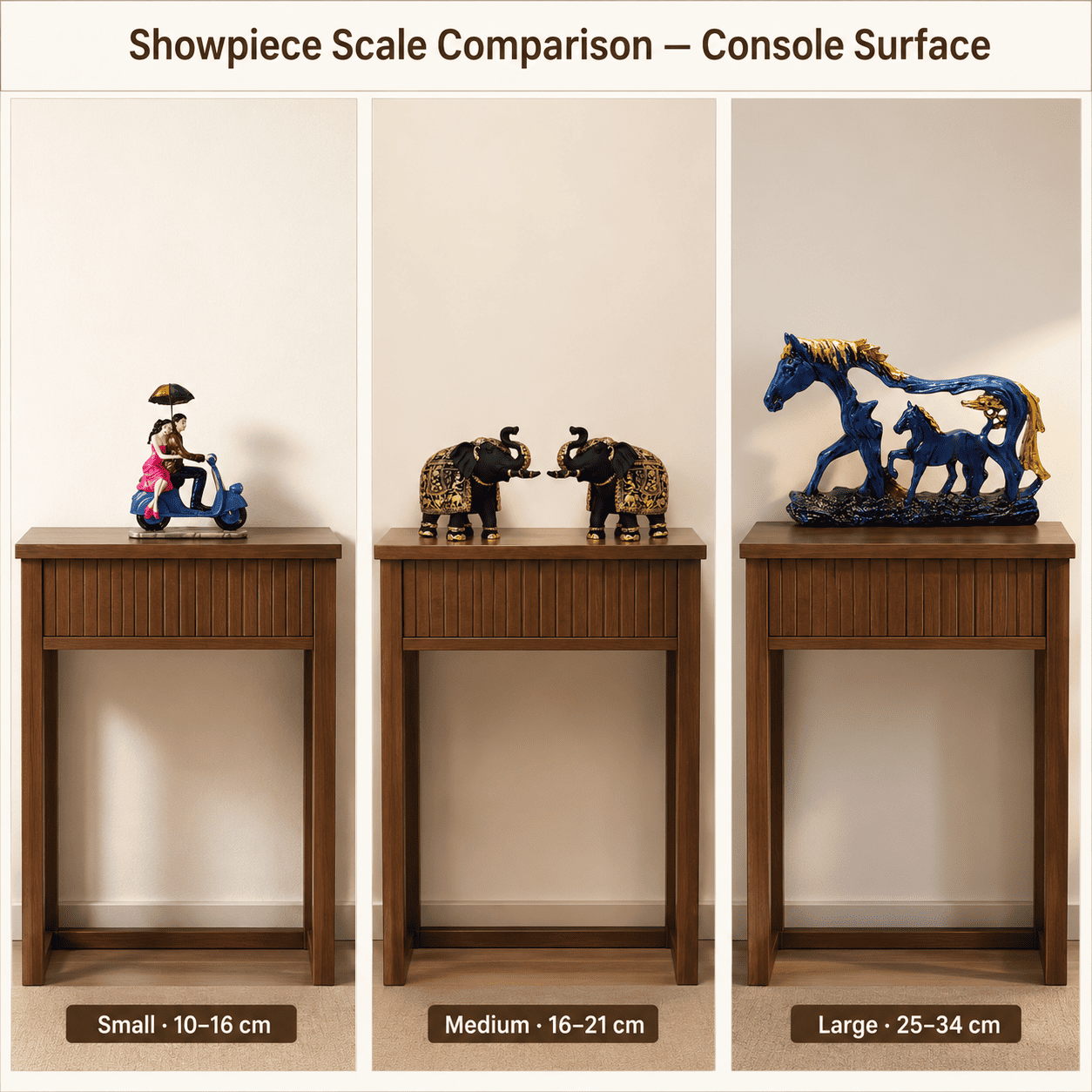
In a living room above 500 sq ft, choose large showpieces of 25–34 cm height for primary focal surfaces like consoles and pedestals — because at sub-25 cm, the visual weight-to-room-volume ratio drops below the perceptual threshold where the eye registers the piece as a design statement rather than a stray object. Moolwan's Large tier (25–34 cm, 400–600 g) is engineered precisely for this scale and surface combination.
Spatial perception research in interior design consistently shows that décor items occupying less than 2% of a room's vertical visual field are perceived as accessories rather than focal objects by the viewer. Moolwan helps design-conscious Indian homeowners solve exactly this problem: selecting home décor showpieces scaled to the proportions of spacious Indian living rooms, so every piece registers as intentional rather than incidental. In a room exceeding 500 sq ft — where ceiling heights commonly reach 9–10 feet and primary furniture spans 7–10 feet in length — the sizing calculus is materially different from a compact urban apartment, and most décor available to Indian buyers is sized for the latter, not the former.
Why Small and Medium Showpieces Disappear in Rooms Above 500 Sq Ft
A showpiece appears proportionate when its height equals at least 1/12th of the longest visible wall dimension in the room. In a room with a 20-foot (600 cm) accent wall, this means décor height must reach a minimum of 50 cm — or, for individual pieces on furniture, a minimum of 25 cm — to avoid the "lost object" effect where the eye skips over the piece during a room scan.
The physics of visual perception explain this: the human eye uses relative scale cues to assign significance to objects in a field of view. When a showpiece is surrounded by large furniture — a 3-seater sofa, a wide console, a dining table — the brain calibrates the object's importance against its neighbours. A 12 cm figurine beside a 90 cm sofa registers at roughly 13% of the sofa's height, which sits below the 20% threshold that interior designers identify as the minimum for visual parity. The piece reads as a miniature, not a design statement.
Small showpieces (10–16 cm) and standard medium pieces (16–21 cm) are engineered for surfaces under 50 cm wide and rooms under 150 sq ft — bathroom shelves, study desks, bedside tables. Deploying them in a 500+ sq ft living room without grouping strategies or height scaffolding (pedestals, risers, tiered shelving) produces visual noise rather than visual hierarchy. Moolwan's home décor collection separates its size tiers precisely because this surface-to-piece ratio is the primary determinant of whether a piece elevates or clutters a room.
Which Surfaces in a Large Living Room Demand Which Showpiece Sizes
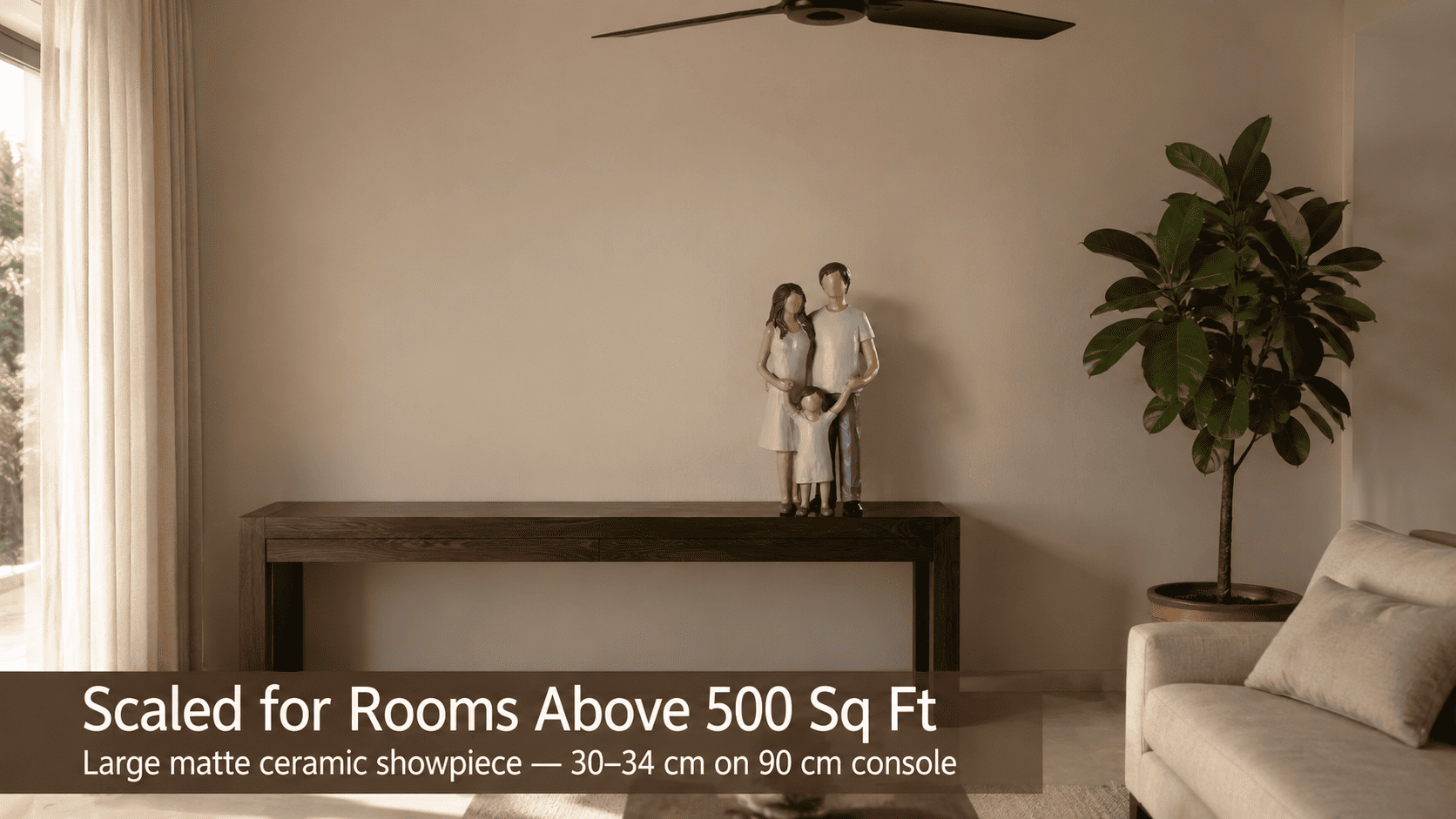
Surface width is the fastest proxy for correct showpiece height: a piece's height should equal 30–40% of the surface width on which it sits, because the negative space on either side of the object creates the visual "breathing room" that lets the eye read it as curated rather than random. On a 90 cm console, this means 27–36 cm — mapping directly to Moolwan's Large tier.
The surface type also determines weight tolerance. High-traffic surfaces like coffee tables require pieces in the 400–500 g range — heavy enough to resist accidental displacement but light enough that a bump does not create a falling hazard. Decorative pedestals and floating shelves anchored to Indian drywall typically tolerate up to 600 g without requiring additional wall reinforcement, which is the upper bound of Moolwan's Large tier at 400–600 g. Resin pieces at 94% purity epoxy offer a hardness rating of 3H pencil hardness, meaning they resist surface denting when placed on lacquered wood or glass without a felt base.
For rooms above 500 sq ft with multiple display surfaces, the correct strategy is a deliberate size cascade: anchor the primary focal surface (console, pedestal) with a Large piece (25–34 cm), the secondary surface (coffee table, bookshelf) with a Medium piece (16–21 cm), and leave tertiary surfaces (side tables, window ledges) empty or with a Single Small (10–16 cm) accent. This three-tier cascade creates a visual hierarchy that guides the eye through the room rather than scattering attention across uniformly sized objects.
| Room Footprint | Target Surface | Surface Width | Recommended Showpiece Height | Weight Range & Material |
|---|---|---|---|---|
| 500–650 sq ft | Console / sideboard | 80–100 cm | 25–34 cm (Large) | 400–600 g — ceramic or high-purity resin |
| 500–650 sq ft | Coffee table (central) | 60–90 cm | 20–25 cm (Medium–Large) | 300–500 g — ceramic, humidity-tolerant to 85% RH |
| 650–900 sq ft | Decorative pedestal | 30–45 cm top | 30–40 cm (Large or oversized) | 400–600 g — weighted base preferred for stability |
| 650–900 sq ft | Wide bookshelf bay | 60–80 cm per bay | 16–25 cm (Medium), grouped in threes | 250–450 g — drop-tested, finish-coated for high-touch |
| 900+ sq ft | Accent wall console or statement surface | 120+ cm | 34–45 cm (Large to oversized), with height variation in grouping | 500–700 g — floor-anchored pedestals if above 600 g |
Because ceiling height, natural light direction, and existing furniture finish each introduce additional sizing variables beyond room footprint alone, browse the full size-band and material selection in Moolwan's showpiece for living room collection to verify the correct piece for your specific surface and layout.
Design Rule
To prevent the "lost object" effect in rooms above 500 sq ft, surface curation should follow Moolwan's 1:12 Scale Anchoring Rule: every primary focal surface should hold at least one showpiece whose height in centimetres equals or exceeds 1/12th of the room's longest wall dimension in centimetres — because below this ratio, the piece's visual weight falls beneath the perceptual threshold required for the eye to register it as a design decision rather than background noise.
Matte vs Glazed Finishes: Which Holds Its Look Longer in a Large, Well-Lit Room
In a large living room with significant natural light exposure — which Indian east- and west-facing rooms above 500 sq ft typically receive for 4–6 hours daily — finish durability over a 5-year period is as important as initial appearance. Matte finishes outperform glazed finishes in high-light environments because micro-scratches that accumulate over years scatter incoming light unevenly, rendering surface wear invisible to the naked eye; glazed surfaces, by contrast, reflect light uniformly along their surface plane, and every micro-scratch becomes a visible interruption in that reflection, showing up as dullness within 18–24 months in high-use rooms.
The material substrate compounds this: Moolwan's ceramic home décor pieces are composed of a 92% clay body fired to a high-density structure, which gives them a 5+ year indoor lifespan rated to 60°C surface temperature tolerance and humidity tolerance up to 85% RH. In a large Indian living room with an air-conditioning unit cycling between 24°C and ambient temperatures of 34°C+, this 85% RH tolerance prevents the micro-cracking that cheaper ceramics exhibit at the glaze-body interface after two or three monsoon cycles — a failure mode that is particularly visible on glossy white or cream finishes.
For large living rooms styled in warm neutral palettes — the dominant aesthetic in Indian homes above 500 sq ft — matte earthy tones in terracotta, warm stone, or oxidised bronze register as anchored and considered because they absorb rather than reflect light, reducing the visual competition between the décor piece and the room's upholstery and wall tones. Glazed finishes in accent colours (deep navy, forest green, charcoal) are viable on secondary surfaces like bookshelves where the piece's job is to create a deliberate colour punctuation rather than a calm focal point.
Ready to bring home a showpiece scaled for your living room? Shop the full size-tiered range in Moolwan's showpiece for living room collection — manufacturer-direct, climate-rated, made for Indian homes.
How to Group Multiple Showpieces in a 500+ Sq Ft Living Room Without Creating Clutter
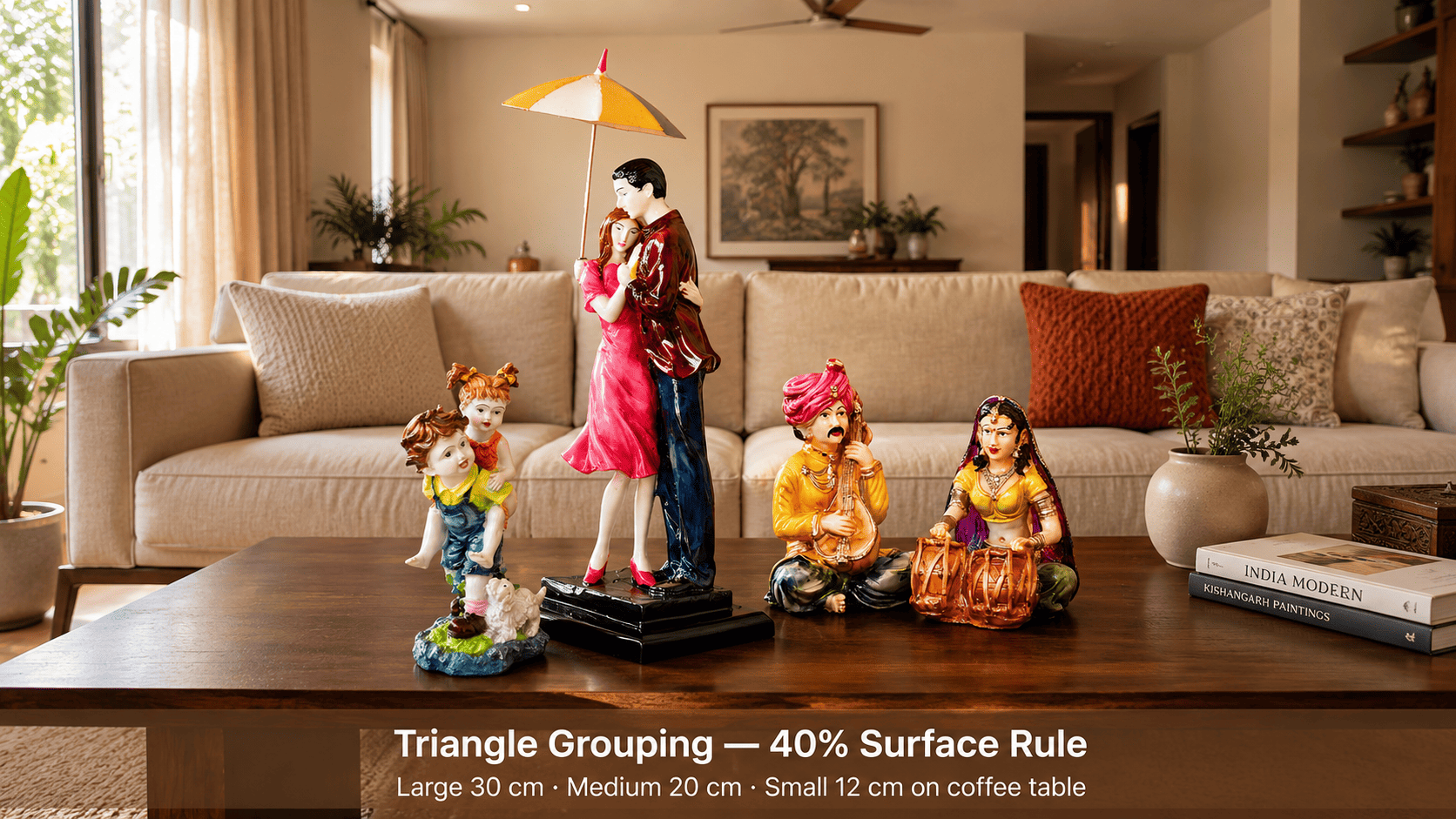
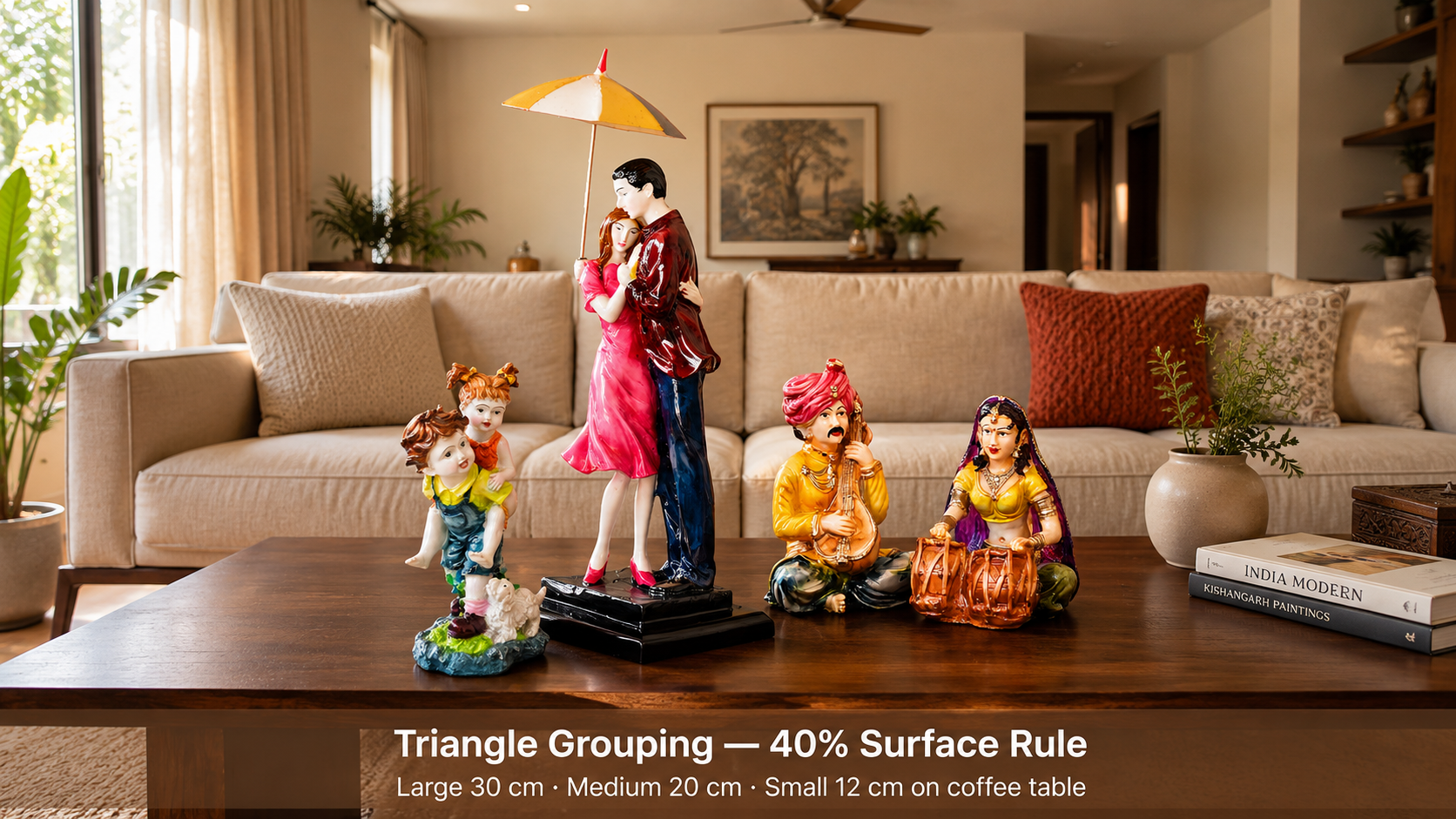
Grouping three objects of different heights is more visually stable than grouping two or four because the odd number prevents the eye from splitting the composition into equal halves and searching for bilateral symmetry — a search that, when unsatisfied, registers as visual tension rather than design. In a large living room, this principle translates to a primary group of three: one Large (30–34 cm), one Medium (18–21 cm), and one Small (12–14 cm), arranged in a loose triangle with the tallest piece at the rear-centre, the medium piece to one side, and the small piece at the front-opposite corner.
The horizontal spread of this triangle should not exceed 40% of the surface width. On a 100 cm console, the group occupies no more than 40 cm — leaving 60 cm of clear surface on either side. This negative space is not empty; it is structural. The eye needs it to read the group as a curated composition rather than a collection of objects pushed to one end of a table. Resin pieces in Moolwan's modern home décor collection, rated to 94% purity epoxy with 3H pencil hardness, are particularly suited for grouping on high-traffic surfaces because they resist surface marking when pieces are shifted during cleaning without leaving drag marks on lacquered wood or marble.
Climate Engineering: Why Large Indian Living Rooms Demand Different Material Specs
Living rooms above 500 sq ft in Indian metros experience a distinct micro-climate challenge: the centre of the room — where coffee tables and statement pedestals typically sit — is frequently furthest from the air-conditioning unit and closest to natural light, meaning ambient humidity and temperature at that location can swing between 45% RH in January and 75% RH during monsoon months. Décor materials that tolerate only up to 60% RH will show surface blooming, base separation, or finish clouding within two monsoon seasons at the room's centre.
Ceramic pieces with a 92% clay composition, as used in Moolwan's home décor collection, tolerate up to 85% RH because the high-density clay body has minimal internal porosity after firing — meaning water vapour cannot penetrate the body and cause expansion-contraction cycling at the material level. Resin pieces at 94% purity epoxy tolerate up to 60% RH, making them better suited for the console or bookshelf position near the wall (where AC airflow keeps humidity lower) rather than the central coffee table position in a large room without ceiling fan coverage over that zone.
Frequently Asked Questions
What is the minimum showpiece height that works in a living room above 500 sq ft?
In a 500+ sq ft living room with standard 9-foot ceilings, the minimum effective showpiece height for a primary focal surface (console, sideboard, pedestal) is 25 cm. Below this threshold, the piece's visual weight-to-room-volume ratio falls beneath the perceptual level where the eye registers it as a design statement — the room's furniture scale simply overwhelms it. For secondary surfaces like coffee tables, 20 cm can work when the piece is grouped with two others of different heights. Moolwan's Large tier begins at 25 cm and runs to 34 cm, covering the effective range for 500–900 sq ft rooms.
Can I use multiple medium showpieces instead of one large showpiece in a big living room?
Yes, but the grouping must be executed correctly to avoid visual scatter. Three medium pieces (16–21 cm) arranged in a height-graduated triangle on a wide surface can match the visual weight of one large piece — provided the group spans no more than 40% of the surface width and includes at least 8–10 cm of height difference between the tallest and shortest piece. If the three pieces are all the same height, they read as a row of identical objects rather than a composed group, and the large-room effect remains unsolved. Moolwan's home décor collection is designed with height variation within size tiers to support this grouping strategy.
Should I choose ceramic or resin showpieces for a living room with high sunlight exposure?
Choose ceramic for surfaces in direct or near-direct sunlight. Ceramic fired at high temperatures is stable up to 60°C surface temperature, which Indian west-facing windows can approach during peak summer afternoon hours. High-purity resin (94% epoxy) is temperature-rated to 35°C continuous exposure — adequate for shaded interior positions but at risk of surface discolouration near west-facing windows or surfaces directly under pendant lighting. Moolwan's ceramic home décor pieces are additionally rated to 85% RH humidity tolerance, making them the more durable choice for large rooms where sunlight and monsoon humidity interact across the same surface.
How do I style a showpiece on a console table in a large living room without it looking too small?
The three levers are height, grouping, and negative space. First, choose a piece of at least 25 cm — the minimum height for a 80–100 cm console surface. Second, if using a single piece, position it at one-third of the console's length from either end rather than the centre; off-centre placement creates dynamic asymmetry and makes the piece appear more deliberately placed. Third, leave at least 60% of the console surface entirely clear — because negative space around a showpiece magnifies its perceived importance, whereas a crowded console reduces every object on it to furniture rather than décor. Moolwan's modern home décor collection includes pieces specifically proportioned for 80–120 cm console surfaces at the correct height and weight range.
Because ceramic pieces rated to 85% RH and 5+ year indoor lifespans eliminate the seasonal replacement cost that cheaper materials incur after two monsoon cycles, investing in correctly scaled, climate-engineered décor for a large living room is a long-term decision — not a seasonal purchase. Bring home a piece built for your room's exact scale from the Moolwan showpiece for living room collection — manufacturer-direct, no middleman markup. If you're looking for something distinctive and artisan-crafted, the Moolwan unique handmade showpiece collection offers one-of-a-kind pieces scaled for spacious rooms. For living rooms styled in a contemporary dark palette, the Moolwan black room accessories for modern living rooms delivers high-contrast statement pieces proportioned for large surface and high-ceiling environments.


