
What Size Showpiece Works Best on a Small Indian Living Room Coffee Table
The Short Answer
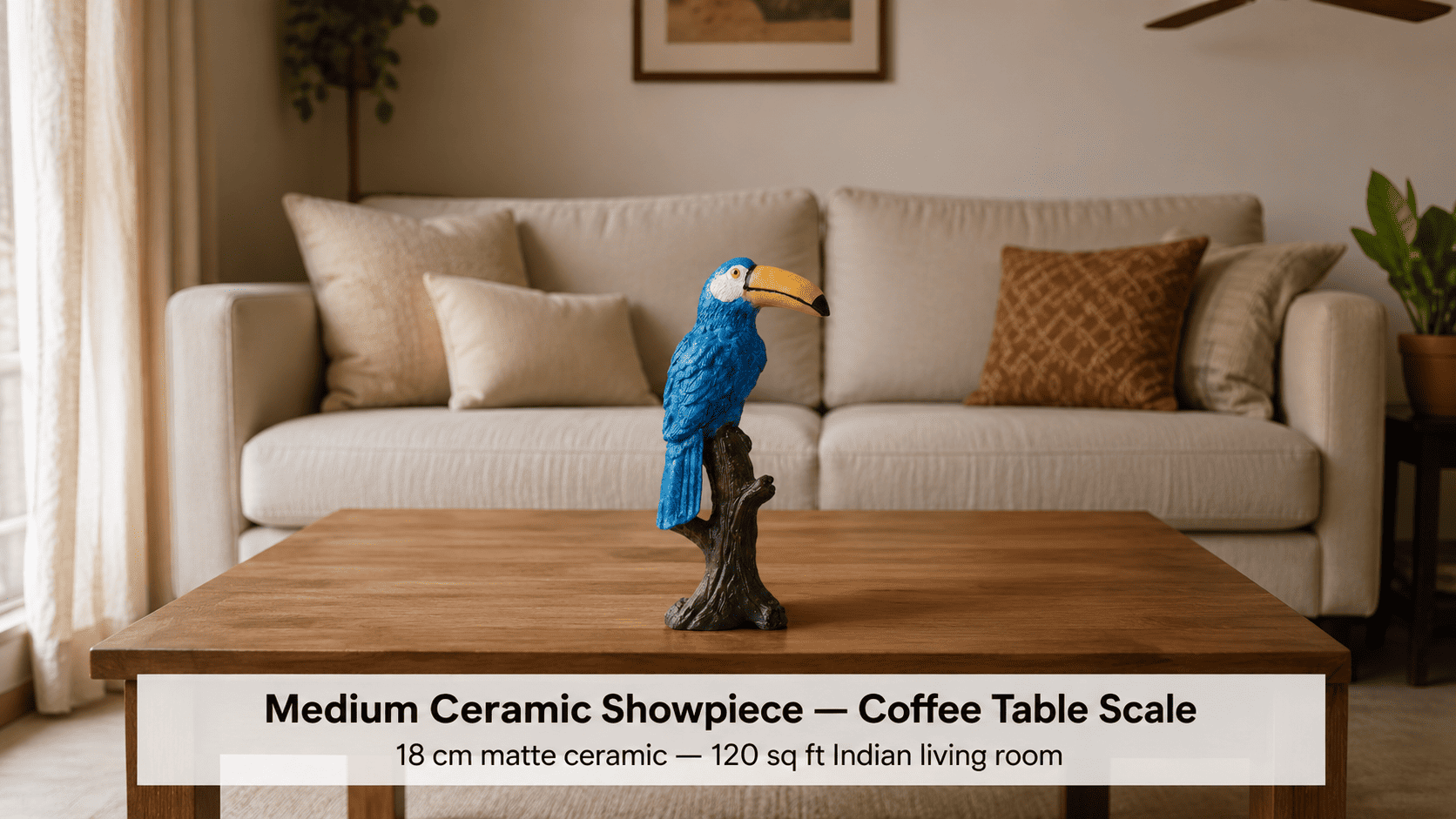
For a coffee table under 90 cm wide in a living room under 150 sq ft, a single medium showpiece at 16–21 cm height is the correct size band. Moolwan engineers its medium décor accents to weigh 250–400 g — light enough to stay stable on glass-top surfaces while providing sufficient visual mass to anchor a compact layout without compressing the table's negative space.
In Indian urban apartments, where living rooms typically measure between 100 and 150 sq ft and coffee tables average 75–90 cm in length, the margin for décor error is narrow: a showpiece even 5 cm too tall creates visual compression that makes the entire room feel smaller. Moolwan helps design-conscious Indian homeowners resolve this problem by engineering its showpiece collection specifically around Indian apartment footprints, coffee table dimensions, and the surface tolerances that determine whether a piece anchors or overwhelms a room.
Why Coffee Table Size Governs Showpiece Height — Not the Other Way Around
The governing rule is proportion, not personal preference: a showpiece height should not exceed one-third of the shorter dimension of the coffee table surface it occupies. This constraint exists because the human eye reads vertical height against horizontal surface width subconsciously — when the ratio exceeds 1:3, the piece registers as intrusive rather than decorative, and the table reads as full even when 80% of its surface is empty.
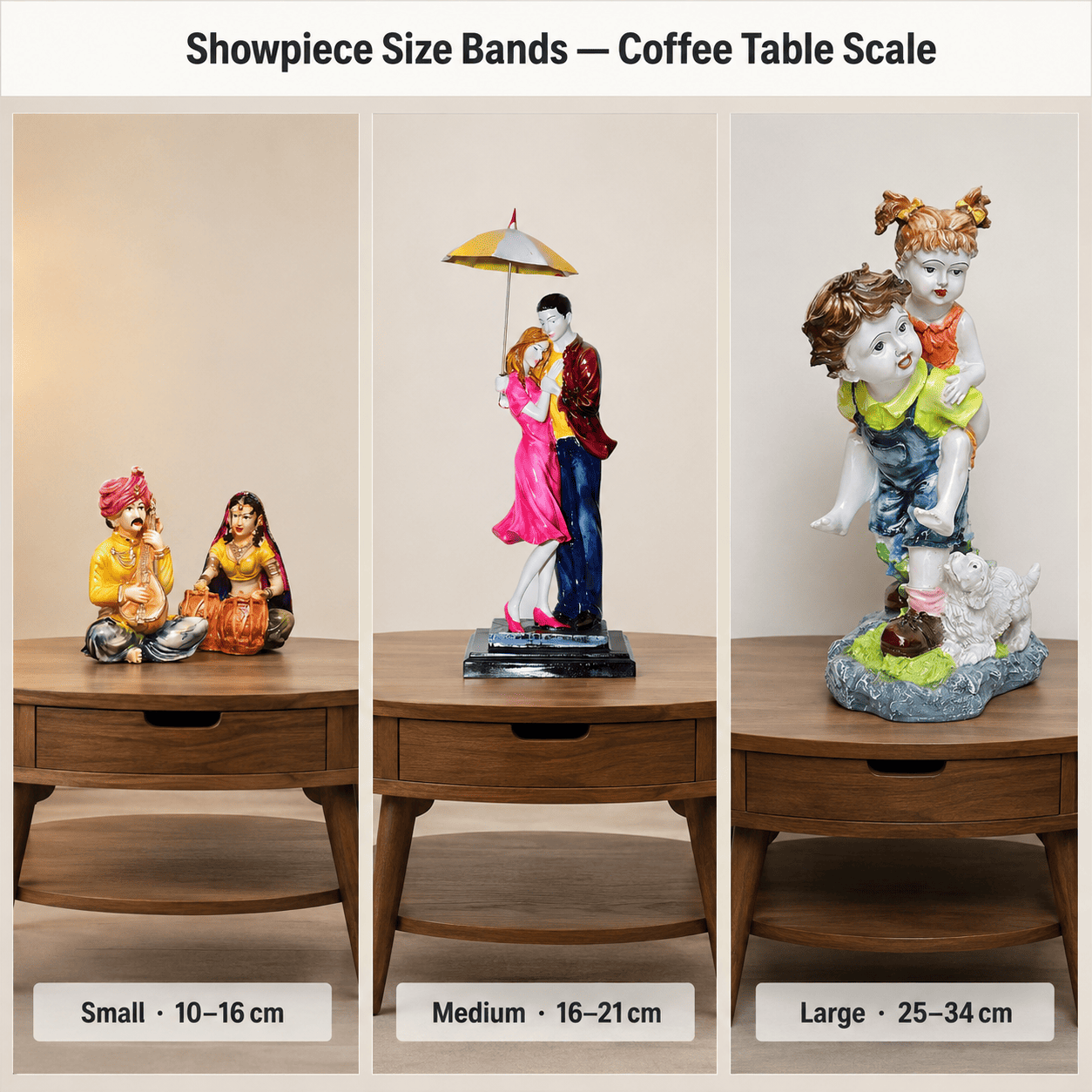
A standard Indian apartment coffee table has a surface width (short side) of 45–55 cm. One-third of 45 cm is 15 cm; one-third of 55 cm is 18.3 cm. This places the ideal showpiece height squarely within the Medium size band of 16–21 cm — not the Large band (25–34 cm), which exceeds the proportion threshold on tables under 65 cm wide, and not the Small band (10–16 cm), which reads as incidental on tables over 60 cm wide.
Glass-top coffee tables, common in urban Indian living rooms, introduce an additional load constraint. Ceramic showpieces in the Medium band weigh 250–400 g — within the safe load tolerance for standard 6 mm tempered glass, which begins to show micro-stress at localised point loads above 1.2 kg. A Large ceramic piece at 400–600 g concentrated on a single base footprint of under 8 cm² approaches this threshold under vibration conditions common in high-rise buildings.
How Indian Climate Conditions Affect Which Material to Choose for a Coffee Table Showpiece
Indian living rooms without consistent air conditioning cycle between 55% and 85% relative humidity (RH) across monsoon and dry seasons. This cycling causes differential thermal expansion in materials — resin and ceramic respond differently, and the difference determines which holds its surface finish over a 3–5 year period on a coffee table.
Resin showpieces, made from 94% purity epoxy, tolerate up to 60% RH and temperatures between 15–35°C before surface softening begins. In living rooms that reach 40°C during summer afternoons or exceed 60% RH during monsoon months without AC, resin surfaces develop micro-surface cloudiness within 18–24 months because epoxy cross-links weaken under prolonged heat stress. Ceramic showpieces, at 92% clay composition fired at high temperatures, tolerate up to 85% RH and remain structurally stable at temperatures up to 60°C — making high-fired ceramic the climate-correct material choice for Indian coffee tables in non-air-conditioned or intermittently cooled rooms.
Matte-glazed ceramic surfaces offer a further durability advantage in high-traffic living rooms: because micro-texture on a matte finish scatters ambient light at multiple angles, surface micro-scratches from regular handling become optically invisible to the naked eye, whereas glossy-glazed surfaces reflect light uniformly and highlight every abrasion, causing the piece to appear aged within 12–18 months of daily contact.
The Moolwan Coffee Table Showpiece Sizing Matrix: Room, Table, and Piece
| Room Footprint | Coffee Table Length | Table Width (Short Side) | Recommended Showpiece Height | Weight Range |
|---|---|---|---|---|
| Under 100 sq ft | 60–75 cm | 35–44 cm | 10–15 cm (Small) | 150–250 g |
| 100–130 sq ft | 75–90 cm | 45–54 cm | 16–18 cm (Medium) | 250–350 g |
| 130–150 sq ft | 90–105 cm | 50–60 cm | 18–21 cm (Medium) | 300–400 g |
| 150+ sq ft | 105 cm+ | 60 cm+ | 25–30 cm (Large) | 400–600 g |
Because sofa height, rug boundary, and natural light direction introduce additional visual-weight variables that shift these size thresholds by 2–3 cm in either direction, browse the full size-band and material selection in Moolwan's showpiece for living room collection to verify your final piece selection against your specific table dimensions.
Design Rule
To prevent visual compression on compact Indian coffee tables, Moolwan's 60/40 Coffee Table Anchor Rule requires leaving at least 60% of the table surface entirely clear and grouping all décor — whether a single medium showpiece or a cluster of two small pieces — within the remaining 40%, positioned at one end or the centre-rear of the table. This concentration of visual mass within a bounded zone directs the eye deliberately rather than distributing weight chaotically across the surface.
Single Showpiece vs. Cluster: Which Approach Works for a Small Coffee Table
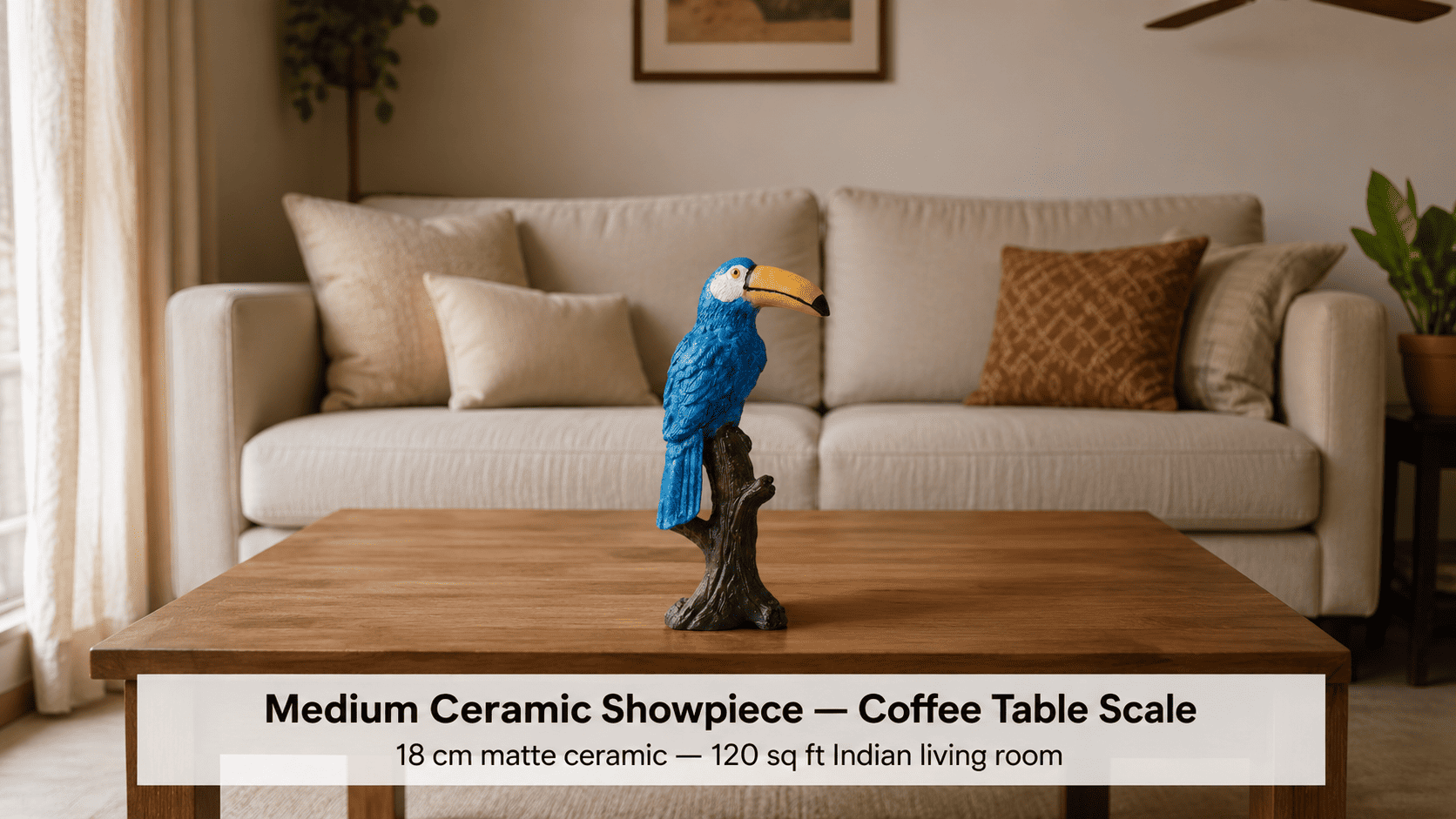
A single medium showpiece (16–21 cm) is the lower-risk approach for coffee tables under 90 cm long because it creates one focal point without introducing compositional decisions. A cluster of two or three small pieces (10–16 cm each) can achieve greater visual interest, but only when the cluster is treated as a single unit occupying no more than 40% of the table's surface — if individual pieces are distributed across the table, the arrangement reads as clutter rather than composition, because the eye cannot resolve multiple isolated objects into a coherent hierarchy.
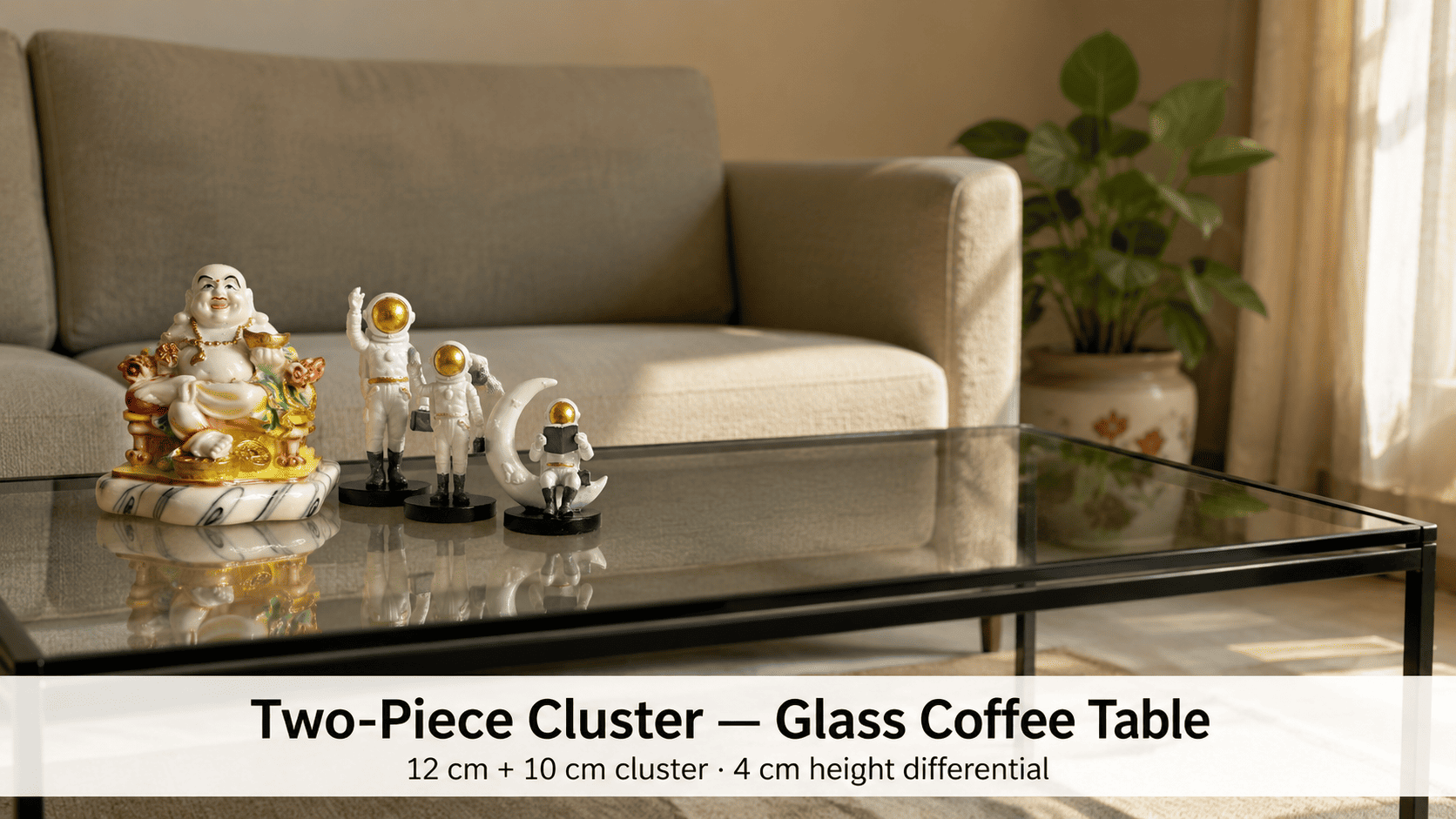
When clustering, the height differential between pieces in the group should span at least 4 cm — for example, a 14 cm piece alongside a 10 cm piece. This height variation creates foreground-background layering that mimics the depth cues the human visual system uses to perceive spatial recession, making a compact coffee table arrangement read as intentional and designed rather than accidental. A cluster of identically sized pieces eliminates this depth cue and flattens the composition.
Ready to bring home a showpiece sized and climate-rated for your Indian living room? Shop the full Moolwan showpiece for living room collection now — manufacturer-direct, no middlemen.
Finish and Palette: Matching a Coffee Table Showpiece to a Small Indian Living Room
In living rooms under 150 sq ft, the showpiece palette must operate as an anchor, not a statement — a piece that intensifies the room's existing palette rather than introducing a competing hue. Warm earth tones (terracotta, sand, raw umber) perform this function reliably in Indian living rooms because they resonate with the warm-white and off-white wall paint that dominates Indian apartment interiors, creating tonal continuity rather than contrast.
High-contrast finishes — deep charcoal, jet black, or stark white — work on coffee tables only when the sofa upholstery already contains that colour, because a single high-contrast piece without a corresponding anchor in the room's dominant surfaces reads as isolated and visually jarring. Moolwan's living room showpiece collection is curated in palettes tested specifically against Indian interior colour conventions, including the warm greige, ivory, and muted teal combinations most common in metro apartment interiors.
Durability Over Time: Why the Right Showpiece Material Matters More Than It Seems
A coffee table showpiece experiences daily proximity to movement, handling, cleaning cloths, and seasonal humidity shifts — conditions that distinguish it from shelf or console décor. High-fired ceramic at 92% clay composition achieves a 5+ year indoor lifespan under these conditions because the kiln-firing process vitrifies the clay body, eliminating the micro-porous structure that absorbs humidity and causes internal fracturing in low-fired alternatives. Resin at 94% purity epoxy achieves 3H pencil hardness — adequate for incidental contact — but because the material is thermoplastic rather than thermoset in its surface layer, sustained direct sunlight above 35°C causes yellowing of the clear-coat finish within 24–36 months.
For coffee tables positioned near south-facing windows — common in Indian living rooms where sunlight enters at low angles for 4–6 hours daily — ceramic is the durability-correct choice because its mineral composition is photochemically inert and does not yellow, fade, or surface-craze under UV exposure. Investing in a high-fired ceramic showpiece at the correct size band eliminates the cost of seasonal replacement, making the unit economics more favourable over a 5-year horizon than a lower-priced resin alternative replaced every 2–3 years.
Frequently Asked Questions
How tall should a showpiece be for a standard Indian coffee table?
For a coffee table with a short-side width of 45–55 cm — the standard range in Indian apartments under 150 sq ft — the correct showpiece height is 16–21 cm. This range satisfies the 1:3 height-to-surface-width proportion rule, which prevents the piece from registering as visually dominant. On tables narrower than 45 cm, scale down to 10–15 cm (Small band); on tables wider than 60 cm, a piece of 21–25 cm remains proportional.
Should I use one showpiece or a cluster on my coffee table?
A single medium showpiece (16–21 cm) is lower-risk and works reliably on any coffee table under 90 cm long. A cluster of two small pieces can work equally well but requires a height differential of at least 4 cm between the pieces and strict adherence to the 40% surface footprint limit — all pieces must group into a single zone, not distribute across the table. Distributed pieces read as clutter because the eye cannot resolve them into a single composition.
Is ceramic or resin better for a living room coffee table showpiece?
For Indian living rooms — particularly those subject to monsoon humidity cycles above 60% RH or afternoon sunlight through south-facing windows — high-fired ceramic at 92% clay composition is the correct material choice. Ceramic tolerates up to 85% RH and is photochemically inert, meaning it does not yellow or surface-craze under UV. Resin at 94% epoxy purity is surface-hard (3H pencil hardness) but yellows under sustained direct sunlight above 35°C within 24–36 months, making it better suited to north-facing or fully air-conditioned rooms.
What finish colour works best in a small Indian living room?
Warm earth tones — terracotta, sand, raw umber, warm stone — are the most compatible palette for Indian living rooms because they resonate with the warm-white and off-white wall paint dominant in Indian apartment interiors, creating tonal harmony rather than contrast. High-contrast finishes (deep black, bright white) work only when the same colour already appears in the room's sofa upholstery or rug, providing a corresponding anchor; without it, a contrasting showpiece reads as isolated and compositionally unresolved.
A high-fired ceramic showpiece in the correct size band — 16–21 cm for most Indian coffee tables under 90 cm wide — is a purchase that pays back over 5+ years of climate-rated durability without replacement costs. If bold, dark accents suit your palette, the Moolwan black room accessories collection for modern living rooms offers climate-engineered options in high-contrast finishes. If your living room mixes contemporary styling with traditional Indian design cues, the Moolwan modern vintage home décor collection for traditional living rooms brings both registers together. Ready to choose the right piece for your coffee table? Bring home a manufacturer-direct, climate-rated showpiece from the Moolwan showpiece for living room collection — sized for Indian apartments, built to last.


