
What Size Statue Works Best as a Focal Point in an Indian Apartment Entryway?
The Short Answer
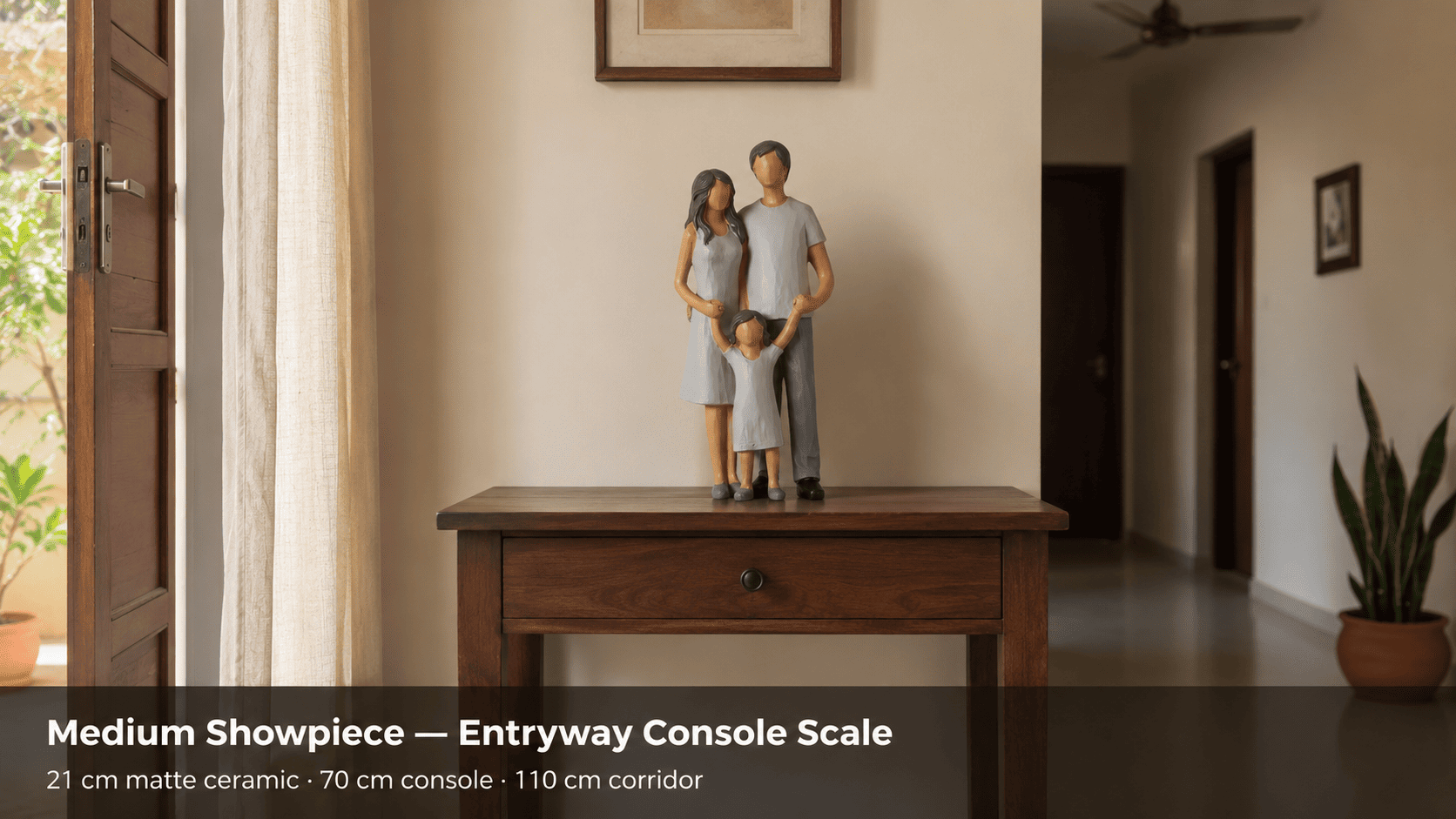
For a standard Indian apartment entryway (console width 60–80 cm, corridor depth under 120 cm), a medium showpiece at 21–25 cm height is the optimal focal-point size. At this height, the piece clears standard console clutter by 5–8 cm, sits within the natural eye-sweep zone of a person walking through, and avoids the visual crowding that larger pieces create in sub-100 sq ft corridors. Moolwan's humidity-tolerant ceramic showpieces in this size band are engineered for exactly this spatial constraint.
Indian apartment entryways are among the most spatially compressed zones in residential interiors — the average metro corridor runs 80–120 cm deep and 90–150 cm wide, giving the homeowner almost no margin for oversized objects. Moolwan helps design-conscious Indian homeowners choose entryway statues that create genuine first-impression impact without compressing the sightline or blocking passage. Getting the size right is not a matter of personal preference — it is a function of console width, corridor depth, ceiling height, and material weight, all of which interact to determine whether a piece reads as a statement or as clutter.
Why Entryway Statue Size Is a Spatial Maths Problem, Not an Aesthetic One
In enclosed corridors under 120 cm deep, human spatial perception registers objects above a certain height-to-depth ratio as obstructions rather than features — the visual cortex interprets the piece as part of the wall plane it is approaching rather than as a decorative accent at rest. This means a statue that would read as a graceful focal point in an open living room will trigger a subconscious "crowding" response in a narrow entryway at the same height. The threshold is approximately 40% of the console's surface width: a piece taller than 40% of the console's width begins to dominate the approach sightline rather than anchor it.
Material weight interacts with this spatial perception effect. High-density objects placed at eye-approach level (80–110 cm from floor, which is where most console surfaces sit) feel heavier in narrow corridors because the compressed viewing distance reduces the background-to-object depth ratio. A ceramic showpiece at 92% clay composition and 400–600 g — the specification range Moolwan uses for its large entryway-rated pieces — exerts far less visual weight than an equivalent-height carved stone or heavy resin piece because the surface texture of high-fired ceramic absorbs and diffuses ambient light rather than reflecting it, making the piece appear to recede slightly into its background.
How Console Width and Corridor Depth Determine the Right Size Band
Corridor depth controls how much visual "runway" a viewer has to process a focal object. At 80 cm of depth, the eye reaches a 25 cm tall object in approximately 1.2 seconds of walking approach — a duration that is long enough to register proportion but too short to appreciate fine surface detail, which is why the size decision (not the finish decision) is the primary driver of first-impression quality in entryways. At 120 cm of depth, the additional runway means a 30–34 cm piece can be processed as a deliberate choice rather than an obstruction.
Console width creates the proportional frame within which the showpiece must sit. International interior design conventions peg focal décor at 25–33% of the surface width for single-piece arrangements, but Indian apartment consoles — which average 60–80 cm wide in sub-1,200 sq ft flats — push this ratio toward the lower bound because the console itself is narrower than in Western home layouts. A 60 cm console can support a single focal piece up to 20 cm tall before the piece-to-surface ratio tips from "curated" to "overcrowded." An 80 cm console extends this to 25–27 cm. These are physical ratios, not design opinions: exceeding them triggers the visual law of figure-ground reversal, where the eye begins reading the space around the object rather than the object itself.
The Multi-Variable Entryway Sizing Matrix
The four parameters that jointly determine the correct statue size are: corridor depth, console width, console surface height from floor, and material weight tolerance of the surface. The matrix below cross-references these against the appropriate showpiece size band and weight range from Moolwan's climate-rated collection specs.
| Corridor Depth | Console Width | Console Height from Floor | Recommended Showpiece Height | Material Weight Range |
|---|---|---|---|---|
| Under 90 cm | Under 60 cm | 75–85 cm | 10–16 cm (Small) | 150–250 g |
| 90–110 cm | 60–70 cm | 75–90 cm | 16–21 cm (Medium) | 250–400 g |
| 110–120 cm | 70–80 cm | 80–95 cm | 21–25 cm (Medium-Large) | 350–500 g |
| Over 120 cm | Over 80 cm | 85–100 cm | 25–34 cm (Large) | 400–600 g |
Because console surface material (marble vs wood vs glass) and entryway lighting angle introduce additional weight-tolerance and finish variables specific to your layout, browse the full size-band and material selection in Moolwan's statues collection to verify your final piece selection against your corridor's exact dimensions.
Design Rule
To prevent visual compression in Indian apartment entryways, select a focal showpiece using Moolwan's Entryway Anchor Rule: the statue's height must not exceed one-third of the console's width, and the piece must be the sole object within a 20 cm horizontal clearance zone on either side — because clustering additional objects within that clearance zone shifts the eye's attention from the focal piece to the negative space between objects, dissolving the intended single-point focal effect.
Which Finish and Material Survive an Indian Entryway's Humidity Swings
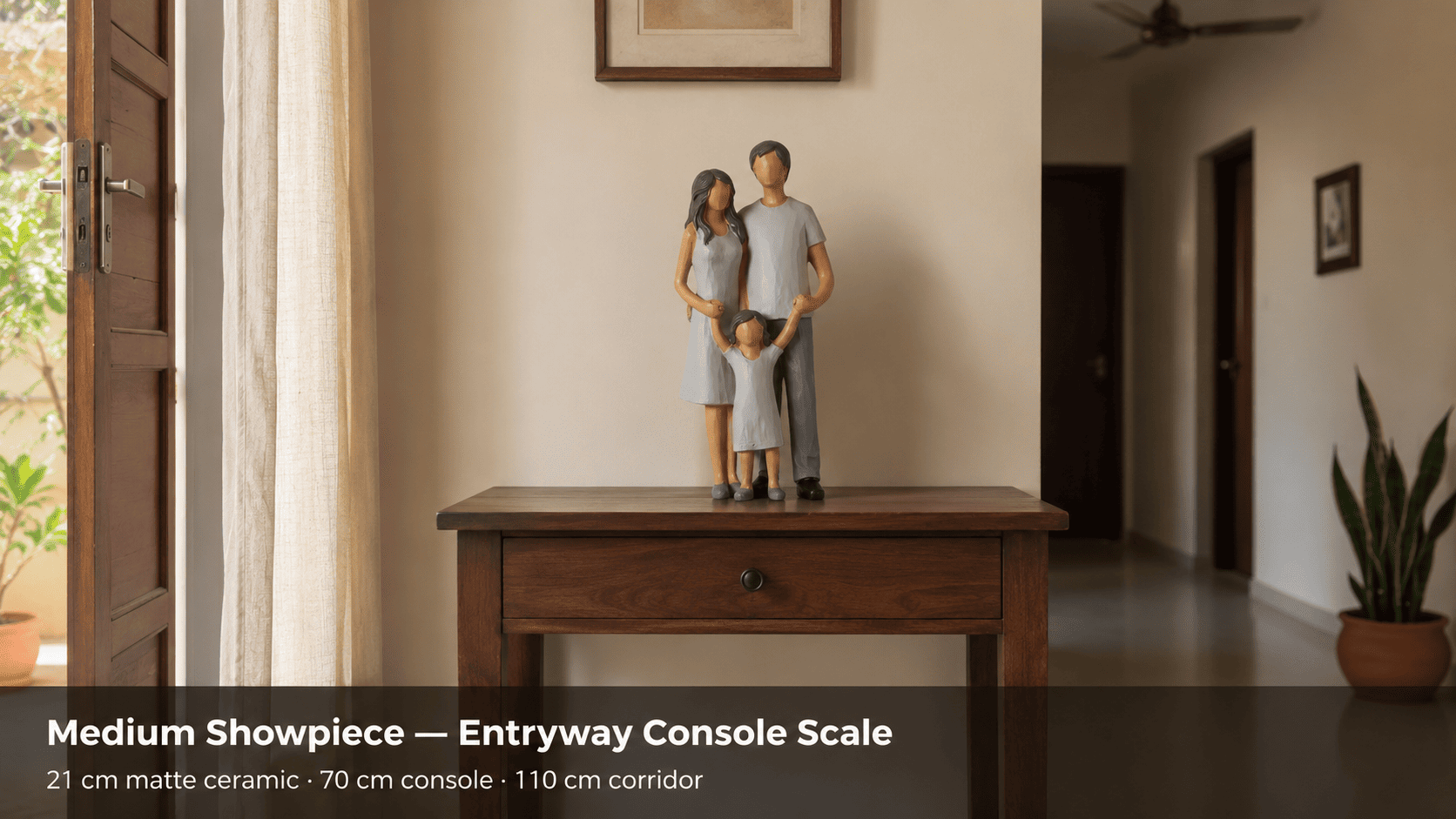
Indian apartment entryways are climatically adversarial surfaces for décor: they are the first interior zone to receive humidity carried in from monsoon-season outdoors, they sit adjacent to exterior doors that open and close dozens of times daily, and they receive the most variable temperature exposure of any room — cycling between 28–38°C on summer evenings and 18–22°C during AC-conditioned nights. Materials that are not engineered for this humidity-and-temperature cycling will micro-crack at their surface coating within 12–18 months, requiring replacement.
High-fired ceramic at 92% clay composition — the material standard Moolwan specifies for its entryway-suitable showpieces — tolerates relative humidity up to 85% RH without structural deformation because the dense sintered clay matrix has a moisture absorption rate under 0.5%, preventing the swelling-and-contraction cycles that cause surface glaze cracking in lower-density ceramics. Resin pieces at 94% purity epoxy tolerate up to 60% RH, making them suitable for entryways in drier climates (Delhi winters, Pune post-monsoon) but less reliable in high-humidity coastal corridors (Mumbai, Chennai, Kochi) where seasonal RH routinely exceeds 75%.
Want to bring home a statue engineered to hold its finish through five monsoon seasons in an Indian entryway? Shop the full Moolwan statues collection now — climate-rated, manufacturer-direct, sized for Indian apartment scale.
Does a Single Large Statue or a Grouped Arrangement Work Better for Entryway Impact?
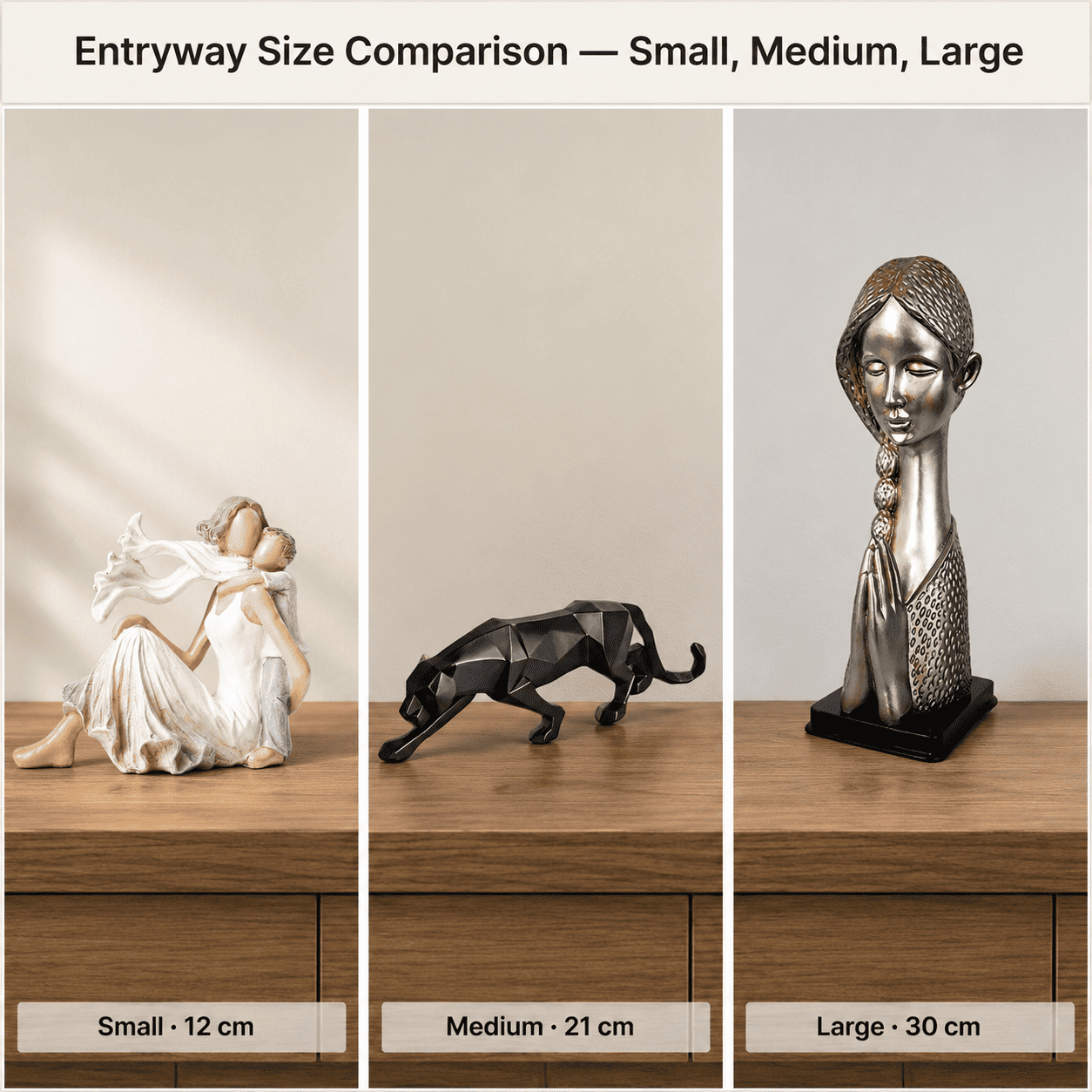
A single large piece (25–34 cm) creates a higher-impact focal point than a grouped arrangement in corridors under 110 cm deep because the narrow viewing distance collapses the inter-object spacing of grouped arrangements into visual noise — at less than 100 cm of approach distance, the brain processes a cluster of three objects as a single unresolved shape rather than as three discrete pieces. A solo large piece, by contrast, resolves clearly as a single intentional object even at close approach distance because its silhouette is unambiguous against the wall plane.
In wider entryways over 110 cm deep, a grouped arrangement of two pieces — one medium (21 cm) and one small (12–14 cm) — placed at different heights using a riser block creates visual layering that a single large piece cannot achieve. The height differential between the two pieces must be at least 7 cm to prevent the brain from perceiving them as a matched pair rather than a composition; below that differential, the eye reads "symmetry attempt" rather than "curated arrangement."
How Ceiling Height Changes the Optimal Statue Size in Indian Apartments
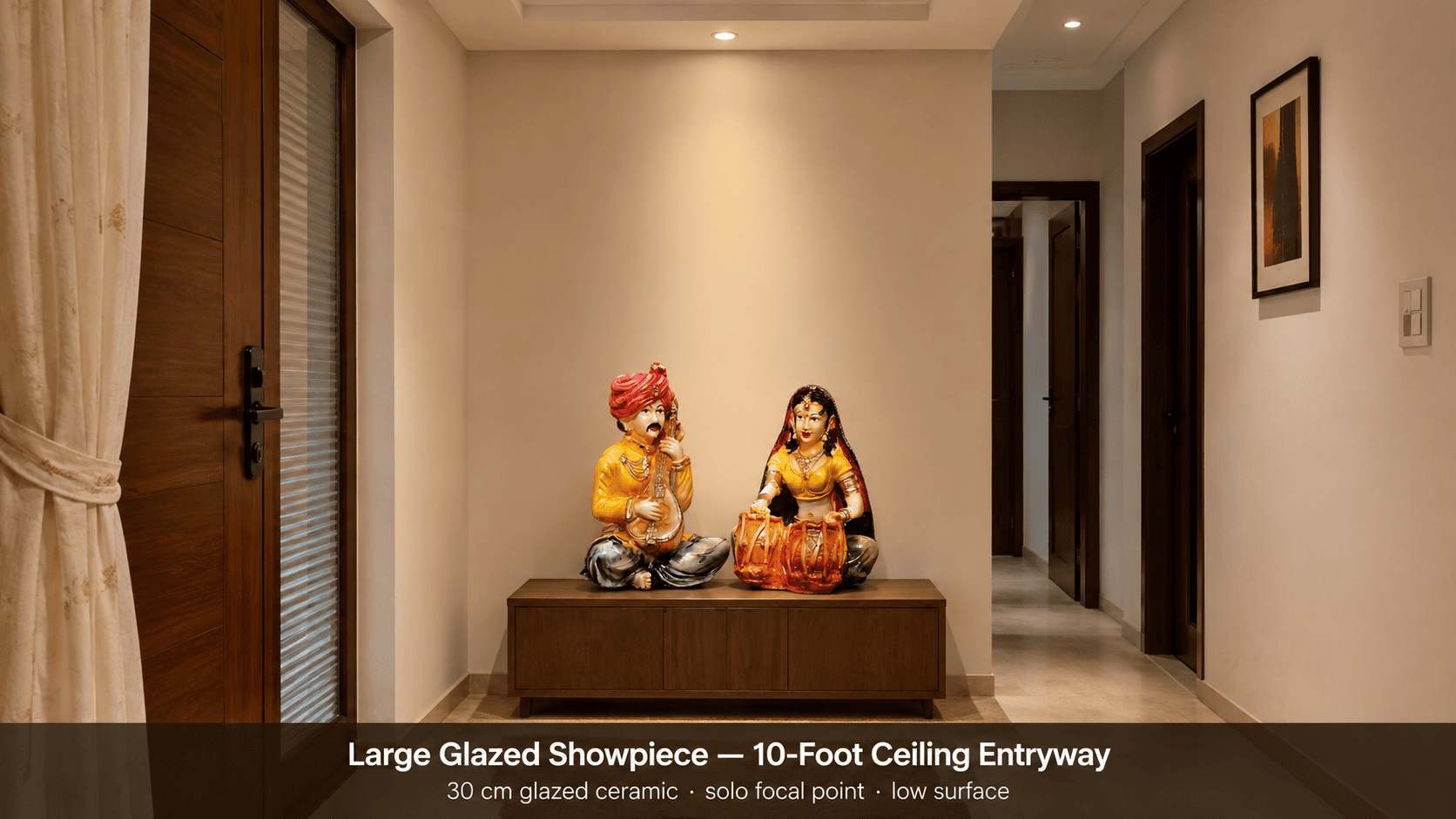
Standard Indian apartment ceiling heights fall into two bands: legacy construction at 9–9.5 feet (274–290 cm) and newer builds at 10–10.5 feet (305–320 cm). Ceiling height alters the perceived scale of entryway décor because the eye calibrates object scale against the vertical space above it — the same 25 cm statue reads as modestly sized under a 10-foot ceiling and as proportionally bolder under a 9-foot ceiling because the reduced vertical space above the console compresses the reference frame.
In 9-foot ceiling apartments, cap entryway statue height at 22 cm to avoid the piece reading as top-heavy against the compressed vertical field. In 10-foot ceiling apartments, a 28–30 cm piece is proportionally appropriate because the taller vertical field provides sufficient negative space above the piece for it to read as a deliberate focal object rather than an accidental filler. This ceiling-height calibration is why sizing recommendations based on console dimensions alone are incomplete — the vertical axis of the room must be factored into every entryway sizing decision.
Frequently Asked Questions
What is the maximum statue height for a narrow Indian apartment entryway under 90 cm deep?
In corridors under 90 cm deep, cap statue height at 16 cm (Small size band, 150–250 g). Beyond 16 cm, the height-to-corridor-depth ratio exceeds 18%, which is the perceptual threshold at which a vertically oriented object begins to read as an obstruction in the approach sightline rather than as a decorative accent — because the compressed viewing distance prevents the eye from capturing the full silhouette of the piece within a single fixation. A piece that cannot be captured in a single visual fixation triggers a perception of clutter rather than intention.
Can I use a resin statue in a Mumbai or Chennai apartment entryway?
Resin at 94% purity epoxy tolerates relative humidity up to 60% RH and temperatures between 15–35°C. Mumbai coastal entryways during July–September regularly exceed 80% RH, placing a resin showpiece outside its structural tolerance range and causing surface micro-blistering within 1–2 monsoon cycles. For high-humidity coastal entryways, high-fired ceramic at 85% RH tolerance is the structurally sound choice because the sintered clay matrix has a moisture absorption rate under 0.5%, preventing the surface deformation that degrades resin finishes at elevated humidity.
Should the entryway statue match the interior palette or contrast with it?
In entryways under 100 sq ft, a tonal match (statue palette within 2–3 colour steps of the wall) preserves the limited visual field by preventing the focal piece from fragmenting the eye's path into the home. A high-contrast piece in a compressed entryway creates competing focal points — the piece, the wall, and the interior glimpsed beyond the corridor — which divides the first-impression effect the homeowner is trying to create. Tonal matching concentrates the eye on form (silhouette, surface texture, height) rather than colour, which is the correct hierarchy for entryway focal objects where approach time is under 3 seconds.
Does Moolwan offer entryway-rated statues for gifting occasions like housewarming?
Yes. Moolwan's climate-rated ceramic showpieces in the 16–25 cm size band are particularly well-suited as housewarming gifts because they are sized to fit the widest range of Indian apartment console and shelf dimensions without requiring the recipient to measure their space in advance. At 250–500 g, they are also light enough that surface weight ratings of standard console furniture (typically 5–10 kg for wood consoles) are not a constraint. Gift-appropriate packaging is available with the collection.
Because a climate-rated ceramic showpiece in the correct size band for your entryway will maintain its surface finish and structural integrity for 5+ years without seasonal replacement — eliminating the annual cost of refreshing décor that has warped or faded — choose a piece once and choose it right. Ready to bring home a statue built for Indian entryway conditions? Order directly from the Moolwan statues collection — manufacturer-direct, no distributor markup, sized for Indian apartment scale. If you are also considering décor accents for the corridor wall or entry shelf, the curated range at Moolwan's decorative items for entrance covers wall-mounted and surface accent options that pair with an entryway statue. For a broader selection of climate-rated accent pieces across room types, the full Moolwan home décor collection provides the complete range.


